

TL;DR:
- Food intolerance is a digestive issue causing non-life-threatening symptoms that depend on food dose, unlike food allergies involving the immune system. Reliable detection methods include hydrogen breath tests, symptom diaries, and supervised elimination diets, while at-home IgG tests are scientifically invalid and often misleading. A methodical approach involving diary keeping, medical consultation, and gradual food reintroduction ensures safe and accurate identification of food triggers, supported by UK Food Intolerance’s non-invasive testing options.
If you have been struggling with bloating, cramps, or fatigue after eating and nobody can tell you why, you are not alone. Explaining food intolerance in 2026 matters more than ever because millions of people in the UK are still confusing it with a food allergy, leading to either unnecessary panic or completely ineffective self-treatment. These two conditions are fundamentally different, and that difference changes everything about how you manage them. In this guide, you will learn exactly what food intolerance is, how to test for it safely, and what actually works when it comes to identifying your triggers.
Table of Contents
- Understanding food intolerance versus food allergy
- Validated non-invasive testing methods in the UK
- Beware of common pitfalls in at-home food intolerance testing
- Practical guide to safely identify and manage food intolerances
- Why the conventional wisdom on at-home intolerance tests is backwards
- How UK Food Intolerance supports safe testing and personalised dietary guidance
- Frequently asked questions
Key Takeaways
| Point | Details |
|---|---|
| Distinguish allergy from intolerance | Food allergies involve the immune system and can be life-threatening, while intolerances are digestive issues causing delayed, dose-dependent symptoms. |
| Trust validated tests | Hydrogen breath tests and symptom diaries followed by supervised elimination diets are the most reliable, evidence-based diagnostic methods. |
| Avoid unreliable kits | Popular at-home IgG, hair analysis, and bio-resonance tests lack scientific validation and may lead to false results and unnecessary dietary restrictions. |
| Follow a safe process | Start with symptom tracking, consult your GP to rule out allergies and serious conditions, then undergo a supervised elimination and reintroduction protocol. |
| Professional guidance matters | Working with healthcare professionals ensures safety, accurate diagnosis, and prevents nutritional deficiencies during food intolerance management. |
Understanding food intolerance versus food allergy
This distinction is not just medical jargon. It has real, practical consequences for how you eat, how you feel, and how urgently you need to act when symptoms appear.
A food allergy involves your immune system. It mistakenly identifies a harmless food protein as a threat and launches a rapid defensive response. Symptoms can appear within minutes and range from hives and swelling to anaphylaxis, which is a severe, potentially fatal reaction. Allergies to peanuts, tree nuts, shellfish, and milk are among the most common and serious examples.
Food intolerance is different. It is a digestive problem, not an immune one. Your body simply struggles to process a particular food properly. The result is uncomfortable but not life-threatening. As one key distinction makes clear, food intolerance is a digestive issue causing dose-dependent symptoms, while allergy involves the immune system and can be life-threatening.
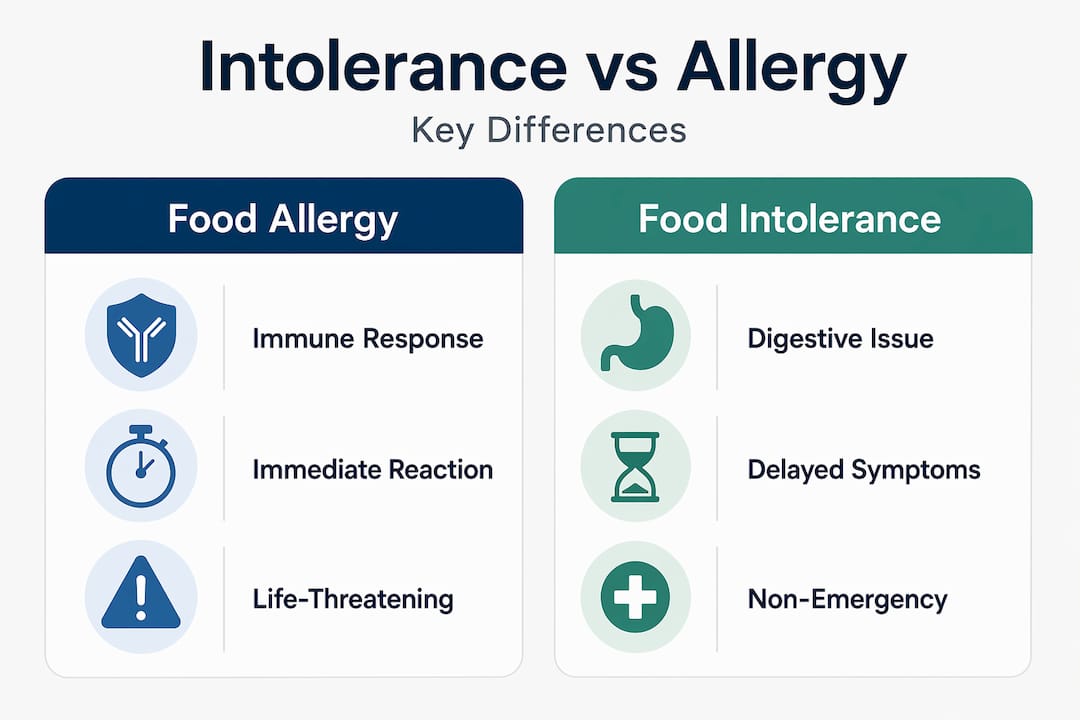
The phrase “dose-dependent” is important here. With intolerance, small amounts of the offending food may cause no symptoms at all. A splash of milk in your tea might be fine; a bowl of cereal with milk might leave you doubled over. That sliding scale simply does not apply to allergies, where even a trace amount can trigger a serious reaction.
Common food intolerance symptoms in 2026 include:
- Bloating and excess gas
- Abdominal cramps or discomfort
- Diarrhoea or loose stools
- Nausea
- Headaches or migraines
- Fatigue and low energy
- Skin issues such as eczema flare-ups
Symptoms often appear hours after eating, which is precisely why many people struggle to connect what they ate to how they feel. If you want to spot the difference between intolerance and allergy clearly, the timing and severity of your symptoms are your first clues.
“If your symptoms appear hours later, feel bad but not dangerous, and seem to depend on how much you ate, food intolerance is a far more likely explanation than allergy.”
Understanding these allergy and intolerance differences helps you decide whether you need an urgent GP visit or a more methodical investigation into your diet.
Now that we clarified the essential difference between intolerance and allergy, let’s explore validated testing methods.
Validated non-invasive testing methods in the UK
Not all tests are created equal. The methods below have clinical backing and are either NHS-recognised or accepted within evidence-based dietary practice in the UK.
Hydrogen breath tests are one of the most reliable non-invasive options available. You consume a small amount of a specific sugar, such as lactose or fructose, and then breathe into a collection bag at intervals over the next few hours. If your digestive system cannot absorb the sugar properly, gut bacteria ferment it and produce hydrogen gas, which shows up in your breath. Hydrogen breath tests are validated, non-invasive clinical options for diagnosing carbohydrate malabsorption conditions like lactose intolerance. They are particularly useful if you suspect lactose or fructose is the culprit behind your symptoms.
Symptom diaries are deceptively simple but genuinely powerful. You record everything you eat and drink, the time you eat it, portion sizes, and any symptoms that follow, including their timing and severity. Done consistently over two to four weeks, patterns begin to emerge. Certain foods repeatedly appear before a bad day, and the gold standard approach confirms that symptom diaries and supervised elimination diets are the most reliable tools for identifying food intolerances.

Supervised elimination and reintroduction diets take the diary findings and test them. You remove the suspected food for a defined period, note whether symptoms improve, and then carefully reintroduce it to see whether symptoms return. This is the confirmation step that turns a hypothesis into a conclusion.
Here is a quick comparison of validated non-invasive testing methods:
| Testing method | Best used for | Accessibility in the UK |
|---|---|---|
| Hydrogen breath test | Lactose, fructose intolerance | NHS clinics and private labs |
| Symptom diary | All intolerances | At home, no cost |
| Elimination and reintroduction diet | Confirming suspected triggers | At home with GP or dietitian support |
You can explore UK non-invasive intolerance testing trends and clear methods for intolerance detection for additional detail on each approach.
Pro Tip: Keep your symptom diary on your phone rather than a paper notebook. It is easier to log in real time immediately after eating, which makes your data far more accurate when you come to review it.
Having explained test types, let’s now consider what to avoid when seeking food intolerance testing at home.
Beware of common pitfalls in at-home food intolerance testing
This is where well-meaning people often go wrong. The commercial at-home food intolerance testing market is large, busy, and unfortunately full of products that sound credible but deliver little of clinical value.
IgG antibody tests are widely advertised online and in pharmacies. They measure your blood levels of IgG antibodies to various foods. The problem is that IgG antibody tests reflect normal food exposure, not intolerance, making many popular tests misleading. If you regularly eat eggs, of course your body has IgG antibodies to egg proteins. That is not a sign of intolerance; it is simply a sign that you have eaten eggs. Yet these tests often flag eggs, wheat, and dairy as “intolerances,” sending people down a path of unnecessary restriction.
Hair analysis tests fall into a similar category. Despite being sold with impressive-looking laboratory reports, they lack clinical validation and can lead to unnecessary dietary restriction. The science simply does not support using hair samples to diagnose food reactions.
Kinesiology and bio-resonance tests are also popular in wellness settings but carry no credible clinical evidence for diagnosing food intolerance. Be cautious of any test that promises results without either biological samples tested in an accredited lab or a clearly explained, evidence-based mechanism.
The real danger with all of these approaches is not just wasted money. False positives lead people to eliminate foods unnecessarily, which creates nutritional gaps, social difficulties, and the frustrating experience of restricting your diet without actually feeling better. You can also check why intolerance tests in 2026 need to meet a proper evidence standard before you invest.
“A test that shows everything as a problem is telling you nothing useful. Good testing narrows the field; poor testing widens it.”
Pro Tip: Use at-home test results only as a starting point for clinical consultation, never as a final diagnosis.
With awareness of testing pitfalls, let’s explore practical steps to identify food intolerances safely at home.
Practical guide to safely identify and manage food intolerances
Here is a clear, step-by-step approach you can begin today. It is methodical, evidence-based, and protective of your nutritional health.
- Keep a two-week food and symptom diary. Record every meal, snack, and drink. Note the time, portion size, and any symptoms that follow, along with their timing and severity. This builds the evidence base you need before making any dietary changes.
- Visit your GP. Before eliminating anything, rule out coeliac disease, inflammatory bowel disease, or other conditions that can mimic intolerance. A blood test for coeliac antibodies is quick and important.
- Identify your top suspects. Review your diary with a GP or registered dietitian. Common food intolerances in 2026 include lactose, fructose, gluten (non-coeliac sensitivity), histamine, and certain food additives.
- Remove one food group at a time. Follow a supervised elimination diet by removing the most suspected trigger for two to four weeks. Note symptom changes carefully.
- Reintroduce foods systematically. Introduce one food every three to four days, maintaining your diary throughout. A clear worsening of symptoms on reintroduction is strong evidence of intolerance.
- Build your personalised map. You now know which foods trigger symptoms and at what quantities. Use this to create a diet that protects your health without unnecessary restriction.
A carefully supervised elimination diet guided by symptom diaries is the most reliable approach to confirm intolerances. And avoiding the removal of multiple food groups unsupervised is essential to prevent nutritional harm.
It is also worth knowing that some foods worsen inflammation, which can amplify intolerance symptoms and make it harder to isolate specific triggers.
Explore how to identify food triggers safely and make dietary adjustments for sensitivities without compromising your nutrition.
Pro Tip: Avoid eliminating multiple major food groups at once. Focus on the single most suspected trigger first, and work outward from there.
Why the conventional wisdom on at-home intolerance tests is backwards
Here is an uncomfortable truth. Most people who purchase commercial at-home intolerance tests are doing so because NHS waiting times are long and they want answers now. That is completely understandable. But the irony is that the most popular and heavily marketed tests are also the least reliable, meaning many people end up with a lengthy list of supposed intolerances that send them down entirely the wrong path.
The result? They cut out wheat, dairy, eggs, and soya simultaneously, feel briefly better because any major dietary overhaul can shift symptoms short-term, and conclude the test “worked.” Months later, they are nutritionally depleted, anxious about food, and no closer to understanding what is actually wrong. Unreliable tests produce false positives and negatives, causing unnecessary restrictions, nutritional harm, and delays in reaching a real diagnosis.
The slow approach feels frustrating at the start. A two-week diary, a GP appointment, a careful four-week elimination, then a methodical reintroduction process. It can feel like six to eight weeks before you have a clear answer. But that answer is real. It is grounded in your actual biology and confirmed by your own direct experience.
Treating a home test result as a hypothesis rather than a conclusion is not just semantically careful. It is practically protective. Use it to inform your diary, to focus your suspicions, to guide a conversation with your GP. Use it as the beginning of a process, not the end of one. The latest research on food intolerance consistently supports this methodical approach.
Pro Tip: Think of any home test result as a compass, not a map. It can point you in a direction, but it cannot tell you exactly where to go.
How UK Food Intolerance supports safe testing and personalised dietary guidance
If you are ready to take a more informed step, UK Food Intolerance offers accessible, non-invasive testing from the comfort of your home. Using a simple hair sample collection process, you can identify potential food and environmental sensitivities across hundreds of items, with results delivered to you within 48 to 72 hours.

Whether you choose the comprehensive food intolerance tests covering over 1,100 items or a more focused option from the intolerance test product range, every result comes with clear, actionable guidance. The safe intolerance management workflow helps you move from results to a practical elimination plan, supported by resources that explain exactly what to do next. Pair your results with input from a healthcare professional, and you have everything you need to make real, confident progress.
Frequently asked questions
What is the main difference between food intolerance and food allergy?
Food intolerance is a digestive problem causing uncomfortable but non-life-threatening symptoms, while food allergy involves the immune system and can cause immediate, severe, and potentially dangerous reactions. The key distinction is that allergy carries a risk of severe reactions, while intolerance does not.
Are at-home IgG food intolerance tests reliable?
No. IgG antibody tests lack scientific validation and often produce misleading results, reflecting normal food exposure rather than genuine intolerance. They are not a clinically accepted diagnostic tool.
How can I safely identify food intolerances at home?
Keep a detailed food and symptom diary for at least two weeks, then follow a supervised elimination diet removing suspected triggers with professional guidance. Symptom diaries combined with supervised elimination diets are the safest and most evidence-based approach for identifying food intolerances.
What non-invasive tests does the NHS recommend for food intolerance?
The NHS recommends hydrogen breath tests for carbohydrate malabsorption conditions such as lactose intolerance, alongside symptom diaries and supervised elimination diets. Hydrogen breath tests are validated and recommended for diagnosing lactose intolerance and similar conditions.










Leave a Reply
Want to join the discussion?Feel free to contribute!