

TL;DR:
- Reliable food intolerance testing relies on symptom diaries and supervised elimination diets.
- Unvalidated commercial tests like hair analysis and bioresonance lack scientific backing and can be harmful.
- Proper diagnosis involves professional guidance to avoid unnecessary restrictions and nutritional deficiencies.
Choosing the right food intolerance test feels overwhelming when the market is flooded with quick fixes and bold claims. Many popular kits promise clear answers but deliver confusing, sometimes harmful results. Unreliable tests can cause false positives, unnecessary dietary restrictions, and nutritional deficiencies. That is a real risk when you are already struggling with unexplained symptoms. This guide cuts through the noise. We will explain the science behind different food reactions, compare evidence-based methods to commercial alternatives, walk you through a safe testing process, and highlight the pitfalls to avoid. By the end, you will know exactly what to look for and what to question.
Table of Contents
- Understanding the foundations of food testing science
- Comparing evidence-based vs commercial food testing methods
- The step-by-step process for safe, non-invasive intolerance testing
- Potential pitfalls: Risks of unreliable food testing kits
- Why the UK’s approach to food intolerance science leads the way
- Explore safe, guided food intolerance testing solutions
- Frequently asked questions
Key Takeaways
| Point | Details |
|---|---|
| Validated methods first | Symptom diary and supervised elimination diets are safest and most evidence-based for identifying food intolerances. |
| Avoid unreliable kits | Hair, bioresonance, and IgG blood tests lack scientific validation and can lead to incorrect diagnosis and poor health outcomes. |
| Expert guidance matters | Working with a dietitian or GP ensures nutritional adequacy and accurate identification of food triggers. |
| Long-term health focus | Evidence-based approaches reduce risk and achieve lasting clarity in managing food sensitivities. |
Understanding the foundations of food testing science
Before you can choose a reliable test, it helps to understand what you are actually testing for. Food reactions are not all the same. Grouping them together is one of the most common sources of confusion.
Here is how the three main categories differ:
- Food allergy: An immune system reaction, usually involving IgE antibodies. Symptoms can appear within minutes and may be severe, including anaphylaxis.
- Food intolerance: A non-immune response, typically affecting the digestive system. Symptoms are slower to appear and rarely life-threatening, but they can significantly affect your quality of life.
- Food sensitivity: A broader, less well-defined term. It often describes reactions that are real but do not fit neatly into the allergy or intolerance categories.
Understanding these distinctions matters because the science behind testing each one is completely different.
| Reaction type | Mechanism | Typical symptoms | Standard test |
|---|---|---|---|
| Food allergy | IgE immune response | Hives, swelling, anaphylaxis | Skin prick, IgE blood test |
| Food intolerance | Non-immune, enzyme-related | Bloating, fatigue, headaches | Symptom diary, elimination diet |
| Food sensitivity | Variable | Varied, often delayed | Supervised elimination |
For confirmed food allergies, the clinical standard is clear. Skin prick tests and IgE blood tests are the validated approach for IgE-mediated reactions. These are conducted or supervised by healthcare professionals and have robust peer-reviewed evidence behind them.
Food intolerances are trickier. There is no single validated biomarker that a test can reliably measure to confirm an intolerance. That is why symptom history is so important. A detailed record of what you eat, when symptoms appear, and how long they last gives clinicians the information they need to guide next steps.
“The absence of a clear biomarker for food intolerance means that clinical judgement, symptom tracking, and supervised dietary protocols remain the gold standard.”
Understanding UK allergy standards helps you navigate what is clinically accepted versus what is simply marketed. And if you have children with possible reactions, understanding childhood intolerances adds another important layer to your knowledge.
Comparing evidence-based vs commercial food testing methods
With the scientific context in place, it is easier to see why some popular tests simply do not hold up under scrutiny.
| Method | Evidence base | NHS recognised | Key limitation |
|---|---|---|---|
| Symptom diary | Strong | Yes | Requires consistency and time |
| Supervised elimination diet | Strong | Yes | Needs dietitian input |
| IgG antibody blood test | None | No | Measures exposure, not intolerance |
| Hair sample analysis | None | No | No validated mechanism |
| Bioresonance testing | None | No | Not scientifically measurable |
The two validated approaches are the symptom diary and the supervised elimination diet. Both are time-intensive, but they produce reliable, actionable results. Food sensitivity diagnosis done properly takes time because the body’s reactions do too.

Now for the commercial options. IgG antibody blood tests are widely sold and often expensive. The problem is that IgG antibody tests lack scientific validation for diagnosing food sensitivities. IgG simply reflects foods you have been exposed to recently, not foods that are causing harm.
Hair sample and bioresonance tests are even more concerning. Hair analysis and bioresonance testing for food sensitivity has no scientific basis or peer-reviewed support. Yet these tests are actively marketed as convenient, non-invasive alternatives.
Convenience is appealing when you are feeling unwell. We understand that completely. But a test that cannot reliably detect anything is not a shortcut. It is a detour.
The risks of unvalidated commercial kits include:
- Falsely implicating foods that are not causing harm
- Missing genuine triggers that do need attention
- Encouraging unnecessary and sometimes drastic dietary changes
- Delaying a proper diagnosis that could actually help
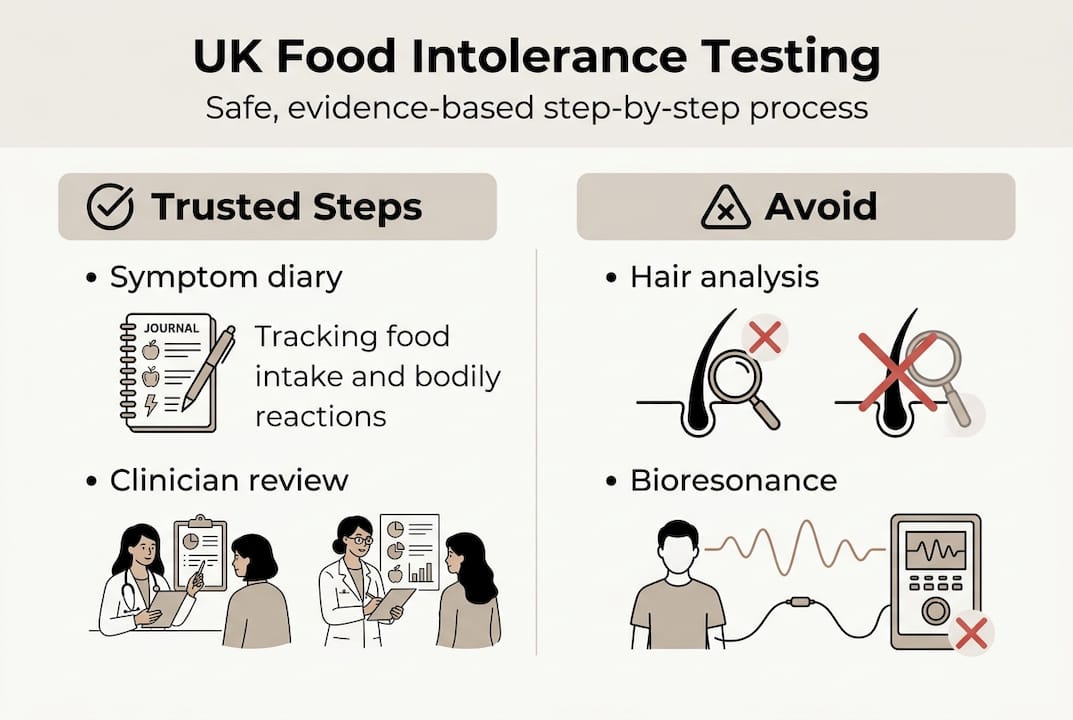
Pro Tip: If a test does not involve a supervised elimination phase or a clinician review, treat the results with caution. Use them as a starting point for conversation with your GP, not as a definitive answer.
For those curious about hair sample testing insights or the mechanics of bioresonance testing, understanding what these tests measure and what they do not is an important first step.
The step-by-step process for safe, non-invasive intolerance testing
Knowing which methods are trustworthy is only useful if you know how to apply them. Here is a practical framework you can follow safely.
Step 1: Start your symptom diary
Record everything for at least two to four weeks. Note what you eat, when you eat it, and any symptoms that follow. Include timing, severity, and any relevant context such as stress or sleep. The NHS recommends a symptom diary and supervised elimination diet as the primary non-invasive approach.
Step 2: Identify patterns and suspect foods
After a few weeks, review your diary for patterns. Are symptoms appearing consistently after certain meals? Are there particular ingredients that keep appearing before a flare? Share this information with your GP or a registered dietitian.
Step 3: Begin a supervised elimination phase
Remove suspect foods from your diet for two to six weeks. This phase works best under professional supervision. For non-IgE food allergies and suspected intolerances, elimination and reintroduction protocols require dietitian oversight to ensure nutritional adequacy and accurate interpretation.
Step 4: Reintroduce foods one at a time
After the elimination phase, reintroduce foods individually, leaving several days between each one. Monitor closely for returning symptoms. This confirmation step is critical. Without it, you cannot be sure which food was the actual trigger.
Step 5: Review and act on your findings
With your dietitian or GP, review what you have learned. Build a longer-term plan that removes confirmed triggers while maintaining a balanced, nutritionally complete diet.
Pro Tip: Do not eliminate more than two or three food groups at once without professional guidance. Over-restriction without supervision can lead to nutritional gaps, particularly with vitamins and minerals like calcium, iron, and B12.
Understanding UK trends in non-invasive testing shows how this approach is evolving. You can also explore rapid detection methods that complement supervised protocols without replacing them.
Potential pitfalls: Risks of unreliable food testing kits
Even with good intentions, using an unreliable test can set your health journey back significantly. It is worth understanding exactly what can go wrong.
Unreliable tests lead to false positives, unnecessary dietary restrictions, nutritional deficiencies, and delayed proper diagnosis. Each of these carries real consequences.
Here is what these pitfalls look like in practice:
- False positives: You are told you react to wheat, dairy, and eggs. None of them are actually causing your symptoms. You cut them all out and your diet becomes severely limited.
- Nutritional deficiencies: Removing dairy without replacement can reduce calcium intake. Cutting wheat can lower fibre and B vitamins. Over time, this affects energy, bone health, and gut function.
- False negatives: The actual trigger, say, FODMAPs or a specific food additive, is never flagged. Your symptoms continue. You assume the test cleared everything, so you stop looking.
- Delayed diagnosis: A serious condition such as coeliac disease, Crohn’s disease, or a genuine IgE-mediated allergy goes undetected because the commercial test distracted you from seeking proper medical advice.
“A result that feels reassuring but is not accurate is often more harmful than no result at all. It closes doors that need to stay open.”
This is why guaranteed clarity through a structured, evidence-aligned approach matters. And if you are considering at-home accuracy, understanding exactly what a test can and cannot confirm protects you from drawing the wrong conclusions.
The bottom line is this: a test that is easy to take but unreliable in its results is not a health tool. It is a source of false reassurance or false alarm.
Why the UK’s approach to food intolerance science leads the way
The UK has one of the clearest evidence-based frameworks for food intolerance and allergy management in the world. The NHS and the British Dietetic Association (BDA) both take a firm stance: clinical validation, professional supervision, and harm avoidance come first.
This stands in sharp contrast to the commercial market. Many commercial sites actively promote hair analysis and bioresonance tests for convenience, despite the absence of any supporting evidence. They fill a gap left by the slow pace of NHS appointments and the genuine frustration of living with unexplained symptoms.
We think that frustration is completely valid. But the answer to it cannot be a test that does not work. The UK framework, grounded in the step-by-step NHS guide, protects you from wasted time, wasted money, and potentially serious health consequences.
Following evidence-based methods takes more patience. But they lead to answers you can actually trust and act on.
Explore safe, guided food intolerance testing solutions
If you are ready to move forward with a structured, science-informed approach, UK Food Intolerance is here to support you. Our testing options are designed to give you a clear starting point.
Browse our tests to find the right fit for your needs, whether you want a broad screen or a focused report. Our range of intolerance tests covers over 1,100 items and delivers results within 48 to 72 hours. Not sure where to begin? Discover how a diet matching test can help align your eating habits with what your body actually tolerates. Clear answers, fast turnaround, and real support throughout the process.
Frequently asked questions
What is the safest way to test for food intolerance in the UK?
The safest approach is a symptom diary followed by a supervised elimination diet, guided by a dietitian or GP. This method is recommended by the NHS and produces reliable, actionable results.
Are hair sample and bioresonance tests for food intolerance reliable?
No. These methods lack evidence and are rejected by the NHS and professional bodies as ineffective for diagnosing food intolerance or sensitivity.
What risks are associated with unreliable food intolerance kits?
Unreliable kits can produce false positives that lead to unnecessary dietary restriction, nutritional deficiencies, and delayed diagnosis of genuine conditions.
What is the difference between food sensitivity, intolerance, and allergy?
Food allergies involve the immune system and can cause rapid, severe reactions. IgE blood tests are the validated diagnostic tool for these. Intolerances are non-immune, usually digestive, and slower to develop. Sensitivities are broader and harder to define clinically.









Leave a Reply
Want to join the discussion?Feel free to contribute!