

There is no single test that can reliably diagnose histamine intolerance in the UK today. That applies to blood tests, cheek swabs and hair tests alike. What does work is a careful process: rule out allergy and other conditions with your GP, then use a short, structured elimination diet and a symptom diary to find your own triggers. This guide explains each step, what the commercial tests can and cannot tell you, and where our own at-home test fits in.
TL;DR
- Allergy UK says there are currently no reliable tests for histamine intolerance, so be wary of any kit that promises a diagnosis.
- The approach clinicians use is a 2 to 4 week low-histamine elimination diet, followed by gradual reintroduction, ideally guided by a dietitian.
- See your GP first. Symptoms such as flushing, hives, headaches and palpitations overlap with allergy and other conditions.
- Our hair-based test is an intolerance screening tool, not a histamine diagnosis. It can give you a starting list of foods to discuss and test, nothing more.
- Keep a food and symptom diary. Histamine tolerance changes day to day, and a diary is the best evidence you will have.
Table of Contents
- What histamine intolerance actually is
- Signs you might be reacting to histamine
- Is there a reliable histamine intolerance test?
- How to test for histamine intolerance properly
- Why your results can feel confusing
- Where a hair-based test fits
- Our perspective
- If you would like a starting list
- When to see a doctor straight away
- FAQ
- Sources
What histamine intolerance actually is
Histamine is a natural chemical in your body. It is also found in food, especially in foods that have been fermented, aged, stored for a long time or have started to break down. Histamine belongs to a group called vasoactive amines, and some people develop symptoms when they eat too much of them. Hospital patient guidance describes these symptoms as similar to those caused by histamine release in an allergic reaction, although the reason is not fully understood.
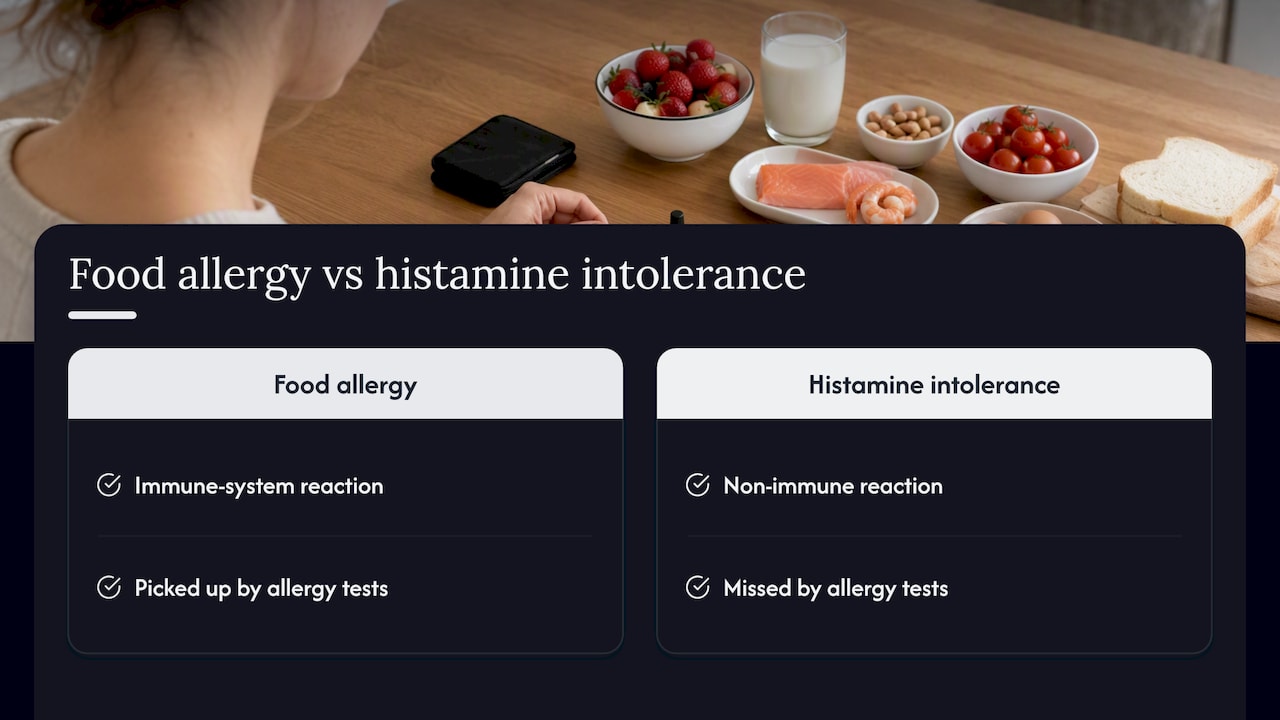
It is not an allergy. A true food allergy involves the immune system. Histamine intolerance is a non-immune reaction, which is why standard allergy tests do not pick it up. The British Society for Allergy and Clinical Immunology (BSACI) describes this as a pharmacological reaction, caused by amines that build up as food degrades during fermentation, storage or decay.
Signs you might be reacting to histamine
Allergy UK lists the common symptoms as skin rashes, hives or itching, flushing, swelling, a blocked or runny nose, breathing difficulty and irregular heartbeat, among others. Digestive symptoms such as nausea and diarrhoea are also reported, and headaches are common.
Timing is a useful clue. Symptoms usually appear from 30 minutes to a few hours after eating foods high in histamine.
Here is the catch. Almost every one of those symptoms can also be caused by something else: a food allergy, coeliac disease, irritable bowel syndrome, a skin condition, a hormonal change. You cannot tell them apart from the symptom list alone, which is why the first step is a conversation with a professional, not a purchase.
A note on cheese and other classic triggers
If you notice headaches, flushing or a blocked nose after cheese, you are not imagining a pattern, but the cause may not be histamine. Aged cheese, fermented foods and cured meats are all named as high-histamine foods in hospital guidance. Yet cheese also contains lactose, milk protein and other amines such as tyramine. A reaction after cheese could be lactose intolerance, a dairy allergy, or sensitivity to a different amine. Only a structured process can separate them.
Is there a reliable histamine intolerance test?
Short answer: no. Here is how the main options stack up.
| Test type | What it claims | What the evidence says |
|---|---|---|
| Blood test for DAO (diamine oxidase) enzyme | Low DAO means you cannot break down histamine | Not recommended as a diagnostic marker: studies show high variability and no consistent link between enzyme levels and symptoms |
| Genetic cheek swab | Gene variants affect histamine breakdown | Shows a predisposition at most. Not a diagnosis, and not backed by UK dietetic guidance as a way to confirm intolerance |
| Supervised histamine challenge | A measured dose of histamine under medical monitoring | Used in research and some specialist settings. Not routine NHS practice |
| Hair or bioresonance test | Identifies foods your body is sensitive to | BSACI says there is no evidence for its diagnostic accuracy |
| Elimination diet and reintroduction | Identifies your personal triggers by observation | The approach used in UK dietetic guidance |
The NHS also advises caution about tests you can buy that claim to diagnose food intolerances, noting limited evidence that they give accurate results.
We sell a hair-based test, so we want to be clear with you about this. We do not claim that our test diagnoses histamine intolerance, and no honest provider can. If a company tells you a single swab or sample will confirm it, ask for the clinical evidence.
How to test for histamine intolerance properly
This is the route we would suggest to a friend. It costs little and it is the one clinicians follow.
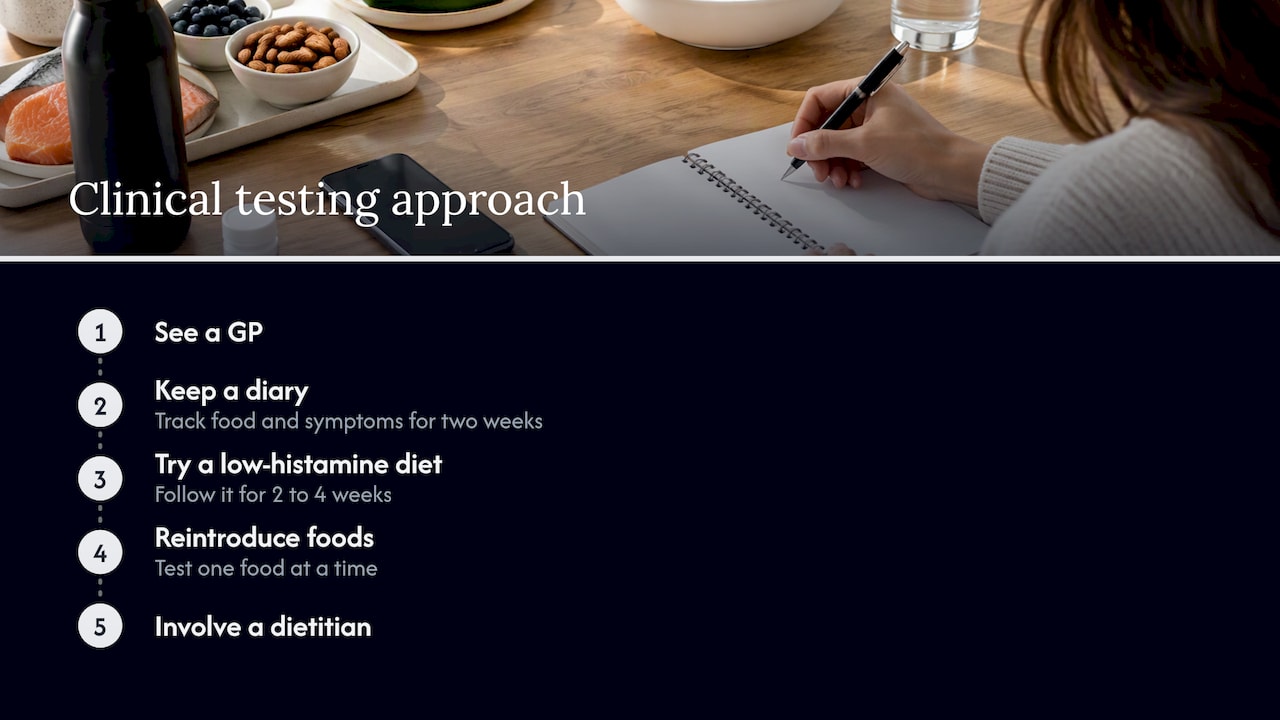
Step 1: See your GP
Allergy UK explains that histamine intolerance is often a diagnosis of exclusion. A doctor or dietitian needs to rule out true food allergy and other health conditions first. Go sooner rather than later if you have swelling of the lips or face, breathing difficulty, or a racing or irregular heartbeat. Those symptoms need medical assessment, not a home experiment.
Step 2: Keep a food and symptom diary
For two weeks, write down everything you eat and drink, the time, and any symptoms with their timing and severity. Add stress, sleep, illness, medication and, if relevant, where you are in your menstrual cycle. This matters because histamine tolerance is dynamic: it can shift with stress, illness, hormone levels and medication, so the same meal may cause a reaction on Monday and none on Thursday.
Step 3: Try a time-limited low-histamine diet
The accepted diagnostic approach is to avoid high-histamine foods for 2 to 4 weeks, including fermented products, aged cheese and cured meats. If your symptoms ease, that is a useful signal. If nothing changes, histamine is probably not your problem, and you should go back to your GP rather than cutting out more foods.
A few honest limits apply. No food list can be 100% accurate, because histamine levels vary within the same food depending on freshness, storage time and bacterial contamination. Fresh is generally safer than leftover.
Step 4: Reintroduce foods one at a time
After the elimination phase, bring foods back gradually, one at a time, and record what happens. The aim is to find your personal threshold, not to ban whole food groups for life. Our elimination diet checklist walks through the practical side, and our guide to the food elimination process covers reintroduction in more detail.
If you drink coffee, remember it can be a separate trigger for some people with digestive symptoms. Reading about caffeine and irritable bowel symptoms can help you decide whether to test it as its own variable.
Step 5: Involve a dietitian
This step protects you. Allergy UK stresses working with a dietitian during an elimination diet so your nutrition stays balanced, because restricting histamine foods can drift into excessive and harmful restriction. Ask your GP for a referral, or look for a registered dietitian who works with food intolerance.
Why your results can feel confusing
People often say the diet “worked, then stopped working”. That is common with histamine, and it is not a failure on your part. Your threshold moves. A glass of wine, a stressful week, a cold or a new medication can all lower the amount of histamine you cope with. Alcohol deserves a mention: Allergy UK discusses vasoactive amines in drinks, including histamine, tyramine and phenylethylamine, which is one reason wine and beer affect some people more than others.
The practical takeaway is to look for patterns over weeks, not single meals. Change one thing at a time, and write it down.
Where a hair-based test fits
Let us be straightforward about what our test is. UK Food Intolerance offers at-home bioresonance-based sensitivity tests. You collect a small hair sample at home, send it to a UK-based laboratory, and receive a digital report within 48 to 72 hours. Our panels cover up to 1,450 items, and the report is designed to give you a clear starting list for an elimination diet.
We also know the wider picture. The BSACI advises against hair analysis and bioresonance as diagnostic tools, and the NHS says commercial tests have limited evidence. We take that seriously, and our own page on the evidence for bioresonance testing says plainly that reproducible evidence is lacking. Our bioresonance side effects guide also covers the real risk, which is nutrient gaps from cutting out too many foods.
So how might it help? Some people find a report useful as a structured prompt. Instead of staring at everything in your kitchen, you start with a shorter list, test it with an elimination diet, and keep what your own body confirms. If you use it this way, as a screening aid alongside your GP and a diary, it can make the first week less overwhelming. If you hope it will diagnose histamine intolerance, it will not, and we would rather tell you now.
What a sensible approach looks like
- See your GP to rule out allergy and other conditions.
- Use any report as a list of ideas to test, never as a verdict.
- Test one food or group at a time, then record the result.
- Reintroduce foods as soon as your symptoms settle, to avoid unnecessary restriction.
- Ask a dietitian to check that your diet stays balanced.
Our perspective
We hear from many people who have spent months feeling unwell after meals and cannot get a clear answer. That frustration is real, and we understand why a simple kit is tempting. What we have learned is that the answer rarely arrives from a single result. It comes from careful observation: what you ate, when, how you felt, and what changed when you adjusted.
That is why we focus on support after the report arrives. A list of foods is only useful if you know what to do with it, so we publish guidance on elimination diets, reintroduction and reading your results. We also say openly that our method suits intolerance screening and not diagnosis, and that anyone with severe or worrying symptoms should see a doctor first.
Histamine is a good example of why honesty matters. It is hard to measure, it moves with stress and health, and no home test can settle it. Use our test, or any other tool, as one input among several. Trust your diary, trust your clinician, and be kind to yourself while you work it out.
— Rob
If you would like a starting list
If you want a broader picture of foods to explore while you follow the steps above, our Ultimate Plus Intolerance Test is £140.99 one-off per person. You can also compare the other panels, including Core, Essential, Premium and Ultimate, on our tests page. Pet owners can see the options on our pet testing page. The report supports an elimination diet. It does not replace medical advice.
Wondering how the process works? Our at-home testing workflow explains each stage, and our digital reports guide shows how to read what you receive.
When to see a doctor straight away
A home approach is only suitable for mild, recurring symptoms that you have already discussed with your GP. Seek urgent medical help for difficulty breathing, swelling of the face, lips or throat, or a fast or irregular heartbeat that does not settle. Do not wait for a test result. If you give a child a restricted diet, speak to your GP or a paediatric dietitian first, because children’s nutritional needs are less forgiving. Our guide to understanding a child’s sensitivity report can help once you have professional support in place.
FAQ
Can the NHS test for histamine intolerance?
Not with a validated test. The NHS and Allergy UK both say there is no reliable test, so your GP will usually rule out allergy and other conditions, then may refer you to a dietitian for a supervised elimination diet.
How do I get checked for histamine intolerance?
Start with your GP and a food and symptom diary. If other causes are ruled out, a dietitian can guide a 2 to 4 week low-histamine diet and then a step-by-step reintroduction. Your reaction to that process is the check.
Is a DAO blood test worth buying?
Dietetic guidance says DAO levels are not recommended as a reliable marker, because they vary and do not consistently match symptoms. A result may be reassuring or alarming without telling you anything dependable.
Why do I react after eating cheese?
Aged cheese is high in histamine, so it is a common suspect. It also contains lactose, milk protein and other amines, so the cause could be different. Try the diary and elimination steps above, and mention it to your GP if the reaction includes swelling or breathing difficulty.
Can a hair test tell me if I have histamine intolerance?
No. BSACI states there is no evidence that hair analysis or bioresonance diagnoses food-related conditions. Our test is a screening aid that gives you a list of foods to try in an elimination diet, not a diagnosis.
Sources
- Allergy UK: Histamine Intolerance
- Allergy UK: Histamine Intolerance factsheet (PDF)
- Allergy UK: Reactions to Alcohol
- NHS: Food intolerance
- BDA: Sensitivity to Histamine and other Vasoactive Amines (2025 update)
- University Hospitals Plymouth NHS Trust: Plain English guide to sensitivity to histamines
- BSACI: Other tests
- BSACI: Non-immune mediated food hypersensitivity









Leave a Reply
Want to join the discussion?Feel free to contribute!