

Many people experiencing unexplained symptoms turn to popular at-home allergy tests hoping for quick answers. Yet most of these kits lack clinical validation, creating confusion rather than clarity. UK clinical standards prioritise careful history-taking and validated testing methods to distinguish true allergies from intolerances and other conditions. This guide explains UK allergy standards, contrasts reliable diagnostic approaches with common pitfalls, and helps you navigate the complex landscape of allergy testing with confidence. Understanding these standards empowers you to make informed decisions about your health.
Table of Contents
- Key takeaways
- What defines allergy standards in the UK
- Diagnosing IgE-mediated allergies: tests and frameworks
- Non-IgE allergies and food intolerances: diagnostic challenges
- Emerging research and regulatory context in UK allergy standards
- Discover accurate food intolerance testing options today
- Frequently asked questions
Key Takeaways
| Point | Details |
|---|---|
| Clinical history essential | UK allergy diagnosis relies on a detailed clinical history supported by validated tests rather than tests alone. |
| Home test kits lack validation | At home test kits have no NHS or NICE endorsement and lack robust validation, leading to confusion. |
| IgE tests require context | Skin prick and specific IgE blood tests must be interpreted alongside clinical history to confirm or rule out allergy. |
| Oral food challenge gold standard | The supervised oral food challenge is the gold standard for confirming food allergy. |
| Voluntary allergen labelling under review | Allergen threshold labelling in the UK is voluntary and currently under research for potential future regulation. |
What defines allergy standards in the UK
Several authoritative bodies shape how clinicians diagnose allergies across the UK. The National Institute for Health and Care Excellence (NICE) publishes comprehensive guidelines that establish quality standards. NHS England implements these standards throughout primary and secondary care. The British Society for Allergy and Clinical Immunology (BSACI) provides specialist guidance for practitioners. The Royal College of Pathologists (RCPath) sets laboratory testing criteria.
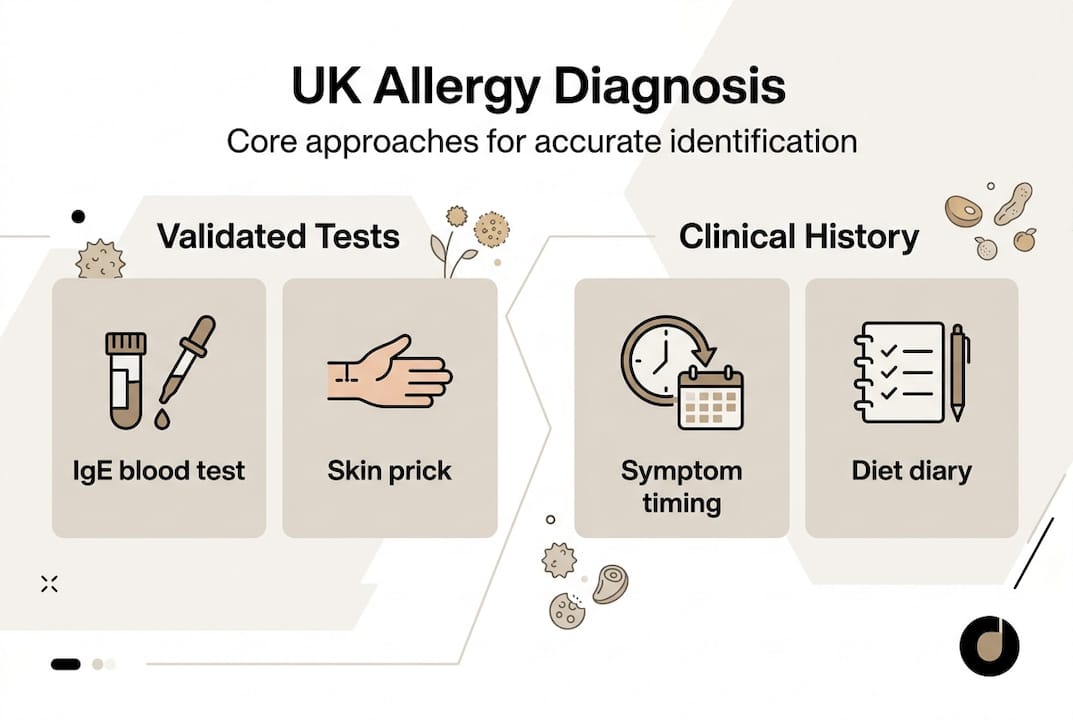
These organisations agree on one fundamental principle: clinical history forms the cornerstone of accurate diagnosis. Your detailed account of symptoms, timing, and triggers provides more diagnostic value than any single test result. Laboratory tests serve to confirm or refute clinical suspicions, never to replace careful history-taking. This approach prevents misdiagnosis and unnecessary dietary restrictions that plague commercial testing.
UK standards distinguish between IgE-mediated allergies and non-IgE-mediated allergies because they require entirely different diagnostic approaches. IgE-mediated reactions occur rapidly, typically within minutes to one hour after exposure. Non-IgE reactions develop more slowly, sometimes taking hours or days to manifest. This timing difference fundamentally changes how clinicians investigate and confirm diagnoses.
Clinicians following UK standards must assess several critical elements:
- Detailed symptom description including severity, body systems affected, and progression
- Precise timing between suspected allergen exposure and symptom onset
- Reproducibility of reactions across multiple exposures to the same food
- Patient age, atopic history, and family history of allergic conditions
- Exclusion of alternative explanations for symptoms
This systematic approach ensures diagnostic accuracy whilst avoiding the pitfalls of relying solely on test results. Understanding these foundational principles helps you recognise when testing adds value versus when it creates confusion. For comprehensive guidance on navigating testing options, explore our intolerance testing guide designed specifically for UK residents seeking clarity.
Diagnosing IgE-mediated allergies: tests and frameworks
IgE-mediated allergies trigger immediate reactions through immunoglobulin E antibodies. Two validated tests help confirm these allergies when clinical history suggests them. Skin prick tests introduce tiny amounts of suspected allergens into the skin’s surface layer. A raised wheal appearing within 15 minutes indicates potential sensitisation. Specific IgE blood tests measure antibody levels to particular foods in your bloodstream.
Neither test alone confirms allergy. You can show positive results yet tolerate the food perfectly well, a phenomenon called sensitisation without clinical allergy. Conversely, negative results don’t always rule out allergy if testing occurs long after exposure or if technical factors affect accuracy. This explains why clinical history remains essential for interpreting any test result correctly.

The supervised oral food challenge represents the gold standard for confirming or excluding food allergy. During this procedure, you consume gradually increasing amounts of the suspected food under medical supervision. Healthcare professionals monitor you closely for any reaction, ready to intervene immediately if symptoms develop. This approach provides definitive answers but requires hospital resources and carries small risks, so clinicians reserve it for unclear cases.
RCPath developed the STAR framework to guide appropriate specific IgE testing in primary care:
- Symptoms consistent with IgE-mediated allergy affecting skin, respiratory, or gastrointestinal systems
- Timing of symptom onset within one hour of suspected allergen exposure
- Attributable to a specific allergen based on clear temporal relationship
- Reproducible reactions occurring consistently with repeated exposures
This framework prevents unnecessary testing whilst ensuring appropriate referrals for specialist evaluation. GPs use these criteria to determine when specific IgE testing adds diagnostic value versus when it risks generating misleading results.
Pro Tip: The one-hour timing criterion serves as a powerful differentiator. If your symptoms consistently appear within 60 minutes of eating a particular food, IgE-mediated allergy becomes more likely. Reactions developing hours later suggest non-IgE mechanisms or food intolerance instead. Tracking this timing carefully helps clinicians choose appropriate investigations.
Understanding these frameworks empowers you to have informed conversations with healthcare providers about which tests suit your situation. When seeking testing options that complement clinical assessment, our guide on choosing intolerance tests provides practical insights for UK residents navigating this complex landscape.
Non-IgE allergies and food intolerances: diagnostic challenges
Non-IgE-mediated allergies involve immune responses without IgE antibodies. They typically affect the gastrointestinal system, causing symptoms like reflux, vomiting, diarrhoea, or blood in stools. These reactions develop more slowly than IgE allergies, often appearing hours or days after eating the trigger food. Common culprits include cow’s milk protein in infants and certain food proteins in older children and adults.
The diagnostic challenge lies in the absence of validated laboratory tests. Unlike IgE allergies, you cannot confirm non-IgE allergies through skin prick tests or blood tests. Instead, clinicians rely on systematic elimination diets followed by supervised reintroduction. You remove suspected foods for several weeks whilst monitoring symptoms. If symptoms improve, you reintroduce foods one at a time under medical guidance to identify triggers definitively.
Food intolerance differs fundamentally from both allergy types. Intolerances involve non-immune mechanisms like enzyme deficiencies or sensitivity to food chemicals. Lactose intolerance results from insufficient lactase enzyme. Some people react to naturally occurring chemicals like histamine or salicylates. Symptoms typically affect digestion, causing bloating, cramping, or altered bowel habits, but rarely involve other body systems.
Diagnosing food intolerance requires careful detective work. Diet diaries help identify patterns between foods and symptoms. Elimination diets remove suspected triggers systematically. Breath tests can confirm specific intolerances like lactose or fructose malabsorption by measuring hydrogen production after consuming test substances. No validated comprehensive at-home test exists for food intolerances despite widespread commercial availability.
| Testing Approach | Official Methods | Unvalidated Commercial Kits |
|---|---|---|
| Non-IgE allergies | Elimination diet, supervised reintroduction, symptom monitoring | Hair analysis, bioresonance, IgG testing |
| Food intolerances | Diet diary, targeted elimination, breath tests for specific sugars | Comprehensive IgG panels, kinesiology, electrodermal testing |
| Evidence base | Supported by NICE, NHS, BSACI guidelines | Lacking validation, not recommended by medical bodies |
| Risk profile | Supervised, addresses nutritional adequacy | Unnecessary restrictions, misdiagnosis, delayed proper investigation |
Commercial at-home kits testing IgG antibodies, hair samples, or using bioresonance technology lack endorsement from NHS, NICE, BSACI, and Allergy UK. These organisations warn against relying on unvalidated methods because they generate false positives, leading people to restrict diets unnecessarily. IgG antibodies to foods represent normal immune exposure, not intolerance or allergy. Hair analysis and bioresonance lack scientific plausibility and reproducibility.
Pro Tip: Be cautious of any test promising to identify dozens or hundreds of food sensitivities simultaneously. Such broad claims typically indicate unvalidated methodology. Genuine food problems usually involve a small number of triggers identifiable through systematic clinical approaches. Restricting your diet based on unreliable results risks nutritional deficiencies and unnecessary anxiety.
Navigating these diagnostic challenges requires understanding which methods provide reliable information. For evidence-based approaches to identifying food triggers, explore our resources on reliable home testing and at-home food intolerance testing designed for UK residents seeking validated solutions.
Emerging research and regulatory context in UK allergy standards
Quality assurance frameworks ensure specific IgE testing maintains accuracy across UK laboratories. External quality assessment (EQA) schemes benchmark laboratory performance against established standards. These programmes send identical samples to participating laboratories, then compare results to identify variations. Performance targets include coefficient of variation below 12% and overall method-related variation in sensitivity (OMRVIS) scores under 100 indicating good performance.
These technical standards matter because they directly affect your test result reliability. Laboratories participating in EQA schemes demonstrate commitment to accuracy and continuous improvement. When your GP orders specific IgE testing, it typically goes to accredited laboratories meeting these benchmarks. This quality infrastructure distinguishes validated testing from unregulated commercial alternatives lacking such oversight.
Allergen labelling regulation presents ongoing challenges in the UK. Currently, no legal thresholds exist for precautionary allergen labelling. Food manufacturers use voluntary phrases like “may contain” or “produced in a facility that handles” without standardised criteria. This inconsistency creates confusion for people managing food allergies who cannot reliably assess risk from packaging alone.
Researchers are developing reference doses to inform future regulations. The ED05 concept represents the eliciting dose causing reactions in 5% of allergic individuals. Scientists have established ED05 values for major allergens including peanut, milk, egg, and others through carefully controlled challenge studies. These doses theoretically protect 95% of allergic consumers if implemented as regulatory thresholds.
| Allergen | Estimated ED05 | Current Labelling Status |
|---|---|---|
| Peanut | Under review for threshold setting | Voluntary precautionary labelling |
| Cow’s milk | Research ongoing for reference doses | Mandatory declaration, voluntary “may contain” |
| Hen’s egg | Scientific assessment in progress | Mandatory declaration, inconsistent warnings |
| Tree nuts | Varies by nut type, under investigation | Voluntary precautionary statements |
The Food Standards Agency (FSA) and international bodies like CODEX Alimentarius continue reviewing evidence for implementing allergen thresholds. However, several challenges complicate this process. Individual sensitivity varies enormously, making single thresholds imperfect. Manufacturing processes cannot always guarantee trace allergen levels below proposed thresholds. Analytical methods for detecting tiny allergen amounts require further refinement.
Future improvements to UK allergy standards may include:
- Standardised precautionary allergen labelling based on validated thresholds
- Enhanced laboratory accreditation requirements for commercial testing services
- Expanded access to specialist allergy services reducing diagnostic delays
- Integration of emerging technologies for rapid allergen detection
- Improved patient education resources about validated diagnostic pathways
These developments aim to reduce confusion whilst protecting allergic individuals more effectively. Understanding the evolving regulatory landscape helps you interpret current labelling and testing options critically. For insights into how testing methodologies continue developing, visit our bioresonance research page exploring the science behind different approaches.
Discover accurate food intolerance testing options today
Navigating food intolerance testing requires understanding which approaches offer genuine value versus those lacking validation. UK Food Intolerance provides comprehensive testing services designed specifically for UK residents seeking clarity about potential food sensitivities. Our validated testing methods help identify triggers affecting your wellbeing, digestive health, and overall quality of life.

We offer convenient at-home testing that delivers detailed reports within 48 to 72 hours, helping you take informed steps towards symptom relief. Our approach complements clinical assessment by providing insights you can discuss with healthcare providers. Explore our range of food intolerance tests or browse our intolerance tests archives for comprehensive information. Learn more about the convenience and reliability of at home intolerance testing tailored to your needs.
Frequently asked questions
Can I rely on at-home allergy tests to diagnose food allergies or intolerances?
Most commercial at-home allergy and intolerance tests lack validation from UK medical authorities including NHS, NICE, and BSACI. These kits often test IgG antibodies, hair samples, or use bioresonance technology without scientific evidence supporting their accuracy. Relying on such tests risks unnecessary dietary restrictions and delayed proper diagnosis. Validated testing requires clinical interpretation alongside your symptom history.
What is the difference between allergy and food intolerance?
Food allergy involves immune system responses, either IgE-mediated causing rapid reactions or non-IgE-mediated causing delayed symptoms. Food intolerance operates through non-immune mechanisms like enzyme deficiencies or sensitivity to food chemicals. Allergies can trigger severe, potentially life-threatening reactions affecting multiple body systems. Intolerances typically cause uncomfortable digestive symptoms without involving the immune system or posing life-threatening risks.
Why is clinical history so important in UK allergy diagnosis?
Clinical history provides context that test results alone cannot offer. You can show positive allergy tests yet tolerate foods perfectly well, or have negative tests despite genuine allergies. The timing, severity, and reproducibility of your symptoms guide clinicians towards accurate diagnosis. UK standards prioritise this approach because it prevents misdiagnosis and ensures appropriate management tailored to your specific situation.
Are there legal allergen thresholds for UK food labelling?
No legal thresholds currently exist for precautionary allergen labelling in the UK. Manufacturers use voluntary phrases like “may contain” without standardised criteria. Research continues into reference doses that could inform future regulations, but implementation faces challenges including individual sensitivity variation and manufacturing limitations. This creates inconsistency that complicates risk assessment for people managing food allergies.
What should I do if I have unexplained symptoms possibly linked to food?
Start by keeping a detailed food and symptom diary noting timing relationships. Consult your GP with this information rather than purchasing commercial testing kits. Your doctor can assess whether symptoms suggest IgE-mediated allergy warranting validated testing, non-IgE allergy requiring elimination protocols, or food intolerance needing different investigation. This clinical pathway ensures accurate diagnosis whilst avoiding unnecessary restrictions and addressing any underlying conditions requiring treatment.










Leave a Reply
Want to join the discussion?Feel free to contribute!