
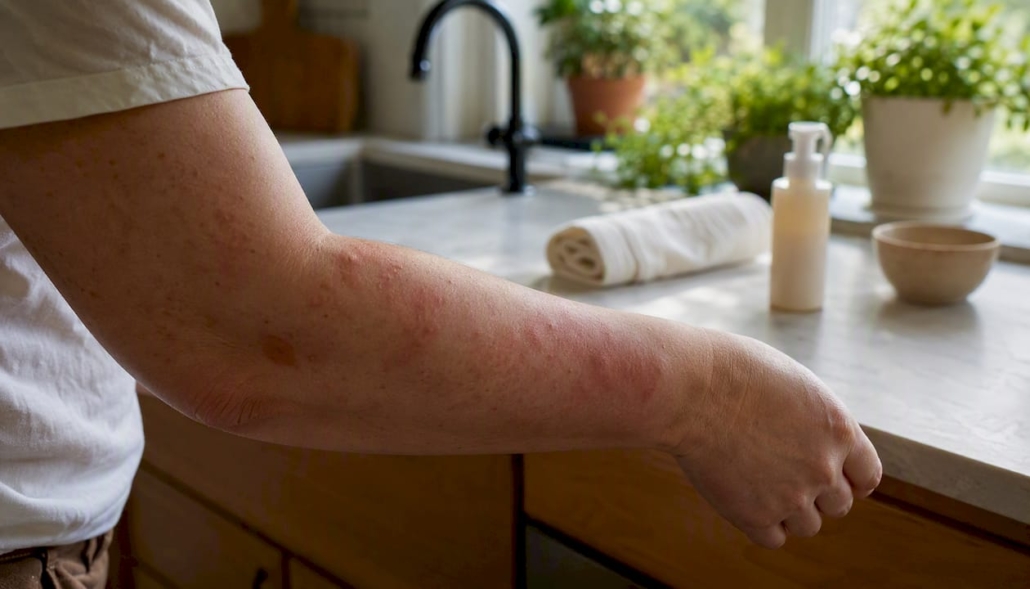
Yes, food intolerances can trigger skin symptoms, including flushing, itching, and hive-like rashes, but this differs from a true food allergy in one crucial way: it isn’t life-threatening. If your skin reacts to food alongside swelling of the face or tongue, breathing difficulty, or dizziness, treat it as an emergency and call 999. Those are signs of anaphylaxis, not intolerance.
For everything else, this guide walks you through how to tell the two apart, what’s actually happening in your skin, and what steps to take next.
Food intolerance is non-immune and usually causes digestive symptoms a few hours after eating, while food allergy is immune-mediated and can bring on rapid, potentially dangerous reactions within minutes to two hours.
Three things to keep in mind as you read on:
- Skin symptoms alone rarely mean allergy. Combined with swelling or breathing trouble, they always warrant urgent care.
- Diagnosing intolerance is usually a process of elimination, not a single test result.
- Home test kits vary hugely in scientific backing. Know what you’re paying for before you buy.
Key Takeaways
Food intolerance can cause skin symptoms like flushing, hives, and rash flares, but genuine allergy risk, marked by swelling or breathing difficulty, always demands emergency care first.
| Point | Details |
|---|---|
| Verdict on skin symptoms | Intolerance can cause flushing, itching, and rashes, but rarely anything life-threatening on its own. |
| Emergency red flags | Facial or tongue swelling, breathing difficulty, or fainting alongside a rash means calling 999 immediately. |
| Diagnosis is often exclusion | Elimination diets, supervised by a professional, remain the practical standard for confirming intolerance. |
| Home tests need scrutiny | Bioresonance and IgG kits lack broad clinical validation, so treat results as a starting point, not a diagnosis. |
| Ukfoodintolerance’s role | Its at-home hair-sample tests, UK lab processing, and 48 to 72 hour digital reports support structured elimination diets, not standalone diagnosis. |
Table of Contents
- Skin symptoms linked to food reactions and how they usually show up
- Food allergy vs food intolerance: the practical differences
- What actually causes food-related skin rashes
- How doctors investigate food-related rashes
- Are at-home intolerance test kits reliable?
- Treating and managing food-related skin rashes
- When to call 999 versus when to book a GP
- Practical steps to take right now
- How at-home bioresonance and IgG testing actually work
- Why caution matters as much as curiosity here
- Exploring at-home testing? Here’s what a trustworthy provider looks like
- Frequently asked questions
- Sources
Skin symptoms linked to food reactions and how they usually show up
Hives are the most recognisable food-related skin symptom: raised, itchy welts that can appear anywhere on the body and often shift location within hours. They’re common with both true allergy and some intolerance-driven reactions, which is exactly why the two get confused so often.
Flushing tends to show up differently. Rather than raised bumps, the skin reddens and feels warm, often across the face, neck, and chest. This is a classic sign of histamine intolerance rather than allergy, and it can appear alongside a headache or a racing heart.
Eczema flares sit in a slower category. Existing eczema can worsen after eating certain foods, though the link is rarely as clean-cut as “food X causes flare Y within an hour.” It’s more commonly a delayed, cumulative effect over a day or two.
Angioedema, deeper swelling under the skin, usually around the eyes, lips, or hands, deserves its own mention because it sits on the border between “concerning” and “emergency.” Mild angioedema without breathing symptoms can be intolerance-related, but any swelling near the airway needs immediate assessment.
Timing is your best clue. Reactions appearing within minutes to two hours point towards an IgE-mediated allergy, while symptoms building up over several hours, or even the next day, are more typical of intolerance.
Pro Tip: Keep a simple note of what you ate in the 24 hours before a flare-up, not just the last meal. Histamine and delayed-type reactions can take longer to surface than most people expect, and the culprit is often a meal from the day before rather than the one you just finished.
Food allergy vs food intolerance: the practical differences
The mechanism is the real dividing line. A food allergy involves your immune system mistakenly identifying a food protein as a threat and releasing IgE antibodies, which is why reactions can escalate fast and involve the whole body. Intolerance is usually digestive or metabolic; your body struggles to break down or process a specific component of food, without the immune system getting involved at all.
Timing backs this up. Allergic reactions typically appear within minutes to two hours, while intolerance symptoms tend to build over several hours and sometimes longer. Dose matters too, in a way it doesn’t with allergy: someone with lactose intolerance might tolerate a splash of milk in tea but react badly to a large glass, whereas an allergic reaction can occur from a trace amount.
| Feature | Food allergy | Food intolerance |
|---|---|---|
| Mechanism | Immune system (IgE-mediated) | Digestive or metabolic, non-immune |
| Onset | Minutes to 2 hours | Several hours to a day or more |
| Dose sensitivity | Can react to tiny amounts | Often dose-dependent |
| Typical signs | Hives, swelling, breathing difficulty | Digestive upset, occasional flushing or itching |
| Risk level | Can be life-threatening | Uncomfortable, rarely dangerous |
Watch for these practical red flags that point towards allergy rather than intolerance:
- Swelling of the lips, tongue, or throat
- Difficulty breathing or wheezing
- Widespread hives appearing suddenly across the body
- Dizziness, fainting, or a rapid drop in blood pressure
If any of these appear alongside a skin reaction, this is a possible anaphylaxis and needs 999, not a GP appointment. Mayo Clinic’s allergy specialists note that anaphylaxis remains a real risk even for people whose previous reactions were mild, which is exactly why skin symptoms should never be dismissed just because “it’s happened before and it was fine.” You can read more on how to spot the difference between food intolerance and allergy if you want a deeper breakdown.
What actually causes food-related skin rashes
Histamine intolerance is one of the more common but underdiscussed culprits. It happens when your body can’t break down dietary histamine efficiently, so it builds up and produces allergy-like symptoms, flushing, itching, hives, even headaches, without any immune involvement at all. Research on histamine intolerance describes it as a metabolic issue rather than an immune overreaction, which explains why it mimics allergy so convincingly while working through an entirely different pathway. Foods high in histamine include aged cheese, cured meats, fermented products, and certain wines.

Coeliac disease sits in its own category. It’s an autoimmune condition triggered by gluten, and one of its lesser-known presentations is dermatitis herpetiformis, an intensely itchy, blistering rash that typically appears on the elbows, knees, and buttocks. Unlike most intolerance-linked skin symptoms, this one has a clear diagnostic pathway through blood tests and, if needed, a skin biopsy.
Then there are the more familiar intolerances, lactose and FODMAPs, which mainly cause bloating, cramping, and digestive discomfort rather than skin symptoms directly. That said, ongoing gut inflammation from these intolerances can indirectly aggravate existing inflammatory skin conditions like eczema in some people, even without triggering a rash on its own.
- Histamine intolerance: flushing, hives, itching, often linked to fermented or aged foods
- Coeliac disease: dermatitis herpetiformis, a blistering, itchy rash tied to gluten exposure
- Lactose or FODMAP intolerance: primarily digestive, but can indirectly worsen existing skin inflammation
How doctors investigate food-related rashes
A proper diagnostic pathway starts with your history, not a lab test. A GP or allergist will ask about timing, quantity eaten, other symptoms, and family history before deciding what testing actually makes sense. That conversation alone rules out a lot of false leads.
From there, testing depends on what’s suspected. Skin prick tests and blood IgE testing are used when true allergy is on the table. Coeliac serology (a blood test looking for specific antibodies) is standard when dermatitis herpetiformis or gut symptoms suggest coeliac disease. A lactose or fructose breath test can confirm sugar malabsorption if digestive symptoms dominate.
| Suspected cause | Common test | What it shows |
|---|---|---|
| IgE food allergy | Skin prick test or blood IgE | Immune sensitisation to a specific allergen |
| Coeliac disease | Coeliac serology (blood test) | Antibodies indicating gluten-triggered immune response |
| Lactose intolerance | Lactose breath test | Ability to digest lactose |
| General intolerance | Elimination diet | Symptom response to removing/reintroducing foods |
For general intolerance, though, there often isn’t a single definitive test. Diagnosis is frequently a process of exclusion, built around a structured elimination diet supervised by a healthcare professional, precisely because symptoms overlap so heavily with other conditions. A broad review of adverse food reactions notes that milder or delayed reactions are the hardest to pin down diagnostically, which is exactly why elimination remains the practical standard.
It’s worth being clear-eyed about what a positive result on some tests does and doesn’t prove. An elevated IgG level, for instance, can simply reflect exposure to a food rather than a genuine intolerance to it, which is one reason IgG panels remain controversial in mainstream allergy medicine.
- Clinical history first, before any testing is ordered
- Targeted tests (IgE, coeliac serology, breath tests) for specific suspected conditions
- Elimination diet as the practical route when standard tests come back inconclusive
Are at-home intolerance test kits reliable?
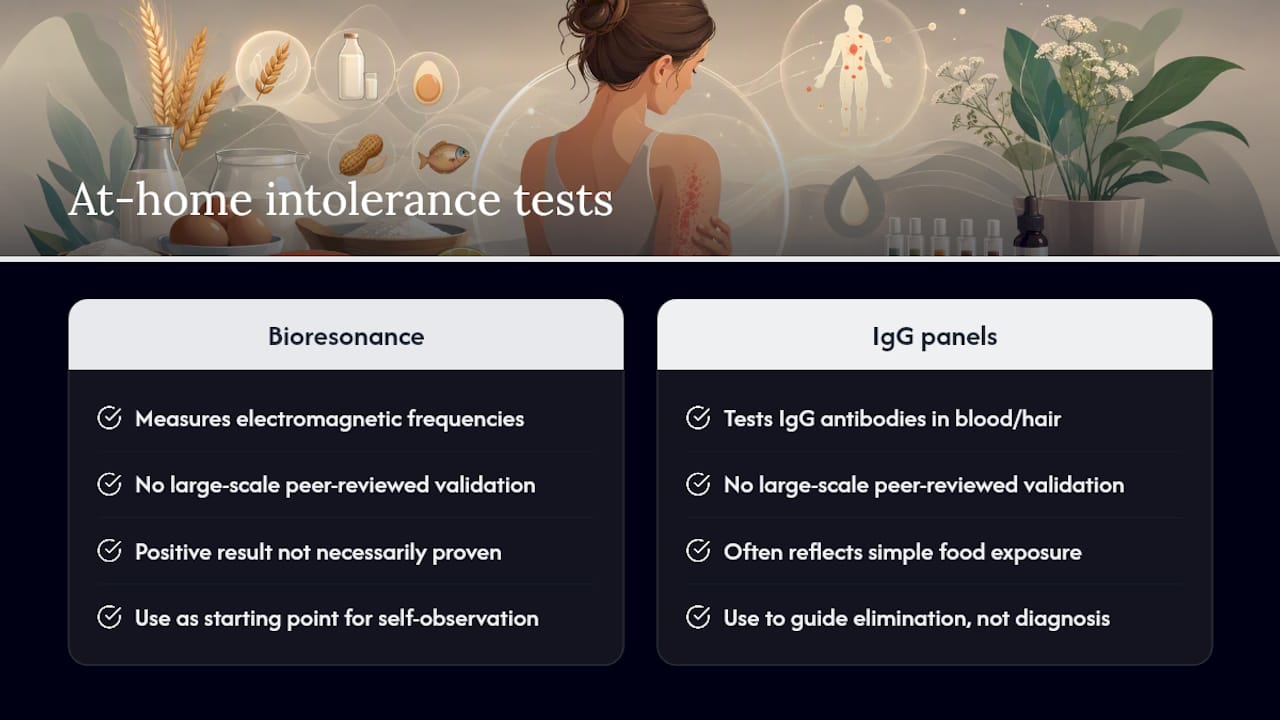
At-home intolerance kits generally fall into two camps: bioresonance testing, which measures the body’s response to electromagnetic frequencies associated with different substances, and IgG antibody panels, which test blood or hair for immune markers linked to specific foods. Both claim to flag foods your body may be reacting to without needing a clinical appointment.
The honest picture is mixed. Neither bioresonance nor IgG panels carry the kind of large-scale, peer-reviewed validation that skin prick testing or coeliac serology has. IgG antibodies, in particular, are now understood to often reflect simple food exposure rather than a genuine problem food, meaning a positive result doesn’t necessarily mean you should cut that food out. Regulatory and allergy bodies have raised this concern for years, and it’s a fair one.
The gap between what a test claims to detect and what it can actually prove is where most consumer confusion starts, and it’s worth understanding before you commit to cutting foods out based on a single report.
None of this means these tests are worthless. Many people use them as a starting point for structured self-observation rather than a diagnosis, and a well-run elimination process built around test results can still be genuinely useful, provided it’s not treated as gospel.
Pro Tip: Before choosing a test provider, check three things quickly: where the lab is based, whether they publish any methodology or validation information, and whether you get follow-up guidance for interpreting results. A provider who ticks all three is worth far more than one who just sends a PDF and disappears.
Treating and managing food-related skin rashes
For flare-ups already happening, short-term relief usually comes first. Antihistamines can calm hives and itching quickly, while topical treatments like emollients or mild steroid creams help soothe irritated skin. If scratching has broken the skin, basic woundcare, keeping it clean and moisturised, prevents secondary infection.
Longer-term management is about precision, not restriction. Once a specific trigger is identified through proper diagnosis, targeted avoidance tends to work far better than broad, sweeping diet changes. A structured elimination and reintroduction process, done one food group at a time, gives you clear answers instead of guesswork.
- Antihistamines for acute itching or hive flare-ups
- Topical emollients or steroid creams for irritated or eczema-prone skin
- Targeted avoidance of a confirmed trigger, rather than cutting multiple foods “just in case”
- Gentle skin care routines to reduce flare frequency during sensitive periods
It’s worth flagging that some readers turn to supplements alongside dietary changes. If digestive support is part of your plan, resources like this guide to choosing protein powder for lactose intolerance can help you avoid accidentally reintroducing a trigger through a supplement.
Cutting out entire food groups without proper diagnosis rarely helps and can create new problems, particularly nutritional gaps. Speak to a GP or dietitian before making major changes, especially if children are involved. For a fuller breakdown of coping day-to-day, see this guide on dealing with symptoms of a food intolerance.
When to call 999 versus when to book a GP
Any skin reaction accompanied by swelling of the face, lips, or tongue, difficulty breathing, or fainting is a medical emergency. Call 999 immediately rather than waiting to see if it settles down.
For everything else, a GP appointment is the right route, particularly if rashes are recurring, persistent, or you suspect coeliac disease based on digestive symptoms and a distinctive blistering rash. It’s also the right move if you’re planning an elimination diet and want proper guidance rather than trial and error.
Turning up prepared makes a real difference to how quickly you get answers. Bring:
- A food-and-symptom diary covering at least two to three weeks
- Photos of the rash at different stages, especially if it’s changed in appearance
- A rough timeline linking meals to symptom onset
A GP who can see patterns rather than a vague description of “I get itchy sometimes” is far more likely to point you towards the right next test.
Practical steps to take right now
Start with observation before you change anything. A food-and-symptom diary is the single most useful tool available to you, and it costs nothing.
- Record everything you eat and drink, including quantities and timing, for at least two weeks.
- Note symptom onset and severity each time something happens, whether it’s an hour later or the next morning.
- Photograph any visible rash, dated, so you and your GP can track changes over time.
- Avoid single suspect foods for one to two weeks at a time, rather than several at once, to keep results interpretable.
- Reintroduce one food at a time, waiting several days between each, watching closely for a repeat reaction.
- Loop in a clinician if symptoms are severe, persistent, or affecting a child, rather than continuing to self-manage indefinitely.
A structured elimination diet checklist can help keep this process organised rather than haphazard, which matters more than people expect once you’re three weeks in and trying to remember what you ate on a Tuesday.
Pro Tip: Try single-ingredient meals for a few days if you suspect histamine intolerance specifically, plain rice with fresh chicken, for example, rather than a sauce-heavy dish with multiple aged or fermented components. It narrows down the suspect list far faster than a full food diary alone.
How at-home bioresonance and IgG testing actually work
Bioresonance testing works by measuring how your body’s energy field is said to respond to different frequency signatures linked to specific substances, using a hair sample rather than blood. Ukfoodintolerance’s process reflects this: you collect a hair sample at home, send it to a UK-based laboratory, and receive a digital report within 48 to 72 hours covering over 1,450 items, spanning food, environmental, and nutritional sensitivities.
The honest EEAT picture matters here. Bioresonance lacks the kind of large-scale peer-reviewed clinical validation that established allergy tests carry, and IgG panels face similar criticism because elevated IgG can simply indicate exposure rather than genuine sensitivity. This doesn’t make either approach useless as a starting point for self-directed elimination work, but it does mean results should be treated as a guide for investigation, not a clinical diagnosis.
A reputable provider should be transparent about all of this upfront. Before trusting any report:
- Check the lab is UK-based and clearly named, not vague or offshore
- Look for published information on methodology, not just marketing claims
- Confirm you’ll get guidance on how to use results for a safe, structured elimination diet
- Understand that results point towards patterns worth investigating, not a medical diagnosis
Pro Tip: Treat your report as the starting point of an elimination diet, not the end of the process. The real answer comes from how your body responds when you remove and reintroduce the flagged items, not from the report alone.
Why caution matters as much as curiosity here
Most people who come to this topic are frightened, and that’s fair. A rash that won’t go away, especially one tied to something as unpredictable as food, wears people down faster than almost any other symptom because it feels impossible to control.
Here’s what tends to get lost in the noise: the overwhelming majority of food-related rashes are manageable once you know what you’re dealing with, and getting there rarely requires drastic measures. The mistake I see most often isn’t ignoring symptoms, it’s overcorrecting. People cut out six food groups on a hunch, feel marginally better for reasons that may have nothing to do with the diet, and end up more confused than when they started.
Patience and structure beat panic every time. A careful diary, a properly staged elimination process, and professional input when things don’t add up will get you further than any single test result, however sophisticated the technology behind it sounds. This article is meant to inform that process, not replace a proper clinical assessment when your symptoms warrant one.
Exploring at-home testing? Here’s what a trustworthy provider looks like
If you’re considering at-home testing as part of your elimination process, look for a provider that’s upfront about how the technology works, uses a UK-based lab, and gives you a genuinely usable report rather than a vague list of foods to avoid. Ukfoodintolerance’s Ultimate and Core Intolerance Tests work from a simple at-home hair sample, processed at a UK laboratory, with digital results delivered within 48 to 72 hours covering food, environmental, and nutritional sensitivities.

A test result is only as useful as what you do with it. Ukfoodintolerance’s reports are designed to support a structured elimination diet, flagging patterns worth investigating rather than handing you a rigid rulebook, and the site’s research and methodology page sets out exactly how the testing approach works so you can make an informed decision. If symptoms are severe, recurring, or affecting a child, pair any test with proper clinical support rather than going it alone.
Ready to start narrowing down your triggers? Browse the full range of intolerance tests and pick the option that matches how deep you want to go.
Frequently asked questions
Can a food intolerance really cause a rash on the skin?
Yes. Histamine intolerance in particular can trigger flushing, itching, and hive-like rashes because your body struggles to break down dietary histamine, not because your immune system is attacking the food.
How do I know if my skin rash is allergy or intolerance?
Speed and severity are the biggest clues. Reactions appearing within minutes and involving swelling or breathing trouble point to allergy; a rash building up over several hours without those symptoms is more typical of intolerance.
Are home intolerance tests accurate for diagnosing a skin rash?
They can highlight patterns worth investigating, but neither bioresonance nor IgG testing has the broad clinical validation of allergy testing or coeliac serology, so results should guide an elimination diet rather than serve as a standalone diagnosis.
When should I see a GP about a food-related rash?
Book an appointment for recurring or persistent rashes, or if you suspect coeliac disease. Bring a food diary and photos of the rash to help your GP spot patterns quickly.
What should I do if a rash comes with swelling or breathing difficulty?
Call 999 immediately. This combination can indicate anaphylaxis, a medical emergency that requires urgent treatment regardless of how mild previous reactions were.
This article is general information, not a substitute for advice from a qualified doctor. Consult a qualified healthcare professional about your own circumstances before acting on anything here.
Sources
The NHS guidance on food intolerance remains the most reliable starting point for understanding the difference between allergy and intolerance, including safety guidance on when to seek emergency care. Allergy UK offers patient-facing advice on symptoms and self-help approaches, useful if you want practical guidance written for the general public rather than clinicians.
For a more technical grounding, the BSACI’s guide to food allergy and intolerance sets out when specialist referral is appropriate, while dermatology research on food-provoked itch explains why thorough clinical history matters more than any single test. Evidence in this area is genuinely stronger for allergy diagnostics than for intolerance testing, which is precisely why exclusion-based approaches remain the practical route for many patients.
Much of the published literature agrees on one point above all: careful history-taking and staged, supervised elimination consistently outperform any single diagnostic test when intolerance, rather than allergy, is suspected.
- Food intolerance
- Histamine intolerance research overview
- Mayo Clinic: food allergy expert answers
- Adverse food reactions: physiological and ecological perspectives









Leave a Reply
Want to join the discussion?Feel free to contribute!