

TL;DR:
- Unexplained symptoms like bloating and fatigue can be caused by underlying health conditions that require medical evaluation.
- Most non-invasive home tests lack scientific validation and may lead to unnecessary dietary restrictions based on false positives.
- The safest and most effective method to identify food intolerances is through a supervised elimination diet guided by a healthcare professional.
Unexplained bloating, persistent fatigue, skin flare-ups, or a stomach that seems to react badly to almost everything — these symptoms are genuinely exhausting to live with. If you have been searching online for answers, you have almost certainly stumbled across a wide range of non-invasive at-home tests promising fast, clear results. But the landscape is confusing, and knowing which approach actually helps can feel impossible. This guide explains what non-invasive testing options exist in the UK, what official health bodies say about them, and what practical steps give you the best chance of identifying your real triggers safely.
Table of Contents
- Understanding non-invasive testing options in the UK
- Essential steps before trying any non-invasive test
- The proven approach: Supervised elimination diets
- What to expect from test results and common pitfalls
- A fresh perspective: Why most people get non-invasive testing wrong in the UK
- Take the next step with UK Food Intolerance solutions
- Frequently asked questions
Key Takeaways
| Point | Details |
|---|---|
| Official guidance matters | UK health bodies advise against most at-home non-invasive intolerance tests due to little evidence and possible harm. |
| GP input is essential | Always speak with your GP and keep a symptom diary before trying any elimination or testing method. |
| Elimination diet is safest | A supervised elimination diet with proper documentation is the only evidence-backed home approach for food intolerance. |
| Results need scrutiny | Interpreting at-home results without professional help leads to risk of over-restriction and missed diagnoses. |
| Long-term solutions exist | There are safe, step-by-step resources and UK-specific support to help manage food intolerances effectively. |
Understanding non-invasive testing options in the UK
The popularity of at-home food sensitivity testing has grown sharply over the past decade. If you type “food intolerance test UK” into a search engine, you will find dozens of products, all with reassuring branding and confident claims. Before spending money or changing your diet, it helps to understand what these tests actually are and what UK health authorities think of them.
The most common non-invasive test types available in the UK include:
- IgG blood tests: These measure immunoglobulin G antibodies in a small finger-prick blood sample. Many companies claim raised IgG levels indicate a food intolerance.
- Bio-resonance testing: This technology analyses energy frequencies said to be emitted by hair or skin samples. Providers claim it can identify reactivity to hundreds of items.
- Hair analysis testing: A strand of hair is submitted to a laboratory, which analyses it for sensitivity markers across a wide range of foods and environmental triggers.
- Kinesiology (muscle testing): A practitioner applies gentle pressure to your arm or hand while you hold a food sample, claiming reactions indicate intolerance.
Each method has its own marketing appeal. They are quick, require no blood draw at a clinic, and often return results across hundreds of items. That breadth sounds reassuring when you are desperate for answers.
However, the reality is more complicated. UK trends in non-invasive intolerance testing show that consumer demand keeps rising even as official guidance remains cautious. Established UK health authorities including the NHS, Guts UK, the British Dietetic Association, Which?, and Allergy UK recommend against these tests due to a lack of scientific evidence, with particular concern about false positives driving unnecessary dietary restrictions.
What health authorities want you to know: A positive result on an unvalidated test does not confirm a food intolerance. Acting on it without professional input can lead to cutting out nutritious foods your body actually tolerates, which may cause nutritional deficiencies over time.
Understanding the real benefits and risks of at-home tests is essential before you commit to any particular route. The table below summarises the key features of the most common test types.
| Test type | Sample required | Claimed output | Official UK endorsement |
|---|---|---|---|
| IgG blood test | Finger-prick blood | Food reactivity list | No |
| Bio-resonance | Hair sample | Sensitivity profile | No |
| Hair analysis | Hair sample | Multi-item report | No |
| Kinesiology | In-person session | Identified intolerances | No |
| Elimination diet | None | Confirmed triggers | Yes |
Essential steps before trying any non-invasive test
Once you understand the landscape, the natural question is: what should you actually do first? The answer, without exception, is to see your GP before you purchase any test or begin removing foods from your diet.
This is not overly cautious advice. Symptoms like persistent bloating, diarrhoea, fatigue, and skin reactions can be caused by conditions that require proper medical investigation. Coeliac disease, inflammatory bowel disease (IBD), irritable bowel syndrome, and even thyroid disorders can all present with symptoms that resemble food intolerance. For identifying food intolerances in the UK accurately, ruling out these conditions first is genuinely important. A GP can order appropriate tests and refer you to a specialist or registered dietitian if needed.
Guts UK advises starting with your GP to rule out serious conditions such as coeliac disease and IBD before exploring any intolerance testing pathway.
While you wait for your GP appointment, or alongside it, start keeping a symptom diary. This is one of the most useful and underrated tools available to you. Here is what to record each day:
- Every meal and snack: Include portion sizes, cooking methods, and any sauces, condiments, or drinks.
- Symptoms: Describe them clearly — type, severity on a 1 to 10 scale, timing of onset, and duration.
- Other relevant factors: Sleep quality, stress levels, medications, exercise, and menstrual cycle if applicable.
- Time patterns: Note whether symptoms appear immediately after eating or several hours later.
Keep this diary consistently for at least two to four weeks before drawing any conclusions. Patterns only become visible over time, and a diary with gaps is much less useful than a thorough one.
Pro Tip: Use your phone’s notes app or a simple printed table to record entries immediately after meals, rather than trying to recall everything at the end of the day. Accuracy fades quickly once hours have passed.
A simple rule to follow: Never start removing entire food groups from your diet based solely on a symptom diary or an at-home test result. Confirm with a professional first. Unnecessary restriction can cause more problems than it solves.
The proven approach: Supervised elimination diets
With your GP consulted and a symptom diary underway, you are ready to consider the approach that UK health authorities actually support: the supervised elimination diet. This is the gold standard for identifying food intolerances in a reliable, evidence-based way.

Guts UK confirms that a supervised elimination diet with symptom diary, followed by gradual food reintroduction, is the most reliable non-invasive method available, ideally with guidance from a GP or registered dietitian to maintain nutritional balance throughout.
The process involves several clear stages:
- Identify your suspected triggers. Use your symptom diary to note which foods or food groups appear most frequently before symptoms develop.
- Remove suspected foods for two to six weeks. This gives your digestive system time to settle. Only remove foods you genuinely suspect, not everything at once.
- Monitor symptoms during elimination. Continue your diary throughout. If symptoms improve significantly, this is meaningful evidence.
- Reintroduce foods one at a time. Add a single food back into your diet every three to five days, in a portion you would normally eat.
- Record reactions carefully. Note whether symptoms return, how severe they are, and how quickly they appear after eating.
- Confirm your findings with a professional. Share your diary and results with your GP or dietitian before making permanent dietary changes.
Following this step-by-step intolerance testing guide approach gives you results grounded in your own body’s real responses, not a generalised test output. Which? also highlights that commercial non-invasive tests lack robust empirical data, while properly supervised elimination diets consistently show reliable symptom improvement.
Pro Tip: If you are working through an elimination process for identifying food sensitivities, consider asking your GP for a referral to an NHS dietitian. This service is free and ensures you are getting accurate nutritional guidance throughout.
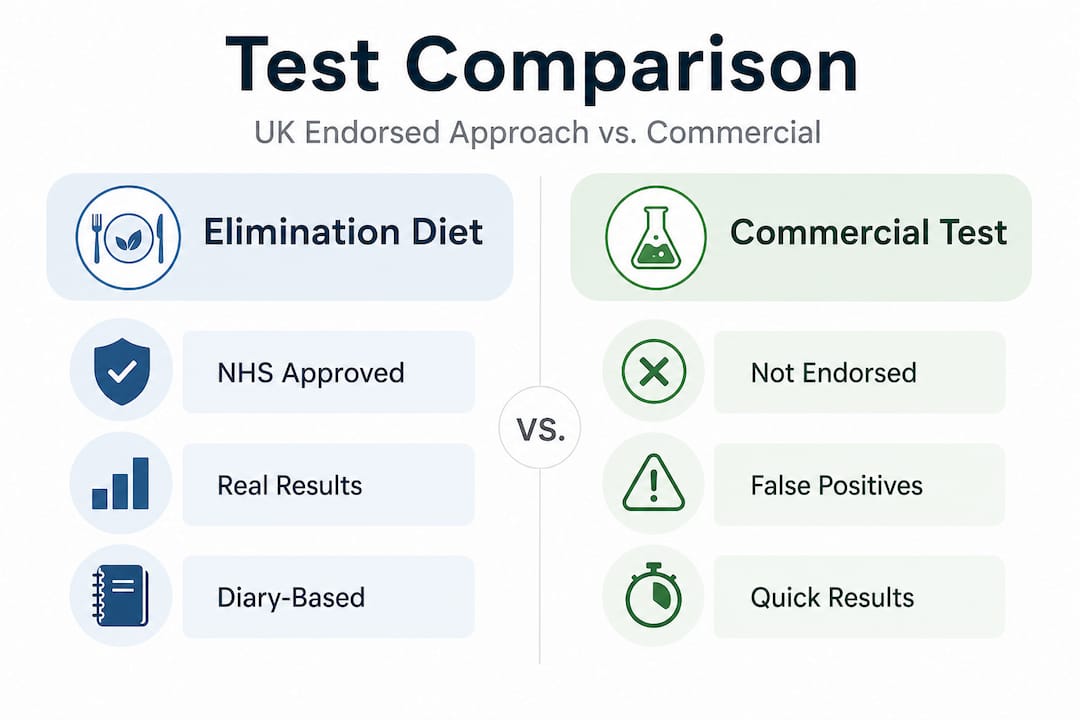
Here is a comparison of the elimination diet against common non-invasive commercial tests to put things in context:
| Feature | Elimination diet | Commercial non-invasive test |
|---|---|---|
| Endorsed by NHS/Guts UK/BDA | Yes | No |
| Evidence base | Strong | Weak or absent |
| Personalised to your symptoms | Yes | Sometimes |
| Risk of false positives | Low | High |
| Cost | Minimal | £50 to £300+ |
| Professional involvement | Recommended | Rare |
| Actionable results | Yes, when done correctly | Uncertain |
What to expect from test results and common pitfalls
Whether you choose to use a commercial test as a starting point or go straight to an elimination diet, understanding how to interpret results is essential. Many people make costly mistakes at this stage, and those mistakes often make their situation worse rather than better.
The most important thing to understand about IgG tests is that a positive result does not mean you are intolerant to that food. Raised IgG levels reflect normal immune exposure to foods you regularly eat. In other words, if you eat bread every day, your IgG levels for wheat will likely be elevated simply because your immune system has been exposed to it frequently. This is completely normal and does not indicate intolerance.
Knowing how to choose intolerance tests wisely means understanding this distinction from the outset.
The most common pitfalls to avoid include:
- Over-restriction: Cutting out five or ten foods at once based on a test result can deprive your body of essential nutrients and make it very difficult to identify the actual culprit.
- Treating the test as a diagnosis: No at-home test replaces a medical diagnosis. A result is a starting point for investigation, not a conclusion.
- Ignoring professional input: Many people act on test results without speaking to a dietitian or GP. This leads to poorly managed elimination and often inconclusive outcomes.
- Anxiety-driven behaviour: Constantly worrying about food or avoiding social eating situations can develop into disordered eating patterns. If you notice this happening, speak to your GP.
- Failing to confirm triggers: Even if you identify a suspected food through elimination, you need to reintroduce it at least twice under controlled conditions to confirm the reaction is real and consistent.
False positives are a particular concern with commercial tests. A test that returns twenty “reactive” foods may contain two or three genuine triggers. Acting on all twenty without verification means unnecessary restriction and ongoing confusion.
A fresh perspective: Why most people get non-invasive testing wrong in the UK
We see this pattern regularly. Someone experiences months of unexplained symptoms, researches their options, and feels a wave of hope when they discover a test that promises to analyse over 1,000 items from a simple hair sample. The marketing is polished and reassuring. The testimonials are compelling. The price feels reasonable when weighed against months of discomfort.
So they buy the test, receive a long list of flagged items, and immediately start cutting foods from their diet. Weeks pass. Their nutrition suffers. They still feel unwell, but now they are also anxious about eating and confused about what is safe.
This is not a failure of the individual. It is a failure of unrealistic expectations, often set by marketing that positions commercial tests as helpful insights while health authorities view the same claims as misleading and potentially harmful.
The uncomfortable truth is that certainty about food intolerances takes time and patience. There is no shortcut that delivers a reliable, actionable answer within 48 hours without any clinical context. That is not pessimism. That is the current reality based on how the science actually works.
What we believe, having worked with people experiencing exactly these issues, is that knowledge is more powerful than any single test result. Understanding why use intolerance tests and what role they can realistically play in your health journey changes everything. Used as one input among several, alongside a symptom diary, GP consultation, and a structured elimination process, testing can be valuable. Used as a standalone solution with no context, it often creates more problems than it resolves.
The people who get the best outcomes are those who approach this with curiosity rather than urgency. They document carefully, work collaboratively with healthcare professionals, and treat each result as a clue rather than a verdict.
Take the next step with UK Food Intolerance solutions
If you have worked through this guide and feel ready to take a more structured approach to understanding your sensitivities, we are here to support you. At UK Food Intolerance, we offer clear, accessible at-home testing options designed to fit into a broader health management plan rather than replace professional guidance.

Our UK intolerance test options include the Core Single Intolerance Test, which covers 500 items, and the Ultimate Single Intolerance Test, which analyses over 1,100 foods and environmental factors. Both use bio-resonance technology on a simple hair sample, with results delivered digitally within 48 to 72 hours. You can order home test kits quickly and easily, and our detailed reports are designed to support your elimination diet journey with clarity and confidence. Browse all broad test packages to find the right starting point for you.
Frequently asked questions
Are non-invasive home intolerance tests approved by the NHS?
No. The NHS and UK health authorities do not endorse non-invasive at-home tests such as IgG blood tests, bio-resonance, or hair analysis due to insufficient scientific evidence and the risk of unnecessary dietary restriction.
What is the safest way to identify a food intolerance at home?
The safest method is keeping a detailed symptom diary alongside a supervised elimination diet with gradual food reintroduction, ideally with support from your GP or a registered dietitian.
Do IgG blood tests reliably detect food sensitivities?
No. Raised IgG levels indicate routine immune exposure to foods you regularly eat rather than a true intolerance, which means positive results frequently flag foods you tolerate perfectly well.
Should I try a non-invasive test before seeing my GP?
No. Always consult your GP first to rule out serious conditions such as coeliac disease or inflammatory bowel disease before pursuing any intolerance testing pathway.










Leave a Reply
Want to join the discussion?Feel free to contribute!