

TL;DR:
- Food safety testing prevents foodborne illnesses by detecting hazards before products reach consumers.
- Food allergy diagnosis relies on oral food challenges, which are the most accurate method for confirming true allergies.
- At-home IgG intolerance tests are less reliable and should be interpreted alongside symptom tracking and professional guidance.
Understanding the role of food testing in wellbeing is something more people are asking about than ever before. You might be dealing with unexplained bloating, skin flares, fatigue, or low mood. You suspect food is involved, but you are not sure where to start or which tests actually mean something. That confusion is completely understandable. The market is full of options, from NHS allergy clinics to at-home hair-sample kits, and the claims can feel overwhelming. This guide cuts through the noise. It covers what food testing genuinely offers your health, what its limits are, and how to use results wisely without doing more harm than good.
Table of Contents
- Key takeaways
- The role of food testing in wellbeing
- Allergy diagnosis versus intolerance testing
- How food testing shapes personal wellbeing
- Interpreting results and avoiding common pitfalls
- My honest take on food testing and wellbeing
- Ready to explore your food sensitivities?
- Common questions
Key takeaways
| Point | Details |
|---|---|
| Food safety testing protects everyone | Detecting hazards before food reaches consumers prevents illness on a population-wide scale. |
| Allergy diagnosis has a gold standard | Oral food challenges remain the most reliable method for confirming true food allergies. |
| IgG intolerance tests need careful use | These tests are most useful when combined with supervised elimination and symptom tracking. |
| Diet changes can support mental health | Reducing ultra-processed foods has been linked to improvements in depression and anxiety. |
| Professional guidance prevents harm | Interpreting test results alongside symptom history reduces the risk of unnecessary restriction. |
The role of food testing in wellbeing
When people talk about food testing, they usually mean one of two very different things. The first is food safety testing, which is carried out by manufacturers, regulators, and scientists to detect biological, chemical, and physical hazards in the food supply. The second is food sensitivity or intolerance testing, which individuals pursue to understand how specific foods affect their own bodies. Both matter, but they operate at completely different levels.
Foodborne diseases cause 420,000 deaths annually worldwide, affecting young people and lower-income communities most severely. Food safety testing sits at the heart of preventing that toll. By catching pathogens, pesticide residues, and allergen contamination before products reach supermarket shelves, food testing protects millions of people who will never know the threat existed.
The best public health outcomes come not from detecting every possible hazard, but from managing the risk of actual illness. Targeting zero detection is neither achievable nor the most practical goal.
Research from Cornell University supports this view. Risk-based food safety strategies that focus on how likely a food is to cause illness are more effective and sustainable than chasing zero-hazard thresholds. Food testing, then, is most powerful as part of ongoing environmental monitoring within food supply chains. It is a continuous process, not a one-off event.
Pro Tip: If you are curious whether a manufacturer tests for allergens on shared production lines, you can contact them directly. Many UK producers are required to provide this information under food labelling law.
Allergy diagnosis versus intolerance testing
This is where a lot of confusion starts. Food allergies and food intolerances are not the same thing, and neither are the tests used to investigate them.
For food allergies, the diagnostic pathway typically follows three stages.
- Symptom assessment. Your doctor records the timing, severity, and pattern of reactions.
- Targeted allergy tests. Skin-prick tests or specific IgE blood tests assess whether your immune system has become sensitised to a particular food.
- Oral food challenge. You consume the suspect food in a controlled clinical setting to confirm whether a true allergic reaction occurs.
The oral food challenge is widely recognised as the gold standard for confirming food allergies because sensitisation does not always equal clinical allergy. A positive skin-prick test tells you that your immune system has produced antibodies. It does not guarantee you will react when you eat that food. Without the challenge step, there is a real risk of removing nutritious foods from your diet unnecessarily.
Food intolerance testing is a different matter. IgG-based tests, which measure a different class of antibody, are popular in consumer health markets. However, the NHS advises against home food intolerance testing kits because elevated IgG levels often simply reflect exposure to foods you eat regularly, not a harmful response. Broad restriction based on these results alone risks nutritional deficiencies.
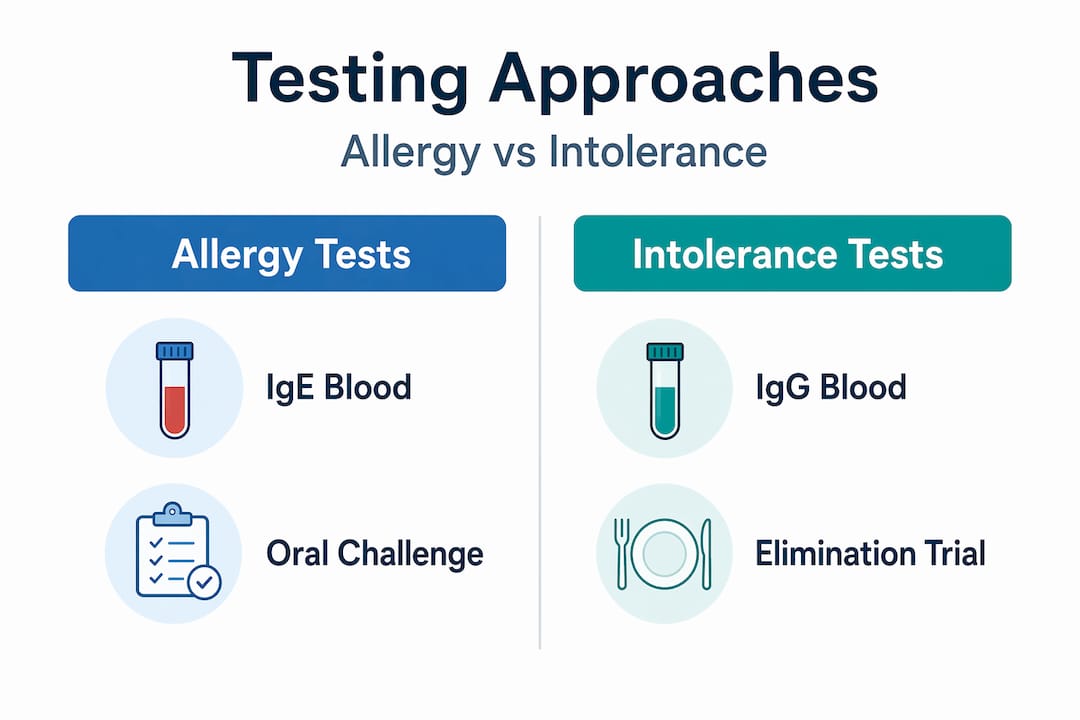
That said, IgG testing used differently tells a more nuanced story. The key distinction is this:
| Approach | Reliability | Best used for |
|---|---|---|
| Oral food challenge | High (gold standard) | Confirming true food allergies |
| Skin-prick or specific IgE test | Moderate (risk assessment) | Identifying sensitisation alongside symptoms |
| IgG elimination diet (supervised) | Moderate for select groups | Guided elimination with clinician support |
| Broad home IgG panel (unsupervised) | Low | Not recommended as sole basis for restriction |
Pro Tip: Before booking any test, write down your symptoms for two weeks. Note what you ate, when symptoms appeared, and how long they lasted. This diary is often more informative than a test result alone. You can find more on this in Ukfoodintolerance’s guide on food intolerance in the UK.
How food testing shapes personal wellbeing
The benefits of food quality testing extend well beyond avoiding an upset stomach. When you identify and address a genuine dietary trigger, the ripple effect on your broader wellbeing can be significant.

Consider migraines. A controlled trial involving 98 participants found that a food-specific IgG elimination diet reduced inflammation markers including IL-6, TNF-α, and CGRP, and improved migraine symptoms over 12 weeks. The critical word there is supervised. The benefit came from structured elimination with a clear protocol, not from simply receiving a report and cutting out 30 foods.
Mental health is another dimension that often surprises people. Reducing ultra-processed foods has been linked to improvements in depression and anxiety symptoms. Integrating nutrition counselling with clinical treatment improves mental health outcomes. However, the same research makes a vital point: dietary interventions can worsen outcomes for people with a history of restrictive eating disorders. Clinicians screen carefully before recommending major dietary changes for this reason.
Dietary change is not a neutral act. The decision to remove foods should be based on clear evidence from testing and symptoms, not on fear or internet-driven restriction.
For those experiencing digestive discomfort, poor sleep, or low energy, addressing a real food trigger through proper testing and a structured elimination protocol can genuinely shift their quality of life. The question is always: what does the evidence actually say about your specific situation? That requires more than a test result. It requires context.
Ukfoodintolerance’s resource on intolerance testing and diets offers practical guidance on how testing fits into dietary planning for UK consumers.
Interpreting results and avoiding common pitfalls
Getting results back can feel exciting and overwhelming at the same time. Here is how to approach them without going wrong.
- Do not cut out foods based on a test alone. Cross-reference every flagged item with your actual symptom history. If you have never noticed a reaction to a food, think carefully before eliminating it.
- Work with a clinician or registered dietitian. A stepwise diagnostic approach that combines test results with symptom assessment prevents unnecessary restriction and improves long-term outcomes.
- Keep a food and symptom diary throughout any elimination phase. This turns your experience into useful data, making reintroduction much more reliable.
- Follow a structured reintroduction protocol. Reintroduce eliminated foods one at a time, in measured amounts, and note your response carefully. This is how you identify genuine triggers versus coincidental associations.
- Watch for signs of over-restriction. Overly restrictive diets impair bone health, growth in children, and quality of life. If you are cutting more and more foods without clear symptom improvement, that is a signal to seek professional input.
Pro Tip: Before reintroducing a food after an elimination period, wait until your baseline symptoms are stable for at least five days. Reintroducing during a symptom flare makes it almost impossible to read the results accurately.
The benefits of food testing for health effects are real, but they depend entirely on how results are used. A test result is the beginning of a process, not a final answer.
My honest take on food testing and wellbeing
Rob’s perspective
I’ve spoken to a lot of people who have spent significant money on at-home tests, received lengthy reports, and ended up more confused and more restricted in what they eat than before they started. That is not a failure of testing in general. It is a failure of using testing without a framework.
What I’ve learned is that food testing, whether for safety or personal health, is most valuable when it is part of a bigger picture. A test tells you something happened. It does not tell you why, whether it matters, or what to do about it. That interpretation step is where most people go wrong, usually because they do it alone.
I’ve also seen the other side: people who used a properly supervised elimination protocol, grounded in their test results and symptom history, and genuinely turned their health around. Better sleep, less bloating, clearer skin, improved mood. These are not trivial changes. They represent a real shift in quality of life.
My honest view is that the importance of food testing lies not in the test itself, but in what you do with the information. Working with a healthcare professional, tracking your symptoms carefully, and following a structured protocol makes the difference between testing that helps and testing that adds noise. Food testing is one valuable tool in your wellbeing toolkit. Treat it as such.
— Rob
Ready to explore your food sensitivities?
If you have been experiencing unexplained symptoms and want a clearer picture of what might be going on, Ukfoodintolerance offers non-invasive at-home testing using bio-resonance technology. You simply collect a small hair sample at home and post it to a UK laboratory. Within 48 to 72 hours, you receive a detailed digital report covering a wide range of food and environmental items.
Ukfoodintolerance’s tests are designed to support, not replace, professional guidance. They work best when you use the results alongside a food and symptom diary and, where possible, with support from a registered dietitian. You can browse the full range of available intolerance tests or explore the full test options to find the right fit for your needs. Taking that first step can bring you genuine clarity.
Common questions
What is the role of food testing in personal wellbeing?
Food testing helps identify dietary triggers that may be contributing to symptoms like bloating, fatigue, or skin issues. When results are interpreted with professional support, they can guide targeted dietary changes that improve quality of life.
Are at-home food intolerance tests reliable?
Home IgG-based tests can indicate food sensitivities, but elevated IgG levels often reflect regular food exposure rather than a harmful reaction. Results should always be used alongside symptom tracking and, ideally, professional guidance rather than as a standalone basis for cutting out foods.
How does food safety testing protect public health?
Food safety testing detects biological, chemical, and physical hazards in food before products reach consumers. Foodborne illness causes hundreds of thousands of deaths annually, and regular testing within supply chains significantly reduces that risk.
Can changing your diet based on test results improve mental health?
Research links reduced consumption of ultra-processed foods to improvements in depression and anxiety. However, major dietary changes should be made carefully, as restrictive eating can harm vulnerable individuals, particularly those with a history of disordered eating.
What is the gold standard for diagnosing food allergies?
The oral food challenge, where a patient consumes a suspect food in a controlled clinical setting, is the most reliable method for confirming a true food allergy and avoiding unnecessary dietary elimination.










Leave a Reply
Want to join the discussion?Feel free to contribute!