

TL;DR:
- At-home food intolerance tests, especially IgG antibody tests, lack scientific validation and can be misleading.
- UK health authorities recommend clinical evaluation and supervised elimination diets over commercial testing.
- Professional guidance is essential to avoid unnecessary dietary restrictions and nutritional deficiencies.
At-home food intolerance reports have become a booming market in the UK, with thousands of people ordering tests online every month in search of answers to their unexplained bloating, fatigue, or skin issues. But here’s what most providers won’t tell you upfront: these reports often create more confusion than clarity. UK health authorities have raised serious concerns about the reliability of commercial intolerance testing, and many people make significant dietary changes based on results that may not reflect genuine sensitivities at all. This article cuts through the noise, explains what your report is actually telling you, and sets out practical, evidence-based steps to help you move forward with confidence.
Table of Contents
- Understanding food intolerance: Definitions and confusion
- Types of intolerance reports and their limitations
- How to interpret intolerance and sensitivity reports sensibly
- Recommended next steps for UK individuals
- A fresh perspective: Don’t let reports dictate your diet blindly
- Explore safe intolerance testing and guidance
- Frequently asked questions
Key Takeaways
| Point | Details |
|---|---|
| Understand intolerance reports | Not all test results reflect true intolerance; most indicate food exposure rather than sensitivity. |
| Avoid unreliable tests | IgG, hair, and bioresonance tests lack scientific backing and can lead to health risks. |
| Follow expert guidance | NHS and BDA recommend supervised elimination diets and professional support for safe diagnosis. |
| Apply practical next steps | Do not make drastic dietary changes based on reports alone; consult specialists and use symptom tracking. |
| Choose safe testing options | Breath tests for lactose/fructose and expert advice offer trusted and effective paths to clarity. |
Understanding food intolerance: Definitions and confusion
Before you can make sense of any report, you need to understand what food intolerance actually means. A food intolerance is a non-immune reaction to a food, usually involving the digestive system. It is not life-threatening. Common culprits include lactose in dairy, gluten-related issues (non-coeliac), and certain food additives. A food allergy, by contrast, involves the immune system and can cause severe or even life-threatening reactions.
These two conditions are frequently conflated, and that confusion is partly fuelled by commercial testing companies marketing broadly to anyone with unexplained symptoms.
Common symptoms associated with food intolerance include:
- Bloating and abdominal discomfort
- Loose stools or constipation
- Fatigue after eating
- Headaches
- Skin rashes or eczema flares
- Brain fog
These symptoms overlap with many other conditions, which is exactly why identifying a food trigger is so difficult without proper assessment.
One of the biggest sources of confusion in the UK comes from IgG antibody tests. These are widely sold as intolerance tests, but the British Dietetic Association is clear: IgG tests measure exposure to foods rather than intolerance, and elevated IgG simply reflects regular consumption, not sensitivity. In other words, if you eat eggs every day, your IgG result for eggs will likely flag as high regardless of whether eggs cause you any problems at all.
For a broader understanding of the landscape, our comprehensive intolerance guide walks through what intolerance is and how the body responds. The NHS approach to diagnosis focuses on clinical evaluation, food and symptom diaries, and supervised elimination, not blood panels sold online. The Guts UK charity also outlines clear testing advice that aligns with this position.
“A positive IgG test merely tells you that you have been exposed to a food. It does not mean you are intolerant to it.”
This distinction matters enormously when you are trying to use a report to guide real dietary decisions.

Types of intolerance reports and their limitations
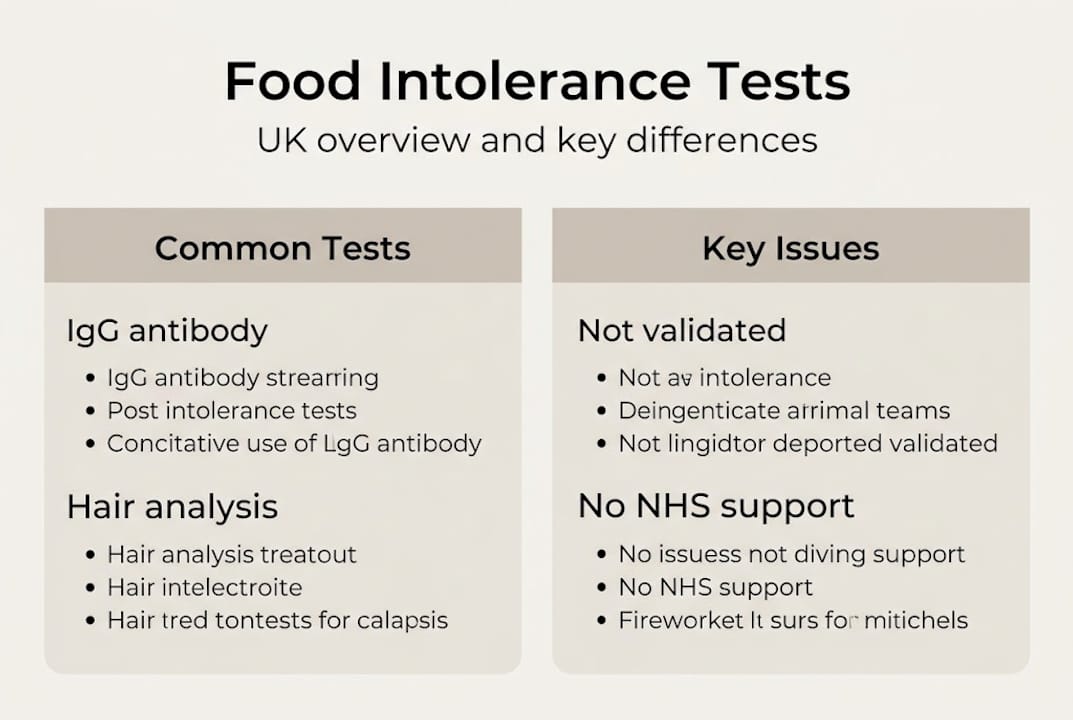
The UK market is flooded with different test types, each producing a report that looks authoritative but varies wildly in scientific credibility. Here is a direct comparison of the most common options:
| Test type | What it measures | Scientifically validated? | Recommended by NHS/BDA? |
|---|---|---|---|
| IgG antibody test | Food-specific antibodies | No | No |
| Hair analysis | Unspecified resonance signals | No | No |
| Bioresonance | Electromagnetic frequencies | No | No |
| Hydrogen breath test | Gas produced after food intake | Yes (for lactose/fructose) | Yes |
| Elimination diet | Symptom response to food removal | Yes | Yes |
As you can see, the methods most heavily marketed online are exactly the ones that lack scientific backing. According to UK intolerance testing experts at Guts UK, at-home IgG antibody tests are not recommended by NHS, BDA, BSACI, or Guts UK due to lack of scientific validation.
Hair analysis tests and bioresonance tests face similar criticisms. There is no peer-reviewed evidence that hair strands can identify food triggers, yet these tests remain popular because they are non-invasive and the reports they produce look detailed and reassuring.
Buying an intolerance kit without understanding what it actually measures is a bit like buying a compass that does not point north but still looks convincing.
Areas to watch out for when reviewing any report:
- Long lists of flagged foods without clinical context
- No guidance on severity or priority of reactions
- Recommendations to eliminate entire food groups immediately
- No referral pathway to a GP or dietitian
Pro Tip: If a report flags more than 20 foods as problematic, treat it with caution. The broader your ‘results’, the less specific and actionable they are likely to be. Our guide on UK trends in testing covers how to spot reputable options.
How to interpret intolerance and sensitivity reports sensibly
Receiving a report packed with flagged foods can feel alarming. But a clear head and a structured approach will help you get real value from any results, whether validated or not.
Here is a step-by-step process for decoding what you have received:
- Identify the test type. Was it IgG, hair analysis, bioresonance, or a breath test? This tells you immediately how much clinical weight the results carry.
- Look for severity grading. Some reports indicate high, medium, or low reactivity. Focus only on the highest-flagged items first, not the full list.
- Cross-reference with your own symptoms. Write down when your symptoms occur and which foods you consumed in the 24 to 48 hours before. Do any flagged foods consistently appear?
- Start a symptom diary. Record meals, symptoms, timing, and severity every day for at least two weeks. This builds a real picture of your body’s responses.
- Trial a limited elimination. Remove only the top two or three flagged foods for two to four weeks, rather than overhauling your entire diet at once.
- Reintroduce one at a time. Reintroduce each food slowly and monitor for reactions over 72 hours.
Important: Commercial IgG tests can lead to unnecessary restrictions, nutritional deficiencies, and misdiagnosis. This is why structured, careful interpretation matters so much.
Our digestive health testing guide gives a thorough walkthrough of this process with practical templates. For tips on what to do in the first 48 hours after receiving results, our 48-hour results guide is a helpful starting point.
One crucial rule: do not use a report as a reason to cut out entire food groups without professional input. This is where people run into nutritional trouble, particularly when dairy or wheat are eliminated without alternatives in place.
Recommended next steps for UK individuals
You have received your report. You have read it carefully. Now what? Here is how to turn your findings into a safe, sensible action plan that UK healthcare professionals would actually support.
- Book an appointment with your GP. Share your report and your symptom diary. This opens a pathway to proper clinical assessment and possible referral to a gastroenterologist or registered dietitian.
- Request validated testing if appropriate. A hydrogen breath test for lactose or fructose malabsorption is available on the NHS and provides clinically reliable results.
- Work with a registered dietitian. A dietitian can design a safe elimination diet tailored to your nutritional needs. The gold standard for identifying food intolerances is a supervised elimination diet with a symptom diary, not lab tests alone.
- Avoid going it alone. Unsupervised restriction of multiple foods carries real risks, including malnutrition, disordered eating patterns, and delayed diagnosis of underlying conditions.
- Follow up after reintroduction. Your dietitian or GP should review your findings after each reintroduction phase to confirm whether a true intolerance has been identified.
Pro Tip: Keep your food diary consistent. Note not just what you eat but how much, how it was prepared, and any stress or lifestyle factors on that day. Gut symptoms are often influenced by more than just food.
Important considerations for specific groups:
- Children should never be put on elimination diets without dietitian supervision. See our guide for parents for age-appropriate advice.
- People with a history of eating disorders should work closely with both a dietitian and a mental health professional.
- Those on medication for digestive conditions should seek GP input before any dietary change.
The BDA food intolerance guidance is an excellent free resource that supports this approach. Understanding how testing impacts diets in practice can also help you frame your next steps realistically.
A fresh perspective: Don’t let reports dictate your diet blindly
We understand the appeal of at-home intolerance reports. You feel unwell, you want answers quickly, and a detailed-looking report feels like progress. But we have seen, time and again, how these reports can send people down the wrong path entirely.
The problem is not just scientific. It is psychological. When you receive a list of flagged foods, your brain treats it as a diagnosis. You cut them out, you feel better for a few weeks (often because of the placebo effect or simply eating more mindfully), and then the original symptoms return. Meanwhile, the real cause, whether it is stress, gut microbiome disruption, or an undiagnosed condition, goes unaddressed.
The UK guidance is consistent: prioritise NHS, BDA, and BSACI-supported approaches, and use elimination diets under professional supervision rather than commercial tests in isolation.
We know testing at home feels easier and faster. But a shortcut that gives you the wrong answer is not a shortcut at all. Our page on at-home testing options explains how to use these tools wisely within a broader, professionally guided framework.
Explore safe intolerance testing and guidance
If you are looking for a starting point that is clear, accessible, and designed with your wellbeing in mind, you are in the right place. We offer a range of intolerance testing options built around transparency and practical support.
Our intolerance tests are straightforward to use from home and come with clear guidance on interpreting your results responsibly. Whether you are exploring sensitivities for the first time or refining your understanding after a previous test, our test options are designed to work alongside, not replace, professional advice. We also provide a dedicated guide on interpreting your results so you always know what your report means and what to do next.
Frequently asked questions
What does a positive IgG intolerance report actually mean?
A positive IgG result indicates exposure to that food, not intolerance or allergy. It usually reflects foods you eat regularly rather than foods causing genuine sensitivity. The BDA confirms that elevated IgG reflects consumption, not a harmful reaction.
Are at-home intolerance tests recommended by the NHS?
No. At-home food intolerance tests are not recommended by the NHS or UK authorities due to a lack of scientific validation. UK health bodies including BDA, BSACI, and Guts UK share this position.
What should I do after receiving an intolerance report?
Consult your GP or a registered dietitian and consider a supervised elimination diet rather than making sweeping dietary changes based solely on the report’s findings.
Are elimination diets safe without professional guidance?
No. Unsupervised elimination diets can lead to nutritional deficiencies and may cause unnecessary restrictions or even misdiagnosis. Always involve a healthcare professional before removing major food groups.
Which intolerance tests are scientifically valid?
Hydrogen and methane breath tests for lactose and fructose malabsorption are clinically recognised as valid. IgG, hair analysis, and bioresonance tests currently lack credible scientific evidence.










Leave a Reply
Want to join the discussion?Feel free to contribute!