

TL;DR:
- Functional medicine offers a personalized, root-cause approach to unexplained symptoms beyond standard NHS tests.
- Many private intolerance tests lack strong scientific evidence and can lead to unnecessary dietary restrictions.
- Starting with a symptom diary and supervised elimination diet is the best first step before considering functional testing.
If you’ve spent months chasing unexplained bloating, fatigue, skin flare-ups, or headaches, only to leave your GP with no clear answers, you’re far from alone. Many people in the UK find that standard NHS pathways, though vital for ruling out serious illness, don’t always get to the bottom of food and environmental intolerances. That’s where functional medicine comes in. This guide explains what functional medicine actually offers, how its testing approaches compare to NHS recommendations, and how you can apply those insights safely to start feeling better. We’ll also be clear about the limits, so you can make genuinely informed choices.
Table of Contents
- What is functional medicine and how does it approach intolerance?
- Common intolerance tests in functional medicine: An evidence-based overview
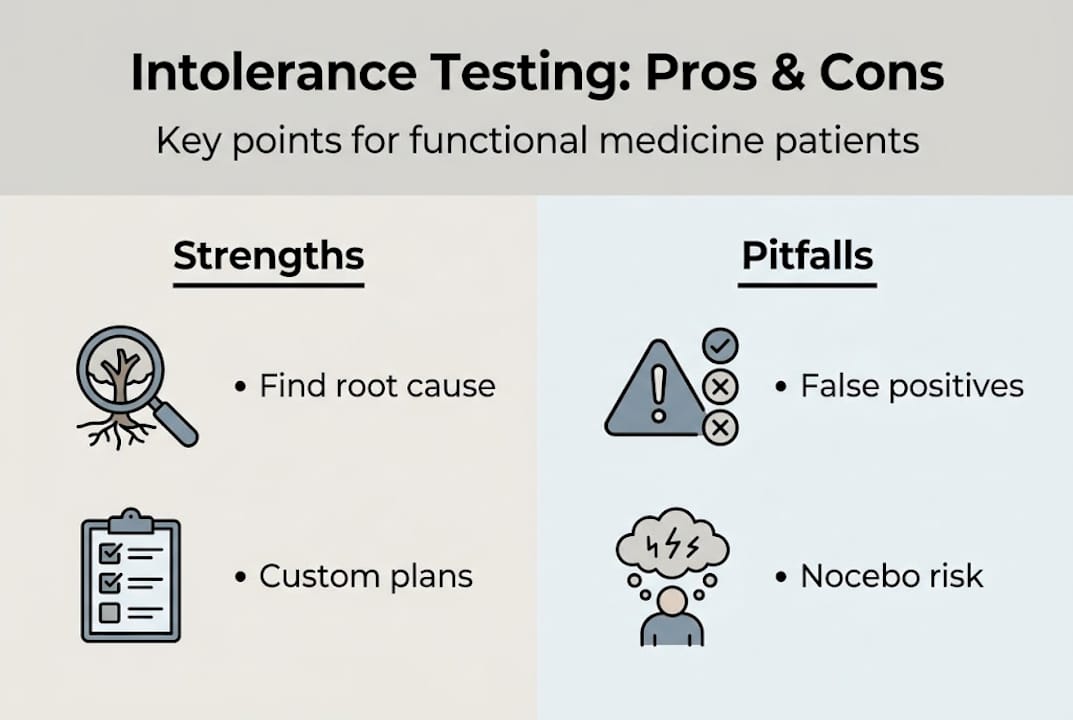
- Strengths and pitfalls: What to know before testing
- Applying functional medicine insights: Practical steps for UK patients
- Perspective: The uncomfortable truths most guides skip about intolerance testing
- Next steps: Find the right test for your health journey
- Frequently asked questions
Key Takeaways
| Point | Details |
|---|---|
| Functional medicine explained | Functional medicine seeks root causes for intolerances through personalised, non-invasive testing methods. |
| NHS vs private tests | NHS supports elimination diets and certain tests, but not most private intolerance panels or bioresonance due to weak evidence. |
| Pros and cons | Functional tests can offer hope but carry risk of false positives and unnecessary dietary changes if unsupervised. |
| Best practice for UK patients | Start with symptom diaries and GP advice, using functional tests as an adjunct alongside professional oversight. |
What is functional medicine and how does it approach intolerance?
Functional medicine is a root-cause, whole-body approach to health. Instead of treating individual symptoms in isolation, it asks why those symptoms are appearing in the first place. This makes it particularly appealing if you’ve had normal results from standard tests but still feel unwell.
The NHS does excellent work identifying allergies, coeliac disease, and serious gastrointestinal conditions. But its pathway tends to focus on diagnosing recognised medical conditions rather than identifying the broader category of food and environmental intolerances. Functional medicine fills that gap, at least in theory, by casting a wider net.
Functional medicine practitioners use non-invasive tests such as GI mapping (a stool analysis that checks for gut bacteria imbalances), nutritional assessments like Metabolomix+, IgG/IgA/IgM antibody panels from providers like Cyrex and the FIT test, urine mycotoxin tests, and genetic testing. Each of these is designed to identify patterns that might be contributing to your symptoms.
Here’s what makes functional medicine stand out:
- Personalised approach: Tests are chosen based on your individual history and symptoms, not a one-size-fits-all protocol.
- Broad screening: Functional medicine checks environmental triggers, gut health, nutritional deficiencies, and food sensitivities in a single workup.
- Non-invasive options: Many tests use saliva, stool, urine, or hair samples rather than blood draws.
- Hope for the unexplained: If standard pathways have failed you, functional tests can offer a new direction.
It’s worth being clear, though. This approach works best as a complement to NHS guidance, not a replacement for it. For a solid starting point, our comprehensive guide to food intolerance testing explains the full landscape simply and clearly.
Pro Tip: If you’ve visited your GP, ruled out allergies, and still feel unwell, a functional medicine consultation can be a worthwhile next step. Always bring your NHS results with you to avoid duplicating tests.
Common intolerance tests in functional medicine: An evidence-based overview
Not all tests are created equal. Here’s a clear breakdown of the main options you’ll encounter:
| Test type | What it claims to detect | Approximate cost | Evidence base | Accepted by NHS? |
|---|---|---|---|---|
| GI mapping (stool) | Gut bacteria imbalances, pathogens | £200-£400 | Moderate | Partially |
| Metabolomix+ | Nutritional deficiencies, metabolism | £250-£350 | Moderate | No |
| IgG/IgA antibody panels | Food-specific antibody responses | £150-£300 | Contested | No |
| Hydrogen breath test | Lactose/fructose malabsorption | £80-£150 | Strong | Yes |
| Bioresonance | Environmental/food sensitivities | £50-£200 | Very limited | No |
| Hair intolerance testing | Food and environmental triggers | £35-£150 | Emerging | No |
The NHS and the British Dietetic Association (BDA) recommend symptom diaries, supervised elimination diets, and hydrogen breath tests for diagnosing lactose or fructose issues. They do not endorse IgG panels, bioresonance, or hair testing due to a current lack of robust clinical evidence.
Some studies have shown up to 70-80% improvement in IBS symptoms following IgG-guided elimination diets, which sounds impressive. However, well-designed randomised controlled trials are still limited, and critics argue that IgG antibodies simply reflect foods you eat regularly rather than foods causing harm. In other words, IgG tests measure exposure, not intolerance.

For a fair view of what food intolerance testing in the UK currently looks like across both mainstream and private sectors, it’s important to read across multiple sources. The British Dietetic Association’s food intolerance guide is a helpful resource for understanding what the evidence actually shows.
Bioresonance testing, which measures electromagnetic signals from the body, lacks biological plausibility according to most clinical experts, yet remains popular in private clinics. Our guide to non-invasive intolerance testing explains which approaches are most practical and what to look for when choosing a test.
Strengths and pitfalls: What to know before testing
Functional medicine testing can offer real value, but it’s vital to go in with clear eyes.
Real benefits:
- Broad, personalised screening that goes beyond standard NHS options
- Accessible, non-invasive formats (hair, saliva, stool) that work for most people
- Can identify patterns in nutrition or gut health that standard tests miss
- Offers hope and direction for people with long-standing unexplained symptoms
Real pitfalls:
- False positives are common, particularly with IgG panels, leading to unnecessary food restrictions
- Cutting out multiple food groups without guidance risks nutritional deficiencies
- Results can feel alarming even when sensitivities are mild or clinically insignificant
- Some tests have no credible scientific mechanism behind them
“Unvalidated intolerance tests can lead patients to follow unnecessarily restrictive diets, risking nutritional deficiency and delaying proper diagnosis.” This concern, widely shared by allergy specialists across the UK, is especially relevant for children, pregnant women, and those with complex health conditions, all of whom require professional oversight before making significant dietary changes.
There’s also a lesser-known risk called the nocebo effect, where the simple act of being told you’re sensitive to something can cause you to feel symptoms in response to it, even if the sensitivity isn’t real. Research into nocebo effects in intolerances shows this is a genuinely documented phenomenon, not just a theory. Don’t let a lab printout convince you to fear your food.
Pro Tip: Before making any dietary changes based on functional test results, speak to a registered dietitian. The impact of intolerance testing on UK diets can be significant, and professional support helps you avoid unnecessary restrictions while still acting on genuine findings.
Applying functional medicine insights: Practical steps for UK patients
Knowing how to use functional medicine insights in a grounded, practical way makes all the difference. Here’s a sensible step-by-step approach:
- Start with your GP. Book an appointment and describe your symptoms clearly. Ask to rule out coeliac disease, inflammatory bowel disease, thyroid issues, and food allergies first. This protects you from missing serious conditions.
- Keep a symptom diary. Track what you eat, when symptoms appear, and their severity for at least two to three weeks. The NHS recommends this as the single most valuable starting point.
- Try a supervised elimination diet. Under dietitian guidance, remove the most common triggers (gluten, dairy, eggs, soya) for four to six weeks, then reintroduce them one at a time. This remains the gold-standard approach.
- Consider functional tests as an adjunct. If the standard pathway hasn’t worked, explore reputable functional tests with a practitioner who can interpret the results and support you nutritionally. Our step-by-step intolerance testing guide is a good place to start.
- Review and adjust. Results should inform a balanced dietary plan, not trigger fear. Revisit your GP if symptoms worsen, change, or new ones appear.
| Scenario | First-line approach | Appropriate functional option | Professional oversight needed? |
|---|---|---|---|
| Bloating and IBS symptoms | Symptom diary, low-FODMAP diet | GI mapping, hydrogen breath test | Recommended |
| Skin rashes and fatigue | GP allergy testing, elimination diet | IgG panel, nutritional panel | Yes |
| Suspected lactose intolerance | Elimination trial | Hydrogen breath test | Optional |
| Environmental sensitivity | GP assessment | Hair or bioresonance test | Yes |
| Child with food reactions | GP and paediatric dietitian | None without medical supervision | Always |
For more independent guidance, the Which? UK intolerance test review offers an honest, consumer-focused assessment of what’s worth considering.
Perspective: The uncomfortable truths most guides skip about intolerance testing
Most articles on functional medicine intolerance testing either oversell it or dismiss it entirely. Neither serves you well.
Here’s what we’ve noticed working with people who are genuinely struggling: the search for a ‘hidden sensitivity’ can sometimes become its own problem. When tests return a long list of reactive foods, it’s tempting to restrict more and more, hoping the answer is just one more elimination away. That cycle rarely leads to better health. It leads to anxiety around food and an increasingly narrow diet.
Testing is not a shortcut past good nutrition or medical advice. A positive result on a functional test is a starting point, not a final answer. The people who see the best outcomes are those who use results as one piece of a larger picture, including balanced eating, medical follow-up, and genuine lifestyle changes.
Emotional relief from getting a diagnosis, even an informal one, is real and valid. But that relief only translates into genuine improvement when it’s backed by action that actually changes your daily habits. Explore the latest UK intolerance trends with that mindset, and you’ll be far better placed to move forward.
Next steps: Find the right test for your health journey
If this guide has helped you feel clearer about your options, the next step is choosing a test that’s trustworthy, practical, and genuinely suited to your symptoms.
At UK Food Intolerance, we offer non-invasive at-home testing using bio-resonance technology, with results delivered within 48 to 72 hours. You simply collect a small hair sample, post it to our UK-based laboratory, and receive a detailed digital report covering over 1,100 items. Explore our UK intolerance test range to find the right option for your budget and needs. Once you have your results, our resources help you match your results with a diet that genuinely supports your wellbeing. Knowledge is only powerful when you act on it thoughtfully.
Frequently asked questions
Are functional medicine intolerance tests recognised by the NHS?
No. Most functional medicine intolerance tests, including IgG panels and bioresonance, are not endorsed by the NHS, which prefers supervised elimination diets and specific medical testing such as hydrogen breath tests.
Do IgG food intolerance tests accurately diagnose reactions?
No. IgG tests measure exposure, not intolerance, and frequently produce false positives. A supervised elimination diet remains a more reliable approach for identifying genuine food reactions.
What risks are there to food intolerance testing without medical advice?
Unsupervised testing can lead to cutting out too many foods unnecessarily, resulting in nutritional deficiencies and missed diagnoses of other conditions that require medical attention.
How should I start if I suspect a food or environmental intolerance?
Begin by tracking your symptoms in a diary and consult your GP to rule out allergies and serious conditions. Only consider additional functional testing once standard pathways have been explored.










Leave a Reply
Want to join the discussion?Feel free to contribute!