

Receiving your sensitivity test results can feel like a breakthrough moment. Finally, some answers. But here is the thing: a list of flagged items is not the same as a diagnosis, and acting on results without proper context can do more harm than good. Standalone sensitivity results can lead to unnecessary dietary restrictions and real nutritional risks. This guide walks you through how to read your results thoughtfully, what steps to take next, and how to use your findings to genuinely improve your wellbeing.
Table of Contents
- The importance of interpreting sensitivity test results
- How sensitivity test results should be interpreted
- Common methods and tests: strengths and limitations
- What to do after receiving your sensitivity results
- Get reliable support for interpreting sensitivity results
- Frequently asked questions
Key Takeaways
| Point | Details |
|---|---|
| Do not rely only on test results | Always interpret sensitivity outcomes with clinical context and professional input. |
| Choose credible test methods | Understand which sensitivity and allergy tests are scientifically validated before making decisions. |
| Avoid unnecessary food restrictions | Restricting foods based on unsupported results can harm your nutrition; act on evidence and guidance. |
| Supervised elimination is key | Carefully monitored elimination diets confirm whether foods trigger your symptoms. |
| Seek help for complex cases | Contact a GP or dietitian for support if symptoms persist or results are unclear. |
The importance of interpreting sensitivity test results
Test results are a starting point, not a finish line. Many people receive their results, spot a flagged food, and immediately cut it out of their diet. That reaction is understandable, but it can cause problems. Removing multiple foods without proper guidance risks nutritional deficiencies, disordered eating patterns, and a great deal of unnecessary stress.
So why does interpretation matter so much? Here are the key reasons:
- Results reflect a snapshot in time, not a permanent biological truth
- Flagged items may not be causing your symptoms at all
- Symptoms often have overlapping causes that a single test cannot untangle
- Cutting foods without monitoring can mask other underlying conditions
- Nutritional gaps can develop quickly when whole food groups are removed
Experts consistently stress that proper interpretation must integrate clinical history, symptom timing, and supervised elimination diets. A result alone tells you very little without that wider picture.
“Sensitivity test results should always be considered alongside your personal health history and current symptoms, not as a standalone verdict.”
Keeping a symptom diary before and after testing is one of the most practical things you can do. Note what you eat, when symptoms appear, their severity, and any other relevant factors. This context transforms your results from a list into a genuinely useful tool. Our guide on interpreting intolerance results explains this process in detail, and our tips for interpreting test results offer practical, step-by-step support. If you are new to testing altogether, our testing guide for digestive health is a great place to begin.
The NHS guidance on food testing highlights that results without clinical context can mislead rather than inform. That is not a reason to avoid testing. It is a reason to approach your results with care.
How sensitivity test results should be interpreted
Now that you understand why interpretation matters, here is a clear, practical framework for working through your results safely.
- Review your symptom history first. Before looking at flagged items, revisit your symptom diary. Which foods did you eat in the days before symptoms appeared? How long after eating did symptoms begin? This timeline is crucial.
- Cross-reference results with your symptoms. Only flagged items that align with your actual symptom pattern deserve immediate attention. A flagged food you eat daily with no reaction is far less urgent than one that consistently precedes discomfort.
- Prioritise one or two items at a time. Attempting to eliminate ten foods simultaneously makes it impossible to identify which change is making a difference.
- Follow a structured elimination and reintroduction process. Remove one food for two to four weeks, monitor your symptoms carefully, then reintroduce it and observe any changes. This is the gold standard for confirming a genuine sensitivity.
- Consult a GP or registered dietitian. Especially if your results flag multiple items or your symptoms are severe. Professional support ensures you maintain nutritional balance throughout the process.
Standalone results can lead to unnecessary restrictions when taken out of context, and validated tests should be interpreted with clinical history to avoid overdiagnosis. These are not warnings against testing. They are reminders that results are most powerful when used correctly.
Pro Tip: Write down your top three symptoms and their frequency before you even open your results. This gives you an objective baseline to measure any dietary changes against.
Our resources on using test results for health and reducing symptoms can help you apply this framework with confidence. The NHS food allergy guidance also provides helpful context on when professional referral is appropriate.
Common methods and tests: strengths and limitations
Not all sensitivity tests are created equal. Understanding what your test actually measures helps you interpret its results more accurately.

| Test type | What it measures | Validated? | Key limitation |
|---|---|---|---|
| Skin prick test | IgE-mediated allergic response | Yes | Requires clinical setting |
| IgE blood test | Specific IgE antibodies | Yes | Does not confirm intolerance |
| IgG blood test | IgG antibodies to foods | No | High false positive rate |
| Elimination diet | Symptom response to food removal | Yes | Time-consuming, needs supervision |
| Bioresonance/hair test | Energetic food responses | Emerging | Requires careful result interpretation |
Here is what you need to know about each:
- Skin prick and IgE blood tests are clinically validated for true allergies. They are reliable but do not diagnose food intolerances.
- IgG tests are widely available but controversial. IgG tests are often positive for commonly eaten foods and are not recommended due to a lack of clinical evidence.
- Elimination diets remain the most reliable method for identifying intolerances, but they require patience and ideally professional oversight.
- At-home bioresonance and hair tests offer accessible, non-invasive screening. They work best as a starting point for further investigation rather than a definitive answer.
The NHS does not recommend home IgG kits as a standalone diagnostic tool, preferring clinical tests and symptom diaries. The AAAAI guidance echoes this, noting that IgG positivity simply reflects dietary exposure, not intolerance.
This does not mean at-home testing has no value. It means the value lies in using results as a guide, not a verdict. Our home testing guide explains how to get the most from at-home results, and our page on why use intolerance tests outlines the genuine benefits when tests are used thoughtfully. For parents considering testing for children, our parent’s testing guide covers the key considerations.
What to do after receiving your sensitivity results
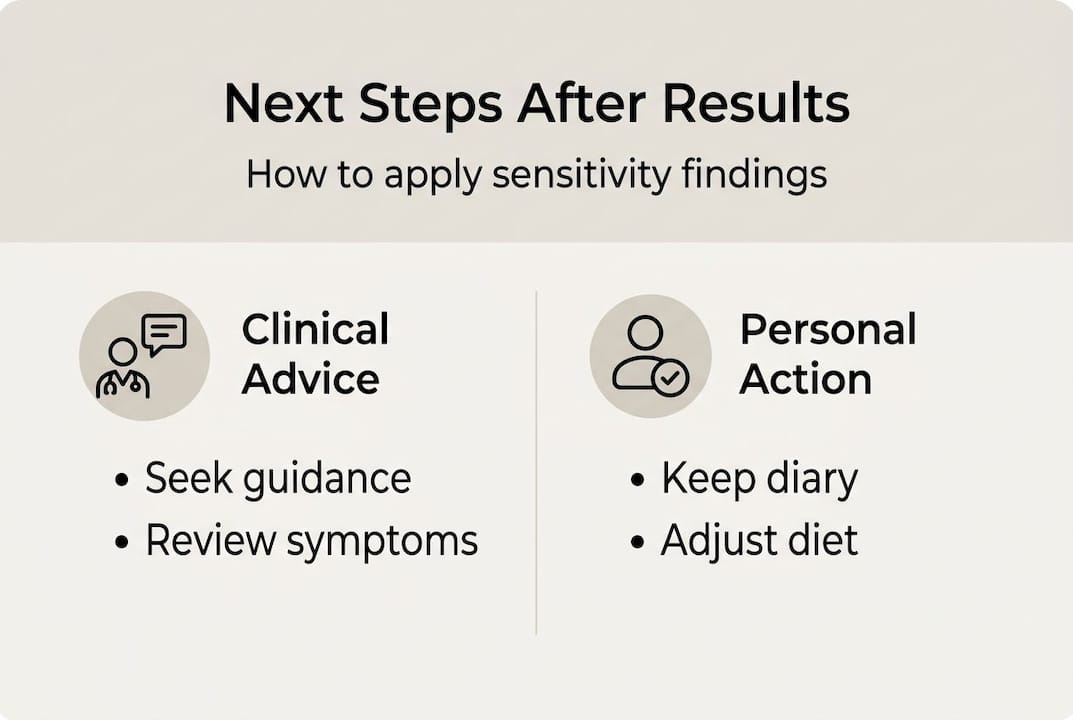
You have your results. Now what? Here is a sensible, evidence-backed plan.
| Step | Action | Timeframe |
|---|---|---|
| 1 | Review results alongside symptom diary | Immediately |
| 2 | Identify top one or two priority items | Days 1 to 3 |
| 3 | Begin structured elimination of priority item | Weeks 1 to 4 |
| 4 | Monitor and record symptom changes | Ongoing |
| 5 | Reintroduce food and observe response | Week 5 |
| 6 | Consult GP or dietitian if symptoms persist | As needed |
Follow these steps carefully:
- Do not panic. A long list of flagged items does not mean you are intolerant to all of them. Many will be coincidental.
- Focus on the most likely culprits. Cross-reference flagged items with your symptom diary and prioritise those with the strongest correlation.
- Make one change at a time. This is the only way to know what is actually helping.
- Keep detailed records. Note energy levels, digestion, skin condition, and mood. Sensitivities affect the whole body, not just the gut.
- Seek professional support when needed. If you are flagging ten or more items, or if symptoms are affecting your quality of life, a registered dietitian can help you navigate safely.
For true allergies, rely on clinical methods; for sensitivities, supervised elimination and reintroduction is the most reliable path forward. It is also worth noting that empirical data shows limited clinical benefit for diets guided solely by IgG test results, which is why pairing any test with symptom monitoring is so important.
Pro Tip: Take a photo of your results and your symptom diary side by side. Seeing both together often makes patterns far more obvious than reviewing them separately.
If you are unsure whether testing is right for you, our page on why you might need a test can help you decide. And once you have your results, our guide on preventing reactions offers practical next steps for reducing symptoms quickly and safely.
Get reliable support for interpreting sensitivity results
Understanding your results is genuinely empowering, but you do not have to navigate it alone. At UK Food Intolerance, we provide clear, accessible testing options alongside resources designed to help you make sense of what your results actually mean for your health.

Our food intolerance tests include the Ultimate Single Intolerance Test, which screens over 1,100 items, and the Core Single Intolerance Test, covering 500 items. Both use non-invasive hair sample analysis, with detailed digital reports delivered within 48 to 72 hours. Alongside your results, we offer clear steps for interpreting results so you always know what to do next. Explore the practical benefits of at-home tests and take the first step towards feeling better with confidence.
Frequently asked questions
Can I rely solely on home sensitivity test results?
No, home test results should always be interpreted alongside your clinical history and, ideally, under professional guidance. Proper interpretation integrates clinical history, symptom timing, and structured dietary changes.
What should I do if my results show multiple sensitivities?
Consult a healthcare professional before cutting out several foods, as unnecessary restrictions carry real nutritional risks. Removing too many foods at once also makes it impossible to identify which change is genuinely helping.
Are IgG food intolerance tests useful for diagnosing symptoms?
IgG tests are not recommended for diagnosis due to limited scientific validity and a high risk of false positives. A positive IgG result typically reflects regular dietary exposure, not a confirmed intolerance.
What is the role of an elimination diet in interpreting sensitivity results?
Carefully supervised elimination diets, followed by structured reintroduction, help confirm whether a food is genuinely causing your symptoms. Supervised elimination diets are considered the most reliable method for non-IgE hypersensitivity interpretation.
When should I seek professional advice after receiving sensitivity results?
If you experience severe reactions, multiple sensitivities, or persistent symptoms that affect your daily life, consult a GP or registered dietitian promptly. Early professional input helps you avoid unnecessary restrictions and ensures your nutritional needs are met throughout the process.










Leave a Reply
Want to join the discussion?Feel free to contribute!