

TL;DR:
- At-home hair-sample and bioresonance tests are not validated methods for diagnosing food allergy or intolerance according to UK health authorities. They can serve as preliminary tools to notice patterns but should not replace professional medical evaluation for serious symptoms. Results should be treated as hypotheses to be tested through structured elimination diets under healthcare supervision.
At-home hair-sample and bioresonance tests are not validated diagnostic methods for food allergy or most food intolerances, according to NHS, NICE, and ASA guidance. That is the honest starting point. Where they can have limited value is as a preliminary prompt, helping you notice patterns worth exploring before a clinical appointment. They are not a replacement for a GP, a dietitian, or a supervised elimination diet.
When to seek medical help before considering any at-home test:
- Severe or sudden allergic reactions, including swelling of the throat, difficulty breathing, or collapse
- Suspected anaphylaxis (call 999 immediately)
- Unexplained weight loss, blood in stools, or persistent vomiting
- Symptoms that overlap with coeliac disease, inflammatory bowel disease, or other chronic conditions
Pro Tip: If your symptoms are mild, intermittent, and linked to specific foods, an at-home test may give you a useful starting list of items to explore. If they are severe or worsening, see your GP first.
Table of Contents
- What are at-home hair-sample and bioresonance tests?
- What do UK health bodies say about hair and bioresonance tests?
- Who should consider an at-home test, and who should see a GP first?
- How to interpret a home-test report safely
- What to expect from a UK at-home testing service
- Limitations and red flags to watch for
- Key takeaways
- What people actually expect from at-home testing
- Ukfoodintolerance: clear, fast at-home testing with UK lab analysis
- Useful sources and further reading
What are at-home hair-sample and bioresonance tests?
Providers of these tests ask you to collect a small hair sample at home and post it to a laboratory. The lab then compares the sample against a proprietary database using a process described as bioresonance: the idea that biological materials emit electromagnetic frequencies that can be read and matched against food and environmental items. The result is a digital report listing items flagged as potential sensitivities.
It is worth understanding that this process is not the same as a clinical blood test or skin-prick test. There is no standardised scientific method underpinning bioresonance for food intolerance, and the databases used vary between providers.
What a typical report includes:
- A list of foods, drinks, or environmental items flagged at different sensitivity levels
- Nutritional or gut-biome indicators (depending on the tier)
- Guidance notes on how to use the results in an elimination diet
| Feature | Core test | Ultimate test |
|---|---|---|
| Items tested | Many | A very large number |
| Method | Bioresonance, hair sample | Bioresonance, hair sample |
| Turnaround | a few days duration | a few days duration |
| Cost band | Lower | Higher |
| Interpretation support | Digital report and guidance | Digital report, detailed guidance, and educational resources |
Pro Tip: A report flagging 30 items does not mean you are intolerant to all 30. Treat the list as a hypothesis, not a diagnosis.
What do UK health bodies say about hair and bioresonance tests?
The picture from UK clinical and regulatory bodies is consistent. The NHS distinguishes clearly between food allergy (immune-mediated, potentially life-threatening) and food intolerance (digestive, delayed, not immune-driven). Clinical testing for allergy uses IgE blood tests, skin-prick tests, and oral food challenges, all performed under medical supervision.
NICE guidance explicitly states that alternative diagnostic methods readily available on the high street, including hair analysis and bioresonance, are not recommended due to a lack of evidence. The British Dietetic Association reinforces this: only a small number of conditions, such as lactose intolerance and coeliac disease, have validated laboratory tests. For most intolerances, the clinically accepted approach is a supervised elimination and reintroduction diet.
“There are no tests, e.g. a blood test, used to diagnose a food intolerance. If a non-IgE mediated food allergy is suspected, a trial elimination diet for several weeks is recommended.”
— Allergy UK
The Advertising Standards Authority has ruled against marketers making unsubstantiated diagnostic claims for hair analysis and bioresonance, including claims linking these tests to diagnoses of IBS, eczema, and lethargy. The BSACI’s Choosing Wisely guidance goes further, warning that alternative tests carry real risks: nutritional deficiencies from unnecessary food exclusion and delayed diagnosis of genuine conditions.
What this means for you as a consumer: be sceptical of any provider using absolute diagnostic language, guaranteeing a cure, or claiming their test can diagnose named medical conditions. If you believe a marketing claim is misleading, you can report it to the ASA at asa.org.uk.
Who should consider an at-home test, and who should see a GP first?
At-home non-invasive tests are most reasonably used by people with mild, non-urgent symptoms who want a structured starting point for dietary exploration. They are not appropriate as a substitute for clinical care.
Potentially suitable use cases:
- Mild, intermittent digestive symptoms (bloating, excess gas, loose stools) with no red flags
- Preventative curiosity about food and environmental sensitivities
- People who have already seen a GP and been cleared of serious conditions
When to see a GP or specialist first:
- Any severe or sudden reaction to food
- Symptoms that have worsened over weeks or months
- Suspected coeliac disease (fatigue, anaemia, persistent diarrhoea)
- Children with growth concerns or persistent skin or respiratory symptoms
- Any symptom that worries you
Pro Tip: Before your GP appointment, keep a food and symptoms diary for two weeks. Note what you ate, when symptoms appeared, and how long they lasted. This is one of the most useful tools a clinician has, and it costs nothing.

How to interpret a home-test report safely
Home reports are not diagnostic. Treat every flagged item as a hypothesis to test through a structured elimination and reintroduction process, not as confirmed fact. The elimination diet checklist below gives you a safe framework.
Step-by-step elimination diet:
- Choose one or two flagged items to test first. Do not remove large food groups simultaneously.
- Eliminate the chosen items completely for four weeks. Read labels carefully; many ingredients appear in unexpected products.
- Keep a daily symptom diary throughout the elimination phase.
- Reintroduce the food gradually after four weeks and monitor symptoms for a few days duration.
- Record your findings and repeat for the next item on your list.
- Consult a registered dietitian if you are removing staple foods or if symptoms do not improve.
When confirmatory clinical tests are appropriate:
- Suspected lactose intolerance: hydrogen breath test
- Suspected coeliac disease: IgA tTG blood test (do not go gluten-free before testing)
- Suspected IgE-mediated allergy: skin-prick test or specific IgE blood test via GP referral
If symptoms worsen during an elimination phase, or if restricting foods causes fatigue, weight loss, or anxiety around eating, stop and speak to your GP or a registered dietitian.
What to expect from a UK at-home testing service
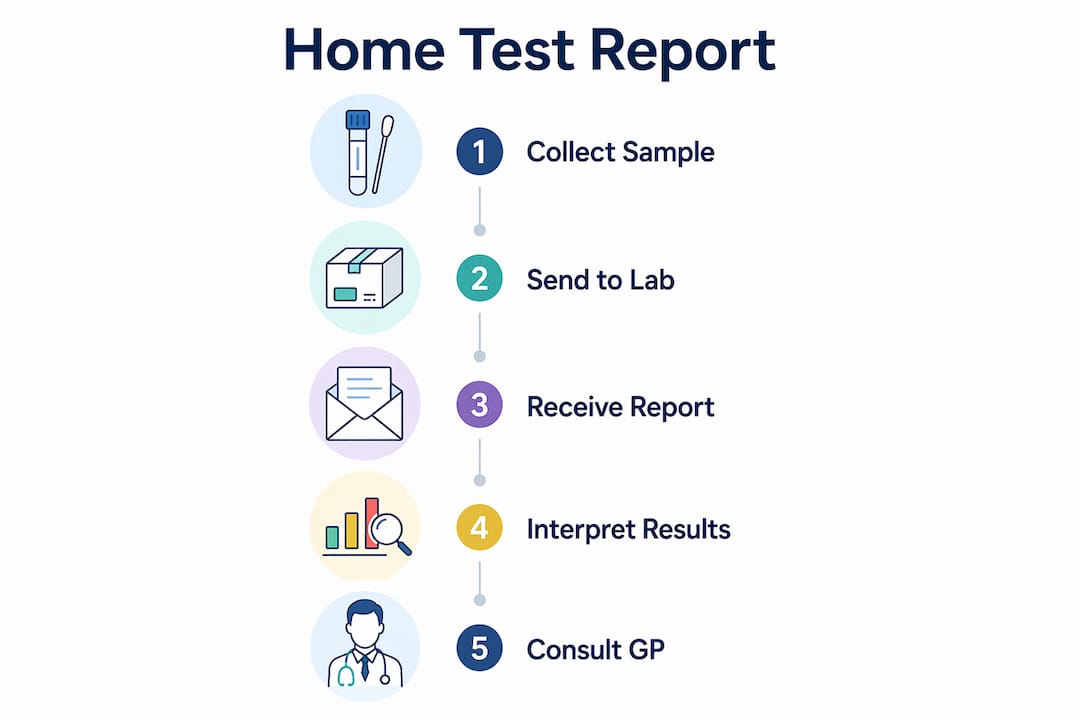
Ukfoodintolerance offers a straightforward process from order to results. Here is what the customer journey looks like.
Step-by-step process:
- Order online: choose the Core or Ultimate test tier based on the number of items you want screened
- Receive your kit: a simple hair-collection pack arrives by post
- Collect your sample: a small amount of hair (including the root) is all that is needed
- Post to the UK lab: use the prepaid envelope included in the kit
- Lab analysis: your sample is analysed at a UK-based laboratory
- Receive your digital report: results arrive within a few days duration of the lab receiving your sample
- Use the resources: Ukfoodintolerance provides elimination-diet guidance and educational materials to help you interpret your report
| Feature | Core test | Ultimate test |
|---|---|---|
| Items tested | Many | A very large number |
| Turnaround | a few days duration | a few days duration |
| Interpretation support | Digital report and guidance notes | Detailed digital report, educational resources |
| Typical use | Starting point for common sensitivities | Broader screening including environmental items |
For accurate results, collect hair from the root rather than cut ends, and avoid using hair that has been chemically treated in the past two weeks where possible.
Pro Tip: Use Ukfoodintolerance’s step-by-step interpretation guide alongside your report. If your results raise questions, book a GP or dietitian appointment to discuss them before making significant dietary changes.
Limitations and red flags to watch for
Understanding the limitations of at-home non-invasive testing helps you use results responsibly.
Key limitations:
- No clinical validation for diagnosing food intolerance or allergy
- Results are not reproducible in the way that clinical tests are
- False positives can lead to unnecessary food restriction and nutritional gaps
- False reassurance is a real risk: a clear result does not rule out a genuine condition
- Hair-based bioresonance is recognised in forensic toxicology for heavy-metal detection, but that validation does not extend to food intolerance screening
Red flags in provider marketing to watch for:
- Claims that the test “diagnoses” a named medical condition
- Guarantees of symptom resolution after following the report
- Sensational lists of conditions the test can supposedly detect or treat
- No mention of clinical limitations or the need for GP follow-up
Advertising for health tests in the UK is governed by ASA and CAP rules. If you see a claim that seems too definitive, you can check the ASA’s rulings database or submit a complaint at asa.org.uk.
Pro Tip: A responsible provider will always tell you what their test cannot do, not just what it claims to do. Transparency about limitations is a sign of a trustworthy service.
Key takeaways
At-home hair-sample tests can prompt useful dietary exploration, but they are not clinically validated diagnostic tools and should never replace GP assessment for serious or worsening symptoms.
| Point | Details |
|---|---|
| Not a clinical diagnosis | NHS, NICE, BDA, and ASA all confirm hair/bioresonance tests are not validated diagnostic methods. |
| Elimination diet is the standard | A supervised 4-week elimination and reintroduction remains the accepted approach for most intolerances. |
| Red flags need a GP | Severe reactions, unexplained weight loss, or blood in stools require medical assessment, not a home test. |
| Use results as hypotheses | Treat flagged items as a starting list to test methodically, not as confirmed intolerances. |
| Ukfoodintolerance | Offers Core (c. 500 items) and Ultimate (1,100+) tests with a few days turnaround and elimination-diet guidance. |
For further support, visit Allergy UK, speak to your GP, or ask for a referral to a registered dietitian via the NHS.
What people actually expect from at-home testing
Most people order an at-home test hoping for two things: fast answers and a clear plan. The a few days turnaround delivers on speed. The “clear plan” part is where expectations sometimes need adjusting.
A report listing flagged items can feel reassuring or, equally, overwhelming if the list is long. Neither reaction is wrong. What matters is how you use the information. People who get the most from these tests tend to approach them as a structured starting point rather than a final answer. They pick one or two items to test through elimination, keep a diary, and check back with a clinician if anything is unclear.
If your results come back largely clear but your symptoms continue, that is important information too. It points you toward a clinical pathway rather than a dietary one, and that is worth knowing sooner rather than later. Managing ambiguous results calmly, and knowing when to escalate, is the most practical skill you can bring to any at-home test.
Ukfoodintolerance: clear, fast at-home testing with UK lab analysis
If you have read this far and decided an at-home test is a reasonable next step for you, Ukfoodintolerance gives you a straightforward way to get started. The service uses UK laboratory analysis and delivers digital reports within a few days duration of receiving your hair sample, with no waiting rooms and no referrals needed.
The Core test screens around 500 food and environmental items, making it a practical starting point for most people. The Ultimate test covers 1,100+ items, including nutritional indicators and gut-biome markers, for a broader picture. Both come with elimination-diet guidance and educational resources so you can translate your results into a safe, structured next step rather than guessing.
Browse the full range of intolerance tests and order directly online. If you have questions before ordering, the customer support team is available to help.
Useful sources and further reading
- Food intolerance, NHS
- Food allergy, NHS
- Food allergy in under 19s: assessment and diagnosis, NICE CG116
- Food allergy and intolerance testing, British Dietetic Association
- Allergy vs intolerance, Allergy UK
- Health and food allergy testing advice, Advertising Standards Authority
- Choosing Wisely: alternative testing in food allergy, BSACI
- Interpreting intolerance results step by step, Ukfoodintolerance
- Non-invasive intolerance testing: UK trends and guidance, Ukfoodintolerance
This article is general information, not medical advice. Always confirm your situation with a GP or qualified health professional before making significant dietary changes or if you have concerns about your symptoms.









Leave a Reply
Want to join the discussion?Feel free to contribute!