

TL;DR:
- Early detection of food intolerance is crucial to prevent nutritional deficiencies and unnecessary dietary restrictions, improving long-term health. Recognizing delayed symptoms through detailed food diaries and clinical evaluations helps distinguish intolerance from allergy, guiding accurate diagnosis and management. Professional tests like oral food challenges are the gold standard, while at-home kits should only support initial insights, not replace medical guidance.
Food intolerance is defined as a non-immune digestive reaction to specific foods or food components, distinct from a true allergy, and the importance of early intolerance detection lies in its direct impact on diagnosis accuracy, quality of life, and long-term wellbeing. When symptoms go unidentified for months or years, the consequences range from persistent digestive discomfort to nutritional deficiencies and unnecessary dietary restrictions. Authorities including the Cleveland Clinic and the American Academy of Pediatrics (AAP) recognise that early clinical evaluation, guided by patient history and targeted testing, is the most reliable path to accurate diagnosis. Getting ahead of the problem is not just reassuring. It is the first step toward doing something about it.
What are the early signs of food intolerance?
Recognising early signs of intolerance is harder than it sounds, because the symptoms are often delayed and easy to attribute to stress, a virus, or simply “a bad day.” Unlike a true allergy, which triggers an immediate immune response, food intolerance reactions typically appear between 30 minutes and 48 hours after eating the offending food.
The most common early signs include:
- Bloating and abdominal distension after meals, particularly following dairy or wheat
- Loose stools, diarrhoea, or constipation without an obvious cause
- Excess gas and cramping, often mistaken for irritable bowel syndrome
- Nausea shortly after eating specific foods
- Headaches or migraines that appear to follow certain meals
- Fatigue and brain fog, especially after eating gluten-containing foods
- Skin reactions such as eczema flares or general itching, without hives
The timing of symptoms relative to food intake is one of the most useful diagnostic clues you have. IgE-mediated reactions occur within minutes to two hours, while non-IgE intolerance reactions are delayed and harder to pinpoint. That distinction matters enormously when you are trying to work out what is causing your symptoms.
Research into coeliac disease shows that subtle precursors such as lower-range haemoglobin, elevated liver enzymes, and lower BMI can precede a formal diagnosis by up to seven years. This means your body may be signalling a problem long before a clinician identifies it.

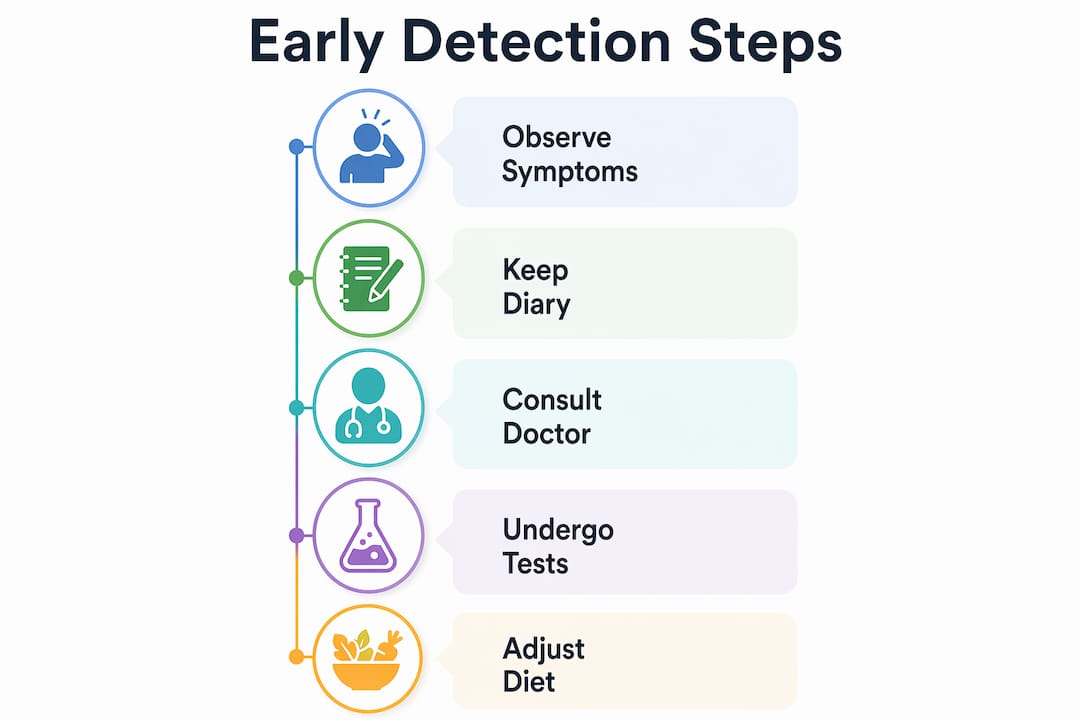
Pro Tip: Start a food and symptom diary for at least two weeks before any medical appointment. Record what you eat, when symptoms appear, and how severe they are. This single habit gives your GP or dietitian a concrete pattern to work with, rather than a vague description of “feeling unwell after eating.”
How does early detection improve diagnosis and outcomes?
Early intervention for intolerance issues does more than relieve symptoms faster. It prevents a cascade of downstream problems that build up when the root cause goes unaddressed.
The diagnostic gold standard for confirming a food allergy or intolerance is the oral food challenge (OFC), a supervised process in which a patient consumes incremental amounts of a suspected food under clinical observation. The OFC confirms true allergy and prevents unnecessary long-term food avoidance, which matters because eliminating foods without confirmation carries its own nutritional and psychosocial costs. Surrogate tests such as skin prick tests and specific IgE (sIgE) assays are useful screening tools, but they measure sensitisation rather than clinical reactivity. A positive sIgE result does not always mean a food will cause symptoms.
| Diagnostic method | What it measures | Limitation |
|---|---|---|
| Clinical history | Symptom patterns and timing | Relies on patient recall accuracy |
| Skin prick test | IgE sensitisation to specific allergens | Does not confirm clinical reactivity |
| Specific IgE assay | Circulating IgE antibodies | High false-positive rate for intolerances |
| Hydrogen breath test | Lactose or fructose malabsorption | Only validated for specific intolerances |
| Oral food challenge (OFC) | True clinical reaction to a food | Requires clinical supervision |
A 2026 multicentre study in Turkey found the median diagnosis time for coeliac disease in children was 7.30 months. That figure represents months of unnecessary symptoms, potential nutritional damage, and missed school or work. Earlier recognition, guided by clinical history before ordering complex tests, reduces that delay significantly.
Unnecessary dietary restrictions from overreliance on sensitisation tests create nutritional and psychosocial burdens that are entirely avoidable with accurate early diagnosis. Children who avoid dairy unnecessarily, for example, risk calcium and vitamin D deficiency at a critical stage of bone development.
Pro Tip: If you are being tested for coeliac disease, do not remove gluten from your diet before testing. Avoiding gluten before testing can invalidate the diagnosis entirely, as the antibodies the test looks for will not be present in sufficient quantities.
Methods for detecting food intolerances early: professional vs at-home tests
Understanding how to detect intolerance early means knowing which tools are reliable and which carry significant limitations.
Professional evaluation methods
Clinician-led assessment remains the most dependable route. A GP or allergy specialist will typically begin with a detailed clinical history, asking about symptom timing, frequency, and any patterns linked to specific foods. From there, targeted tests are ordered based on what the history suggests. For lactose intolerance, the hydrogen breath test is a validated diagnostic tool that measures hydrogen produced by undigested lactose in the gut. For suspected coeliac disease, blood tests measuring tissue transglutaminase antibodies (tTG-IgA) are the standard first step, followed by a gut biopsy if results are positive.
Elimination diets, conducted under dietitian supervision, remain one of the most practical tools for identifying non-coeliac food intolerances. The process involves removing suspected foods for two to six weeks, then reintroducing them one at a time to observe reactions. It is time-consuming but highly informative when done correctly.
At-home testing: what the evidence says
At-home food sensitivity tests lack reliable evidence, and professional evaluation is recommended to avoid misdiagnosis. Most commercially available kits test for IgG antibodies, which are a normal immune response to food exposure rather than a marker of intolerance. The presence of IgG antibodies simply means you have eaten that food recently. No validated biomarkers exist for most intolerances, with the exception of specific conditions like lactose intolerance and coeliac disease.
That said, at-home testing can serve a useful supporting role when used alongside professional guidance rather than as a replacement for it. You can read more about home testing options and how they fit within a broader detection strategy. The key is to treat any at-home result as a starting point for conversation with a clinician, not a definitive answer.
For practical self-assessment before a professional consultation, the most reliable steps are keeping a detailed food and symptom diary, noting any family history of coeliac disease or food allergies, and identifying whether symptoms follow a consistent pattern after specific foods.
Why distinguishing intolerance from allergy early is vital
The importance of detecting food intolerances accurately is inseparable from the need to distinguish them from true allergies. Getting this wrong carries real consequences in both directions.
A food allergy is an immune-mediated reaction involving IgE antibodies. The body treats a harmless food protein as a threat and mounts a rapid, sometimes severe response. A food intolerance, by contrast, is a digestive or metabolic reaction with no immune involvement. The difference between allergy and intolerance shapes every decision that follows, from which tests to order to how strictly a food must be avoided.
The risks of misclassification fall into two categories:
- Under-diagnosis of allergy: If a true IgE-mediated allergy is labelled as an intolerance, a person may continue consuming a food that could trigger anaphylaxis. This is a serious and potentially life-threatening outcome.
- Over-restriction from misdiagnosed intolerance: If a food intolerance is incorrectly treated as an allergy, a person may follow an unnecessarily strict elimination diet, leading to nutritional gaps, social limitations, and anxiety around eating.
Early detection builds testable hypotheses from clinical history before ordering complex tests, which improves both efficiency and safety. The AAP emphasises that categorising the reaction mechanism quickly based on history directs testing appropriately and avoids both under-treatment and over-restriction. Medical guidance is not optional in this process. It is the safeguard that keeps diagnosis accurate and management proportionate.
Key takeaways
Early intolerance detection reduces diagnostic delay, prevents unnecessary food restriction, and protects long-term nutritional health by directing clinical testing toward confirmed reactions rather than assumed ones.
| Point | Details |
|---|---|
| Start with a symptom diary | Record food intake and symptoms for two weeks to identify patterns before any clinical appointment. |
| Know the diagnostic gold standard | The oral food challenge (OFC) confirms true reactions and prevents unwarranted food elimination. |
| Distinguish allergy from intolerance | Misclassification risks either dangerous under-treatment or unnecessary dietary restriction. |
| Be cautious with at-home tests | IgG-based kits lack validated evidence; use them as a starting point, not a diagnosis. |
| Screening high-risk groups matters | Early screening even without symptoms reduces diagnostic delay and prevents complications. |
Rob’s view: what I have seen that most articles miss
Most conversations about food intolerance detection focus on which test to take. In my experience, the more important question is when to start paying attention, and most people wait far too long.
The pattern I see repeatedly is this: someone spends two or three years attributing their symptoms to stress, a sensitive stomach, or getting older. They try cutting out various foods on a hunch, sometimes improving slightly, sometimes not. By the time they seek proper clinical evaluation, they have already restricted their diet based on guesswork, which makes accurate testing harder and the diagnostic picture murkier.
The research on coeliac disease is a useful illustration. A median diagnosis time of over seven months in children, despite clear symptoms, tells you that even when the signs are present, the connection is not being made quickly enough. In adults, that delay is often far longer.
What I think gets underemphasised is the psychosocial cost of prolonged uncertainty. Eating becomes stressful. Social situations feel complicated. People start avoiding foods they may not actually need to avoid, and missing foods they could safely eat. Early and accurate detection resolves that uncertainty and restores a sense of control.
My honest advice: do not wait for symptoms to become severe before seeking clarity. A food diary costs nothing and takes ten minutes a day. It is the single most useful thing you can do before any test or consultation. Pair that with a GP appointment and a clear description of your symptom timeline, and you are already ahead of most people who come to this process years later.
— Rob
Find out what your body is reacting to
If unexplained symptoms have been affecting your daily life and you are ready to take a practical first step, Ukfoodintolerance offers accessible at-home testing designed to help you identify potential food and environmental triggers.
The Ultimate Single Intolerance Test screens over 1,100 items using bioresonance technology, with results delivered digitally within 48 to 72 hours. The process is simple: collect a small hair sample at home, post it to the UK-based laboratory, and receive a clear, detailed report you can use to guide an elimination diet or inform a conversation with your GP. For those seeking a more affordable entry point, the Core Single Intolerance Test covers 500 items. Both options are designed to give you clarity, not confusion. Explore the full range of tests and find the right fit for your situation.
FAQ
What is the difference between food intolerance and food allergy?
A food allergy is an immune-mediated reaction involving IgE antibodies and can cause severe, rapid symptoms including anaphylaxis. A food intolerance is a digestive or metabolic reaction with no immune involvement, producing delayed symptoms such as bloating, diarrhoea, or headaches.
How long does it take to get a food intolerance diagnosis?
Diagnosis timelines vary significantly. Research shows the median diagnosis time for coeliac disease in children was 7.30 months, and delays in adults are often longer. Keeping a detailed symptom diary and seeking early clinical evaluation reduces this timeline.
Are at-home food sensitivity tests reliable?
Most at-home kits test for IgG antibodies, which reflect food exposure rather than intolerance. Professional evaluation is recommended to avoid misdiagnosis, though at-home results can serve as a useful starting point for a clinical conversation.
What is the most accurate way to confirm a food intolerance?
The oral food challenge (OFC) is the gold standard for confirming food reactions. For lactose intolerance specifically, the hydrogen breath test is a validated clinical tool. Clinician-supervised elimination diets are also widely used for non-specific intolerances.
Can food intolerance symptoms appear years before diagnosis?
Yes. Studies show that subtle clinical precursors such as low haemoglobin and elevated liver enzymes can precede a coeliac diagnosis by up to seven years, highlighting the value of early screening in high-risk individuals.










Leave a Reply
Want to join the discussion?Feel free to contribute!