

Chronic, low-grade inflammation is most often driven by modifiable lifestyle factors and common environmental exposures — and targeted at-home sensitivity testing can help you identify personal food or environmental triggers when used alongside an elimination approach and GP oversight. The British Heart Foundation identifies physical inactivity, poor sleep, obesity, and diets high in sugar and ultra-processed foods as the leading drivers. NHS guidance adds that food intolerances and environmental sensitivities can sustain low-level inflammatory responses over time. Understanding inflammation causes matters because, unlike acute inflammation that resolves in days, chronic inflammation can quietly contribute to conditions including heart disease, type 2 diabetes, and arthritis.
Your practical next steps: keep a symptom and exposure diary, follow a structured elimination approach, and use targeted testing to narrow down suspects — then interpret results with a GP where symptoms are serious or unclear.
- Main drivers: lifestyle factors, diet, environmental exposures, gut health
- Safe route: symptom diary → elimination diet → targeted test → GP review if needed
- UK testing option: Ukfoodintolerance offers at-home bioresonance testing with results in 48–72 hours
Table of Contents
- What are the main causes of chronic inflammation in the UK?
- How do food and environmental triggers actually cause inflammation?
- How can you tell whether a food or environmental trigger is affecting you?
- What types of at-home sensitivity tests are available, and what are their limits?
- How should you interpret results and decide on next steps?
- Practical steps to lower your overall inflammatory load right now
- How does Ukfoodintolerance’s at-home test work?
- Common food additives and preservatives as inflammation triggers
- How do chronic infections and microbiome imbalances drive inflammation?
- Key takeaways
- Why pairing evidence with testing gives you the clearest answers
- Ready to find your personal triggers with Ukfoodintolerance?
- Authoritative UK and international sources to read next
What are the main causes of chronic inflammation in the UK?
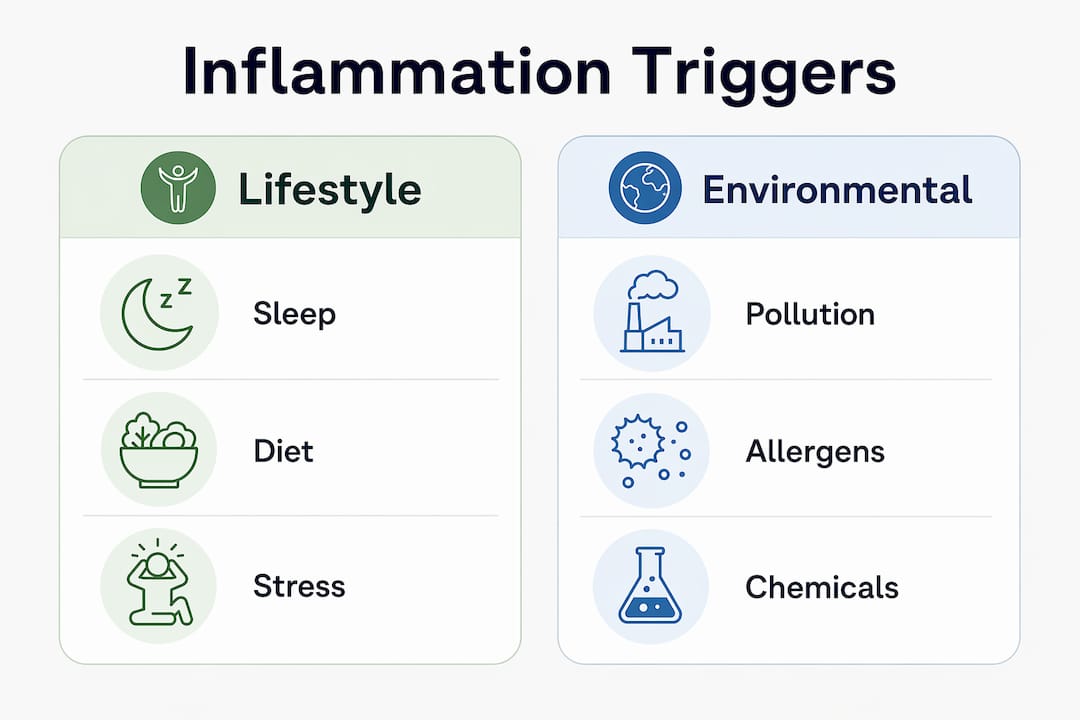
The University of Birmingham’s research on inflammaging confirms that lifestyle changes — diet, activity, and sleep — are the most powerful levers for reducing systemic inflammatory load. For most people in the UK, the triggers are closer to home than they might expect.
Key lifestyle drivers:
| Risk Factor | Threshold or Guidance |
|---|---|
| Poor sleep | Fewer than 7 hours per night |
| Obesity | obesity |
| Physical inactivity | Sedentary lifestyle, insufficient daily movement |
| Diet | High in sugar, trans fats, ultra-processed foods |
| Chronic stress | Persistent psychological or physiological stress |
Statistic: Which? notes that diet, activity, sleep, and oral health are the most actionable areas for tackling chronic inflammation.
Common environmental triggers found in UK homes and cities include air pollution, heavy metals, house dust mites, pet dander, mould, and chemical irritants in detergents or fragrances. Newcastle Hospitals NHS Foundation Trust confirms that environmental triggers such as dust mites, pets, and cleaning products are among the most common causes of persistent skin and immune reactions. You cannot eliminate every trigger, but you can reduce your exposure significantly.
Pro Tip: Start with the lifestyle factors you can change this week — sleep duration and cutting ultra-processed foods — before investigating environmental triggers with guidance from this practical step guide. These changes also make test results easier to interpret by reducing background inflammatory noise.

How do food and environmental triggers actually cause inflammation?
Acute inflammation is your immune system doing its job: it activates quickly in response to injury or infection, then resolves within hours or days. Chronic inflammation is different. It develops when that immune response fails to switch off, or when low-level triggers keep re-activating it over months or years — producing persistent cytokine elevation and gradual tissue damage.
Several distinct pathways are relevant here. IgE-mediated allergies produce rapid, sometimes severe reactions within minutes of exposure. Non-immediate responses, sometimes linked to IgG antibodies (though their role remains debated clinically), tend to be slower and subtler. Gut dysbiosis — an imbalance in your gut microbiome — and increased intestinal permeability (often called ‘leaky gut’) can allow bacterial fragments and food particles to enter the bloodstream, triggering ongoing systemic inflammation. Environmental pollutants and chemical irritants provoke a parallel pathway, irritating mucosal surfaces and activating immune cells directly.
“The gut is increasingly recognised as ground zero for chronic inflammation. When the microbiome is disrupted, the immune system can remain in a state of low-level alert — even when no obvious external trigger is present.” — iNews, summarising functional medicine expert views
Understanding the difference between food intolerance and allergy matters here. NHS guidance is clear: a food intolerance is not immune-mediated in the same way as an allergy, but it can still provoke symptoms and contribute to sustained low-grade inflammation, particularly when gut health is compromised.
How can you tell whether a food or environmental trigger is affecting you?
The most reliable approach is to combine a symptom and exposure diary with a structured elimination and re-challenge, using targeted testing to narrow down the most likely suspects. This gives you real evidence rather than guesswork.
Start by recording every symptom — bloating, fatigue, skin reactions, joint discomfort, headaches — alongside everything you eat, drink, and encounter in your environment. Do this for at least two weeks. Patterns pointing to food triggers often appear within hours of eating; environmental reactions may take longer or correlate with specific locations or seasons.
“A diary of symptoms and foods ingested within an hour of onset would be helpful to assess reproducibility and association.” — Manchester University NHS Foundation Trust, Food Allergy in Adults guidance
For identifying food triggers safely, remove one suspected item at a time for two to four weeks, then reintroduce it and observe. Avoid making multiple changes simultaneously — it makes causation impossible to establish. Typical timelines for noticing improvement range from a few days (digestive symptoms) to several weeks (skin or joint symptoms).
Safety notes: Stop any elimination if you experience significant weight loss, nutritional deficiency symptoms, or worsening health. See your GP promptly if you notice breathing difficulties, swelling of the face or throat, severe abdominal pain, or any symptom that feels sudden and serious. Avoid elimination diets during pregnancy without medical supervision.
What types of at-home sensitivity tests are available, and what are their limits?
At-home tests vary considerably in what they measure and how reliable they are. Understanding the differences helps you choose wisely and interpret results honestly.
- Bioresonance tests (such as those offered by Ukfoodintolerance) analyse hair samples using waveform analysis to identify potential sensitivities across a wide range of food and environmental items. They are non-invasive and cover a broad scope — over 1,450 items in Ukfoodintolerance’s case — with digital results typically within 48–72 hours.
- IgE antibody tests measure immediate allergic responses and are the clinical gold standard for diagnosing true food allergies. They require a blood sample and are usually arranged through a GP or allergy clinic.
- IgG tests are marketed as indicators of delayed food sensitivities, but their clinical interpretation remains contested. Elevated IgG to a food may simply reflect regular exposure rather than a problematic reaction.
- Patch tests are used primarily for contact dermatitis and are conducted in dermatology settings.
Key limitations to keep in mind:
- No at-home test provides a definitive medical diagnosis.
- False positives and false negatives occur with all test types.
- Results should always be paired with diary evidence and, where symptoms are significant, reviewed with a GP.
- Bioresonance is not currently endorsed by mainstream NHS allergy services, though many people find it a useful starting point for an elimination approach.
How should you interpret results and decide on next steps?
When your results arrive, work through a short decision checklist before making any dietary changes. Ask yourself: does the flagged item match patterns in your symptom diary? How severe are your symptoms? Is there another explanation — a recent infection, a new medication, seasonal allergies?
“Testing is most useful when combined with an elimination and reintroduction protocol. A positive result alone is not sufficient evidence of causation.” — functional medicine consensus, summarised in iNews
Use a practical interpretation guide to map results against your diary before removing anything. For items flagged as potential triggers, remove them one at a time for two to twelve weeks depending on the symptom pathway, then reintroduce carefully and document what happens.
Seek urgent GP review if you experience: breathing difficulties, facial or throat swelling, signs of anaphylaxis, or any severe new systemic symptom. For persistent or worsening symptoms that do not respond to dietary changes, ask for a referral to an NHS allergy clinic or gastroenterologist.
Practical steps to lower your overall inflammatory load right now
You do not need to wait for test results to start reducing inflammation. These evidence-backed steps lower systemic inflammatory load regardless of your specific trigger — and they make test signals cleaner.
- Sleep: Aim for at least 7 hours per night. Poor sleep is one of the most consistent drivers of elevated inflammatory markers.
- Movement: Add short walks after meals. Even modest daily activity reduces inflammatory cytokines over time.
- Diet: Cut ultra-processed foods and added sugar first. Prioritise oily fish (salmon, mackerel, sardines) for omega-3 fatty acids, which actively counter inflammatory pathways.
- Stress: Chronic stress sustains cortisol elevation, which in turn drives inflammatory signalling. Restorative practices — even ten minutes of breathing exercises daily — help.
- Visceral fat: Visceral adipose tissue acts as an endocrine organ, releasing pro-inflammatory compounds independently of what you eat. Sustainable weight management, not crash dieting, is the goal.
Pro Tip: Swap one ultra-processed meal per day for a home-cooked alternative built around vegetables, legumes, and oily fish. You do not need a complete diet overhaul — one consistent swap creates measurable change over weeks. Pair this with managing food triggers practically for a structured approach.
How does Ukfoodintolerance’s at-home test work?
Ukfoodintolerance uses bioresonance technology to analyse a small hair sample you collect at home. The process is simple: order your kit online, collect a hair sample, post it to a UK laboratory, and receive a detailed digital report within 48–72 hours. The analysis covers over 1,450 food, environmental, and nutritional items — including potential vitamin and mineral imbalances, hormone responses, and gut biome indicators.
The test suits people with persistent, unexplained symptoms who want targeted clues to guide an elimination diet, rather than a definitive medical diagnosis. It is particularly useful when symptoms are diffuse and difficult to pin to a single cause through diet observation alone.
“At-home testing works best as a starting point, not an endpoint. Use the report to prioritise what to remove first, then track your response carefully.” — Ukfoodintolerance guidance
Ukfoodintolerance recommends pairing results with your symptom diary and, for significant or unclear symptoms, discussing findings with your GP before making major dietary changes. The bioresonance methodology is explained in full on the Ukfoodintolerance research pages for those who want technical transparency.
Common food additives and preservatives as inflammation triggers
Several widely used food additives are associated with increased inflammatory responses in sensitive individuals. Sulphites (found in wine, cider, and dried fruit) can provoke respiratory and skin reactions. Benzoates, used as preservatives in soft drinks, fruit juices, and condiments, are linked to histamine-type responses. Monosodium glutamate (MSG), present in cured meats and many savoury snacks, may trigger symptoms in susceptible people. Artificial sweeteners such as sorbitol can disrupt gut bacteria balance, indirectly fuelling inflammation.
NHS guidance lists sulphites, benzoates, salicylates, and MSG among the ingredients most commonly implicated in food intolerance reactions. Reading ingredient labels carefully and keeping a diary of additive exposure is a practical first step. Many people find that reducing ultra-processed foods — which concentrate multiple additives — produces noticeable symptom improvement within weeks.
How do chronic infections and microbiome imbalances drive inflammation?
Chronic low-grade infections, including persistent viral or bacterial activity, keep the immune system in a state of partial activation. This sustained immune response elevates inflammatory markers even when no acute illness is present. Conditions such as Helicobacter pylori infection, chronic sinusitis, and recurring urinary tract infections are common examples in UK primary care.
Microbiome imbalance (dysbiosis) compounds this. A disrupted gut microbiome reduces the production of short-chain fatty acids that normally help regulate immune responses and maintain the gut lining. When the gut barrier becomes more permeable, bacterial fragments can enter the bloodstream and trigger systemic inflammation. StatPearls clinical data confirms that gut dysbiosis is now recognised as a significant contributor to chronic inflammatory conditions. Antibiotic overuse, a low-fibre diet, and chronic stress are the most common causes of dysbiosis in the UK population.
Key takeaways
Chronic inflammation is most often driven by modifiable lifestyle factors and personal food or environmental triggers, and a structured diary-to-elimination-to-testing approach gives you the clearest evidence for making changes.
| Point | Details |
|---|---|
| Main drivers | Lifestyle factors (sleep, diet, inactivity, stress) and environmental exposures are the primary causes. |
| Safe identification route | Keep a symptom diary for two weeks, then follow a structured elimination and re-challenge before testing. |
| When to see a GP | Seek prompt review for breathing difficulties, facial swelling, severe new symptoms, or no improvement after elimination. |
| Reduce load now | Prioritise 7+ hours of sleep, cut ultra-processed foods, and add oily fish to lower inflammation while you investigate. |
| Ukfoodintolerance testing | Ukfoodintolerance’s at-home bioresonance test covers numerous items and provides a digital report within a few days to guide elimination. |
Why pairing evidence with testing gives you the clearest answers
Most articles about inflammation hand you a list of triggers and leave you to figure out which ones apply to you. That gap between general information and personal clarity is exactly where people get stuck — and where well-intentioned elimination diets go wrong.
The evidence-first approach outlined here matters because chronic inflammation is genuinely individual. Two people eating the same diet can have completely different inflammatory responses, driven by differences in gut microbiome, stress load, sleep quality, and genetic predisposition. A test result without diary context is a list of possibilities. A diary without a test is a long process of elimination with no starting point. Together, they give you something far more useful: a prioritised, evidence-backed shortlist of what to address first.
Bioresonance testing is not a replacement for clinical allergy testing or GP diagnosis. What it offers is a practical, non-invasive way to generate hypotheses — quickly and affordably — that you can then test through structured elimination. For people who have been living with vague, persistent symptoms and getting no clear answers, that starting point has real value. The key is treating results as a map, not a verdict.
Ready to find your personal triggers with Ukfoodintolerance?
If your symptom diary is pointing to food or environmental triggers and you want a clear, structured starting point for elimination, Ukfoodintolerance’s at-home bioresonance test gives you a comprehensive picture fast. No clinic appointment, no blood draw — just a simple hair sample posted to a UK laboratory.

Each kit includes everything you need for sample collection, a prepaid return, and a detailed digital report covering over 1,450 food, environmental, and nutritional items. Results arrive within 48–72 hours, with guidance on how to use them alongside an elimination diet. Browse the full range of intolerance tests or read about how the tests work before you order.
One important reminder: pair your results with your symptom diary, and speak to your GP if your symptoms are severe, worsening, or have not responded to dietary changes. Testing is a tool to inform your next step, not a substitute for medical advice.
Authoritative UK and international sources to read next
- NHS — Food intolerance
- British Heart Foundation — anti-inflammatory diet
- University of Birmingham — inflammaging and lifestyle tips
- Harvard Health — inflammation overview
- StatPearls (NCBI) — chronic inflammation
- Cleveland Clinic — what is inflammation?
- Royal Berkshire NHS — reducing chronic inflammation
- Newcastle Hospitals NHS — environmental triggers
- Which? — what causes chronic inflammation
This article is general health information, not medical advice. Consult your GP or a qualified healthcare professional for guidance specific to your own situation, particularly before starting an elimination diet or if you have existing medical conditions.










Leave a Reply
Want to join the discussion?Feel free to contribute!