

Laboratory testing sits at the heart of NHS clinical decision-making, and understanding its role matters whether you are waiting for a GP referral or considering an at-home sensitivity test. According to the Royal College of Pathologists, around 95% of clinical pathways in England rely on pathology services, with hospital labs running over 1.12 billion tests per year at a cost of approximately £2.2 billion. That scale tells you something important: objective test data, interpreted alongside a clinical history, underpins almost every diagnosis you will ever receive.
Here is the honest verdict on at-home non-invasive tests:
- Validated clinical tests (skin prick, serum-specific IgE, structured food challenges) are the diagnostic gold standard for allergy and intolerance workups.
- Consumer at-home tests (hair analysis, bioresonance, IgG panels) are not recommended by NICE or the British Dietetic Association (BDA) for diagnosing food allergy. They carry a real risk of false positives and unnecessary dietary restriction.
- Used responsibly, an at-home sensitivity screen can be a useful first prompt, provided you treat results as exploratory and follow up with your GP or a registered dietitian for anything significant.
- See your GP first if you have had an anaphylactic reaction, severe symptoms, or significant weight loss. Do not rely on any consumer test in those circumstances.
Table of Contents
- How does laboratory testing support your health in the UK?
- What do results actually mean? Sensitisation versus clinical allergy
- What are the limits and risks of consumer at-home tests?
- How do at-home, non-invasive tests work in the UK?
- When does testing make sense for you?
- How to interpret your at-home results safely and what to do next
- Validated clinical tests versus at-home consumer tests: what to expect
- Key takeaways
- A practical perspective on using at-home tests responsibly
- Ukfoodintolerance: a clear, practical starting point for UK sensitivity screening
- Useful UK sources for further reading
How does laboratory testing support your health in the UK?
The GIRFT national pathology report describes laboratory testing as an end-to-end service, not just a result on a page. The value lies in the whole pathway: the right clinical question, correct sample handling, a validated analytical method, and a clinician who can interpret what the numbers actually mean for you. GIRFT’s Clean Framework puts it plainly: “the right test, at the right time, with the right answer.”
Within the NHS, the tests most commonly used for allergy and intolerance workups are:
- Skin prick testing (SPT): a small amount of allergen extract is placed on the skin and pricked through; a raised weal suggests sensitisation. Performed under medical supervision, usually in specialist clinics.
- Serum-specific IgE blood tests: measure IgE antibodies to a suspected food or environmental trigger. Available more broadly, including in primary care.
- Structured oral food challenges: considered the gold standard for confirming or ruling out food allergy, carried out in a clinical setting with resuscitation equipment available.
UK laboratories processing these tests are expected to meet UKAS accreditation standards, which sets a baseline for analytical quality that consumer services do not always match.
What do results actually mean? Sensitisation versus clinical allergy
A positive test does not mean you have a clinical allergy. This distinction is one of the most misunderstood points in allergy testing, and getting it wrong leads to unnecessary food restrictions that can cause real harm.
Sensitisation means your immune system has produced IgE antibodies to a substance. Clinical allergy means you experience reproducible symptoms when you are exposed to it. Many people are sensitised without ever reacting. NICE guidance (CG116) is clear: an allergy-focused clinical history must come before any IgE test is ordered, and results must always be interpreted in that context.
Practical checklist for reading any allergy or sensitivity report:
- Does the flagged item match a food or substance you have actually reacted to?
- Is the reaction reproducible, meaning it happens every time you eat or encounter it?
- Does the result level (e.g., IgE class) correlate with symptom severity? It often does not predict severity reliably.
- Have you discussed the result with a GP or allergy specialist before making dietary changes?
Pro Tip: A positive result for a food you eat regularly without symptoms is almost certainly a false positive. Do not eliminate it without speaking to a clinician first.
What are the limits and risks of consumer at-home tests?
NICE CG116 explicitly lists the methods you should avoid for diagnosing food allergy: vega testing, applied kinesiology, hair analysis, and serum-specific IgG testing. The BDA is equally direct.
“Alternative allergy tests are not based in scientific evidence. They are a waste of your money and may suggest long lists of foods to be excluded from the diet unnecessarily. Excluding a major food group, or a combination of different foods, can cause nutritional deficiencies, malnutrition and reduced quality of life.” — British Dietetic Association
The practical risks of relying on non-validated tests include:
- Unnecessary elimination of major food groups (wheat, dairy) without clinical justification
- Nutritional deficiencies, particularly in children who need a balanced diet for growth
- Anxiety driven by a long list of flagged items that do not reflect true intolerances
- Wasted money and delayed access to proper diagnosis
Widespread screening with large panels is not recommended precisely because high false-positive rates do not correlate with real symptoms. For a balanced view of what non-invasive approaches can and cannot offer, the risks and real benefits of at-home testing are worth reading before you buy.
How do at-home, non-invasive tests work in the UK?
There are several types of consumer at-home test available in the UK. They differ significantly in what they measure and what they can legitimately claim.
- Hair sample analysis / bioresonance: A small hair sample is sent to a UK laboratory. The lab analyses the sample using bioresonance technology, comparing energy frequencies against a database of food and environmental items. Results indicate potential sensitivities rather than confirmed clinical allergies. Turnaround is typically 48–72 hours for digital reports. This method is not validated for diagnosing IgE-mediated allergy, but some people find the broad sensitivity overview useful as a starting point for an elimination trial.
- Dried blood spot (DBS) tests: A finger-prick blood sample is collected at home and posted to a laboratory. DBS tests can measure specific IgE or other markers, and some are processed by UKAS-accredited labs. Quality varies significantly between providers.
- Stool microbiome tests: A stool sample is analysed for gut bacteria composition. These tests can provide useful information about gut health but cannot diagnose food allergy or intolerance in a clinical sense.
- IgG food panels: Measure IgG antibodies to foods. IgG antibodies are found in all healthy adults regardless of symptoms, so a positive result does not indicate intolerance. Not recommended by the BDA or NICE.
For a clear explanation of testing terms and methods, it helps to understand what each approach actually measures before you choose.
Pro Tip: When choosing an at-home test, look for UK laboratory processing, a transparent methodology page, a clear statement of what the test cannot diagnose, and access to follow-up resources. Avoid any provider that claims their test can definitively diagnose clinical allergy.

When does testing make sense for you?
Not every symptom warrants a test, and not every test warrants a GP visit. Here is how to think about it.
Go to your GP first if you have:
- Had a suspected anaphylactic reaction (throat swelling, difficulty breathing, collapse)
- Severe or rapidly worsening symptoms after eating
- Significant unexplained weight loss or nutritional concerns
- Symptoms in a child that are affecting growth or development
NHS serum-specific IgE testing is indicated in primary care when skin prick testing is unavailable, when you cannot stop antihistamines, or following a recent anaphylaxis, according to NWL pathology guidance.
An at-home sensitivity screen may be a reasonable preliminary step if:
- Your symptoms are mild and chronic (bloating, low energy, skin reactions without anaphylaxis risk)
- You want a broad overview to guide an elimination trial before a GP appointment
- You understand the results are exploratory, not diagnostic
Avoid repeat testing without a clear clinical reason. Unnecessary retesting increases costs, creates confusion, and does not improve outcomes.
How to interpret your at-home results safely and what to do next
Receiving a report with a long list of flagged items can feel alarming. Here is a safe workflow.
- Read the limitations section first. Every reputable at-home test report should state clearly what the test cannot diagnose. If it does not, treat the results with extra caution.
- Cross-reference with your actual symptoms. Only items that match foods or substances you have genuinely reacted to are worth investigating further.
- Do not self-prescribe a major elimination diet. Removing multiple food groups without supervision risks nutritional deficiency. Use the elimination diet checklist to plan safely.
- Book a GP appointment for red-flag results. Any marker linked to a potential anaphylaxis risk, or results that surprise you significantly, need clinical review before you act on them.
- Work with a registered dietitian for any elimination lasting more than two to three weeks, particularly if you are removing dairy, wheat, or multiple food groups simultaneously. Reintroduction under guidance is as important as the elimination itself.
For children, supervised dietary changes are non-negotiable; see how to introduce new foods and allergies safely for practical guidance on testing and dietary introduction. The steps for testing children at home include specific guidance on paediatric follow-up. For a practical guide to interpreting your results step by step, Ukfoodintolerance provides clear, accessible resources alongside every report.
Pro Tip: Bring a printed copy of your at-home test report to your GP appointment. Frame it as background information, not a diagnosis. Most GPs will appreciate the context and can order confirmatory NHS tests if warranted.
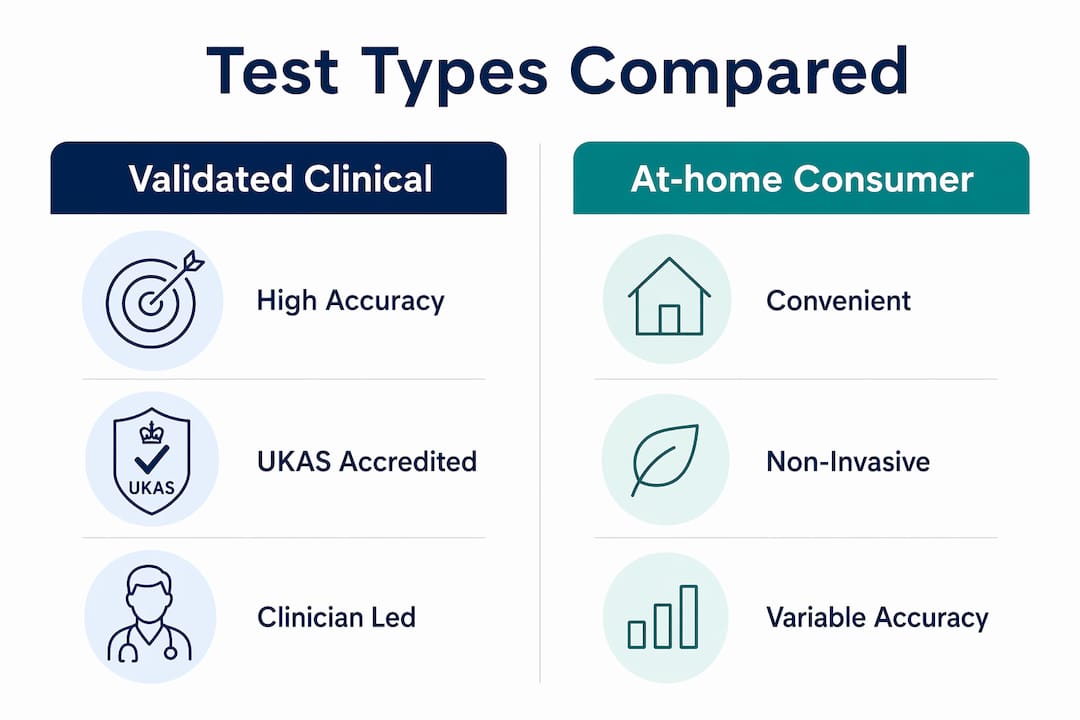
Validated clinical tests versus at-home consumer tests: what to expect
| Feature | Validated clinical tests | Accredited private lab (DBS/IgE) | Consumer sensitivity panels (bioresonance/hair) |
|---|---|---|---|
| Evidence base | Strong (NICE, BSACI, RCPath) | Moderate (method-dependent) | Limited; not validated for allergy diagnosis |
| Sample type | Blood, skin, oral challenge | Finger-prick blood, saliva | Hair sample |
| Clinician required | Yes, always | Recommended for interpretation | Not required, but strongly advised |
| Typical turnaround | Days to weeks (NHS) | 3 days | 48–72 hours |
| Appropriate for | Diagnosis, monitoring | Screening, monitoring | Exploratory sensitivity overview |
| Cost (approximate) | NHS: free; private: — | — | — |
Key takeaways
Laboratory testing underpins around 95% of NHS clinical pathways, and at-home sensitivity tests are most useful as an exploratory prompt, not a clinical diagnosis.
| Point | Details |
|---|---|
| Scale of lab testing in the UK | Hospital labs run over 1.12 billion tests per year; pathology supports 95% of NHS clinical pathways. |
| Sensitisation is not allergy | A positive IgE or sensitivity result requires clinical history to determine whether it reflects a true allergy. |
| Non-validated tests carry risks | NICE and the BDA advise against hair analysis, vega testing, and IgG panels for diagnosing food allergy. |
| When to see your GP | Anaphylaxis history, severe symptoms, or significant weight loss always require NHS assessment before any consumer test. |
| Ukfoodintolerance as a first step | Ukfoodintolerance’s hair-based bioresonance screen covers over 1,450 items and delivers results in 48–72 hours, suitable as an exploratory tool before GP or dietitian follow-up. |
A practical perspective on using at-home tests responsibly
The conversation around at-home sensitivity testing tends to split into two camps: those who dismiss it entirely, and those who treat a flagged item list as gospel. Neither approach serves you well.
What the evidence actually supports is a middle path. Validated NHS tests are the right tool when symptoms are severe, when anaphylaxis is a possibility, or when a clinician needs a definitive answer. But for the large number of people living with chronic, low-grade symptoms, bloating, fatigue, or skin reactions that never quite get investigated, a broad sensitivity screen can be a genuinely useful first step. Not because it diagnoses anything, but because it gives you a structured starting point for a conversation with your GP or dietitian.
The key is treating the results as a hypothesis, not a verdict. You collect the sample, review the report, note which flagged items match your actual experience, and then bring that information to a professional. That workflow respects both the limits of the technology and the value of clinical expertise. Skipping the follow-up step is where people run into trouble, particularly when they start eliminating multiple food groups without nutritional support.
Used that way, an at-home test is a reasonable, low-risk tool. The problem is not the test itself. It is the expectation that it replaces clinical care.
Ukfoodintolerance: a clear, practical starting point for UK sensitivity screening
If you are dealing with unexplained digestive symptoms, skin reactions, or low energy and want a structured place to start, Ukfoodintolerance offers a straightforward at-home option. You collect a small hair sample at home, post it to a UK laboratory, and receive a detailed digital report within 48–72 hours covering over 1,450 food and environmental items, including potential vitamin and mineral imbalances and gut biome indicators.
The service is designed to sit at the beginning of your health journey, not the end. Use the report to identify patterns, cross-reference with your symptoms, and then bring the findings to your GP or a registered dietitian for confirmation and supervised dietary changes. Ukfoodintolerance provides clear interpretation resources and a step-by-step elimination guide to support you at every stage.
Browse the full range of at-home intolerance tests and choose the option that fits your needs. Results are for sensitivity screening purposes only and do not constitute a clinical diagnosis. Always consult your GP or a registered dietitian before making significant dietary changes.
Useful UK sources for further reading
- NICE CG116: food allergy assessment and diagnosis — clinical guidance on validated allergy testing and methods to avoid; the primary reference for GPs and patients.
- British Dietetic Association: food allergy and intolerance testing — clear patient-facing advice on which tests are evidence-based and which to avoid.
- GIRFT national pathology report (RCPath) — statistics on NHS lab testing scale and the importance of end-to-end pathology pathways.
- NWL pathology: food allergic disorders guidance — practical GP-level guidance on when to order serum IgE tests and how to interpret results.
- NHS England: optimising blood testing in primary care — best practice for appropriate test requesting and avoiding unnecessary repeat testing.
- Ukfoodintolerance: bioresonance methodology — the client’s own methodology and research page, explaining how hair-based bioresonance analysis works and what it covers.
- Ukfoodintolerance: why use intolerance tests — practical overview of who benefits from at-home sensitivity screening in the UK.
This article is general information, not medical advice. For symptoms that concern you, please consult your GP or a qualified health professional and verify current NHS guidance for your specific situation.










Leave a Reply
Want to join the discussion?Feel free to contribute!