

TL;DR:
- Food allergy involves immune responses; intolerance results from digestive difficulties without immune activation.
- Accurate diagnosis requires professional tests and personalized assessment, as self-diagnosis is unreliable.
- Managing allergies involves strict avoidance, while intolerances can often tolerate small amounts with guidance.
Cutting out gluten, then dairy, then eggs, then wondering why you still feel awful. Sound familiar? Millions of people in the UK go through exactly this cycle, removing foods one by one without truly knowing whether they have a food allergy or a food intolerance. These two conditions are genuinely different, and confusing them can lead either to unnecessary dietary restrictions that affect your nutrition, or worse, overlooking a reaction that could become dangerous. Getting this right is not just useful knowledge. It is the foundation of managing your health well.
Table of Contents
- What is the real difference between allergy and intolerance?
- How can you tell the difference from your symptoms?
- Getting the right diagnosis: why professional assessment matters
- Managing your condition: practical steps for allergy and intolerance
- Edge cases and expert nuances: the grey area between allergy and intolerance
- What most people get wrong about food sensitivities
- Find clarity and support on your food journey
- Frequently asked questions
Key Takeaways
| Point | Details |
|---|---|
| Allergy is immune-based | Food allergies trigger a true immune response and can be life threatening. |
| Intolerance is digestive | Intolerances involve difficulty digesting certain foods but don’t trigger immunity. |
| Diagnosis needs experts | Proper diagnosis relies on professional testing and advice, not unreliable kits. |
| Management differs | Allergies require strict avoidance; intolerances may allow for flexibility with guidance. |
| Edge cases exist | Some reactions blur the lines and demand careful expert investigation. |
What is the real difference between allergy and intolerance?
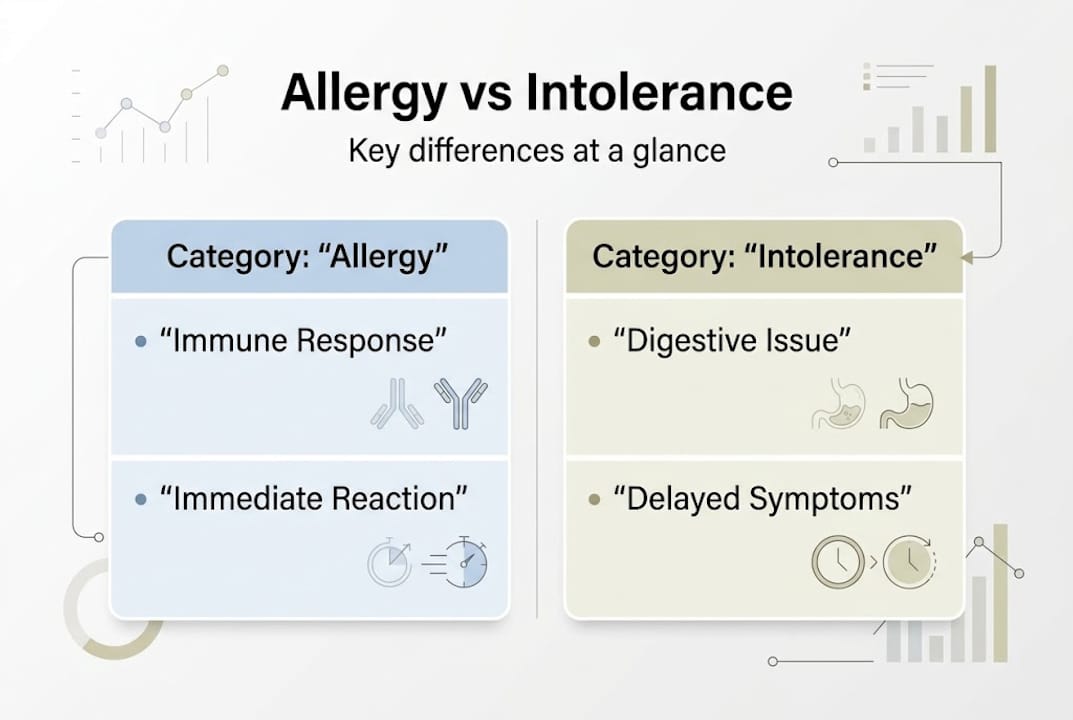
Understanding the core distinction saves you time, confusion, and potentially serious harm. Food allergy involves an immune system response to food proteins, while food intolerance does not involve the immune system and is typically due to digestive difficulties such as enzyme deficiencies.
That single distinction changes everything about how each condition is managed, diagnosed, and treated.
Food allergy means your immune system mistakenly identifies a food protein as a threat. It launches a defence response, releasing chemicals like histamine. This can happen within minutes of eating the trigger food and can range from uncomfortable to life-threatening.
Food intolerance means your digestive system struggles to break down or process a particular food. Lactose intolerance is a well-known example: the body lacks sufficient lactase enzyme to digest lactose (milk sugar). No immune alarm is triggered. The result is discomfort, not danger.

Here is a clear comparison to help you tell them apart:
| Feature | Food allergy | Food intolerance |
|---|---|---|
| Immune system involvement | Yes | No |
| Typical onset after eating | Minutes to 2 hours | 30 minutes to several hours |
| Symptom severity | Can be severe or life-threatening | Usually mild to moderate |
| Dose sensitivity | Even tiny amounts can trigger reaction | Small amounts often tolerated |
| Management basics | Strict avoidance, carry adrenaline if severe | Reduce or limit trigger food |
Common food allergy symptoms include:
- Hives, itching, or skin redness
- Swelling of the lips, tongue, or throat
- Difficulty breathing or wheezing
- Nausea and vomiting
- Anaphylaxis (a severe, life-threatening reaction requiring immediate medical attention)
Common food intolerance symptoms include:
- Bloating and trapped wind
- Stomach cramps or pain
- Diarrhoea or loose stools
- Nausea
- Headaches or brain fog in some cases
“Understanding which condition you have is not just about labelling symptoms. It shapes every practical decision about your diet and safety.”
Exploring food sensitivity testing options is one way to gather early information, though professional assessment remains the cornerstone of accurate diagnosis.
How can you tell the difference from your symptoms?
Now that you know the scientific distinction, let’s look at how symptoms show up in real life and how to spot key clues that point one way or the other.
The most practical clue is timing. Allergic reactions typically appear within minutes to two hours of eating. Intolerance symptoms tend to arrive later, sometimes three to six hours after a meal. If you eat a bowl of pasta and feel unwell the next morning, that pattern points more towards intolerance than allergy.
Food intolerance is more common than allergy, and self-reported cases are high, though confirmed diagnoses are often lower. Many people living with ongoing digestive discomfort may never receive a formal label, yet their symptoms are very real and very manageable once the triggers are identified.
Here is a practical step-by-step approach to help you start identifying what might be happening:
-
Write down every symptom. Note exactly what you experienced, how long after eating it appeared, and how severe it was. Be specific. “Bloating” is useful. “Severe bloating with cramping two hours after lunch” is far more useful to a healthcare professional.
-
Record everything you ate. Keep a detailed food and symptom diary for at least two to three weeks. Include ingredients in sauces, drinks, and snacks. Many triggers hide in processed foods.
-
Look for repeatable patterns. Does the same food reliably cause the same reaction? With true allergies, this pattern is almost always consistent. Every exposure tends to trigger a response. With intolerance, the reaction may depend on how much you ate or what else you consumed.
-
Note the severity and recovery time. Allergy symptoms can escalate quickly and may need treatment. Intolerance symptoms are uncomfortable but typically resolve on their own.
-
Consider related triggers. Some people experience childhood intolerance signs that persist into adulthood, especially with dairy or wheat. Knowing your history helps.
Pro Tip: If a reaction happens every single time you eat a specific food, regardless of portion size, take that seriously and seek medical review promptly. This pattern is more consistent with an immune-mediated allergy than a digestive intolerance.
Understanding common food triggers in the UK population can also help you narrow down suspects before seeing a professional. The most frequent allergens include peanuts, tree nuts, milk, eggs, wheat, soy, fish, and shellfish, while the most common intolerances involve lactose, gluten (non-coeliac), and certain food additives.
Getting the right diagnosis: why professional assessment matters
Spotting symptoms is just the start. Diagnosis can be tricky, especially with mixed reactions or confusing test options flooding the market.
Diagnosis of IgE allergy involves an allergy-focused history, skin prick tests, and specific IgE blood tests. Intolerance, on the other hand, is typically identified through elimination and reintroduction under professional guidance, and experts advise strongly against using IgG-based tests for this purpose.
This is important because the shelves and websites are full of kits claiming to identify dozens or even hundreds of food intolerances through a simple IgG blood test. At-home IgG tests are unreliable for intolerance, frequently lead to unnecessary restrictions, and professional guidance from a GP or dietitian should always come first for UK patients.
Here is how the diagnostic routes compare:
| Condition | Diagnostic approach | Key tests used |
|---|---|---|
| Food allergy (IgE-mediated) | Allergy-focused clinical history | Skin prick test, specific IgE blood test |
| Food allergy (non-IgE) | History, elimination trial | Supervised food challenge |
| Food intolerance | Symptom diary, elimination and reintroduction | Hydrogen breath test (for lactose), dietitian review |
Why professional input matters so much:
- A GP can rule out serious conditions like coeliac disease, inflammatory bowel disease, or other causes before attributing symptoms to intolerance
- A registered dietitian ensures that eliminating foods does not create nutritional deficiencies
- Supervised elimination diets follow structured protocols that give far more reliable results than self-managed attempts
- For allergy testing, only trained professionals can safely interpret skin prick tests and manage potential reactions
Pro Tip: Before booking any commercial test, speak to your GP first. Explain your symptoms, request a referral, and ask specifically about elimination diets under dietitian supervision. This path is more reliable and often more affordable than private testing kits.
If you are curious about how to start identifying intolerances at home in a safe, structured way, it is possible, but it works best as a complement to professional guidance rather than a replacement. Reviewing the UK allergy diagnosis guide can help you understand what to expect from a formal assessment.
Managing your condition: practical steps for allergy and intolerance
Once you have a clear diagnosis, tailored management helps keep you safe and feeling your best every day.
The management approaches for allergy and intolerance are quite different, and treating one like the other can cause real problems.
For food allergies:
Allergy requires strict avoidance and, if severe, carrying an adrenaline auto-injector at all times. Even trace amounts of an allergen can trigger anaphylaxis in highly sensitive individuals.
- Read every food label, every time. Manufacturing processes change.
- Inform restaurants, catering staff, and friends and family about your allergy.
- Carry antihistamines and an adrenaline auto-injector (such as an EpiPen) if prescribed.
- Create a written allergy action plan with your GP or allergist.
- Never assume a “free from” label means the product is safe for your specific allergy.
For food intolerances:
Intolerance allows small amounts sometimes, and the focus should be on a balanced diet supported by a dietitian to avoid nutritional deficits. This is a more flexible situation, but it still requires careful attention.
- Identify your personal threshold. Many people with lactose intolerance can tolerate small amounts of hard cheese or butter.
- Use a food and symptom diary to test and confirm your tolerance level.
- Work with a dietitian to replace any nutrients lost from restricted foods.
- Consider digestive enzyme supplements (such as lactase tablets) where appropriate and advised by a healthcare professional.
- Explore at-home intolerance tests as part of a broader, professionally guided approach.
“A good dietitian is not just about food lists. They help you build a sustainable, nutritious diet that fits your life, not just your restrictions.”
Environmental factors can also play a role in how your body handles food. For example, air purifiers for allergy relief can reduce the overall allergenic load in your home, which may help those with multiple sensitivities feel more comfortable day to day.
Pro Tip: If you have been told you are intolerant to a food, do not simply cut it out and never revisit it. Many intolerances change over time. Revisit your thresholds every six to twelve months with dietitian support to avoid unnecessary long-term restriction.
Edge cases and expert nuances: the grey area between allergy and intolerance
Even with a good understanding of the basics, some cases defy easy classification. It is useful to know when to seek further help rather than forcing a diagnosis that does not quite fit.
One of the more complex scenarios involves non-IgE allergies. These are immune-mediated reactions that do not involve the typical IgE antibody pathway. Because of this, standard skin prick tests and IgE blood tests often come back negative, even though the person is genuinely reacting. Non-IgE allergies mimic intolerances, with delayed gut symptoms, and require a careful clinical history and elimination approach to distinguish them from standard intolerance.
Key edge cases to be aware of:
- Non-IgE-mediated allergy: Shows delayed symptoms, often in the gut, which can easily be mistaken for intolerance. Common in infants and young children but can persist into adulthood.
- Mixed allergic reactions: Some individuals experience both IgE and non-IgE components to the same food, making diagnosis particularly complex.
- Non-coeliac gluten sensitivity: This sits in genuinely contested territory. Gluten intolerance existence is debated by some experts, with immune involvement unclear and symptoms that overlap significantly with other gastrointestinal conditions.
- Eosinophilic oesophagitis: An immune-driven condition that resembles both allergy and intolerance, requiring specialist gastroenterology input.
“Not every reaction fits neatly into a box. When your symptoms are inconsistent, confusing, or severe, that is exactly when professional input becomes most valuable.”
If your reactions are unpredictable or you have had inconclusive test results, reviewing UK intolerance trends may help contextualise your experience. You are not alone in navigating these grey areas, and the landscape of testing and diagnosis continues to evolve.
What most people get wrong about food sensitivities
Here is an honest perspective that may challenge some widely held assumptions.
The most common mistake we see is people assuming every uncomfortable reaction after eating must be either a full-blown allergy or something easily identified by a home test kit. Neither of these assumptions holds up to scrutiny, and both can lead you further from the answers you need.
Most UK sufferers either over-attribute their symptoms to allergy or assume that any commercial test kit will give them reliable, actionable answers. The reality is more nuanced. Unreliable IgG-based home tests and unchecked self-diagnosis frequently lead to unnecessary and sometimes damaging food restrictions. We have seen people eliminating four or five major food groups based on test results that are not clinically validated, ending up nutritionally depleted and no better in terms of symptoms.
The people who make the most meaningful progress are those who balance careful, structured personal observation with professional input. They keep thorough diaries, ask the right questions at GP appointments, and engage with dietitians who understand the complexity of food reactions. They also do not demand a label prematurely. Sometimes the most useful thing you can do is sit with uncertainty for a short period while gathering proper evidence.
We also believe strongly in using well-designed sensitivity screening as a starting point, not an endpoint. Exploring food sensitivity guidance can help you go into professional appointments better informed and better prepared. It is not about replacing clinical diagnosis. It is about arriving at it with more useful information.
Clarity is absolutely possible. But it requires weighing professional evidence more heavily than marketing claims, however appealing a quick answer might seem.
Find clarity and support on your food journey
If you have been living with unexplained digestive symptoms, skin reactions, or persistent fatigue after eating, you deserve real answers, not guesswork.

At UK Food Intolerance, we offer comprehensive intolerance tests that screen over 1,100 items using bio-resonance technology, all from a simple hair sample collected at home. Our UK-based laboratory processes your sample and delivers a detailed digital report within 48 to 72 hours. It is fast, non-invasive, and genuinely useful as a starting point for your health journey. For those looking for a more accessible option, our Core Single Intolerance Test covers 500 items at a lower price point. Both options make convenient home testing a practical reality for anyone in the UK. Pair your results with professional guidance and you have a solid foundation for real change.
Frequently asked questions
Can food intolerance symptoms be delayed or change over time?
Yes, symptoms of intolerance can appear hours after eating and may vary in intensity, making them harder to pinpoint than allergy reactions. Non-IgE reactions also show delayed symptoms, which further complicates self-identification without professional support.
Do at-home test kits for intolerance provide reliable answers?
At-home IgG test kits for intolerance are not considered reliable and can lead to unnecessary avoidance of foods; always consult a GP or dietitian alongside any screening tool you use.
If I can eat a small amount of a food without symptoms, is it likely an intolerance?
Most likely yes, as allergies typically cause reactions after any exposure regardless of quantity, while intolerances may permit small amounts without noticeable effects due to their non-immune, dose-dependent nature.
Is it possible to suffer from both food allergy and intolerance?
Yes, some people experience both allergy and intolerance simultaneously, and mixed reactions are possible, requiring careful professional diagnosis rather than self-assessment.
Why is gluten intolerance controversial?
Some experts disagree on whether gluten intolerance exists outside of coeliac disease, as immune involvement is unclear and symptoms overlap significantly with other gastrointestinal conditions, making definitive classification genuinely difficult.










Leave a Reply
Want to join the discussion?Feel free to contribute!