

TL;DR:
- Food intolerance involves digestive issues without immune response, unlike life-threatening allergies.
- Reliable intolerance tests include symptom diaries, supervised elimination diets, and hydrogen breath tests.
- Many commercial IgG, hair, or bioresonance tests lack scientific backing and can lead to nutritional deficiencies.
Food intolerance and food allergy are not the same thing, yet they are constantly treated as though they are interchangeable. That misunderstanding matters, because food intolerance involves non-immune, delayed digestive symptoms while allergy triggers an immune response that can be life-threatening. When you blur those two things together, you end up choosing the wrong test, spending money on kits that prove nothing, and potentially missing a condition that actually needs medical attention. This guide cuts through the noise, defines the terms you keep seeing, and walks you through which approaches are genuinely supported by evidence.
Table of Contents
- Key intolerance and allergy terms explained
- Recommended non-invasive tests: What truly works
- Popular but unreliable testing methods
- Nuance and exceptions: When the science gets tricky
- Our take: Why clear terms and cautious testing matter
- Next steps: Explore supported intolerance testing solutions
- Frequently asked questions
Key Takeaways
| Point | Details |
|---|---|
| Intolerance vs allergy | Intolerance is a digestive issue, not an immune reaction like an allergy. |
| Reliable test methods | Symptom diaries and elimination diets are trusted by UK health experts. |
| Avoid unreliable tests | IgG kits, hair analysis, and bioresonance lack scientific support and can mislead you. |
| Seek professional help | Work with a dietitian or GP before making major dietary changes. |
Key intolerance and allergy terms explained
Having set the scene on why confusion exists, it is vital to define the basic terms before exploring the tests themselves. Getting these definitions right changes everything about how you approach your symptoms.
Food intolerance is a digestive issue. Your gut struggles to process a particular food or ingredient, and the result is bloating, wind, diarrhoea, stomach cramps, or fatigue. Crucially, intolerance is not driven by your immune system. It is a mechanical or chemical failure in digestion, not a defence response.
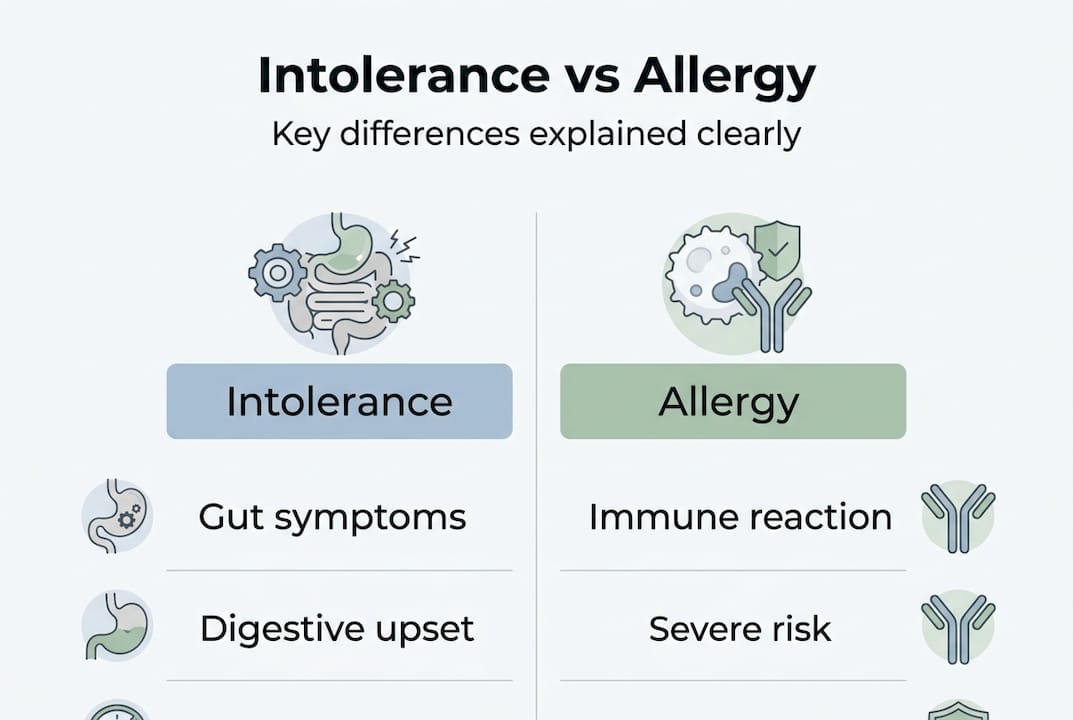
Food allergy is an immune system event. Your body wrongly identifies a food protein as a threat and launches a defence. That defence involves a type of antibody called IgE (immunoglobulin E). The reaction is rapid, sometimes within minutes, and can range from hives to anaphylaxis. The NHS confirms that allergy testing uses skin prick tests or specific IgE blood tests, not the kits marketed for intolerance.
Understanding intolerance vs allergy is not just academic. It determines whether you need emergency medication, a supervised elimination diet, or something else entirely.
Here is a side-by-side comparison of the two conditions:
| Feature | Food intolerance | Food allergy |
|---|---|---|
| Immune involvement | No | Yes (IgE-mediated) |
| Onset of symptoms | Delayed (hours to days) | Rapid (minutes to 2 hours) |
| Symptoms | Bloating, cramps, fatigue | Hives, swelling, anaphylaxis |
| Life-threatening | Rarely | Potentially yes |
| Diagnosis method | Diary, elimination diet, breath test | Skin prick test, IgE blood test |
| Self-managed? | Often, with guidance | Needs medical supervision |
Other terms worth knowing:
- IgG (immunoglobulin G): An antibody your body produces in response to foods you eat regularly. Often measured by commercial kits, but this simply shows exposure, not intolerance.
- Symptom diary: A written record of what you eat and how you feel, used to identify patterns over time.
- Elimination diet: A structured process of removing suspect foods, then reintroducing them one at a time to observe reactions.
- Non-invasive testing: Any method that does not require needles, blood draws, or invasive procedures. Includes breath tests and hair sample analysis.
- Coeliac disease: An autoimmune condition triggered by gluten, not a standard intolerance. Requires specific blood tests and biopsy for diagnosis.
- Red flag symptoms: Signs that point to something more serious than intolerance, including unexplained weight loss, blood in stools, or persistent vomiting. These require urgent medical review.
“Misidentifying a food allergy as an intolerance, or vice versa, can lead to serious health consequences. Knowing the difference is the first step towards choosing the right path forward.”
Misusing these terms leads directly to misusing testing services. If you suspect an allergy, a commercial intolerance kit will not help you. If you suspect intolerance, a GP-ordered IgE blood test is not designed for your situation either.
Recommended non-invasive tests: What truly works
With terms clarified, you can now focus on the reliable pathways recommended by health authorities for intolerance testing. The good news is that the most effective methods are straightforward and do not require expensive equipment.
The NHS recommends three key validated approaches for diagnosing food intolerance: a food and symptom diary, a supervised elimination diet, and hydrogen breath testing for specific intolerances such as lactose and fructose malabsorption.
Here is how each one works in practice:
-
Food and symptom diary (2 to 4 weeks). Write down everything you eat and drink, alongside any symptoms you experience. Note timing, portion size, and severity. After two to four weeks, patterns usually become visible. This is your starting point, and it costs nothing.
-
Supervised elimination diet (2 to 6 weeks). Based on your diary, a registered dietitian removes the suspected food from your diet for a set period, typically two to six weeks. If symptoms resolve, foods are reintroduced one at a time to confirm which triggers your symptoms. This is the gold standard for intolerance identification.
-
Hydrogen breath test. This is a specific, clinically validated test for lactose intolerance and fructose malabsorption. You consume a small amount of the suspect sugar, then breathe into a device at intervals. If your gut bacteria ferment the undigested sugar, they produce hydrogen, which shows up in your breath. It is non-invasive, reliable, and available through the NHS or private clinics.
The following table summarises what each method reliably detects:
| Method | What it identifies | Who administers it |
|---|---|---|
| Food and symptom diary | Patterns across many foods | Self-managed, reviewed by GP or dietitian |
| Supervised elimination diet | Specific trigger foods | Registered dietitian |
| Hydrogen breath test | Lactose, fructose, SIBO | Clinic or hospital |
Pro Tip: Start your food diary before you book any test or appointment. Arriving at your GP with two to four weeks of detailed symptom records dramatically speeds up the diagnostic process and makes your appointment far more productive.
Your GP is the right first port of call if symptoms are affecting your quality of life. They can rule out serious conditions, refer you to a registered dietitian, and order validated tests where appropriate. For broader guidance on how these approaches fit into the current landscape, our UK testing guidance resource offers useful context.

If you are looking for structured next steps, reviewing validated tests and understanding detection methods can help you feel more prepared before speaking with a professional.
Popular but unreliable testing methods
Knowing what to trust also means understanding the pitfalls of popular but unreliable commercial test options. The UK market is saturated with intolerance kits, and not all of them have the science to back up their claims.
The most commonly sold tests use one of these approaches:
- IgG blood testing: Measures IgG antibodies to hundreds of foods. These antibodies are a normal immune response to eating. Higher levels simply indicate that you eat a food regularly, not that you are intolerant to it. IgG testing measures food exposure, not intolerance, and is not recommended by the NHS, the British Society for Allergy and Clinical Immunology (BSACI), the British Dietetic Association (BDA), or Allergy UK.
- Hair analysis: Claims to identify intolerances through analysis of hair samples using various proprietary methods. There is no peer-reviewed scientific evidence supporting this approach for diagnosing food intolerance.
- Bioresonance testing: Uses electronic devices that claim to detect energy frequencies from the body or hair to identify sensitivities. Like hair analysis, it is listed as unreliable by Allergy UK alongside Vega testing, kinesiology, and applied kinesiology.
- Kinesiology and applied kinesiology: Based on muscle resistance testing in response to food exposure. No scientific evidence supports this for intolerance diagnosis.
The cost of these tests ranges considerably. IgG kits sold online or on the high street range from around £39 to £299. That is a significant spend for a result that leading health bodies say cannot confirm intolerance.
The risks go beyond wasted money. If an inaccurate test suggests you are intolerant to ten or fifteen foods, and you remove them all from your diet without professional supervision, you risk serious nutritional deficiencies. Cutting out dairy, wheat, eggs, and soy simultaneously, for example, can leave significant gaps in protein, calcium, B vitamins, and iron.
Pro Tip: Before purchasing any commercial test, check whether the method is endorsed by the NHS, BSACI, BDA, or Allergy UK. If it is not listed as a validated approach by any of these bodies, treat the results as exploratory at best and always seek professional input before changing your diet significantly.
For a clearer picture of what the market looks like and how to navigate it safely, our reliable testing guide walks through the current landscape in plain language.
Nuance and exceptions: When the science gets tricky
Some scenarios defy the simple rules. This section explores crucial exceptions and the situations where professional advice is not optional but essential.
Coeliac disease is the most important example. It is often grouped with food intolerances, but it is actually an autoimmune condition. The standard blood test looks for an antibody called tTG-IgA (tissue transglutaminase IgA). The critical detail is that this test is only accurate if you are still eating gluten at the time of testing. Many people cut out gluten before getting tested because they feel better without it, then receive a negative result that provides false reassurance. If coeliac disease is a possibility, do not reduce your gluten intake until after testing.
Delayed symptoms add another layer of complexity. Because intolerance reactions can appear hours or even days after eating a trigger food, identifying the culprit without a detailed diary is genuinely difficult. A single bad day is easy to misattribute to the last meal you ate. A carefully kept diary over several weeks reveals the actual pattern.
There are also important nuances around IgG antibodies. Some researchers argue that elevated IgG to a specific food might occasionally reflect a developing tolerance rather than a problem. The immune system produces IgG as part of normal adaptation. This is part of why IgG results are so difficult to interpret without professional context.
Key points to keep in mind for these complex scenarios:
- Do not go gluten-free before a coeliac test. You may invalidate the result.
- Do not restrict multiple foods based on a single unvalidated test. The risk of nutritional harm is real.
- Delayed reactions need documented tracking. Gut feelings (literally) are not reliable enough.
- IgG results need professional interpretation. High IgG to a food does not equal confirmed intolerance.
“Long-term dietary restriction without professional confirmation can create new health problems. The goal is to identify what is causing harm, not to remove as much as possible.”
If you are already working with results from a test and are unsure what to do next, our guide on dietary adjustments provides practical, safe steps for making changes to your diet without overreaching.
Our take: Why clear terms and cautious testing matter
There is a pattern we see repeatedly. Someone feels unwell, struggles to get answers through traditional routes, and turns to a commercial test kit for clarity. The kit returns a long list of flagged foods. They eliminate them all. Months later, they are nutritionally depleted, still symptomatic, and more confused than when they started.
This is not a failure of the person. It is a failure of an industry that profits from complexity and urgency. The language around intolerance testing is often deliberately vague, blending real science with pseudoscience in ways that are hard for non-specialists to unpick.
Plain language and clear definitions are not just helpful. They are a form of protection. When you understand what IgG actually measures, you are far less likely to pay £150 for a test that tells you little of diagnostic value. When you know that coeliac disease requires gluten to be in your diet at the time of testing, you avoid a costly mistake that could delay a serious diagnosis by months or years.
We also think the conversation about UK trends in non-invasive testing needs to be more honest. Non-invasive does not automatically mean reliable. Hair analysis is non-invasive. So is a hydrogen breath test. The method of sample collection tells you very little about the scientific validity of the result.
The most empowering thing you can do is approach testing as a two-step process: first, educate yourself on what each test actually measures and whether it is validated; second, involve a professional at every meaningful decision point. A registered dietitian is not a luxury. When you are considering restricting multiple food groups, professional oversight is what keeps you safe and well-nourished.
Consumers deserve better than conflicting online advice and expensive kits with limited evidence. Demanding science-backed approaches is not being difficult. It is being sensible.
Next steps: Explore supported intolerance testing solutions
You now have a clear picture of which approaches are worth your time and which ones to question. Taking that next step feels much more straightforward when you have reliable information behind you.

At UK Food Intolerance, we offer testing options designed to give you a useful starting point for your wellbeing journey, not a definitive medical diagnosis. Our tests use bio-resonance technology with hair samples, processed in our UK-based laboratory, with results delivered within 48 to 72 hours. We always encourage you to use your results alongside professional guidance. Browse our shop intolerance tests page to see what suits your needs, or review our test options in detail. If you want to understand how testing can support better food choices, our article on how to find your ideal diet is a helpful next read. We are here to support you, not replace your GP.
Frequently asked questions
How long should I keep a food diary before testing for intolerance?
A food and symptom diary should be kept for 2 to 4 weeks to spot patterns and guide further testing. This duration gives enough data to identify recurring triggers reliably.
Can a single test result confirm all my food intolerances?
No; intolerance diagnosis usually requires a dietary diary and supervised elimination, as no reliable single test can confirm all sensitivities. Results from any single test should be treated as a guide, not a definitive answer.
Are IgG blood tests recognised by the NHS for intolerance testing?
No; the NHS, BSACI, and Allergy UK do not recommend IgG blood tests for diagnosing intolerance. These tests measure recent food exposure, not sensitivity.
What should I do if a test recommends cutting multiple foods?
You should seek dietetic guidance before making significant changes, as unnecessary dietary restriction carries a genuine risk of nutritional deficiency. A registered dietitian can help you make safe, targeted adjustments.










Leave a Reply
Want to join the discussion?Feel free to contribute!