

TL;DR:
- Approximately one in four UK adults report food intolerances, with symptoms ranging from digestive issues to skin and mood problems.
- The NHS and BDA recommend structured elimination diets and symptom diaries as the most reliable identification methods.
- At-home testing kits lack scientific validation and should be used as guides rather than definitive diagnoses.
Almost one in four UK adults now report some form of food intolerance, yet most are genuinely unsure which foods are causing problems or whether popular at-home tests actually deliver reliable answers. The market for intolerance products and testing kits is booming, social media is full of confident claims, and it can feel impossible to separate fact from noise. If you’ve been struggling with bloating, fatigue, or skin flare-ups and wondering where to start, this guide cuts through the confusion. We cover the real data on prevalence, what drives the trend, and which identification methods are actually worth your time and money.
Table of Contents
- How common are food intolerances in the UK?
- Drivers behind the rise: Why food intolerance reporting is increasing
- How to identify a food intolerance: Evidence-based approaches
- At-home food intolerance tests: Popularity, promise and pitfalls
- Why self-testing is not a shortcut: Avoiding common pitfalls in 2026
- Take the next step: Find clarity with guided intolerance testing
- Frequently asked questions
Key Takeaways
| Point | Details |
|---|---|
| Prevalence rising | Between 12% and 25% of UK adults now report food intolerances, especially in urban and younger groups. |
| Science over hype | Elimination diets with symptom tracking remain the gold standard for identification, despite market growth in at-home tests. |
| Test wisely | Use at-home test results for guidance only, and avoid making drastic dietary changes without robust evidence or professional advice. |
| Awareness expands | Symptoms of intolerance can include non-gut issues, driving more people to explore their diet and health. |
| Professional support matters | A guided approach combining reliable testing and expert input is key to lasting well-being. |
How common are food intolerances in the UK?
With so many people affected, it’s important to understand just how widespread food intolerances have become in the UK. The figures are striking. Self-reported intolerance rates range from 12% in government surveys to 24-25% in broader polls, meaning that somewhere between one in eight and one in four adults believes they have a food intolerance. That’s a significant proportion of the population managing daily life around what they eat.
The Food and You 2 survey from the Food Standards Agency reports the more conservative 12% figure, based on structured interviews across England, Wales, and Northern Ireland. Rates are notably higher among younger adults and urban residents, where awareness of gut health is greater and access to testing options is wider. You can explore more about UK food intolerance trends to see how reporting has shifted over recent years.
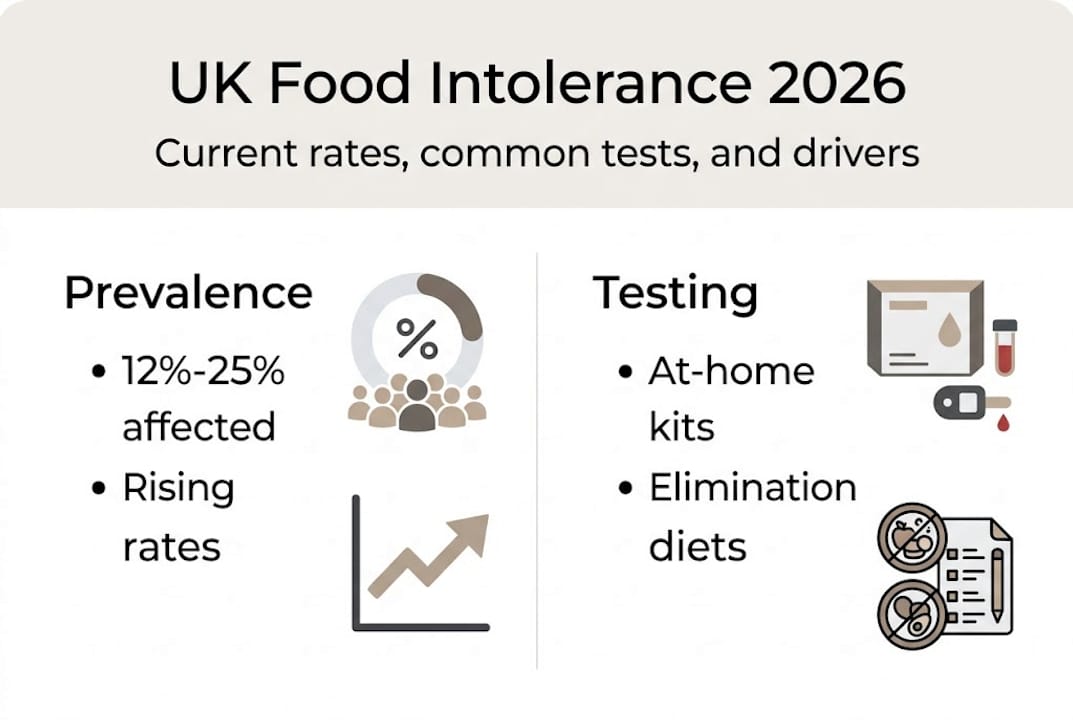
| Population group | Estimated self-reported intolerance rate |
|---|---|
| UK adults overall | 12% to 25% |
| Urban adults | Higher than rural average |
| Adults aged 18 to 34 | Above national average |
| Children and adolescents | Growing, see childhood food intolerance patterns |
What surprises many people is the range of symptoms linked to food intolerances. This is not just about an upset stomach after eating dairy. Symptoms can include:
- Digestive issues such as bloating, cramping, diarrhoea, and constipation
- Fatigue and brain fog that persists despite adequate sleep
- Skin reactions including eczema flare-ups, rashes, and acne
- Mood changes such as irritability, low mood, and anxiety
- Headaches and migraines with no obvious trigger
This breadth of symptoms explains why intolerance is so commonly missed or misattributed. Many people spend years attributing these problems to stress, poor sleep, or simply “the way they are.”
“Food intolerance symptoms are often delayed and diverse, making them genuinely difficult to pinpoint without structured investigation. Unlike allergies, the reaction can appear hours or even days after eating the trigger food.”
The focus on supporting gut health has grown considerably in public conversation, particularly as research into the gut microbiome has become more mainstream. People are now more aware that the digestive system can influence mood, immunity, and energy, which helps explain why so many are actively seeking answers about their own food responses.
Drivers behind the rise: Why food intolerance reporting is increasing
With this context, let’s examine what drives these trends and how the market and public attitudes are evolving. Reporting rates alone don’t tell the whole story. What’s actually fuelling this apparent surge in food intolerances across the UK?
Social media and health influencers play a substantial role. Platforms like Instagram, TikTok, and YouTube are full of creators sharing personal stories about eliminating gluten, dairy, or nightshades and experiencing dramatic health improvements. This content is compelling, relatable, and spreads fast. It’s also not always evidence-based, but it consistently raises awareness and encourages self-investigation.
Gut health has become a mainstream health priority. Conversations about the microbiome, digestive health, and the gut-brain connection are no longer confined to medical journals. They appear in mainstream media, on food packaging, and in everyday conversation. As understanding of gut health grows, more people recognise that their symptoms could be diet-related and feel motivated to find out which foods are involved.

Access to self-directed testing has expanded enormously. A decade ago, getting tested for food intolerances typically meant visiting a GP or paying for a private clinic appointment. Today, dozens of at-home testing kits are available online, often for under £100. This accessibility has made modern testing trends a significant part of the intolerance conversation.
The commercial market is reflecting this demand. The European food allergy and intolerance products market is projected to grow at 14.6% CAGR between 2026 and 2033, driven by both genuine medical need and health-trend purchasing behaviour.
39% of people identify their intolerances through personal research, while 14% use at-home testing kits, according to Ipsos polling data. This tells us that most people are essentially guiding their own health decisions without professional support.
Key factors driving increased reporting:
- Greater public awareness of gut health science
- Social media amplifying personal health stories
- Wider availability and lower cost of at-home test kits
- Increased presence of “free-from” products in UK supermarkets
- Growing cultural normalisation of food restrictions
Pro Tip: If you suspect a food intolerance, start by tracking your symptoms before buying any test kit. A structured symptom diary over two weeks will give you far more reliable initial data than reacting impulsively to a trend.
How to identify a food intolerance: Evidence-based approaches
Understanding what drives intolerance trends helps clarify why robust identification methods matter. Having a name for your symptoms is less useful than having a reliable method to find the cause. Here’s what the evidence actually supports.
The NHS and British Dietetic Association (BDA) both recommend the elimination diet as the primary method for identifying food intolerances. This is not a fad approach; it is a structured, validated protocol that has been used in clinical settings for decades.
Here is how a standard elimination diet works:
- Identify your suspected foods. Based on your symptom diary, note which foods correlate most often with your symptoms. Common culprits include dairy, gluten-containing grains, eggs, soy, and certain additives.
- Remove all suspected foods for two to six weeks. This period allows inflammation and symptoms to settle so you have a clear baseline to work from.
- Maintain a detailed symptom diary throughout. Note what you eat, when symptoms occur, their severity, and any relevant lifestyle factors such as stress or sleep quality.
- Reintroduce foods one at a time. Add a single food back into your diet and wait three to five days before introducing the next. This spacing is critical. It allows you to clearly identify which food triggers a response before adding further complexity.
- Record all reactions carefully. Any return of symptoms during reintroduction is meaningful data. Note the severity, timing, and nature of the reaction.
- Seek dietitian support if needed. If your symptoms are severe or if you are removing several food groups at once, a registered dietitian can ensure you are meeting your nutritional needs throughout the process.
“NHS guidance on food allergy and intolerance recommends symptom diaries and structured elimination diets as the most reliable identification tools available, alongside validated breath tests for specific intolerances such as lactose and fructose malabsorption.”
The elimination diet requires patience. Two to six weeks feels like a long time when you’re uncomfortable and looking for fast answers. But the data it generates is genuinely yours: specific, contextual, and based on your own body’s responses rather than a laboratory’s interpretation of a hair sample. For more practical guidance, see our article on identifying intolerances naturally.
Pro Tip: Use a free app or a simple notebook to log meals and symptoms in real time rather than trying to recall at the end of the day. Memory is unreliable when it comes to health tracking, and accuracy matters here.
At-home food intolerance tests: Popularity, promise and pitfalls
Once you’ve learned the evidence-based methods, many still consider at-home tests, so how should you approach and interpret them? The at-home testing market has expanded rapidly, and understanding what each test type can and cannot tell you is essential before you spend money or change your diet.
Here is an overview of the most common test types available:
| Test type | Method | Scientific status | Best used as |
|---|---|---|---|
| IgG blood test | Finger-prick blood sample | Measures antibody exposure, not intolerance | A starting guide, not a diagnosis |
| Hair analysis / bioresonance | Hair strands sent by post | No validated clinical evidence | Elimination diet starting point |
| Skin prick / patch test | Applied by GP or allergy clinic | Validated for allergies, not intolerance | Allergy identification only |
| Hydrogen breath test | Measures gas after ingesting substrate | Validated for lactose and fructose | Confirmed malabsorption testing |
At-home tests including hair analysis and bioresonance are widely criticised by clinicians for high false positive rates and a lack of independent scientific validation. The NHS does not recommend IgG testing or hair-based analysis for diagnosing food intolerances. This is worth knowing before you invest.
However, dismissing these tests entirely misses how many people actually use them. For a significant number of individuals, an at-home test provides a structured starting point for an elimination diet that they might otherwise never attempt. If you understand the test’s limitations, you can use its results as a hypothesis rather than a verdict.
The key risks to watch for:
- Over-restriction: Self-testing trends risk nutritional imbalances when people eliminate multiple food groups without dietary support
- False reassurance: A negative result does not rule out intolerance
- Misidentification: A positive marker indicates exposure to a food, not necessarily intolerance to it
You can read more about the science behind different approaches in our guide to testing options explained, our at-home accuracy guide, and specifically about hair sample testing and what it can realistically offer.
Pro Tip: If you use an at-home test, treat the results as a shortlist of foods to investigate through a proper elimination protocol, not as a confirmed list of things you must stop eating permanently.
Why self-testing is not a shortcut: Avoiding common pitfalls in 2026
There’s a cultural urgency right now around identifying food problems. Health content is everywhere, and it’s easy to feel that if you haven’t pinpointed your triggers, you’re somehow falling behind. That urgency can lead people to over-restrict their diets based on unvalidated results, and the consequences are real. Nutritional deficiencies, disordered eating patterns, and unnecessary anxiety around food are all documented outcomes of poorly guided self-testing.
Experts consistently emphasise that most at-home self-diagnosis methods are prone to misinterpretation. A test result is one data point. It should sit alongside your symptom diary, your dietary history, and ideally some input from a healthcare professional or registered dietitian.
The most effective approach combines structured self-observation with professional context. That means keeping your symptom diary, following a methodical elimination protocol, and using any test results to narrow your focus rather than set your diet in stone. Our guide on managing sensitivities naturally offers practical steps for doing exactly this.
Trust your body’s signals. Build habits of observation. Be cautious about permanent exclusions based on a single test. Real clarity comes gradually, not from one result.
Take the next step: Find clarity with guided intolerance testing
If you’ve been managing unexplained symptoms and feel ready to take a more informed, structured approach, you don’t need to navigate it alone. Understanding how to match the right diet to your body starts with having reliable information about your potential triggers.

At UK Food Intolerance, we offer simple, non-invasive hair sample testing analysed at a UK-based laboratory, with detailed digital reports returned within 48 to 72 hours. Our results are designed to support your elimination diet journey, giving you a clear, actionable starting point rather than a confusing diagnosis. Whether you’re new to intolerance testing or looking for a more thorough review, you can order an at-home intolerance test or explore all intolerance tests to find the option that suits your needs and budget.
Frequently asked questions
What are the most common symptoms of food intolerance?
Symptoms often go well beyond digestive discomfort and can include fatigue, skin reactions, and mood changes, which is why many people don’t immediately connect them to food. If you experience a cluster of seemingly unrelated symptoms, diet is often worth investigating.
How reliable are at-home food intolerance tests in 2026?
Most at-home kits, including IgG blood tests, hair analysis, and bioresonance, lack scientific validation and should be treated as guides rather than clinical diagnoses. They can be useful starting points for elimination diets when interpreted carefully.
What is the gold standard for identifying food intolerances?
NHS and BDA recommend structured elimination diets combined with symptom diaries, removing suspected foods for two to six weeks and reintroducing them one by one. This method produces the most reliable, personalised evidence available.
Can diet changes based on self-testing have side effects?
Yes. Self-testing risks nutritional imbalances when people eliminate multiple food groups without proper guidance, potentially leading to deficiencies in calcium, fibre, protein, or essential vitamins.
Are food intolerance rates actually increasing in the UK?
Self-reported rates up to 25% show a clear upward trend, particularly among younger and urban populations, driven by greater health awareness, social media influence, and easier access to testing options.










Leave a Reply
Want to join the discussion?Feel free to contribute!