

TL;DR:
- Most commercial food intolerance tests lack scientific validation and are not recommended by UK health authorities.
- Consulting a GP is essential to rule out serious conditions like coeliac disease and IBD before testing.
- Effective identification relies on supervised elimination diets and validated non-invasive tests such as hydrogen breath tests.
Millions of people across the UK live with bloating, cramping, and unpredictable digestion, quietly convinced that something in their diet is to blame. The market for at-home food intolerance tests has exploded in response, with hundreds of kits promising quick answers. But here is the uncomfortable truth: most of these popular commercial tests are not recommended by the NHS or leading UK health authorities. Knowing which non-invasive approaches actually work, and which ones waste your time and money, can make all the difference to your gut health and your overall wellbeing. This guide cuts through the confusion and gives you a clear, evidence-based path forward.
Table of Contents
- How to approach digestive symptoms: Where to start and red flags
- Clinically recommended non-invasive tests for food intolerances
- Other essential tests: Bloods, coeliac disease screening, and IBS workup
- Commercial tests and pitfalls: What does NOT work and why
- After testing: Next steps for gut health and sustainable change
- Why most self-testing for intolerances misses the real picture
- Find effective, science-backed testing for digestive health
- Frequently asked questions
Key Takeaways
| Point | Details |
|---|---|
| Start with medical advice | Always consult your GP to exclude serious health issues before testing for intolerances. |
| Evidence beats hype | Elimination diets and NHS-backed breath tests are the gold standard for non-invasive diagnosis in the UK. |
| Avoid unvalidated tests | Commercial tests like IgG blood kits are not reliable and can lead to unnecessary food avoidance. |
| Practical change matters | Work with professionals post-testing to improve gut health without risking nutritional deficiencies. |
How to approach digestive symptoms: Where to start and red flags
Before you order any test or start cutting foods from your diet, the single most important step is to see your GP. This is not just a formality. Digestive symptoms can have multiple overlapping causes, and some of those causes are serious. Ruling out conditions like coeliac disease, inflammatory bowel disease (IBD), or gut infections must come first. As IBS management guidelines make clear, you should always rule out organic disease before pursuing intolerance testing, since multiple causes often coexist.
Knowing the red flag symptoms helps you act quickly and confidently. Speak to your GP urgently if you notice any of the following:
- Unexplained weight loss over a short period
- Blood in your stools or rectal bleeding
- Severe or persistent abdominal pain
- Symptoms that wake you from sleep
- A family history of bowel cancer or coeliac disease
These symptoms need investigation before any intolerance testing begins. Conditions like small intestinal bacterial overgrowth (SIBO) can also mimic food intolerance, and it can overlap with other digestive problems at the same time. Getting the right diagnosis means asking your GP for specific tests rather than accepting a vague reassurance.
Ask your GP directly: “Can we screen for coeliac disease and check inflammatory markers before we discuss intolerance testing?” Being specific gets you better results.
Pro Tip: Bring a written symptom diary to your GP appointment. Note when symptoms occur, what you ate, and how long they last. This gives your doctor a much clearer picture and helps you follow a step-by-step intolerance guide more effectively once serious conditions are ruled out.
Clinically recommended non-invasive tests for food intolerances
Once your GP has cleared you of serious conditions, you can move on to identifying specific food intolerances. Not all non-invasive tests are created equal. Here is what the evidence actually supports.
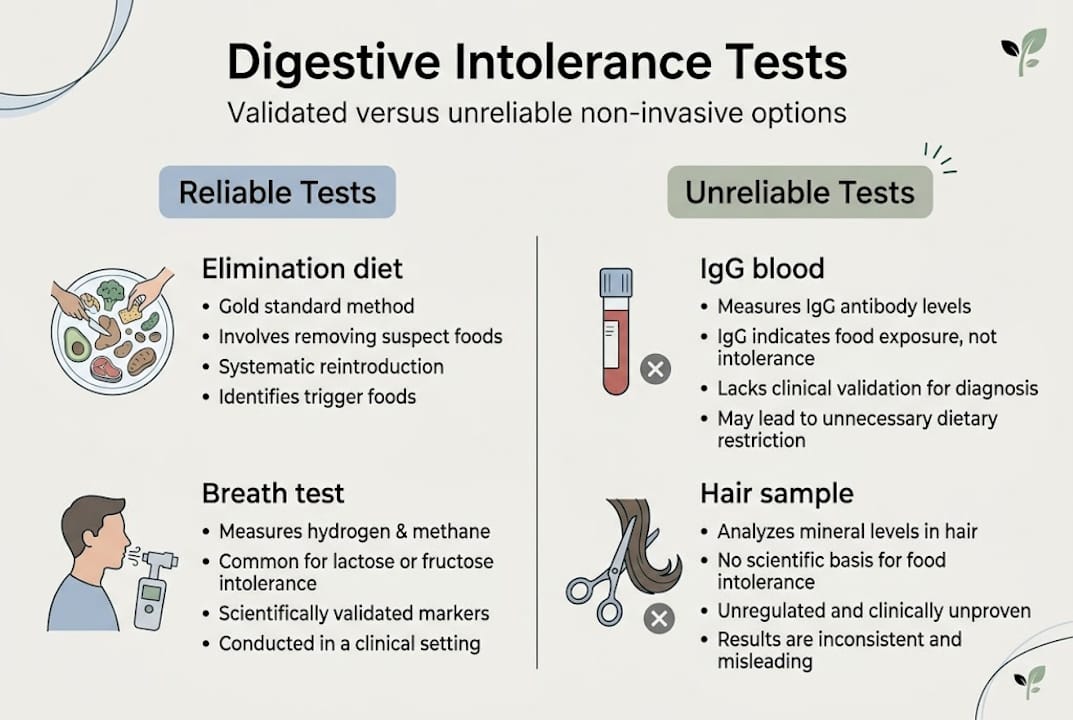
The gold standard approach is a supervised elimination diet combined with careful symptom tracking, ideally guided by a registered dietitian. You remove suspected trigger foods for a set period, then reintroduce them one at a time to observe your body’s response. It requires patience, but it produces reliable, personalised results.
For specific intolerances, hydrogen breath tests are a validated, non-invasive option. Hydrogen breath tests are clinically recognised for diagnosing lactose intolerance, fructose malabsorption, and SIBO. You drink a solution containing the sugar being tested, then breathe into a device at intervals. If your gut bacteria ferment the unabsorbed sugar, hydrogen levels in your breath rise, signalling a problem.
| Test method | What it detects | Evidence level | Invasive? |
|---|---|---|---|
| Elimination diet | Multiple food triggers | High (gold standard) | No |
| Hydrogen breath test | Lactose, fructose, SIBO | High (validated) | No |
| IgE skin prick test | True food allergies | High | Minimal |
| IgG blood test | Not reliably anything | Low (not recommended) | Yes |
Here is a simple, evidence-based sequence to follow:
- See your GP and rule out serious conditions
- Ask for a hydrogen breath test if lactose or fructose intolerance is suspected
- Work with a dietitian to begin a structured elimination diet
- Track symptoms carefully throughout each reintroduction phase
- Review results with your dietitian before making permanent dietary changes
Pro Tip: Check UK non-invasive testing trends to stay informed about which methods are gaining clinical support, and always ask whether a test has been validated before committing to it. Understanding why intolerance tests matter helps you make smarter choices from the start. You can also explore rapid food intolerance methods if you need results more quickly.
Other essential tests: Bloods, coeliac disease screening, and IBS workup
Blood tests are often the unsung heroes of digestive health investigation. They can reveal conditions that closely mimic food intolerance but require very different treatment.

Coeliac disease is a prime example. It is an autoimmune condition triggered by gluten, and its symptoms, including bloating, fatigue, and diarrhoea, look almost identical to a wheat intolerance. Coeliac screening uses a blood test for tTG-IgA antibodies, followed by an intestinal biopsy if the result is positive. Critically, you must keep eating gluten before and during the test. Stopping gluten too early causes false negative results, meaning the disease gets missed entirely.
For IBS diagnosis, a combination of tests helps distinguish a functional gut disorder from something more serious:
- Full blood count (FBC): Checks for anaemia and infection
- C-reactive protein (CRP): Elevated levels suggest inflammation, pointing away from IBS
- Faecal calprotectin: A stool test that helps separate IBS from IBD with good accuracy
- Thyroid function: An underactive thyroid can cause constipation and fatigue that mimic gut problems
A normal calprotectin result is genuinely reassuring. It makes IBD significantly less likely and supports an IBS or intolerance diagnosis instead.
| Blood/stool test | Purpose | Key point |
|---|---|---|
| tTG-IgA antibodies | Coeliac screening | Must eat gluten beforehand |
| CRP | Inflammation marker | High = investigate further |
| Faecal calprotectin | IBS vs IBD distinction | Non-invasive stool sample |
| Full blood count | General health screen | Rules out anaemia, infection |
Understanding the impact of intolerance testing on your diet decisions becomes much clearer once you have these baseline results. For guidance on choosing food sensitivity tests that complement your medical workup, it helps to know exactly what your GP has already investigated. For detailed information on lactose-specific testing, lactose test details provide a clear breakdown of what to expect.
Commercial tests and pitfalls: What does NOT work and why
Here is where many people lose time, money, and nutritional balance. The UK market is full of commercial intolerance testing kits, and the marketing can be very persuasive. But the science tells a different story.
Commercial IgG, hair, and bioresonance tests lack scientific validation and are not recommended by the NHS, the British Dietetic Association (BDA), or Which?. These tests are widely sold but produce results that are not clinically meaningful.
Here is why each popular option falls short:
- IgG blood tests: IgG antibodies simply reflect recent food exposure, not intolerance. Eating a food regularly will raise your IgG levels for it. A positive result means you ate it, not that you cannot tolerate it.
- Hair analysis: No peer-reviewed evidence supports the idea that hair can reveal food sensitivities. The results vary wildly between labs testing the same sample.
- Bioresonance devices: These claim to detect energy frequencies linked to intolerances. There is no scientific mechanism or clinical trial evidence to support this claim.
Statistic to note: Some investigations have found that different commercial labs testing the same individual’s sample return completely different lists of “intolerances,” highlighting how unreliable these tests are in practice.
The real danger is not just wasted money. Unnecessary food elimination based on unreliable results can lead to nutritional deficiencies, disordered eating patterns, and a reduced quality of life. Always check trends in commercial tests critically before purchasing.
Pro Tip: If a test promises to screen for hundreds of intolerances from a single sample with no medical involvement and no follow-up support, treat that as a warning sign rather than a selling point.
After testing: Next steps for gut health and sustainable change
Getting a result, whether from an elimination diet, a breath test, or a medical blood panel, is only the beginning. What you do next determines whether your gut health actually improves.
Here is a practical sequence for moving from diagnosis to lasting change:
- Review your results with a professional. A dietitian or GP can help you interpret what the findings mean for your specific situation.
- Follow a structured reintroduction plan. Removing foods permanently without need can harm your gut microbiome diversity. Reintroduce foods one at a time and observe your response carefully.
- Keep a symptom diary. Track what you eat, how you feel, and when symptoms appear. Patterns become obvious over time.
- Prioritise gut diversity. Eating a wide variety of plant-based foods supports a healthier gut microbiome, which in turn improves tolerance and overall digestive function.
- Seek ongoing support. Your needs will change. Regular check-ins with a dietitian keep your approach evidence-based and sustainable.
As post-testing guidance consistently emphasises, supervised reintroduction and dietary diversity are essential to avoid nutritional deficiencies after any elimination phase.
Pro Tip: Explore at-home testing options and the sensitivity test wellbeing guide to complement your medical journey with practical, accessible tools that fit around your daily life.
Why most self-testing for intolerances misses the real picture
We understand the appeal of a quick, postal test that promises a neat list of foods to avoid. It feels empowering. But in our experience, this approach often leaves people more confused, not less.
The core problem is that digestive symptoms rarely have a single, clean cause. Stress, gut bacteria imbalances, motility issues, and genuine intolerances can all produce identical symptoms. A commercial kit cannot distinguish between them. It simply produces a list.
Real improvement comes from working with the full picture: medical investigation, professional dietary support, and careful self-observation over time. Cutting out twenty foods based on an unvalidated test result does not heal a gut. It often makes things worse by reducing dietary variety and increasing anxiety around eating.
We believe that choosing quality food tests means asking hard questions about the evidence behind any product before you buy. The most effective path to better gut health is rarely the fastest one. It is the one built on accurate information, professional guidance, and sustainable habits.
Find effective, science-backed testing for digestive health
If you are ready to take your gut health seriously, the next step is choosing a testing approach that is reliable, accessible, and genuinely useful.

At UK Food Intolerance, we offer a range of evidence-based intolerance tests designed to give you clear, actionable information from the comfort of your home. Our simple hair sample process is non-invasive, fast, and processed at a UK laboratory, with detailed digital reports delivered within 48 to 72 hours. Whether you want to explore a broad range of potential sensitivities or focus on specific triggers, our full range of intolerance tests gives you options that suit your needs and budget. Ready to match your diet to your gut and start feeling better? We are here to support you every step of the way.
Frequently asked questions
What is the difference between a food allergy and a food intolerance?
A food allergy triggers an immune response and can be life-threatening, whereas a food intolerance usually involves digestion and mainly causes discomfort rather than severe illness.
Are commercial IgG blood tests reliable for diagnosing intolerances?
No. IgG tests lack scientific support and are not recommended by the NHS or leading UK authorities as a method for diagnosing food intolerances.
What is the most accurate non-invasive test for lactose intolerance in the UK?
Hydrogen breath tests are the validated, NHS-recognised method for diagnosing lactose intolerance non-invasively.
How should I prepare for a coeliac disease blood test?
Continue eating gluten before the test, as stopping gluten can lead to false negative results that cause the condition to be missed.
What should I do after getting a positive intolerance test result?
Work with a qualified dietitian to reintroduce foods carefully and maintain a balanced diet, following supervised reintroduction principles to avoid unnecessary long-term restrictions.










Leave a Reply
Want to join the discussion?Feel free to contribute!