

If you’ve spent months feeling bloated, exhausted, or uncomfortable after meals without any clear explanation, you’re not alone. Food intolerances cause delayed symptoms like bloating, diarrhoea, and fatigue, and because these reactions differ from immediate allergic responses, they’re notoriously difficult to pin down. The promise of a quick online test or a home kit that delivers answers overnight is understandably tempting. But before you spend money on something that may not help, it’s worth understanding what actually works for fast, safe intolerance detection in the UK.
Table of Contents
- What is a food intolerance and why detection is different from allergies
- Which intolerance detection methods are genuinely fast and reliable?
- How fast is ‘fast’? Real-world timelines for each method
- The risks of quick-fix tests: what most people miss
- Validated and emerging options for quick, safe detection
- Getting support: safe, guided testing for peace of mind
- Frequently asked questions
Key Takeaways
| Point | Details |
|---|---|
| Understand intolerance basics | Intolerances cause delayed symptoms quite unlike allergies and often go undetected without a clear process. |
| Beware unvalidated home kits | Most commercial self-tests lack scientific backing and can lead to unnecessary dietary changes. |
| Fast detection means careful tracking | Symptom diaries and apps can speed up pattern recognition but still require days, not minutes, for real insights. |
| Consult the experts | GPs and dietitians offer the safest, most effective way to diagnose intolerances and avoid nutritional risks. |
| Some new tech helps | AI-based tools can suggest possible triggers fast but should be used in combination with professional advice. |
What is a food intolerance and why detection is different from allergies
A food intolerance is your body’s difficulty processing a particular food or ingredient. Unlike a food allergy, it does not involve your immune system producing IgE antibodies. Instead, it tends to involve digestive enzymes, gut sensitivity, or chemical reactions to certain compounds in food.
The key challenge is timing. Delayed digestive symptoms like bloating, diarrhoea, stomach cramps, and fatigue can appear anywhere from 30 minutes to 72 hours after eating the trigger food. That delay makes it genuinely hard to connect what you ate to how you feel.
Common symptoms of food intolerance include:
- Bloating and wind
- Diarrhoea or loose stools
- Stomach pain or cramping
- Fatigue and brain fog
- Skin reactions such as rashes or eczema flare-ups
- Headaches
This is very different from an allergy, where symptoms appear within minutes and can be life-threatening. Because the mechanisms differ, the testing approaches differ too. Allergy testing looks for IgE antibodies. Intolerance detection is more complex, and choosing the wrong test leads to wasted money and persistent symptoms. You can read more in our food intolerance guide or explore childhood intolerances if you’re concerned about a younger family member.
According to Healthdirect, understanding the type of reaction you’re experiencing is the essential first step before choosing any test.
Which intolerance detection methods are genuinely fast and reliable?
Not all tests are created equal. Here’s a clear comparison of the main options available to UK consumers:
| Method | Speed | Reliability | Cost | Requires expert? |
|---|---|---|---|---|
| Elimination diet | 4–8 weeks | High (gold standard) | Low | Yes, ideally |
| IgG blood test | 3–7 days | Low | £50–£200 | No |
| Hair/bioresonance test | 48–72 hours | Unproven clinically | £30–£150 | No |
| AI symptom analysis | Days to weeks | Emerging, hypothesis only | Free to low | No |
| Hydrogen breath test | 1 day (in clinic) | High (for lactose/fructose) | £100–£300 | Yes |
The gold standard remains a supervised elimination diet with structured reintroduction, because no reliable lab test exists for most food intolerances. That said, it takes weeks, not hours.
For those wanting faster initial direction, an intolerance test comparison can help you weigh up your options. If you’re unsure where to start, our guide on choosing an intolerance test walks you through the decision step by step.
For specific conditions like lactose intolerance, hydrogen breath tests are clinically validated and can give results within a single appointment. For broader intolerances, however, no single rapid test has strong clinical backing.

Pro Tip: Before spending anything on a test, keep a detailed food and symptom diary for two weeks. It costs nothing, and it gives you and any healthcare professional a clear picture of patterns. This is often the fastest genuine insight tool available.
Expert guidelines from AAAAI reinforce that symptom tracking combined with professional oversight remains the most reliable starting point.
How fast is ‘fast’? Real-world timelines for each method
When people search for fast intolerance detection, they often hope for same-day answers. The reality is more nuanced. Here’s what you can realistically expect:
| Method | Time to first insight | Time to confident result |
|---|---|---|
| Symptom diary | 1–2 weeks | 2–4 weeks |
| AI symptom app | Days (pattern spotting) | Weeks of data needed |
| IgG blood test kit | 3–7 days (lab turnaround) | Unreliable regardless |
| Hydrogen breath test | Same day (in clinic) | Same day |
| Elimination diet | 2–4 weeks (removal phase) | 6–8 weeks total |
| Hair/bioresonance test | 48–72 hours | Unvalidated clinically |
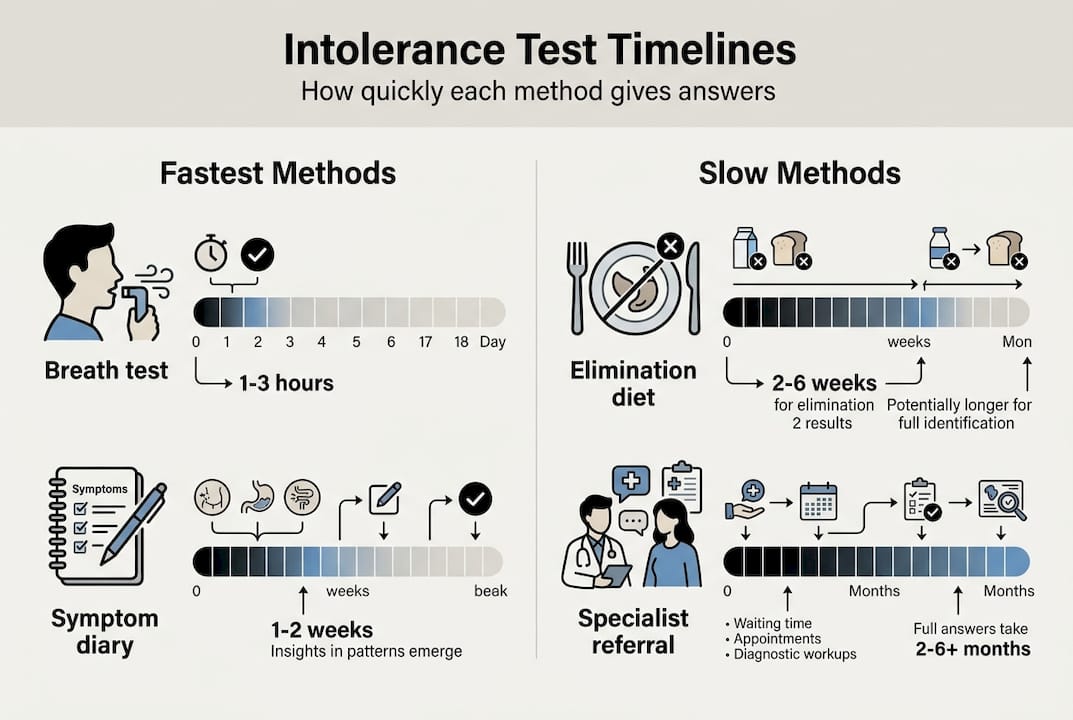
One important fact to keep in mind: symptoms can be delayed by up to 72 hours after eating a trigger food. This is precisely why so many people struggle to identify their triggers without structured tracking.
Stat callout: Up to 72 hours can pass between eating a trigger food and experiencing symptoms. This delay is the single biggest reason intolerances go undetected for months or even years.
NHS waiting times for specialist dietitian referrals can stretch to several months in some areas. Private clinics offer faster access, typically within one to two weeks. Our step-by-step intolerance testing guide helps you plan your approach regardless of which route you take.
For context, NHS advice recommends keeping a food diary as the first practical step before any formal testing.
The risks of quick-fix tests: what most people miss
The appeal of a fast, affordable home test is completely understandable. But there are real risks to be aware of before you commit.
Commercial IgG blood tests are not endorsed by the NHS, the British Society for Allergy and Clinical Immunology (BSACI), the British Dietetic Association (BDA), or the AAAAI. They measure IgG antibodies, which simply reflect foods you’ve been exposed to, not foods you’re intolerant to. A positive result may mean nothing more than the fact that you eat that food regularly.
Key risks of unvalidated tests include:
- False positives: Rates of 20–30% are common, leading you to cut out foods unnecessarily
- Nutritional deficiencies: Unnecessary dietary restrictions can lead to deficiencies in calcium, fibre, and essential vitamins
- Delayed proper diagnosis: Chasing false leads means the real trigger stays hidden
- Financial cost: Many kits cost £100 or more with no clinical value
“Patients who act on unvalidated test results often end up on highly restrictive diets with no improvement in symptoms, and sometimes with new nutritional problems.” This reflects the consistent position of UK dietitians and allergy specialists.
A Which? investigation into home intolerance testing kits found significant concerns about accuracy and value for money across multiple popular products.
Pro Tip: Always speak to your GP or a registered dietitian before eliminating any major food group. Cutting out dairy or gluten without guidance can cause more problems than it solves.
If you’re curious about specific methods, our pages on hair sample testing and bioresonance testing explain how these approaches work and what to expect from them.
Validated and emerging options for quick, safe detection
So what actually works? Here are the options that are either evidence-based or responsibly emerging for UK adults:
-
GP-supervised elimination diet with reintroduction — Still the most reliable method. Your GP or dietitian removes suspected foods for two to six weeks, then reintroduces them one at a time to identify triggers. Slow, but accurate.
-
Hydrogen breath test — Clinically validated for lactose and fructose intolerance. Available through NHS referral or private clinics. Results are available the same day.
-
Structured symptom diary — Free, immediate, and genuinely useful. Logging meals, symptoms, and timing over two to four weeks gives you and your healthcare provider a clear picture to work from.
-
AI-based symptom tracking apps — These tools analyse food logs and symptoms for correlations, including lagged reactions of 12 to 72 hours. They’re non-invasive and can speed up hypothesis generation, but they require consistent data over time and are not a substitute for clinical diagnosis.
-
Private dietitian consultation — Faster than NHS referral, typically within one to two weeks. A registered dietitian can guide you through elimination and reintroduction safely.
The most effective approach combines digital tracking tools with professional oversight. Technology can help you spot patterns faster. A professional helps you act on them safely.
Pro Tip: Use an AI symptom app as a tracking tool to gather data, then bring that data to a GP or dietitian appointment. You’ll get more from the consultation and potentially reach answers faster.
For more on responsible, non-invasive approaches, see our non-invasive testing guidance and our 2026 intolerance overview for the latest thinking on what’s available in the UK.
NHS guidance consistently recommends working with a healthcare professional rather than self-diagnosing through commercial kits.
Getting support: safe, guided testing for peace of mind
Now that you have a clearer picture of what works and what to avoid, the next step is finding practical support that fits your situation.

At UK Food Intolerance, we provide non-invasive at-home testing using bioresonance technology, with results delivered within 48 to 72 hours. Our tests screen over 1,100 items (or 500 with our Core option), giving you a detailed digital report you can use as a starting point for an informed conversation with your GP or dietitian. We also offer clear guidance on how to match your diet with test results so your next steps feel manageable, not overwhelming. Ready to take action? Explore our food intolerance tests and find the option that suits you best.
Frequently asked questions
Can you really detect food intolerances quickly at home?
You can begin by logging symptoms and diet to spot patterns, but definitive diagnosis requires professional guidance and often takes days to weeks. No reliable lab test exists for most food intolerances, making professional oversight essential.
What home tests for fast intolerance detection are scientifically backed?
Lactose intolerance breath tests are validated and give same-day results; most other home kits lack scientific support. Validated breath tests are used specifically for lactose and fructose intolerance in clinical settings.
Are commercial IgG blood tests reliable for quick intolerance answers?
No. IgG tests are unreliable for intolerance detection and are not endorsed by the NHS, BSACI, BDA, or AAAAI due to high false positive rates and no clear clinical benefit.
How long after eating do intolerance symptoms appear?
Symptoms typically appear between 30 minutes and 72 hours after eating a trigger food, which is why connecting symptoms to a specific meal is so difficult without structured tracking.










Leave a Reply
Want to join the discussion?Feel free to contribute!