

Glutamate sensitivity is the name people give to reacting to free glutamate, most often the added kind, monosodium glutamate (MSG, E621 on UK labels). Reported symptoms are usually mild and short-lived: flushing, headache, tingling, a tight or burning feeling around the mouth. The evidence on MSG is mixed, so the most useful step is a careful, structured look at your own pattern. Below you will find the symptoms, the foods and labels to know, and a safe way to find out what is behind your reactions.
TL;DR
- Reported symptoms include flushing, headache, muscle aches, tingling, palpitations and drowsiness, usually mild.
- Free glutamate sits in foods such as tomatoes, cheese, soy extracts and yeast extract, and appears as E621 on labels.
- Glutamate intolerance is not an allergy. It does not involve the immune system in the way an allergy does.
- Keep a food and symptom diary, and speak to your GP or a dietitian before cutting foods out, especially for children.
- If you want a wider picture of possible triggers, a home sensitivity test can give you a list to work from.
Table of Contents
- What glutamate sensitivity actually means
- Symptoms people report
- How strong is the evidence?
- Foods and ingredients that contain free glutamate
- Eating out and shopping with less guesswork
- How to find out whether glutamate is your trigger
- Our perspective
- Testing children and managing family meals
- Choosing the right test for you
- Ready to look at your triggers?
- FAQ
- Sources
What glutamate sensitivity actually means
Glutamate is an amino acid. It is found in almost all protein foods and is made naturally by your body. It is also the compound behind the savoury taste often called umami.
Most glutamate in food is “bound”, locked inside protein. Free glutamate is released from protein, whether through ageing, fermenting, cooking down or manufacturing, and it is the form your tongue picks up as savoury. MSG is the purified salt of glutamate added to food as a flavour enhancer.
When people talk about glutamate sensitivity, they usually mean one of two things:
- A reaction after eating foods with added MSG, sometimes called the MSG symptom complex.
- A suspicion that a wider range of glutamate-rich foods is behind recurring headaches, flushing or digestive discomfort.
It helps to be clear about what this is not. Unlike a food allergy, which is an immune system overreaction that can cause swelling or anaphylaxis, an intolerance is not immune-mediated and does not cause serious allergic reactions. That is reassuring. It also means the pattern can be harder to pin down, because reactions can be mild and vary from meal to meal.
Symptoms people report
If you react to MSG, the symptoms are usually mild. MedlinePlus lists these as the typical ones:
- flushing
- headache
- muscle aches
- numbness or burning in or around the mouth
- heart palpitations
- tingling
- drowsiness
People searching “MSG sensitivity symptoms” often want to know timing. One published summary of MSG intolerance says symptoms typically appear within two hours of eating, but that is a general pattern, not a rule. Intolerance reactions in general can be delayed and can build with the amount eaten, so a single meal may not tell the whole story.
When a symptom needs a doctor, not a diary
Palpitations, a racing heart, swelling of the lips or face, difficulty breathing or any sudden severe reaction need urgent medical attention. Do not put them down to a food sensitivity. Speak to your GP about symptoms that keep returning, and about anything unexplained that is getting worse.

How strong is the evidence?
Honest answer: it is mixed, and you deserve to hear that plainly.
- Regulators such as the FDA consider adding MSG to food generally recognised as safe.
- Well-controlled double-blind studies have not established a conclusive link between MSG and health problems, and much of the alarming coverage came from rat studies using extremely high doses.
- A 2016 systematic review in The Journal of Headache and Pain found inconsistent results and poor blinding in human studies, which makes a causal link with headache hard to establish. Many studies used strong MSG solutions that are easy to taste, so participants could tell what they were drinking.
- On the other hand, a 1997 challenge study found MSG produced greater symptom severity than placebo in sensitive participants, with an apparent threshold of 2.5 g on rechallenge.
What this means for you: many people eat MSG with no trouble, and some report clear reactions. Your own experience is a legitimate reason to look more closely at what you eat, and a structured approach is the way to do it.
Foods and ingredients that contain free glutamate
The search “glutamate foods list” is really a question about free glutamate. The FDA notes that it occurs naturally in tomatoes, cheeses and a number of ingredients: hydrolysed vegetable protein, autolysed or hydrolysed yeast, yeast extract, soy extracts and protein isolate. Other glutamate salts, such as monopotassium and monoammonium glutamate, are also used.
| Group | Examples | What to look for |
|---|---|---|
| Naturally rich | Tomatoes and tomato sauce, aged cheeses, mushrooms, seaweed | Often better tolerated in normal portions, but note which you eat together |
| Fermented and savoury | Soy sauce, miso, fish sauce, stock | Concentrated free glutamate |
| Flavour enhancers | MSG | E621 on UK labels |
| Processed ingredients | Yeast extract, hydrolysed vegetable protein, protein isolate | Common in stock cubes, gravy, crisps and ready meals |
In the UK and Europe, MSG appears as E621, so that is the code to scan for on ingredient lists.
Eating out and shopping with less guesswork
Whole, unprocessed foods are the simplest starting point, and checking labels for E621 is the next. Restaurants are not required to declare MSG as one of the 14 major allergens, so ask staff directly whether it is used. Broths, sauces and buffet-style dishes are the places to ask about.
A few practical habits help:
- Check labels for E621, yeast extract and hydrolysed protein, not just the word “MSG”.
- Cook simple meals from scratch for a couple of weeks while you observe.
- Ask about stock, marinades and seasoning blends when you eat out.
- Write down what you ate, roughly how much, and what you felt afterwards.
How to find out whether glutamate is your trigger
With a suspected intolerance, the approach that works is to look at patterns over time. The NHS says a dietitian may recommend avoiding a suspected food for a few weeks and then eating it again to see whether symptoms come back.
A simple step-by-step approach
- Keep a diary for two weeks. Record meals, snacks, drinks, symptoms and timing.
- Look for repeats. Do headaches or flushing follow the same kinds of meal, such as takeaways, instant noodles or stock-based dishes?
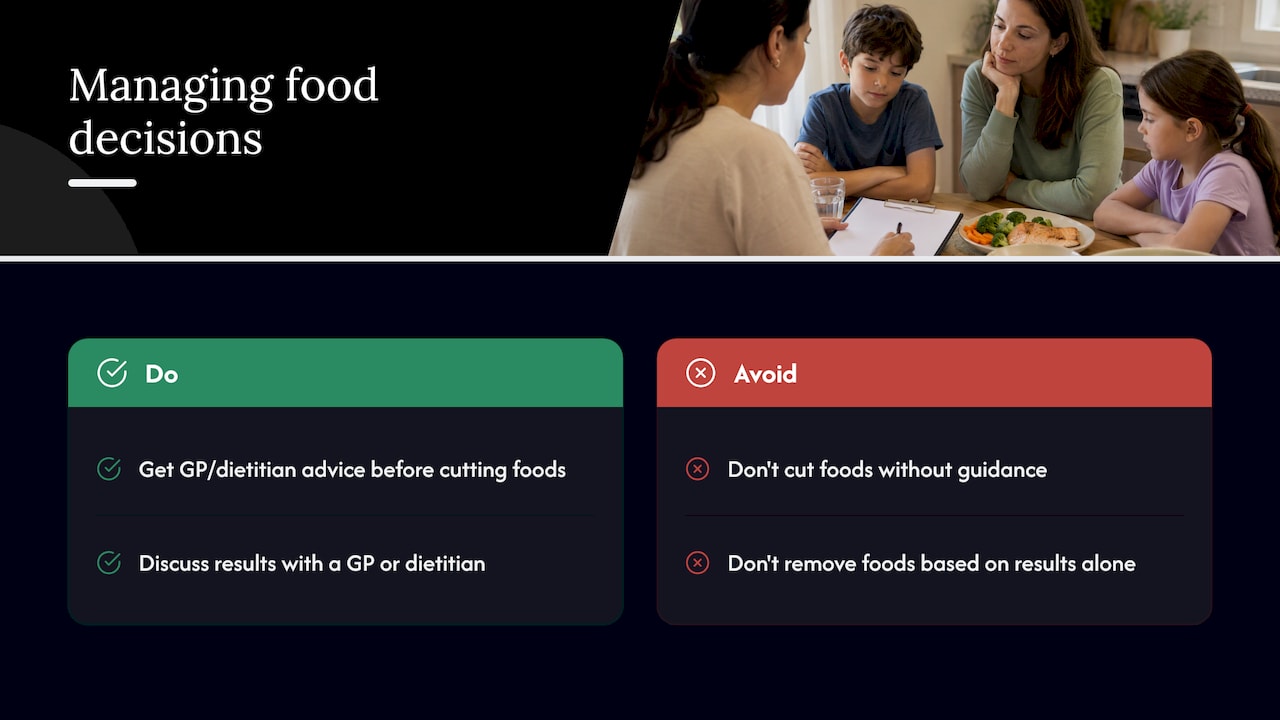
- Get professional guidance before removing foods. The NHS advises that you do not cut foods from your or your child’s diet without advice from a GP or dietitian, as you could miss important vitamins and minerals.
- Reintroduce one food at a time. This shows whether the symptoms really return.
- Review with your GP or dietitian. They can rule out other causes and help you plan balanced meals.
Where testing can fit in
A diary shows you patterns in what you already suspect. It is harder when several foods overlap in the same meal, because glutamate-rich ingredients tend to turn up together with wheat, dairy, tomato and soy. Some people find it useful to start with a broader view of possible triggers, so they know which foods to look at first. If you want to read about the different approaches, there is a guide to food sensitivity testing that explains the options, and our own pages on identifying food intolerances at home walk through the diary method in more detail.
Our perspective
We hear from many people who have a feeling that something they eat is not agreeing with them, but cannot say what. Headaches, flushing, bloating and tiredness rarely come with a label attached, and takeaways, stock cubes and sauces are full of ingredients that overlap.
That is why we built our service around a simple idea: give you a clear, wide list of items to work from, without needles or clinic visits. Our bioresonance hair test is designed to screen for food and environmental sensitivities, and our panel covers up to 1,450 items, the largest we know of in the UK. You collect a hair sample at home, send it to our UK-based laboratory and receive a digital report within 48 to 72 hours.
We are open that our tests are best suited to intolerance screening, and that they work best alongside an elimination diet. Your report gives you a starting point and a shortlist, and the reintroduction step shows you what is really going on for your body. If you are cutting foods out, we always encourage you to involve your GP or a dietitian, particularly for children.
{: }
Rob
Testing children and managing family meals
If your child has unexplained headaches, stomach upsets or tiredness, the same principles apply, with more care. Children are growing, so removing foods without guidance can leave gaps. The NHS advice to speak to a GP or dietitian before cutting foods from a child’s diet is the rule to follow here.
A hair sample is a gentle, needle-free way to collect information, which many parents find easier than other options. Our guide to testing children at home explains the steps. Use the results as a shortlist to discuss with your GP or dietitian, rather than a reason to remove foods straight away.
Choosing the right test for you
We offer several options, from our Core test (500 items) to our Ultimate range. If you want the widest view, the Ultimate Plus Intolerance Test is £140.99 one-off per person. If you are weighing up the options, our comparison of Core and Ultimate tests shows who each one suits. For background on what the report includes, see key markers in intolerance tests.
Ready to look at your triggers?
If you have been guessing at what sets off your symptoms, a clear list can make the next step much easier. Our at-home hair test is simple and non-invasive, and your digital report arrives within 48 to 72 hours of your sample reaching our UK laboratory.

You can see every option on our tests page, or go straight to the Ultimate Plus Intolerance Test. Each report comes with guidance on using the results in an elimination diet.
FAQ
Is glutamate sensitivity the same as an MSG allergy?
No. An allergy involves the immune system and can cause severe reactions such as swelling or anaphylaxis. MSG intolerance is non-immune-mediated and does not cause serious allergic reactions. If you ever have swelling or breathing difficulty, seek urgent medical help.
What foods are high in glutamate?
Free glutamate is found in tomatoes, cheeses, soy extracts, yeast extract, hydrolysed vegetable protein and protein isolate, as well as added MSG. In the UK, look for E621 on labels. Soy sauce, stock and aged cheeses are common everyday sources.
How long after eating do MSG symptoms start?
People who react typically notice symptoms within a couple of hours, and they are usually mild: flushing, headache, tingling or muscle aches. Timing can vary. A food and symptom diary helps you see whether the same meals come before the same symptoms.
Do restaurants have to tell me if a dish contains MSG?
No. MSG (E621) is not one of the 14 major allergens that UK restaurants must declare, so ask staff directly about broths, sauces and buffet dishes.
Sources
- MSG symptom complex, MedlinePlus Medical Encyclopedia
- Questions and Answers on Monosodium glutamate (MSG), FDA
- What is MSG and is it really bad for you?, BBC Good Food
- Does monosodium glutamate really cause headache? A systematic review, The Journal of Headache and Pain
- The monosodium glutamate symptom complex: assessment in a double-blind, placebo-controlled study
- Food intolerance, NHS
- Food sensitivity testing guide










Leave a Reply
Want to join the discussion?Feel free to contribute!