

TL;DR:
- Core tests identify common food sensitivities, suitable for standard diets and first-time testers.
- Ultimate tests cover over 1,100 items, including environmental triggers, ideal for complex or persistent symptoms.
- Results guide elimination diets; ongoing tracking and professional advice enhance effectiveness.
Choosing between a core and an ultimate intolerance test can feel genuinely overwhelming, especially when you’re already dealing with bloating, fatigue, or skin flares that nobody seems to be able to explain. You search online, see both options listed side by side, and wonder: does the more expensive test actually give better answers, or is the core version perfectly good enough? The truth is, both serve a purpose, but they suit different people in different situations. This guide breaks down exactly what each test covers, how to compare them honestly, and how to use your results to start feeling better.
Table of Contents
- What are core and ultimate intolerance tests?
- Side-by-side comparison: core vs ultimate intolerance test
- How to interpret your intolerance test results
- Limitations and evidence: what should you know?
- The bottom line: what most people overlook about intolerance testing
- Explore your options and get support
- Frequently asked questions
Key Takeaways
| Point | Details |
|---|---|
| Clear definitions | Core tests cover common triggers while ultimate tests include a wider range of foods and substances. |
| Practical comparison | A side-by-side approach helps you pick a test based on your symptoms, diet, and budget. |
| Result interpretation matters | How you use your results and adjust your diet makes more impact than which test you choose. |
| Limitations exist | Intolerance test results are a useful guide, but not medical diagnoses and should be acted on with care. |
| Actionable next steps | Support and test options are available for UK readers seeking personalised insights. |
What are core and ultimate intolerance tests?
Food intolerance tests are designed to identify which foods or environmental items may be triggering unwanted reactions in your body. They are not allergy tests, and they do not diagnose medical conditions. Instead, they give you a starting point: a list of potential sensitivities that you can use to guide your diet and lifestyle choices.
The core intolerance test focuses on the most commonly consumed foods. Think wheat, dairy, eggs, gluten, soy, and a range of fruits, vegetables, and additives. It typically covers around 500 items and is well suited to people who eat a fairly standard diet and want to identify the most likely culprits behind their symptoms.
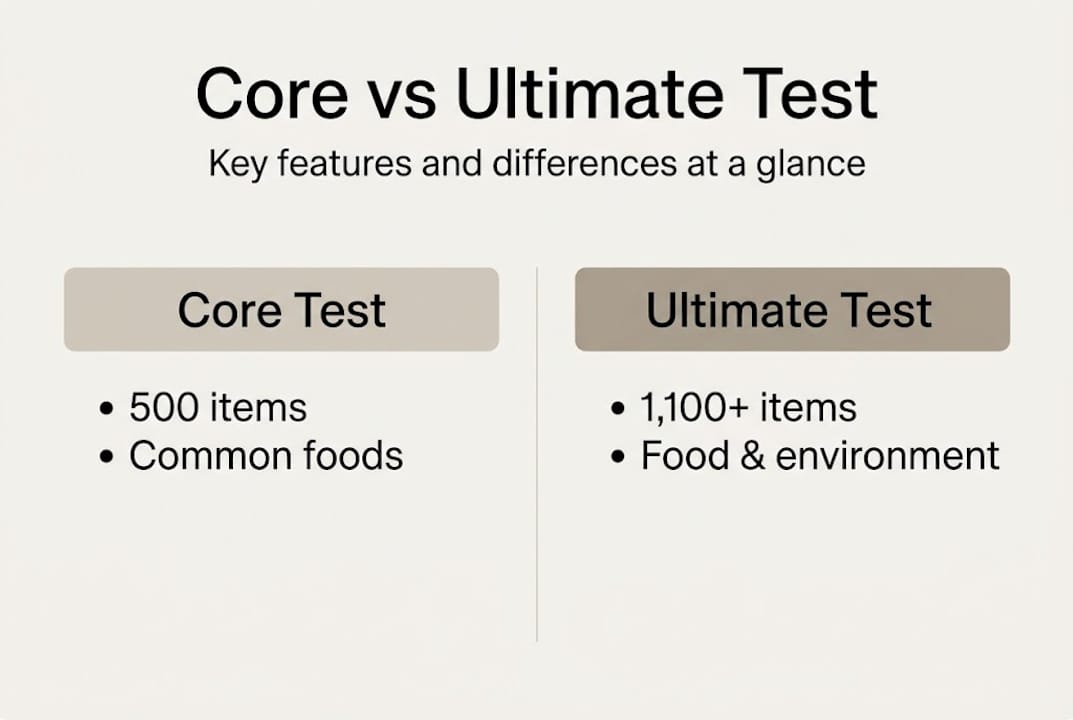
The ultimate intolerance test goes further. It tests over 1,100 items, including less common foods, environmental triggers such as dust mites and pollens, and even certain metals and moulds. It is aimed at people with more complex or persistent symptoms who suspect something less obvious is involved.
Both tests use bioresonance technology, which analyses a small hair sample you collect at home and post to a UK laboratory. The process is entirely non-invasive, meaning no blood draws, no needles, and no clinic visits. You simply send your sample and receive a detailed digital report within 48 to 72 hours.
Here is a quick summary of what each test covers:
- Core test: Around 500 items, primarily food-based, fast turnaround, more affordable
- Ultimate test: Over 1,100 items, includes environmental and non-food triggers, deeper analysis
- Both tests: Use bioresonance technology, hair sample collection, UK laboratory analysis
- Neither test: Provides a medical diagnosis or replaces professional healthcare advice
Many users report symptom relief after following elimination diets based on their results, though this evidence is largely anecdotal. Explore the full test range to see all available options before deciding.
Side-by-side comparison: core vs ultimate intolerance test
Now that you understand the basics, here is a closer look at how the two tests differ in practice. The table below covers the key features that matter most when you are trying to choose.
| Feature | Core intolerance test | Ultimate intolerance test |
|---|---|---|
| Items tested | ~500 | 1,100+ |
| Food categories | Common foods only | Common and rare foods |
| Non-food triggers | Not included | Included (moulds, metals, pollens) |
| Price range | More affordable | Higher investment |
| Turnaround time | 48 to 72 hours | 48 to 72 hours |
| Report detail | Clear sensitivity list | Extended, detailed breakdown |
| Best suited for | Standard diets, first-time testers | Complex symptoms, unusual diets |
The core test details show it is an excellent starting point if you are new to intolerance testing or if your diet is fairly conventional. It covers the foods most likely to cause reactions in the general UK population.

The ultimate intolerance test is the better choice if you have already tried eliminating common foods without much improvement, or if you follow a specialist diet such as vegan, vegetarian, or gluten-free and want broader coverage.
Special considerations worth noting:
- Children: Both tests can be used for children, as the hair sample method is completely painless
- Families: Ordering separate tests per family member gives the most accurate individual results
- Vegetarians and vegans: The ultimate test includes more plant-based and alternative food items
- Unusual diets: If you eat a wide variety of international or specialist foods, the ultimate test offers more relevant coverage
Users following elimination diets after testing often report noticeable improvements in digestion and energy, though individual results vary.
Pro Tip: If you are unsure which test to start with, consider your symptom history. If symptoms are broad and persistent, the ultimate test may save you time by ruling out more triggers in one go.
How to interpret your intolerance test results
Receiving your results is exciting, but it is also the moment where many people go wrong. Understanding what your report actually means will help you get far more out of it.
Your results will show a list of items flagged as potential sensitivities, often ranked by severity. This is not a diagnosis. It is a guide. Think of it as a map rather than a verdict.
Here is a step-by-step approach to using your results effectively:
- Review the full report before making any changes. Note which items appear at the highest sensitivity level.
- Prioritise the top sensitivities. Start by eliminating the top three to five flagged items rather than everything at once.
- Keep a food diary. Record what you eat and how you feel each day. This is essential for tracking genuine improvements.
- Follow an elimination period. Remove the flagged items for at least four to six weeks to give your body time to respond.
- Reintroduce foods one at a time. After the elimination period, bring foods back slowly and note any returning symptoms.
- Adjust based on your observations. Your diary is your evidence. Use it to refine your diet over time.
For further guidance, interpreting your results is covered in detail on our dedicated support page.
“The process of elimination and reintroduction is where the real insight happens. The test gives you the list; your diary gives you the proof.”
It is also worth managing expectations. Some people feel significant improvement within weeks. Others notice more subtle changes. User experiences post-elimination are largely positive but vary from person to person. Patience and consistency matter more than speed.
Limitations and evidence: what should you know?
Being honest about what intolerance testing can and cannot do is important. Here is what the current picture looks like.
Bioresonance technology analyses the energetic frequencies of a hair sample to identify potential sensitivities. It is a non-invasive method that many people find accessible and reassuring. However, formal scientific validation of its accuracy is limited, and independent testing reviews note that no empirical benchmarks have been established for this type of testing.
So why do so many people report genuine improvement? Several factors are likely at play:
- Increased dietary awareness: The act of testing encourages closer attention to what you eat
- Elimination benefits: Removing processed or inflammatory foods often improves wellbeing regardless of specific sensitivities
- Placebo effect: Believing you are taking action can itself reduce perceived symptoms
- Genuine sensitivity identification: For some users, the results do appear to reflect real reactions
Here is a summary of the current evidence landscape:
| Evidence type | Current status |
|---|---|
| Peer-reviewed clinical trials | Limited for bioresonance specifically |
| User-reported outcomes | Largely positive post-elimination |
| Expert medical consensus | Recommends combining with GP advice |
| Placebo contribution | Acknowledged but not fully quantified |
The core intolerance test and the ultimate plus test are best used as personal health tools rather than medical instruments. They are most valuable when combined with professional medical advice, particularly if your symptoms are severe or long-standing.
The key takeaway: use these tests as a starting point for self-awareness, not as a final answer.
The bottom line: what most people overlook about intolerance testing
Here is something we see time and again. People receive their test results, read through the list, and immediately expect the report alone to fix everything. They cut out the flagged foods for a week, notice no dramatic change, and conclude the test was useless.
That is not how this works, and it misses the real value entirely.
The most meaningful improvements come from what you do after you receive your results. The test is a prompt, not a prescription. It gives you a focused starting point so that your food tracking becomes purposeful rather than random. Without that structure, most people simply carry on as before, vaguely aware that something is wrong but unsure where to look.
What actually creates change is the combination of a sensitivity list, a consistent food diary, and a willingness to adjust your diet over several weeks. The test makes that process targeted. It narrows a very large field of possibilities down to a manageable shortlist.
We also think people underestimate the value of simply paying closer attention to their body. Many users tell us that the act of testing prompted them to notice patterns they had ignored for years. That awareness alone, separate from any specific result, can be genuinely life-changing.
Explore your food intolerance test options with that mindset, and you will get far more from the experience.
Explore your options and get support
If you have read this far, you are clearly ready to take a more informed approach to your health. That is a great position to be in.
At UK Food Intolerance, we make it straightforward to compare professional test kits and choose the option that fits your symptoms, lifestyle, and budget. Whether you are starting with the core test or going straight to the ultimate, you can order securely online and receive your digital report within 48 to 72 hours. We also offer a range of home test options with full support resources, including result interpretation guides, to help you take confident next steps. You do not have to figure this out alone.
Frequently asked questions
Can I trust the results of a core or ultimate intolerance test?
Results are a useful guide for dietary awareness, but they should not be treated as medical diagnoses. User reports show improvement after elimination, though scientific support for bioresonance testing remains limited.
What is the main advantage of the ultimate test over the core test?
The ultimate test checks over 1,100 items including non-food triggers such as moulds and pollens, making it more useful if you suspect less common or environmental sensitivities.
Is intolerance testing suitable for children or special diets?
Yes, the hair sample method is painless and non-invasive, making it suitable for children, and the ultimate test covers a broader range of foods relevant to specialist diets.
Do I need both a core and an ultimate intolerance test?
For most people, one test is enough. Start with the core test if your diet is standard, or go straight to the ultimate if your symptoms are complex or you follow a specialist diet.










Leave a Reply
Want to join the discussion?Feel free to contribute!