

Dietary triggers can worsen acid reflux and GERD symptoms for many people, but they do not cause the condition on their own. The most practical first step is not a sweeping elimination diet. It is a short food and symptom diary, kept for 2–4 weeks, that helps you identify which specific foods actually provoke your symptoms before you cut anything out permanently.
- Dietary triggers worsen reflux in many people but are rarely the sole cause of GERD.
- Individual responses vary widely: food that reliably triggers one person may cause no symptoms in another.
- NHS guidance advises avoiding patient-identified triggers rather than following a blanket exclusion list.
- NICE clinical guidance recommends lifestyle measures, including trigger avoidance and weight reduction, as the first non-pharmacological step.
- Diet trials work best alongside, not instead of, medical review when symptoms are persistent or severe.
Pro Tip: Start your diary before changing anything. Two to four weeks of baseline data is far more useful than two weeks of guessing after you have already cut out five foods at once.
Key takeaways
Dietary triggers worsen reflux symptoms for many people, but individual responses vary so much that personalised tracking is the only reliable way to identify what affects you specifically.
| Point | Details |
|---|---|
| Start with a diary | Keep a 2–4 week food and symptom diary before making any exclusions. |
| Trial one trigger at a time | Remove single suspect food for 2–4 weeks, then reintroduce it to confirm the link. |
| Weight loss has the strongest evidence | Reducing excess weight consistently improves reflux symptoms and is a primary NICE recommendation. |
| Red flags need a GP | Difficulty swallowing, unintentional weight loss, or bleeding require urgent clinical review, not a diet trial. |
| Ukfoodintolerance as an adjunct | An at-home bio-resonance test can prioritise your elimination shortlist, covering over 1,450 items with results in 48–72 hours. |
Table of Contents
- How do dietary triggers affect reflux? The physiological mechanisms
- Which foods commonly trigger reflux, and how strong is the evidence?
- What dietary patterns have the best evidence for reducing reflux?
- How to safely test dietary triggers: an elimination and reintroduction protocol
- How to avoid nutritional harm when restricting foods
- When should you see a GP? Red flags and how diet fits with medical treatment
- Can at-home sensitivity testing help you identify dietary triggers?
- How strong is the overall evidence, and why does personalisation matter?
- What practitioners commonly see, and the pitfalls worth avoiding
- Ukfoodintolerance: a practical starting point for personalised trigger testing
- Sources
How do dietary triggers affect reflux? The physiological mechanisms
The role of dietary triggers in reflux is not simply about acidity or spice. Food alters reflux risk through several distinct biological pathways, and understanding them helps you make smarter choices rather than avoiding foods unnecessarily.
The lower oesophageal sphincter (LES) is the muscular valve that keeps stomach contents from travelling upward. When it relaxes at the wrong moment, reflux occurs. Certain foods directly influence this process. Fat is one of the most studied culprits: it stimulates the release of cholecystokinin (CCK), a gut hormone that both slows gastric emptying and relaxes the LES. A high-fat meal therefore creates a double problem: more stomach contents sitting longer, with a valve less able to hold them back.
Beyond fat, carbonated drinks introduce gas that increases gastric pressure, physically forcing the LES open. Alcohol and caffeine both have direct relaxant effects on the sphincter. Spicy foods and acidic items such as citrus and tomato do not necessarily worsen LES function, but they can irritate the oesophageal mucosa directly, making existing reflux more painful even when they do not increase the volume of reflux itself.
Meal size and timing matter just as much as food type. A large meal distends the stomach, raising intragastric pressure and increasing the likelihood of transient LES relaxations. NICE recommends having the evening meal 3–4 hours before bedtime, which allows gastric emptying to reduce the volume available to reflux when you lie down. Eating behaviour also plays a role: eating quickly and swallowing air (aerophagia) contributes to bloating and can trigger reflux episodes that are then wrongly attributed to a specific food.
Key mechanisms to keep in mind:
- LES relaxation: triggered by fat (via CCK), alcohol, caffeine, and chocolate.
- Delayed gastric emptying: high-fat meals slow stomach clearance, prolonging reflux risk.
- Increased intragastric pressure: large meals, carbonated drinks, and tight clothing all raise pressure.
- Mucosal irritation: acidic and spicy foods worsen symptoms by irritating the oesophageal lining, even without increasing reflux volume.
- Aerophagia: rapid eating and carbonated drinks increase swallowed air and bloating.
Peer-reviewed evidence confirms these mechanisms are plausible and well-supported physiologically, though the clinical trial evidence linking individual foods to measurable reflux reduction is more variable.
Which foods commonly trigger reflux, and how strong is the evidence?
NHS patient information and NICE guidance both identify a consistent set of foods as common reflux precipitants. The list below reflects that UK clinical consensus alongside an honest appraisal of the evidence behind each item.
| Trigger | Primary mechanism | Evidence strength | Practical trial tip |
|---|---|---|---|
| Coffee | LES relaxation, increased acid secretion | Moderate (individual variation common) | Remove for 2 weeks; note whether decaf also triggers symptoms |
| Alcohol | LES relaxation, mucosal irritation | Moderate (dose-dependent) | Trial complete abstinence for 2–4 weeks rather than reduction |
| Chocolate | LES relaxation (methylxanthines, fat) | Moderate | Eliminate entirely for 2 weeks; dark and milk chocolate both implicated |
| Fatty foods | CCK release, delayed gastric emptying | Strong (mechanistic) | Switch to lower-fat cooking methods for 2–4 weeks |
| Spicy foods | Mucosal irritation | Moderate (highly individual) | Remove all chilli and pepper for 2 weeks; reintroduce one at a time |
| Citrus/tomato | Mucosal irritation, acidity | Moderate | Avoid raw citrus and tomato-based sauces for 2 weeks |
| Carbonated drinks | Increased intragastric pressure | Moderate | Replace with still water for 2 weeks |
| Onions and garlic | LES relaxation, fermentation/gas | Weak to moderate | Trial cooked forms first; raw forms are more likely to provoke symptoms |
| Mint | LES relaxation | Weak (limited trial data) | Avoid mint teas, sweets, and toothpaste flavouring for 2 weeks |
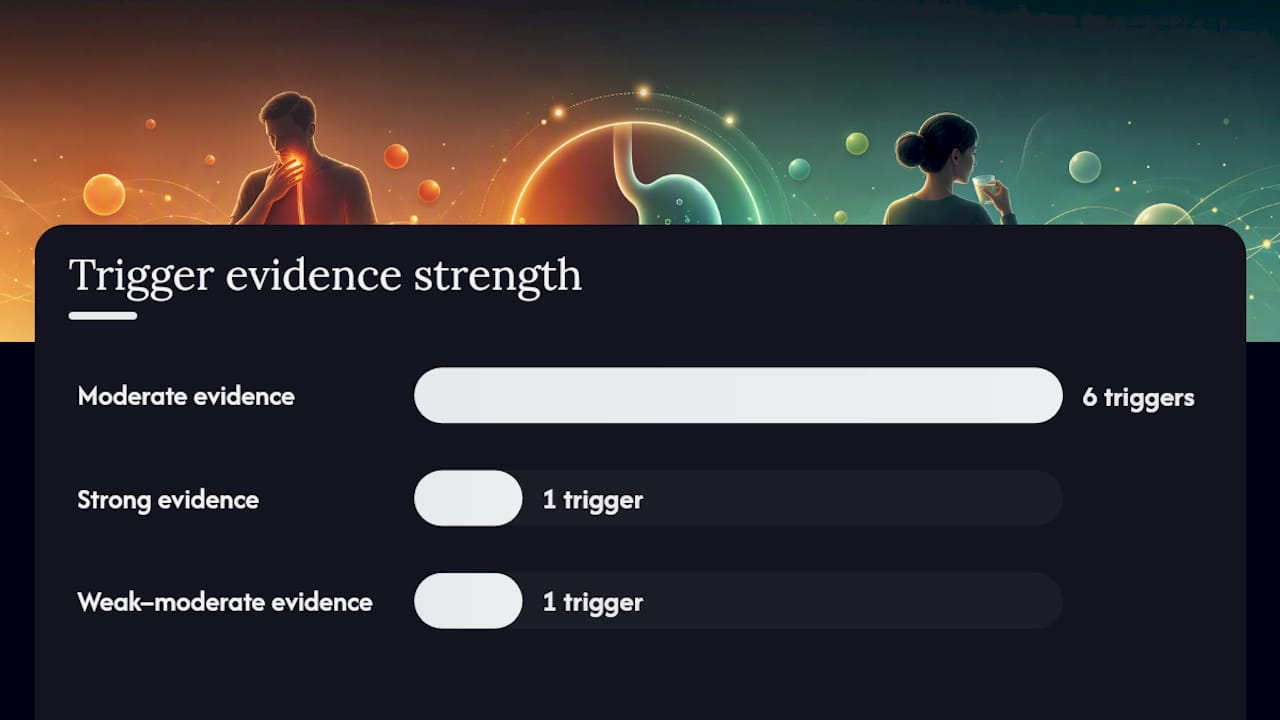
A few important caveats. Coffee and alcohol are frequently cited in guidance, but systematic review evidence shows that controlled trials have not consistently demonstrated symptom improvement when they are removed. This does not mean they are harmless for everyone; it means individual tracking matters more than blanket avoidance. Your foods to avoid checklist for digestive health can help you structure this process.
Pro Tip: Trial one trigger at a time. Removing five foods simultaneously makes it impossible to know which change, if any, made the difference.
- The NHS advises avoiding the specific triggers you have personally identified, not every food on a generic list.
- NICE includes avoidance of known precipitants alongside weight reduction and meal timing as first-line lifestyle advice.
- Research on functional foods and GERD suggests that some dietary components may protect the oesophageal mucosa, though evidence quality varies.
What dietary patterns have the best evidence for reducing reflux?
Single-food avoidance gets most of the attention, but whole-diet patterns often have stronger and more consistent evidence behind them.
Weight loss has the most robust support. Excess abdominal weight increases intragastric pressure and is a well-established risk factor for GERD. Controlled trials and observational studies consistently show symptom improvement with weight reduction in overweight patients, and NICE lists it as a primary lifestyle intervention. Even modest weight loss can produce meaningful symptom relief.

A low-fat, moderate-calorie diet addresses the CCK-LES mechanism directly and tends to reduce gastric emptying delay. The evidence here is mechanistically strong, though long-term trial data is limited. A Mediterranean-style diet, rich in vegetables, wholegrains, and lean protein with limited processed food and saturated fat, aligns well with the low-fat principle and has emerging evidence for symptom benefit, partly through weight management and partly through reduced mucosal inflammation.
Low-FODMAP diets are primarily evidenced for irritable bowel syndrome (IBS), but there is growing interest in their use for people with overlapping IBS and GERD symptoms, given that gas production and bloating can worsen reflux. The evidence for low-FODMAP as a primary GERD intervention remains limited; it is most relevant when IBS symptoms co-exist. You can read more about the overlap between IBS and food triggers if this applies to you.
| Dietary pattern | Typical effect on reflux | Evidence confidence |
|---|---|---|
| Weight loss (where overweight) | Consistent symptom improvement | High |
| Low-fat diet | Reduces LES relaxation and gastric delay | Moderate (mechanistic support strong) |
| Mediterranean-style diet | Symptom reduction, anti-inflammatory | Moderate (emerging) |
| Low-FODMAP | Reduces gas/bloating; limited GERD-specific data | Low to moderate (IBS overlap only) |
- NICE guidance recommends weight reduction, avoiding large meals, and eating the evening meal 3–4 hours before bedtime as core lifestyle measures.
- Peer-reviewed reviews confirm that diets limiting fats and simple sugars and increasing fibre may offer symptom benefit, but trial results are heterogeneous.
- Functional food research identifies certain fibres and probiotics as potentially helpful for selected patients, though the evidence base is not yet consistent enough for universal recommendations.
How to safely test dietary triggers: an elimination and reintroduction protocol
The recommended total timeline for a structured dietary trigger trial is a few weeks. For a single suspected food, several weeks of elimination is usually sufficient to see a meaningful change in symptoms. More complex patterns, or multiple suspected triggers, may need longer.

Milton Keynes University Hospital patient guidance recommends keeping a food and symptom diary for 2–4 weeks as the starting point for identifying personal triggers.
Here is a stepwise protocol you can follow safely at home:
- Baseline tracking (1–2 weeks). Before changing anything, record every meal, portion size, eating time, posture after eating, symptom severity (use a 0–10 scale), and any medications taken. This baseline is your reference point.
- Identify your top one or two suspects. Review your diary and pick the food or drink most consistently associated with symptoms. Do not eliminate more than two items at once.
- Elimination phase (2–4 weeks). Remove the suspect item completely. Keep everything else the same, including medications. Log symptoms daily using the same severity scale.
- Assess the result. If symptoms improve by at least 50%, the item is a likely contributor. If there is no change, that food is probably not your primary trigger.
- Structured reintroduction. Reintroduce the eliminated food in a normal portion on one day, then observe for 48–72 hours before drawing conclusions. A clear return of symptoms confirms the trigger.
- Washout between trials. Allow 3–5 days of symptom stability before trialling the next suspected item.
- Interpretation. Build a personal trigger list based on confirmed responses, not suspicion. Use this list to guide long-term dietary adjustments.
Your diary should log: food and drink consumed, portion size, time of eating, time of symptoms, symptom type and severity, medications taken, sleep position, and stress level (a useful confounder to track).
Pro Tip: Keep your medication use stable throughout the trial unless your GP advises otherwise. Changing your diet and your medication at the same time makes it impossible to attribute any improvement to either.
A practical guide to identifying food triggers safely can walk you through each step in more detail.
Important: Do not stop prescribed proton pump inhibitor (PPI) therapy or any other medication without speaking to your GP first. Dietary trials complement medical treatment; they do not replace it.
How to avoid nutritional harm when restricting foods
Restrictive diets carry real nutritional risks, particularly when multiple food groups are removed without a plan; a gut health family diet overhaul: a practical guide can help maintain balance while identifying triggers. The NHS advises maintaining a balanced diet and cautions against unnecessary exclusions.
Specific nutrient gaps to watch for:
- Calcium and vitamin D: at risk if dairy is restricted. Consider fortified plant milks, tinned fish with bones, and leafy greens as alternatives. A supplement may be appropriate if intake is consistently low.
- Fibre: at risk if wholegrains, vegetables, or legumes are cut. Low fibre can worsen constipation and indirectly worsen bloating, which may aggravate reflux.
- B vitamins (especially B12): at risk if animal products are broadly restricted.
- Iron: at risk if red meat and fortified cereals are removed simultaneously.
Practical dos and don’ts:
- Do replace excluded foods with nutritionally equivalent alternatives rather than simply removing them.
- Do consider a broad-spectrum multivitamin and mineral supplement if you are excluding a major food group for more than four weeks, as hospital nutrition guidance suggests.
- Don’t remove more than two food groups simultaneously without dietetic supervision.
- Don’t assume that a food being a “trigger” means it must be avoided forever. Many people can reintroduce foods in smaller quantities or different preparations once symptoms are under control.
A registered dietitian can help you maintain nutritional adequacy while working through a structured elimination plan.
When should you see a GP? Red flags and how diet fits with medical treatment
Diet trials are appropriate for mild to moderate, uncomplicated reflux symptoms. They are not a substitute for medical assessment when warning signs are present.
Seek urgent GP review if you experience any of the following:
- Unintentional weight loss
- Persistent or worsening difficulty swallowing (dysphagia)
- Persistent vomiting or vomiting blood
- Black or tarry stools (possible gastrointestinal bleeding)
- Anaemia (unexplained tiredness, pallor)
- New or worsening symptoms in adults over 55
- Symptoms that do not respond to 4 weeks of lifestyle changes and over-the-counter antacids
Within the NICE pathway for dyspepsia and GORD, lifestyle measures including trigger avoidance, weight loss, and meal timing are recommended as first-line steps. If symptoms persist, your GP may recommend a trial of PPI therapy (such as omeprazole or lansoprazole), which reduces stomach acid production and is the standard pharmacological treatment for GERD in the UK. For persistent, severe, or complicated disease, endoscopy or specialist referral may be indicated.
Dietary changes and PPI therapy are not mutually exclusive. Clinical reviews confirm that diet is one component of a multidisciplinary approach, and that some patients with refractory symptoms benefit from addressing lifestyle and mucosal irritants alongside acid suppression rather than relying on medication alone.
Pro Tip: When you see your GP, bring your food and symptom diary, a list of current medications, and a note of how long you have had symptoms. This information helps your GP assess severity and decide whether investigations are needed.
Can at-home sensitivity testing help you identify dietary triggers?
At-home sensitivity tests, including bio-resonance tests, can suggest candidate triggers and help you prioritise which foods to trial in an elimination protocol. They are not allergy diagnostics and do not replace structured elimination/reintroduction or clinical assessment. Used sensibly, they can be a useful starting point.
Ukfoodintolerance offers at-home bio-resonance testing using hair samples processed in UK laboratories. The digital report covers over 1,450 items and includes potential food sensitivities, environmental sensitivities, nutritional imbalances, and gut biome indicators. Results are typically delivered within 48–72 hours. This kind of report can help you narrow down a long list of suspected triggers to a shorter, prioritised set, which makes your elimination diary more targeted and less overwhelming.
How to use a test sensibly within the overall workflow:
- When to order: after completing an initial 1–2 week baseline diary and before starting a formal elimination phase. The report can help you decide which items to trial first.
- How to use results: treat flagged items as candidates for elimination trials, not confirmed intolerances. Use the report alongside your diary data and, where possible, discuss results with a dietitian or GP.
- Nutrient flags: the report includes data on potential vitamin and mineral imbalances, which is useful context when planning a restricted diet.
- What the test does not do: it does not diagnose food allergies, coeliac disease, or any medical condition. If you suspect a true allergy or coeliac disease, speak to your GP for appropriate testing.
You can find out more about how testing can match your diet to your body and explore the bio-resonance testing methodology in detail.
Pro Tip: Use your test report as a shortlist, not a verdict. The elimination and reintroduction protocol is still the gold standard for confirming which foods genuinely affect your symptoms.
How strong is the overall evidence, and why does personalisation matter?
The honest answer is that the evidence is mixed. Weight loss and basic lifestyle measures (meal timing, portion control, head-of-bed elevation) have the strongest and most consistent support. Single-food avoidance has a plausible mechanistic basis but weaker and more variable trial evidence.
Key limitations in the research:
- Most dietary intervention studies for GERD are small, short-term, and use inconsistent definitions of reflux (symptom scores versus objective pH monitoring).
- Systematic analyses identify significant methodological heterogeneity and call for better-designed trials with consistent outcome measures.
- Confounding factors, including concurrent PPI use, weight changes, and stress, make it difficult to isolate the effect of any single dietary change.
- Patient responses are genuinely heterogeneous: a trigger that reliably worsens symptoms in one person may have no effect in another with the same diagnosis.
Practical implications of this evidence picture:
- Prioritise interventions with stronger evidence first: weight loss if relevant, meal timing, portion size, and avoiding your personally confirmed triggers.
- Use objective tracking (a diary with a symptom severity scale) rather than relying on memory or general impressions.
- Involve a clinician when results are ambiguous, symptoms are severe, or you are making significant dietary changes over an extended period.
- Treat guidance lists as starting points for investigation, not prescriptions for universal avoidance.
What practitioners commonly see, and the pitfalls worth avoiding
The most common mistake people make is going too broad, too fast. Cutting out eight foods simultaneously, stopping their PPI, and starting a new supplement all in the same week makes it impossible to understand what is actually helping. When symptoms improve, they cannot identify the cause. When symptoms persist, they feel stuck.
The second most common pitfall is misattributing symptoms to a single dramatic food, such as chilli, while overlooking the more mundane contributors: meal size, eating speed, late-night eating, or alcohol consumed alongside the meal. The impact of food choices on reflux is rarely about one dramatic villain.
Combining self-monitoring with professional input, even a single dietitian appointment, tends to produce better outcomes than either approach alone. A diary gives you data. A clinician helps you interpret it without bias.
Ukfoodintolerance: a practical starting point for personalised trigger testing
If you have kept a diary and still feel uncertain about which foods are driving your symptoms, an at-home sensitivity test from Ukfoodintolerance can help you narrow the field. Rather than working through a generic list of 20 possible triggers one by one, you get a prioritised report covering over 1,450 items, including foods, environmental factors, and nutritional markers, delivered to you digitally within 48–72 hours of sending your hair sample to a UK laboratory.

The process is straightforward: order your test online, collect a small hair sample at home, post it to the lab, and receive a clear digital report. Use the flagged items as your shortlist for structured elimination trials, and share the nutrient imbalance data with your GP or dietitian for context. This approach saves time and helps you focus your efforts where they are most likely to make a difference.
Explore the full range of at-home intolerance tests or go straight to the home test kit options to find the right test for you.
Sources
The following resources underpin the guidance in this article and are worth bookmarking for further reading.
- Heartburn and acid reflux – NHS
- Scenario: Dyspepsia – unidentified cause | Management | Dyspepsia – unidentified cause | CKS | NICE
- The role of diet in the development and management of gastroesophageal reflux disease: why we feel the burn – PMC
- Gastro‑Oesophageal Reflux and Nutrition – Milton Keynes University Hospital
- Functional Food in Relation to Gastroesophageal Reflux Disease (GERD) – PMC
- PMC review on multidisciplinary management of reflux
- PMC article on research gaps and need for high‑quality trials
This article provides general information about dietary triggers and reflux management. It is not a substitute for professional medical or dietetic advice. If you have persistent, severe, or worsening symptoms, please consult your GP or a registered healthcare professional.










Leave a Reply
Want to join the discussion?Feel free to contribute!