

TL;DR:
- Food allergy involves an immune response that can be life-threatening, whereas intolerance is a digestive issue not usually dangerous. Recognizing symptom timing, severity, and affected systems helps differentiate between the two for safer management. Professional guidance and structured testing, including diary methods and elimination trials, remain the most reliable approach to identifying food triggers.
If you’ve ever felt unwell after eating and wondered whether it’s an allergy or just something your body struggles to digest, you’re not alone. Millions of people in the UK experience food-related symptoms every year, yet allergy and intolerance are genuinely different conditions with different mechanisms, different risks, and different solutions. Confusing the two isn’t simply a matter of getting the label wrong. It can mean missing a potentially life-threatening allergy, cutting out nutritious foods unnecessarily, or spending months chasing the wrong answers. This guide gives you the clarity to understand both conditions, recognise your own symptoms, and take the safest possible steps forward.
Table of Contents
- What is the difference between allergy and intolerance?
- How to recognise symptoms and red flags
- The safest steps for at-home food intolerance discovery
- What about commercial at-home tests?
- Conditions that mimic allergy or intolerance
- Why most people get allergy vs intolerance wrong (and what actually works)
- Get expert guidance on your food symptoms
- Frequently asked questions
Key Takeaways
| Point | Details |
|---|---|
| Know the basic difference | Allergy involves the immune system and can be serious, but intolerance affects digestion and is rarely dangerous. |
| Look for red flag symptoms | Immediate or severe symptoms, breathing difficulty, or blood in stools should prompt medical advice. |
| Use safe at-home methods | The most reliable self-assessment combines a detailed diary with cautious, time-limited elimination and reintroduction. |
| Commercial tests have limits | NHS and Allergy UK warn that most commercial home ‘intolerance tests’ are not clinically valid and may cause needless restriction. |
| Always consider other conditions | Some diseases can mimic intolerance or allergy; consulting a clinician is crucial for lasting, safe results. |
What is the difference between allergy and intolerance?
To start, let’s break down the science and practical differences between food allergy and intolerance.
A food allergy is an immune system reaction. Your body mistakenly identifies a food protein as a threat and mounts a defence. This triggers the release of chemicals, including histamine, which causes symptoms that can appear rapidly and become severe. Classic allergic foods include peanuts, tree nuts, shellfish, fish, milk, eggs, wheat, and soya. In serious cases, a food allergy can trigger anaphylaxis, a life-threatening reaction requiring immediate medical attention.
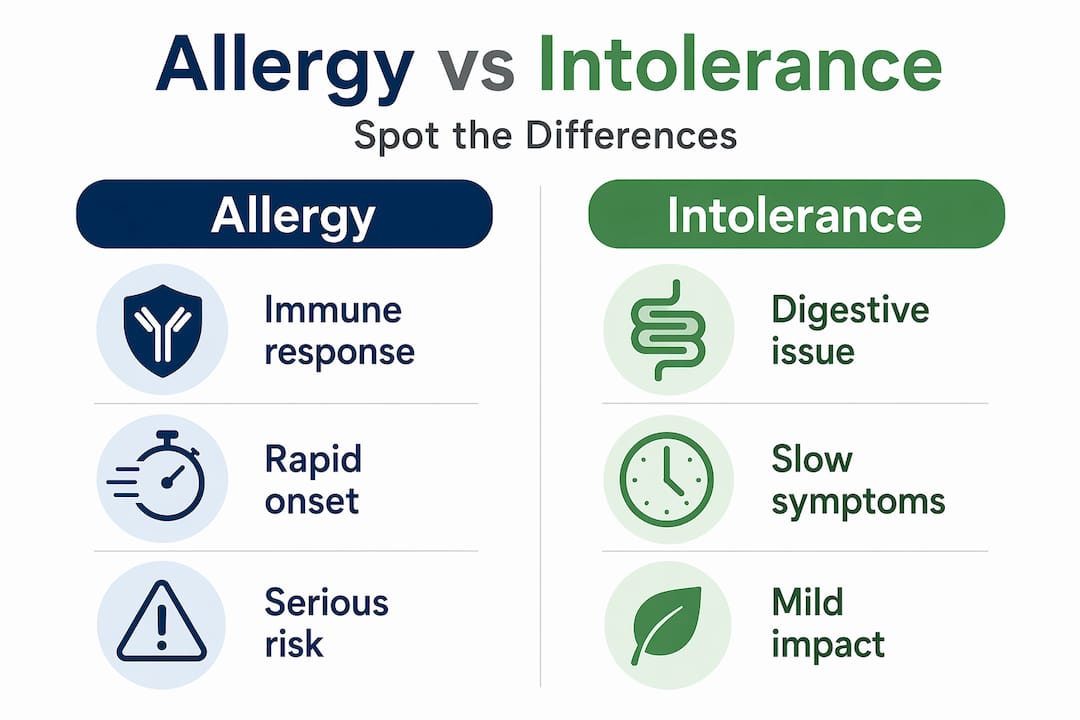
A food intolerance, by contrast, is primarily a digestive issue. As Allergy UK explains, intolerance involves difficulty digesting a food or its components and does not involve the immune system in the same way. This means it is not life-threatening like a true allergy. Lactose intolerance, where the body lacks the enzyme to break down lactose in milk, is a well-known example. Fructose malabsorption and sensitivity to food additives are others.
The overlap in symptoms is a key reason so many people become confused. Both can cause nausea, abdominal discomfort, and digestive upset. However, timing, severity, and the presence of specific signs can help you start to tell them apart.

| Feature | Food allergy | Food intolerance |
|---|---|---|
| Mechanism | Immune system (IgE-mediated) | Digestive or chemical |
| Onset | Minutes to 2 hours | Often hours to days |
| Severity | Can be life-threatening | Rarely dangerous |
| Immune involvement | Yes | No (or minimal) |
| Typical triggers | Peanuts, shellfish, eggs, milk | Lactose, gluten (non-coeliac), additives |
| Reversible with exclusion | Sometimes | Often yes |
Key distinctions to remember:
- Allergies can occur from tiny trace amounts of a food.
- Intolerances are often dose-dependent, meaning small amounts may cause no symptoms.
- Allergy symptoms frequently involve the skin, airways, or cardiovascular system.
- Intolerance symptoms are usually confined to the gut.
“Intolerance is not the same as allergy and not life-threatening. Food intolerance is about difficulty digesting a food or its components and does not involve the immune system.” — Allergy UK
Understanding food intolerance vs allergy explained in this way is the first step towards making sense of your own experience. For a broader comparison, our allergy vs intolerance guide goes into further detail.
How to recognise symptoms and red flags
Having understood what sets allergy and intolerance apart, let’s look at how you can spot the signs in your own health story.
Common allergy symptoms tend to appear quickly, usually within minutes to two hours of eating the trigger food. These include:
- Hives, itching, or eczema flare-ups
- Swelling of the lips, tongue, face, or throat
- Wheezing, difficulty breathing, or a tight chest
- Vomiting and stomach pain
- A sudden drop in blood pressure (anaphylaxis)
Common intolerance symptoms typically develop more slowly and are usually limited to the digestive system:
- Bloating and excess wind
- Abdominal cramping or discomfort
- Diarrhoea or loose stools
- Nausea after meals
- Headaches or fatigue in some cases
The timing and overlap of symptoms can make self-diagnosis genuinely difficult. Some non-immune reactions are delayed, and certain intolerances can cause skin or head-related symptoms that initially look like allergy responses.
Red flags that need urgent medical attention include:
- Difficulty breathing or swallowing
- Swelling of the throat or tongue
- Rapid heartbeat combined with dizziness
- Blood in stools
- Unintentional and unexplained weight loss
- Symptoms that escalate with each exposure
If you experience any of these, do not attempt home management. See a GP or call 999 without delay.
Initial self-evaluation steps:
- Write down exactly what you ate and when symptoms started.
- Note how long symptoms lasted and how severe they were.
- Identify whether symptoms were confined to your digestive system or spread elsewhere.
- Check whether symptoms improved when you avoided the suspected food.
- Look for patterns across multiple episodes rather than relying on a single event.
Learning to recognise intolerance symptoms at home is a practical skill, but it should always be paired with professional guidance when anything feels serious.
Pro Tip: Keep a record for at least two to four weeks before drawing any conclusions. A single food incident is rarely enough evidence to identify a clear pattern, and prolonged unnecessary exclusion of foods without evidence can cause nutritional problems of its own.
The safest steps for at-home food intolerance discovery
If you’re considering self-testing your reactions at home, it’s essential to follow a stepwise, safe plan rather than simply cutting foods at random.
Allergy UK advises that the safest non-invasive approach to suspected food intolerance combines a symptom diary with a structured elimination and reintroduction trial. Elimination periods typically run two to six weeks for suspected non-IgE-mediated reactions. This method gives your body enough time to settle before you reintroduce foods one at a time.
Step-by-step process:
- Consult a healthcare professional first. Rule out red flag symptoms and serious conditions before you begin any exclusion. This protects your health and stops you from mismanaging something that needs medical treatment.
- Start your food and symptom diary. Record everything you eat, the time you eat it, and any symptoms that follow. Note the severity, duration, and location of discomfort.
- Identify your top suspected foods. Based on patterns in your diary, pinpoint two or three foods that seem to correlate with your worst symptoms.
- Begin a structured elimination phase. Remove the suspected food completely from your diet for two to six weeks. Make sure you are still meeting your nutritional needs with suitable alternatives.
- Reintroduce foods one at a time. After the elimination phase, reintroduce one food at a time and monitor carefully for 48 to 72 hours before trying the next.
- Review and interpret your findings. Consider what the pattern tells you and discuss the results with a dietitian or GP before making permanent changes.
| Stage | Duration | Goal |
|---|---|---|
| Symptom diary | 2 to 4 weeks | Identify patterns |
| Elimination phase | 2 to 6 weeks | Reduce suspected trigger |
| Reintroduction | 2 to 3 days per food | Confirm trigger |
| Review | Ongoing | Refine and adjust |
Tracking symptoms at home consistently over time gives you far better data than memory alone. Our guide to identifying food intolerances naturally also walks you through practical approaches in more detail.
Allergy UK also warns that excluding foods unnecessarily and without structure can restrict important nutrients. This is why dietitian support is strongly recommended, particularly if you are removing whole food groups like dairy or gluten-containing grains.
Pro Tip: Only eliminate one food at a time wherever possible. Cutting multiple foods simultaneously makes it nearly impossible to pinpoint which one was actually responsible for your symptoms.
What about commercial at-home tests?
Many readers wonder whether it’s worth buying an “at-home intolerance test”, so let’s examine what science and medical advice says about these kits.
The commercial test market includes several types of kits:
- IgG antibody blood tests: These measure antibodies to various foods, but IgG antibodies are a normal immune response to eating, not a sign of intolerance.
- Hair sample and bioresonance tests: These analyse hair samples and claim to detect sensitivities based on energy frequencies.
- Skin prick and patch tests: These are used by medical professionals to diagnose true allergies and are not the same as consumer kits.
The important caution here is that many commercial IgG-based intolerance tests are not considered clinically valid or endorsed for diagnosis. Reputable sources, including NHS guidance, warn that these tests can lead to unnecessary dietary restriction. Following the results of an unvalidated test without professional review could mean you cut out nutritious foods that weren’t actually causing your symptoms.
This doesn’t mean commercial tests have no role at all. For some people, a test result that highlights a potential sensitivity can be a useful starting point for a conversation with their GP or dietitian. The key is to treat any result as a hypothesis, not a diagnosis.
You can explore the range of about at-home tests available and understand what they do and don’t tell you before making a decision.
Pro Tip: Think of any commercial intolerance test as a discussion starter for your healthcare provider, not as final authority. A structured elimination trial and professional review remain the most reliable route to understanding your food triggers.
Conditions that mimic allergy or intolerance
Even with the right tools, sometimes symptoms are not caused by a straightforward allergy or intolerance.
Several conditions can produce symptoms that look very similar to food-related reactions:
- Coeliac disease: This is an immune-mediated condition triggered by gluten. Coeliac disease damages the lining of the small intestine and causes diarrhoea, abdominal pain, bloating, and fatigue. It is neither an allergy nor an intolerance in the traditional sense and requires specific blood tests and a gut biopsy for diagnosis. Cutting gluten before testing can actually make results inaccurate.
- Irritable bowel syndrome (IBS): IBS causes recurrent gut symptoms including cramps, bloating, and altered bowel habits. Certain foods, particularly those high in fermentable sugars (known as FODMAPs), can worsen IBS symptoms without there being any true intolerance.
- Eosinophilic oesophagitis (EoE): A condition where a type of white blood cell builds up in the oesophagus, often linked to food triggers. It can cause difficulty swallowing and chest pain and requires specialist diagnosis.
- Functional dyspepsia: A long-term condition causing stomach pain and bloating with no clear structural cause, often triggered or worsened by certain foods.
- Inflammatory bowel disease (IBD): Conditions like Crohn’s disease or ulcerative colitis can cause significant gut symptoms that might be mistaken for food intolerance.
Missing a diagnosis like coeliac disease by assuming symptoms are caused by a simple intolerance can delay essential treatment and lead to long-term damage. Always get proper tests before making permanent dietary changes.
This is why healthcare consultation before you begin any long-term exclusion is so important. The right diagnosis changes everything about how you manage your symptoms safely.
Why most people get allergy vs intolerance wrong (and what actually works)
Here’s a frank take on what’s usually misunderstood and how to stay safer and healthier.
The most common mistake we see is that people assume any unpleasant food reaction is an intolerance and start cutting foods out immediately. In reality, managing food sensitivities effectively requires a more structured approach than simply avoiding anything that recently preceded a bad day.
The second mistake is the opposite: dismissing genuine intolerance symptoms as normal digestion or stress, and never investigating them at all. This leads to months or even years of unnecessary discomfort when the solution might be relatively straightforward.
There’s also a cultural tendency in the UK to either over-rely on commercial test results or distrust them entirely. The nuanced reality is that no single test, diary, or consultation tells the whole story. The gold standard remains a detailed medical history combined with a clinician-supervised food challenge. A symptom diary is a genuinely powerful self-help tool that feeds directly into that process.
Perhaps the most overlooked truth is this: cutting out foods for months without a clear evidence base can cause real nutritional harm, particularly if you’re removing dairy, gluten, or other food groups that provide essential vitamins and minerals. The discomfort of an unmanaged intolerance is real. But the solution is careful, methodical investigation rather than sweeping elimination driven by anxiety.
What actually works is a layered approach. Start with professional guidance. Build a solid symptom diary. Follow a structured elimination and reintroduction process. Treat any commercial test as supplementary information, not a final verdict. And revisit your approach with a dietitian if you’re not getting clear answers.
Get expert guidance on your food symptoms
Ready to take positive action? Here’s how you can get reliable help matching your health needs.
Understanding whether your symptoms point to an allergy, intolerance, or something else entirely is the foundation of better health. At UK Food Intolerance, we offer accessible, non-invasive tools to help you start building that picture. Whether you want to explore food intolerance tests from the comfort of home or browse our range of at-home test kits, our resources are designed to support your investigation, not replace medical care.

Our hair-sample based analysis is fast, simple, and UK-based, with results delivered digitally within 48 to 72 hours. Use those results alongside the guidance in this article to identify food triggers safely and effectively and take the next steps with your healthcare provider. You deserve clarity, and we’re here to support every step of that process.
Frequently asked questions
Can a food intolerance ever become a true allergy?
No. Food intolerance does not turn into a food allergy because the mechanisms are entirely different. Intolerance involves digestion; allergy involves the immune system.
How quickly do allergy symptoms start compared to intolerance?
Allergy symptoms typically appear within minutes to two hours of exposure, while intolerance reactions can develop hours or even a day or two later.
Are any at-home intolerance tests endorsed by the NHS?
No. IgG-based intolerance test kits are not endorsed by the NHS, which warns they can lead to unnecessary restriction of nutritious foods.
What conditions should be considered before blaming a food intolerance?
Coeliac disease is a key example, but IBS, eosinophilic oesophagitis, and inflammatory bowel disease can all produce gut symptoms that closely resemble intolerance reactions.
Is it safe to eliminate foods for a long time?
No. Excluding foods unnecessarily can restrict essential nutrients. Always consult a dietitian or healthcare provider before removing whole food groups from your diet for an extended period.










Leave a Reply
Want to join the discussion?Feel free to contribute!