

TL;DR:
- Hair strand allergy tests are sensitivity screening tools, not clinical diagnoses for allergies.
- They analyze electromagnetic frequencies in hair to identify potential sensitivities to foods and environmental items.
- Results should be used as a starting point for investigations, not definitive proof of allergies.
Many people across the UK assume a hair strand allergy test will hand them a definitive list of allergies. That expectation is understandable, but it misses what these tests actually do. Hair strand testing is a sensitivity screening tool, not a clinical diagnosis. If you have been struggling with bloating, fatigue, skin flare-ups, or other unexplained symptoms, understanding exactly what this type of test offers, and where its limits lie, will help you use it wisely. This guide walks you through everything clearly, from the science behind the process to what to do once your results arrive.
Table of Contents
- What is a hair strand allergy test?
- How hair strand allergy tests work in practice
- Comparing hair tests, blood tests, and NHS allergy diagnosis
- What to do with your results: Next steps and UK guidance
- Our take: Where hair strand allergy testing really fits in your journey
- Find the right test and support for your journey
- Frequently asked questions
Key Takeaways
| Point | Details |
|---|---|
| Test limitations | Hair strand tests may flag sensitivities but do not replace clinical allergy diagnosis in the UK. |
| At-home process | You can collect and submit hair samples from home and receive results within 72 hours. |
| Consider alternatives | Evidence-based tests and NHS guidance should be your next step for reliable allergy diagnosis. |
| Interpreting results | Use your hair test results as a starting point, and consult a GP when symptoms persist or are severe. |
What is a hair strand allergy test?
A hair strand allergy test uses bio-resonance technology to analyse your hair sample. The idea is that hair carries electromagnetic frequency data linked to your body’s responses. Hair strand tests use bio-resonance technology, analysing electromagnetic frequencies in hair samples to detect sensitivities to foods and environmental items. It is a non-invasive approach that requires nothing more than a few strands of hair collected at home.
These tests are designed to identify potential sensitivities, not confirmed allergies. That distinction matters enormously. Here is a quick breakdown:
| Term | What it means | How it is tested |
|---|---|---|
| Allergy | Immune response, often IgE-mediated | Clinical blood or skin prick test |
| Intolerance | Digestive or systemic sensitivity | Elimination diet, IgG test, hair test |
| Sensitivity | Broader reactivity to a substance | Hair test, food diary, bio-resonance |
Hair tests are best placed in the sensitivity and intolerance category. They are not designed to replace a GP-referred allergy test for serious reactions such as anaphylaxis.
Common items screened through hair sample testing include:
- Foods: dairy, gluten, nuts, eggs, shellfish, and hundreds more
- Environmental triggers: dust mites, pet dander, pollen, mould
- Additives and preservatives found in processed foods
- Household chemicals and personal care ingredients
A common misconception is that these tests are equivalent to NHS allergy testing. They are not regulated as medical diagnostic tools in the UK. Their value lies in helping you identify patterns and potential triggers that you can then investigate further, either through an elimination diet or a conversation with your GP.
Pro Tip: Hair tests work best as a starting point. Use your results to narrow down suspects before committing to a full elimination diet, which can be time-consuming and restrictive if you are working without any direction.
How hair strand allergy tests work in practice
The process is straightforward and takes only a few minutes at home. Tests screen 500 to 1,100+ items from a few hair strands collected at home, with results returned in 48 to 72 hours via UK labs. That speed and breadth is one of the key reasons so many UK residents choose this route when they are struggling with unexplained symptoms.
Here is what the process typically looks like:
- Order your test kit online and choose between a core test (around 500 items) or an ultimate test (over 1,100 items).
- Collect your hair sample by cutting a small amount of hair close to the root. You do not need a large quantity, just a few strands will do.
- Post your sample to the UK-based laboratory using the prepaid envelope included in your kit.
- The lab analyses your sample using bio-resonance technology, cross-referencing your hair’s electromagnetic profile against a wide database of foods and environmental items.
- Receive your digital report within 48 to 72 hours, clearly showing which items registered as potential sensitivities.
Your report will typically categorise items by sensitivity level, making it easy to prioritise what to focus on first. The step-by-step testing guide explains how to read these categories confidently.

Pro Tip: Always collect hair from close to the scalp. Hair that is too old or heavily treated may affect the quality of your sample. Fresh growth gives the clearest reading.
When choosing a test, it is worth comparing what each kit covers. The UK allergy testing kit comparison can help you decide which level of screening suits your needs and budget. If you are unsure whether you are ready to test, the food sensitivity testing checklist is a practical starting point.
Key fact: A single hair sample can screen over 1,100 items in under 72 hours. That is broader coverage than most standard GP referrals for food sensitivity, delivered without a waiting list.
Comparing hair tests, blood tests, and NHS allergy diagnosis
It is important to understand where hair strand testing sits alongside other options available to you in the UK. Each method has its place, and knowing the differences helps you make informed decisions.
| Method | What it tests | Availability | Cost | Speed |
|---|---|---|---|---|
| Hair strand test | Sensitivities, intolerances | At-home, online | Low to moderate | 48 to 72 hours |
| IgE blood test | True allergies | GP referral | NHS funded | Days to weeks |
| IgG blood test | Food sensitivities | Private clinics | Moderate to high | Days |
| NHS patch test | Contact allergies | Dermatology referral | NHS funded | Weeks to months |
| Elimination diet | Food intolerances | Self-managed | Low | Weeks |
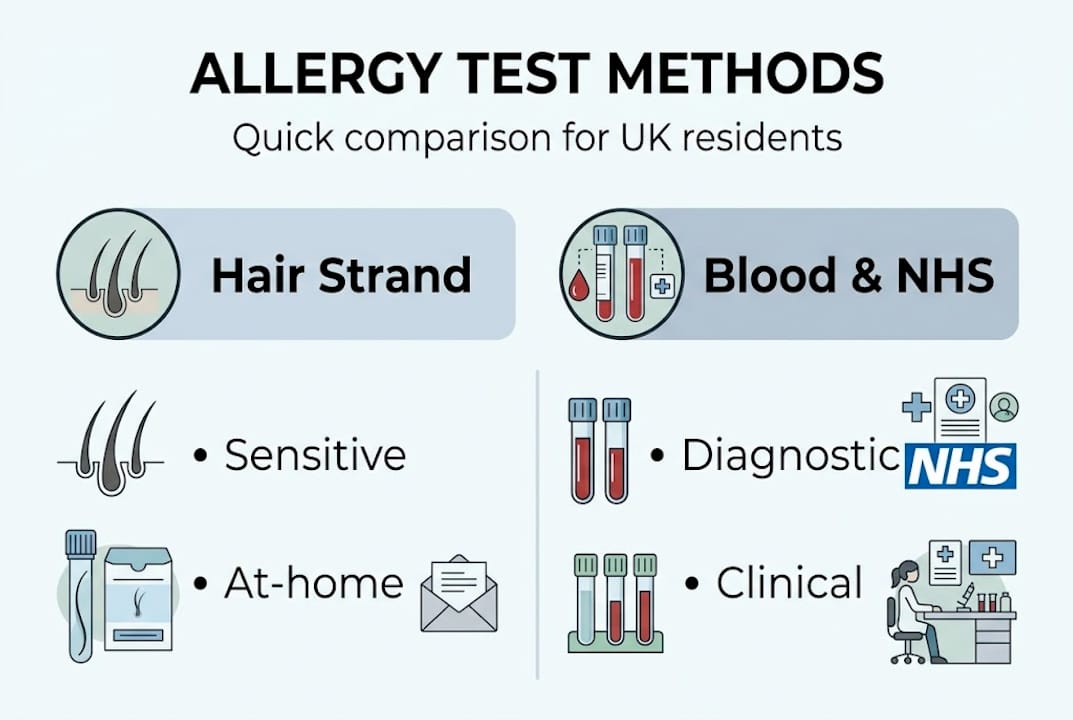
Evidence-based alternatives include blood tests that measure IgE for allergies and IgG for sensitivities, elimination diets, and NHS patch testing for contact allergies rather than food reactions.
Here is a clear summary of the pros and cons of each approach:
- Hair strand test: Fast, affordable, non-invasive, broad coverage. Not clinically validated for diagnosis.
- IgE blood test: Clinically validated for true allergies. Requires GP referral and can involve waiting times.
- IgG blood test: Available privately, useful for food sensitivities. Costs more and requires a blood draw.
- NHS patch test: Gold standard for contact allergies. Not suitable for food reactions and involves a long referral process.
- Elimination diet: Highly informative when done correctly. Time-consuming and requires discipline.
The UK allergy diagnosis guide explains when each method is most appropriate and how UK standards apply.
If you experience severe reactions, breathing difficulties, or swelling after eating, you should always seek NHS assessment first. Hair strand testing is not appropriate as a sole investigation for potentially serious allergic responses.
“Hair strand testing fills a gap for people who are experiencing real symptoms but cannot yet access NHS specialist referrals. It gives them something actionable to work with in the meantime.”
What to do with your results: Next steps and UK guidance
Receiving your results is just the beginning. Knowing how to act on them is what turns a list of flagged items into genuine progress for your health.
Here is a practical approach to working through your findings:
- Review your high-sensitivity items first. These are the ones most worth investigating. Do not try to eliminate everything at once.
- Start a food diary. Track what you eat alongside any symptoms. This helps you spot real patterns rather than reacting to every flagged item.
- Begin a structured elimination diet. Remove your top flagged items for two to four weeks, then reintroduce them one at a time to observe your body’s response.
- Note any improvements. If symptoms ease during elimination and return on reintroduction, that is meaningful information.
- Consult your GP if symptoms are persistent, severe, or affecting your quality of life significantly.
For UK individuals, consult your GP or NHS for ongoing symptoms. Hair tests may prompt useful questions but should not replace professional evidence-based assessment.
Key things to keep in mind when using your results:
- A flagged item does not mean you are allergic. It indicates a potential sensitivity worth exploring.
- Not every flagged item will cause noticeable symptoms in your daily life.
- Results are most useful when combined with personal observation and dietary changes.
The guide to interpreting your sensitivity results walks you through what each category means in plain language. If you are ready to make dietary changes, the practical guide to adjusting your diet is a helpful companion. For a broader action plan, the managing sensitivities workflow gives you a structured path from results to real change.
Pro Tip: Share your results with your GP. Even if they do not formally accept them as diagnostic, the information can help shape a more targeted conversation about your symptoms and what to investigate next.
Our take: Where hair strand allergy testing really fits in your journey
We have supported thousands of UK customers through the process of understanding their sensitivity results, and one pattern comes up repeatedly. People either dismiss their results entirely or treat every flagged item as a confirmed problem. Neither approach serves you well.
Hair strand testing is one data point. A valuable one, but still just one. The real power comes from using it as a springboard. It narrows the field. Instead of guessing which of the hundreds of foods in your diet might be causing your symptoms, you have a focused shortlist to investigate.
What we have seen is that customers who combine their results with a structured elimination diet and a GP conversation tend to make the most meaningful progress. Those who act on results alone, without any follow-up, often feel uncertain about what to trust.
The bio-resonance technology behind these tests is not magic, and we would never claim otherwise. It is a screening tool that works best when you treat it as the start of a process, not the end of one. Your symptoms deserve a thorough investigation, and hair testing can be a genuinely useful first step in that journey.
Find the right test and support for your journey
If you are ready to stop guessing and start getting answers, taking an at-home hair strand test is a simple, affordable way to begin. You do not need a GP referral, you do not need to give blood, and you will not wait weeks for results.
UK Food Intolerance offers two clear options: the Core Single Intolerance Test covering 500 items, and the Ultimate Single Intolerance Test covering over 1,100 items. Both are processed at a UK-based laboratory with results delivered digitally within 48 to 72 hours. Browse the full range of at-home intolerance tests to find the right fit. You can also explore all allergy and intolerance test kits or follow the step-by-step allergy testing guide to feel fully prepared before you order.
Frequently asked questions
Can hair strand tests diagnose allergies in the UK?
No. Hair strand tests are not recognised for clinical allergy diagnosis in the UK and should not replace GP or NHS assessment. They are sensitivity screening tools, not diagnostic instruments.
How many items can be tested with a hair strand allergy test?
Most UK hair tests screen 500 to 1,100+ items from a single hair sample, covering foods, environmental triggers, additives, and more.
What is the difference between an allergy and an intolerance in these tests?
Hair strand tests focus on food sensitivities and intolerances rather than classic IgE-mediated allergies. True allergies require clinical testing, as IgE and IgG blood tests measure immune responses that bio-resonance screening does not replicate.
Are hair strand test results accepted by the NHS for treatment?
No. The NHS does not use hair strand allergy test results for treatment or official diagnosis. For persistent symptoms, always consult your GP for evidence-based assessment and appropriate referral.










Leave a Reply
Want to join the discussion?Feel free to contribute!