

Almonds can trigger non-allergic intolerance reactions in some people, most often causing delayed digestive discomfort rather than a sudden reaction. The most common pattern is bloating, wind and stomach cramps appearing hours after eating, sometimes stretching into the next day. A smaller number of people also notice headaches, fatigue or skin flare-ups, though these symptoms overlap with many other causes.
TL;DR:
- Keep a food and symptom diary for one to two weeks, eliminate almonds for two to four weeks, then reintroduce a measured amount.
- Reactions may depend on portion size, repeated servings, stress, sleep, or illness, so record these factors alongside foods and symptoms.
- No validated clinical test diagnoses most food intolerances; bioresonance screening can suggest foods to investigate, but it cannot replace clinical diagnosis or structured food trials.
- Seek medical care for blood in stools, severe persistent pain, unexplained weight loss, or rapid, severe reactions that may signal allergy.
- Flavored almond milk, bars, and baked goods may contain sweeteners or emulsifiers, while other foods can cause similar symptoms, so track your whole diet.
Table of Contents
- Typical intolerance symptoms after eating almonds
- Timing and pattern: why almond intolerance feels different from allergy
- What might be causing the reaction
- How to check if almonds are behind your symptoms
- When to see a GP or dietitian and what happens next
- Managing symptoms safely while you investigate
- Common cross-reactive foods and triggers to watch for
- How bioresonance screening looks at almond sensitivity
- Reading your almond result on a sensitivity report
- Using your almond result inside an elimination diet
- Almond allergy versus almond intolerance: the key differences
- How our screening fits into your wider sensitivity check
- Ready to screen for almond sensitivity at home
- FAQ
- Sources
Typical intolerance symptoms after eating almonds
Food intolerance reactions to almonds tend to centre on the gut. Food intolerance is a non-immune difficulty digesting certain foods, and it typically produces gastrointestinal symptoms rather than the rapid, sometimes dangerous reaction seen in allergy.
The most frequently reported symptoms include:
- Bloating and a feeling of fullness or distension after eating
- Wind or flatulence, often worse an hour or two after a meal
- Stomach cramps or general abdominal discomfort
- Diarrhoea, loose stools or, in some people, constipation
Beyond the gut, some people link almonds to headaches, fatigue, joint discomfort or skin rashes. Allergy UK notes that these extra-intestinal symptoms are commonly described by people with food intolerances, but they are non-specific: the same symptoms show up in stress, poor sleep, hormonal changes and other health conditions. A single headache after a handful of almonds proves very little on its own. What matters is whether a cluster of symptoms repeats reliably after similar exposures, which is why pattern-spotting over time carries far more weight than any one bad afternoon.
Timing and pattern: why almond intolerance feels different from allergy
One of the clearest signs you’re dealing with intolerance rather than allergy is timing. Symptoms from almond intolerance tend to show up hours after eating, sometimes not until the following day, and they can linger longer than a typical allergic reaction.
A few other patterns worth tracking:
- Dose matters. A few almonds might cause no issue at all, while a larger handful triggers bloating and cramps later that evening.
- Day-to-day variation is normal. The same portion can feel fine one week and uncomfortable the next, often depending on stress, sleep quality or whether you’re fighting off a cold.
- Cumulative exposure counts. Almonds eaten across several meals in a day, in granola, a snack bar and almond milk, can add up to a reaction that no single serving would have caused.
These patterns are why a one-off bad experience rarely tells you much, while a diary kept over several weeks usually does.
What might be causing the reaction
The exact mechanisms behind almond intolerance are not fully mapped out, and most explanations remain broad rather than definitive. One possibility is simple difficulty digesting certain plant compounds or fibres in almonds, which can ferment in the gut and produce the bloating and wind many people describe.
Another possible factor is naturally occurring vasoactive amines. Allergy UK’s guidance on histamine intolerance describes how amine-rich foods can provoke intolerance-like symptoms, including rapid headaches and skin flushing, in people who are more sensitive to them, managed through dietary reduction rather than a lab test. Processed almond products, such as flavoured almond milks, protein bars or bakery items, can also introduce additives, sweeteners or emulsifiers that cause symptoms independently of the almonds themselves.
Evidence in this area is limited, and no single mechanism explains every case. For many people, the honest answer is that the “why” matters less than confirming “whether”, which is where structured testing comes in.
How to check if almonds are behind your symptoms
The most reliable way to confirm almond intolerance is a structured trial: a food and symptom diary, followed by elimination and controlled reintroduction. NHS guidance recommends this approach as the standard route to diagnosis in primary care.
A useful diary records what you ate, the portion size, the time, and any symptoms along with when they started and how long they lasted. For example, you might note: “Tuesday, 3pm, 30g almonds as a snack, no symptoms until 9pm, then bloating and cramps lasting into Wednesday morning.” Patterns like this, repeated across a few weeks, are far more informative than memory alone.
The process generally looks like this:
- Keep the diary for one to two weeks before changing anything
- Remove almonds and obvious almond-containing products for 2 to 4 weeks
- Reintroduce almonds in a measured amount and watch closely for a repeat of your usual symptoms
- Repeat the reintroduction once if the result is unclear, rather than drawing conclusions from a single attempt
Pro Tip: Track mood, sleep and stress alongside food, since these confounders can mimic or mask an intolerance pattern.
Working with a GP or a registered dietitian during this process helps you avoid cutting out more foods than necessary and keeps the elimination nutritionally balanced. Our guide to the food elimination process walks through this in more detail if you want a structured checklist to follow.
When to see a GP or dietitian and what happens next
Most almond intolerance symptoms are uncomfortable rather than dangerous, but a few signs warrant medical attention rather than self-management:
- Significant unintentional weight loss
- Blood in stools or persistent, severe abdominal pain
- Symptoms that disrupt daily life despite dietary changes
- Any sign of a more severe, rapid-onset reaction, which needs urgent assessment separate from intolerance
A GP will usually start with your history and diary, run selective tests to rule out other causes such as coeliac disease or irritable bowel syndrome, and refer you to a dietitian if elimination and reintroduction are needed. Clinical guidance for GPs is clear that there are no validated clinical tests to diagnose most food intolerances, so structured elimination remains the standard rather than a single blood or skin test.
Managing symptoms safely while you investigate
While you work through diagnosis, a few practical steps reduce discomfort without creating new problems. Partial avoidance, rather than cutting out every nut-adjacent food overnight, is usually enough to see whether symptoms ease.
- Read labels carefully, since almond flour, almond milk and almond extract appear in many processed foods, from granola to baked goods
- Swap almonds for other nuts or seeds you tolerate well to maintain healthy fats and protein intake
- Keep an eye on calcium, vitamin E and magnesium if nuts make up a large part of your usual diet, and consider food-based alternatives rather than dropping these nutrients altogether
Over-the-counter remedies for bloating or discomfort can ease symptoms temporarily, but relying on them without identifying the trigger risks masking an ongoing problem. Our practical guide to dietary adjustments covers food swaps in more depth for anyone eliminating a specific ingredient long-term.
Common cross-reactive foods and triggers to watch for
Almond intolerance rarely exists in isolation. Many people who react to almonds also notice symptoms with other tree nuts, such as cashews, walnuts or hazelnuts, since these foods share some structural and digestive characteristics even without a true allergic cross-reaction.
Processed foods built around almonds often introduce their own triggers alongside the nut itself. Almond milk frequently contains added gums or sweeteners; protein bars and granola may include syrups or emulsifiers; and marzipan or bakery items often combine almonds with high sugar content, any of which could be contributing to symptoms independently.
For people with suspected histamine sensitivity, other amine-rich foods, including aged cheese, cured meats, fermented products and certain wines, can produce similar symptom patterns to almonds, which is why a diary that tracks the whole diet, not just nuts, gives a clearer picture. If you consistently react to several of these foods together, it’s worth discussing a broader sensitivity pattern with your GP or dietitian rather than assuming almonds are the sole cause.

How bioresonance screening looks at almond sensitivity
Our Ultimate Plus Intolerance Test and other panels use bioresonance technology to screen a hair sample against a wide range of foods, including almonds and other tree nuts, as part of a broader panel. You send a small hair sample to our UK laboratory, and our digital report arrives within 48 to 72 hours, flagging items that show a measurable response. Our educational guide to bio-resonance technology explains the principles behind the method in plain terms for anyone who wants to understand how the screening works before ordering.
Reading your almond result on a sensitivity report
When your report flags almonds, it’s a starting point for investigation rather than a finished diagnosis. Our guide to understanding sensitivity reports explains how to read the scoring and what a flagged item typically means in practice.
A flagged result on almonds is most useful alongside your own symptom diary. If your report highlights almonds and you’ve also noticed bloating or wind after eating them, that overlap gives you a clear, specific food to test through elimination and reintroduction rather than guessing across your whole diet. If the report flags almonds but you’ve never associated them with symptoms, it’s worth watching for signs over the following weeks rather than removing them immediately. Our items tested page lists the full panel so you can check exactly which nuts and related foods are covered before you order.
Using your almond result inside an elimination diet
A flagged almond result works best as the first entry on your elimination list, not the only one. Once you have your report, the next step is to remove almonds and any obvious almond-containing products for 2 to 4 weeks, following the same structured approach recommended for intolerance investigation generally.
Our elimination diet checklist sets out the practical steps for this phase, including how to reintroduce foods one at a time afterwards. If your report flags several items alongside almonds, our step-by-step diet optimisation guide helps you sequence removals so you’re not cutting too much at once. Throughout, keep your symptom diary running: the combination of a screening result and real-world tracking gives a far clearer picture than either on its own, particularly when you eventually discuss findings with a GP or dietitian.
Almond allergy versus almond intolerance: the key differences
Almond allergy and almond intolerance are different conditions with different mechanisms, timeframes and risks, and confusing the two can lead to unnecessary worry or, worse, missed urgent symptoms. Allergy involves the immune system reacting rapidly, often within minutes, and can range from mild to severe. Intolerance, by contrast, is a non-immune difficulty digesting or processing almonds, and NHS guidance confirms that its symptoms typically appear hours or days later and centre on gastrointestinal discomfort.
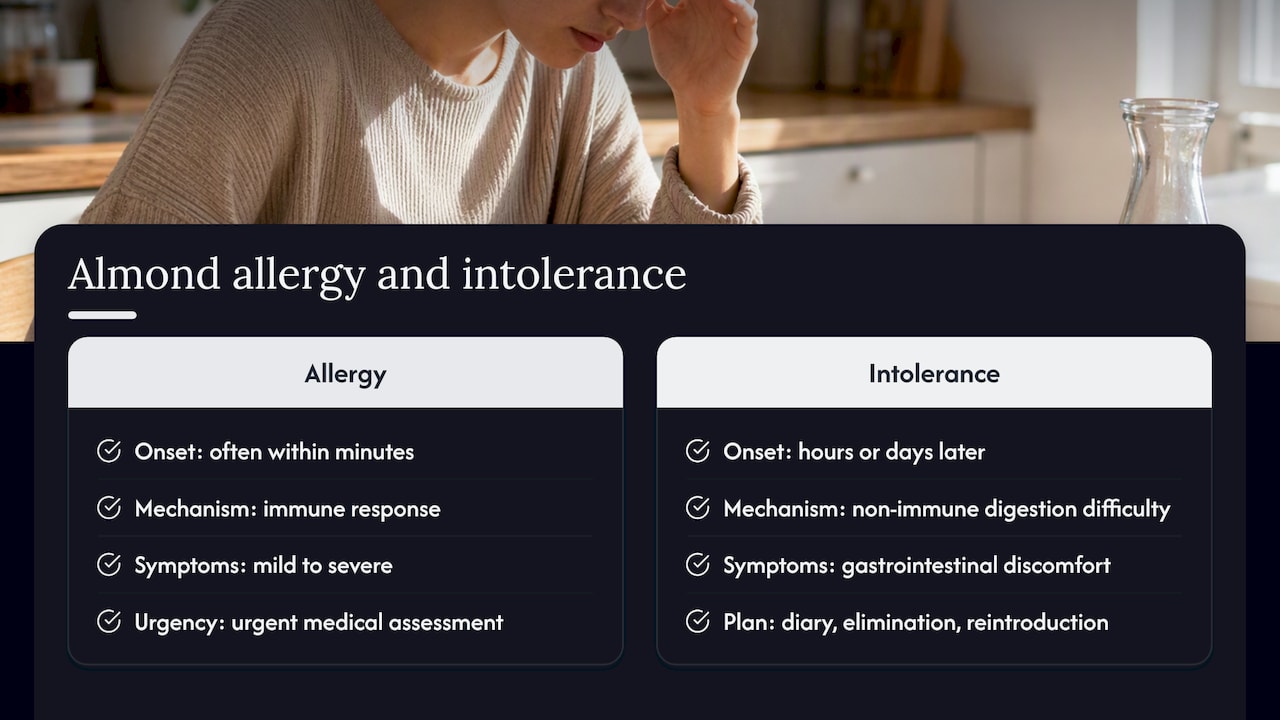
The practical difference that matters most: allergic reactions need urgent medical assessment and clear avoidance strategies set out by a specialist, while intolerance is generally investigated through diary tracking, elimination and reintroduction at a pace you control. Food Standards Agency research notes that tree nuts are among the foods commonly linked to self-reported hypersensitivities in the UK, and that these are more often described as mild to moderate than severe, which fits the intolerance pattern rather than a severe allergic one. If you’ve ever had a rapid, severe reaction to almonds, that points towards allergy and a GP referral, not a gradual elimination trial.
How our screening fits into your wider sensitivity check
Non-invasive hair-sample tests processed in a laboratory with digital reports in 48 to 72 hours can screen for almonds alongside hundreds of other items. Such tests can be positioned as screening aids that help structure an elimination diet and conversations with healthcare providers, not replacements for clinical diagnosis.
— Rob
Ready to screen for almond sensitivity at home
If you’d rather start with a structured screening than guess your way through weeks of elimination, our at-home tests give you a practical starting point. You order online, collect a small hair sample at home, and send it to our UK laboratory for analysis, with your digital report ready within 48 to 72 hours.

- Browse our full range on the our tests page, including the Core Test, Essential Test and Ultimate Test
This article is general information, not a substitute for advice from a qualified doctor. Consult a qualified healthcare professional about your own circumstances before acting on anything here.
FAQ
What’s the difference between almond allergy and intolerance symptoms?
Allergy involves a fast immune reaction, often within minutes, and can be serious, while intolerance is a non-immune digestive issue that typically causes bloating, cramps and diarrhoea hours or days after eating. If your reaction is sudden and severe, treat it as a possible allergy and seek medical advice rather than attempting elimination alone.
How long should I eliminate almonds to check for intolerance?
A structured trial typically involves removing almonds for 2 to 4 weeks before a controlled reintroduction. This timeframe gives your gut enough time to settle so any reaction during reintroduction is easier to spot clearly.
Is there a reliable test for almond intolerance?
There’s no single validated clinical test for diagnosing most food intolerances, and GP guidance recommends structured elimination and reintroduction as the standard approach instead. Screening tools, including our bioresonance-based tests, can support this process by highlighting items worth investigating first.
What are the most common symptoms of almond intolerance?
The most frequently reported symptoms are bloating, wind, stomach cramps and diarrhoea, usually appearing hours after eating. Some people also notice headaches, fatigue or skin rashes, though these are non-specific and can have other causes.
Can I have almond intolerance without reacting to all nuts?
Yes, intolerance to almonds doesn’t necessarily mean every tree nut will cause symptoms, since reactions can vary by food and by portion size. Keeping a detailed food and symptom diary helps you work out which specific nuts, if any, are genuinely linked to your symptoms.
Sources
- Food intolerance | NHS
- Food intolerance | Allergy UK
- Advice on diagnosis and assessment of food allergic disorders (GP guidance)










Leave a Reply
Want to join the discussion?Feel free to contribute!