

TL;DR:
- Food sensitivities can cause symptoms like bloating, headaches, and skin issues.
- Diagnosis involves keeping a detailed food and symptom diary and following a supervised elimination diet.
- Commercial sensitivity tests lack scientific backing; systematic, evidence-based approaches are safer and more reliable.
Unexplained bloating after meals. Persistent headaches that appear out of nowhere. Skin that flares up for no obvious reason. If any of this sounds familiar, food sensitivities could be playing a role in how you feel day to day. Around 20% of people in the UK believe they have a food intolerance, yet pinpointing exactly which foods are responsible is rarely straightforward. The good news is that a clear, step-by-step approach exists. By following evidence-based UK guidance, you can start identifying your triggers and making dietary changes that genuinely help.
Table of Contents
- How to know if your symptoms suggest food sensitivities
- Preparing to adjust your diet safely
- How to implement an evidence-based elimination diet
- Understanding non-invasive food sensitivity tests
- Why evidence-based diets outperform quick-fix sensitivity tests
- Explore UK food sensitivity solutions
- Frequently asked questions
Key Takeaways
| Point | Details |
|---|---|
| Rule out serious conditions | Always consult your GP before adjusting your diet to address unexplained symptoms. |
| Diary and evidence first | Keep a detailed food and symptom diary to guide your safe diet changes. |
| Elimination diet is best | NHS-approved elimination diets are the most reliable way to identify sensitivities. |
| Test limitations | Commercial tests are convenient but may not be backed by strong scientific evidence. |
| Children/pregnancy caution | Edge cases need strict professional supervision due to added nutritional risks. |
How to know if your symptoms suggest food sensitivities
The first step is recognising whether your symptoms are actually linked to food. Many people live with daily discomfort and assume it is just normal. It is not always the case.
Common signs that may suggest a food sensitivity include:
- Bloating or abdominal discomfort after eating
- Loose stools or constipation that comes and goes
- Skin problems such as eczema, rashes, or itching
- Persistent headaches or migraines with no clear cause
- Fatigue or brain fog following certain meals
- Nausea or indigestion that does not have an obvious explanation
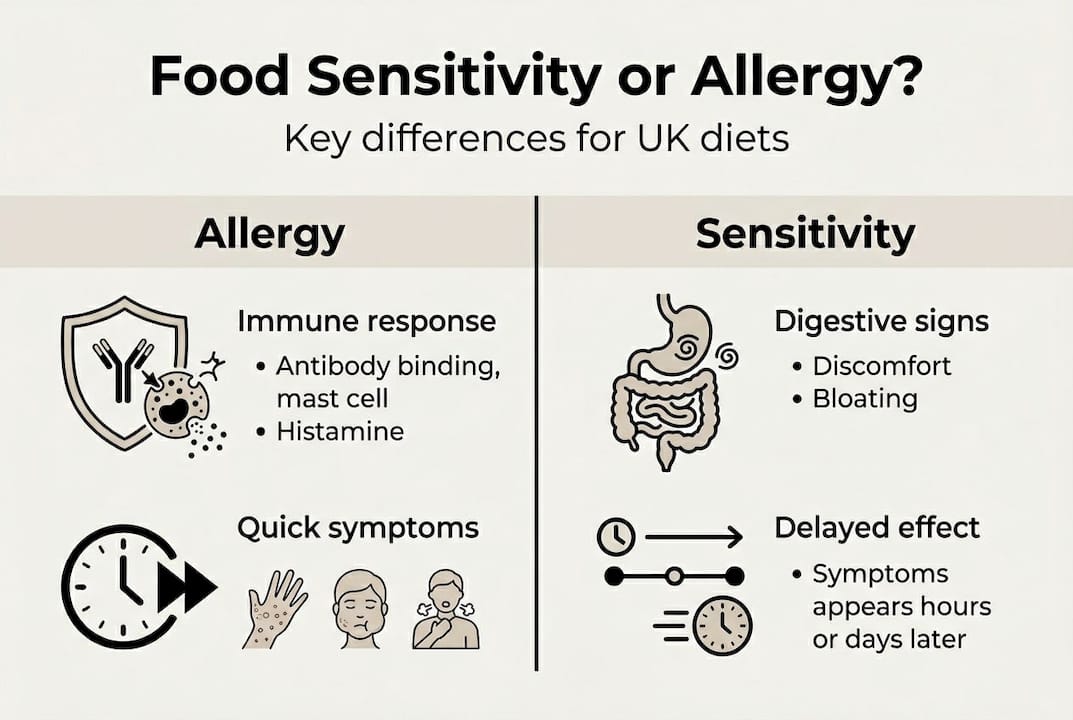
Importantly, these symptoms are not the same as a food allergy. Understanding the difference matters.
| Feature | Food allergy | Food sensitivity/intolerance |
|---|---|---|
| Immune response | Yes, immune system involved | No immune response |
| Onset of symptoms | Immediate (minutes) | Delayed (hours to days) |
| Severity | Can be life-threatening | Rarely life-threatening |
| Diagnosis method | Allergy testing by clinician | Elimination diet, diary |
| Examples | Peanut, shellfish | Lactose, gluten (non-coeliac) |
A food intolerance overview from AAAAI confirms that intolerances are non-immune and typically cause delayed digestive symptoms, which is why they are so easy to overlook.
Before you start identifying food sensitivities and changing your diet, please see your GP. The NHS recommends ruling out serious conditions such as coeliac disease, IBS, or a true food allergy before investigating sensitivities. This step protects your health and prevents unnecessary dietary restrictions based on guesswork.
Once serious conditions are ruled out, a food and symptom diary becomes your most powerful tool. Use it before making any changes. Record what you eat, when symptoms appear, and how intense they feel. Even one week of consistent diary entries can reveal patterns that point you in the right direction. You can also use a sensitivity testing checklist to make sure you are approaching the process in an organised way.
Preparing to adjust your diet safely
Once you recognise potential signals, it is crucial to prepare correctly before making changes to your diet. Jumping straight into cutting out foods without preparation often leads to confusion and nutritional gaps.

Keeping a detailed food and symptom diary is the foundation of everything. Here is what to record each day:
| What to log | Why it matters |
|---|---|
| Every food and drink consumed | Identifies potential trigger foods |
| Time of eating | Shows the delay between eating and symptoms |
| Symptom type and severity | Tracks patterns and progress |
| Stress levels and sleep | Rules out non-food triggers |
| Medications and supplements | Avoids confounding variables |
Aim to keep the diary for at least two weeks before drawing any conclusions. Patterns rarely show up in a day or two.
Before making dietary changes, you should also:
- Visit your GP and request tests to rule out coeliac disease (a blood test is the starting point, per coeliac diagnosis guidance)
- Ask about referral to a registered dietitian if symptoms are complex
- Confirm whether IBS or another functional gut condition may explain your symptoms
- Stop self-diagnosing based on online lists alone
The NHS advises using a food and symptom diary as a primary tool, followed by a supervised elimination diet. This sequence is deliberate. It prevents you from eliminating nutritious foods unnecessarily and keeps the process safe.
Pro Tip: Do not try to manage this alone. A workflow for managing sensitivities can give you a structured path to follow so nothing gets missed. Support from a dietitian or a clear step-by-step guide makes the process far less overwhelming. You can also explore natural sensitivity management strategies that complement medical advice.
How to implement an evidence-based elimination diet
With the right preparation, you can now begin to adjust your diet using the elimination method. This is the approach that NHS food allergy advice supports as the primary method for identifying food sensitivities. It works by removing suspected foods and then reintroducing them one at a time.
Here is a step-by-step approach:
- Identify suspects. Use your diary to shortlist two to five foods that appear most often before symptoms.
- Eliminate them. Remove all suspected foods from your diet for two to four weeks. Be thorough. Hidden ingredients in sauces or processed foods count.
- Monitor carefully. Keep your diary going throughout. Note whether symptoms improve, worsen, or stay the same.
- Reintroduce one at a time. After the elimination phase, reintroduce one food every three to seven days. Watch for any return of symptoms.
- Confirm your findings. If a food clearly triggers symptoms on reintroduction, that is your answer. If not, that food is likely safe.
You can adapt this elimination diet workflow to suit your lifestyle, but do not rush the phases. Patience is essential.
Common mistakes to avoid:
- Eliminating too many foods at once. This makes it impossible to identify which food is responsible and risks nutritional deficiencies.
- Not giving each phase enough time. Reactions can be delayed by up to 72 hours, so a day or two is not enough.
- Assuming no improvement means no sensitivity. Other factors like stress or medication may mask results.
Pro Tip: If you have children or are adjusting a child’s diet, follow the family sensitivity steps and always involve a healthcare professional. Children’s nutritional needs are different and require closer supervision.
Understanding non-invasive food sensitivity tests
Now that you know how to conduct an elimination diet, it is worth reviewing the role and limits of non-invasive sensitivity tests offered commercially. These tests are widely advertised, and it is important to understand what they can and cannot do.
Non-invasive tests typically fall into two categories:
| Test type | How it works | Evidence base |
|---|---|---|
| IgG blood test | Measures antibody levels to foods | Not supported by NHS, BDA, or AAAAI |
| Bioresonance (hair sample) | Analyses hair using electromagnetic frequencies | Lacks robust clinical evidence |
| NHS elimination diet | Removes and reintroduces foods | Supported by clinical guidelines |
The AAAAI food intolerance guidance states that commercial tests such as IgG blood and bioresonance hair tests are promoted as non-invasive alternatives, but lack scientific evidence and may lead to unnecessary food restrictions.
This is an important caution. Removing too many foods based on an unreliable result can lead to:
- Nutritional deficiencies, particularly in calcium, fibre, or protein
- Increased anxiety around eating, making social situations stressful
- Missed diagnoses, because the real cause of symptoms remains unaddressed
- False reassurance, if a true sensitivity is not flagged by the test
Relying solely on a commercial test without medical guidance can delay getting the right support and leave you no closer to understanding your symptoms.
That said, some people find commercial tests a useful starting point for conversation with their GP or dietitian. Used alongside, not instead of, professional guidance, hair sample intolerance testing can provide an additional reference point. If you are curious about what this type of testing involves, food intolerance insights explain the process clearly so you can make an informed choice.
Why evidence-based diets outperform quick-fix sensitivity tests
Here is something worth saying plainly: a test result is not a diagnosis. It is a number on a page. What matters is what you do with it, and whether it is grounded in a method that actually reflects how your body works.
Commercial sensitivity tests are appealing because they are fast and feel definitive. But speed without accuracy is not helpful. An elimination diet, properly conducted, gives you real-world evidence. You eat a food, you observe your body, you make a decision. That feedback loop is personal and reliable in a way that a hair sample result simply cannot replicate on its own.
We have seen many people eliminate entire food groups based on commercial test results, only to find their symptoms unchanged months later. The issue was never the foods the test flagged. It was a different trigger entirely, one that only careful diary work and reintroduction revealed.
Patience yields results. Systematic, personalised approaches prevent unnecessary restrictions and protect long-term nutritional health. For symptom relief tips that support the process, evidence-led methods are always the most reliable foundation.
Explore UK food sensitivity solutions
If you are ready to take your dietary adjustment further, UK Food Intolerance is here to support your next steps. Whether you are at the very beginning of your journey or looking for additional guidance to complement your NHS-approved approach, our resources are designed with you in mind.

Our range of intolerance test options includes tests covering over 1,100 items, all from the comfort of home using a simple hair sample. Explore how matching your body with the right diet can support your elimination diet journey. Our at-home sensitivity tests guide walks you through exactly what to expect, so you can move forward with confidence and clarity.
Frequently asked questions
Can I adjust my diet without supervised medical advice?
It is strongly recommended to consult a GP first, especially to rule out serious conditions like coeliac disease or allergies, before making any major dietary changes. Unsupervised changes can lead to nutritional gaps or a missed diagnosis.
What makes food sensitivities different from allergies?
Food sensitivities typically cause delayed, non-immune symptoms such as bloating or fatigue, while allergies trigger an immediate immune response that can be severe or life-threatening.
Are at-home food sensitivity tests reliable?
Commercial tests like IgG blood and bioresonance hair tests are non-invasive, but lack scientific evidence and are not supported by the NHS, BDA, or AAAAI as standalone diagnostic tools.
Is it safe for children or pregnant people to adjust their diets for sensitivities?
Unsupervised dietary changes for children or during pregnancy carry higher nutritional risks. Always seek professional advice first, and follow coeliac disease diagnosis guidance to rule out serious conditions before making any adjustments.









Leave a Reply
Want to join the discussion?Feel free to contribute!