

If your symptoms haven’t eased after a few weeks on a low FODMAP diet, you haven’t failed, and the diet isn’t a dead end. The diet doesn’t work for everyone. Sometimes small details get in the way, and sometimes your triggers lie elsewhere. NHS guidance says that if there is no improvement after four to six weeks, you should stop the restrictions and go back to your usual foods. Then you can look at what else might be going on.
This guide explains the most common reasons the diet stalls, how to check you’re following it properly, what to do next, and when to speak to a GP or dietitian.
TL;DR
- Give the strict phase four to six weeks. If there is no improvement, NHS Southampton advises stopping the restrictions and returning to your usual foods.
- Common culprits are hidden high-FODMAP foods, too much FODMAP load across the day, stress, irregular meals and a diagnosis that doesn’t fit.
- Persistent symptoms deserve a GP conversation, because other conditions can look like IBS.
- A dietitian can tailor the next step. A sensitivity screening test can add another set of clues for an elimination diet, alongside medical advice.
Table of Contents
- What the low FODMAP diet is designed to do
- How often does it not work?
- Seven reasons it may not be working
- Check you’re doing it correctly
- What to do if your symptoms continue
- A simple diary template
- Our perspective on a stalled low FODMAP diet
- Looking for other triggers? How our tests can help
- Make the next phase easier
- FAQ
- Sources
What the low FODMAP diet is designed to do
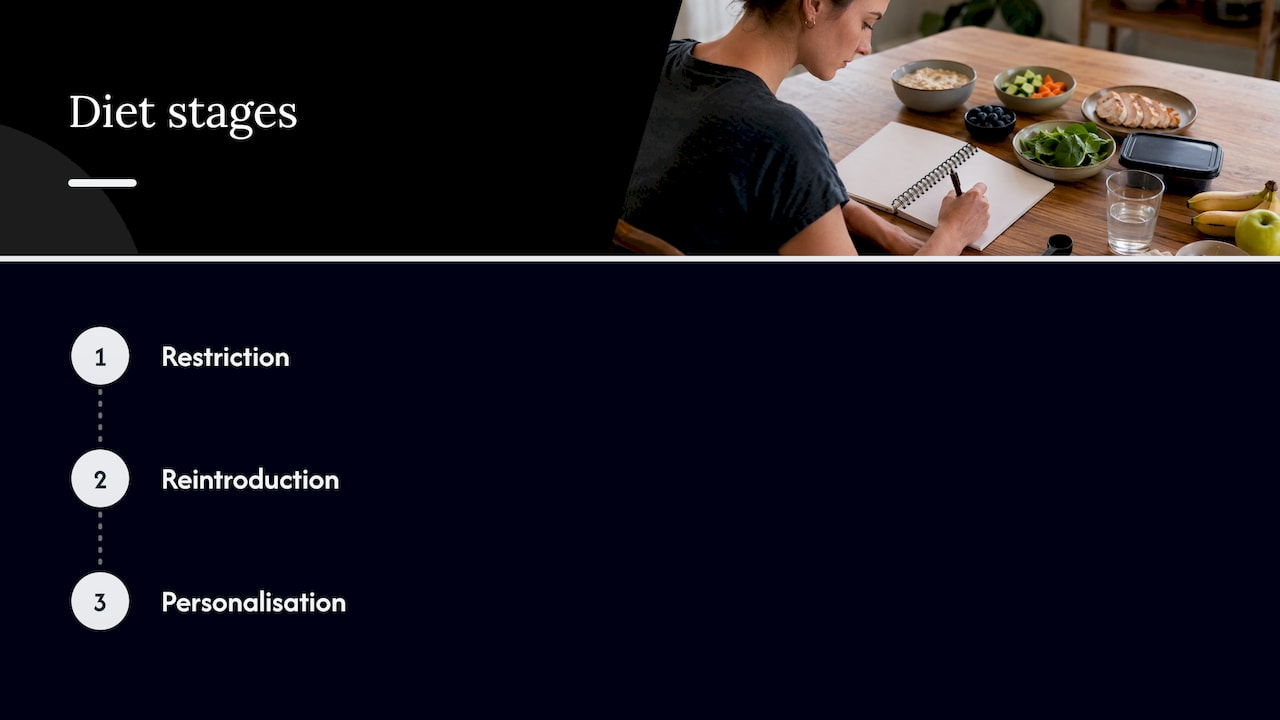
FODMAPs are a group of fermentable carbohydrates found in foods such as onions, garlic, wheat, some fruits, beans and dairy. The diet has three stages: restriction, reintroduction and personalisation. It is meant to be a short investigation, not a way of eating for life. If you want a plain-English primer first, our guide to FODMAP sensitivity covers symptoms, causes and management.
In the UK it is usually used as a second step. NICE guideline CG61 says that when IBS symptoms persist despite general lifestyle and dietary advice, further dietary management may include a low FODMAP diet, provided by a healthcare professional with expertise in dietary management. A 2023 UK review also calls it a second-line strategy and notes that it works best with dietitian-led education, because the stages are complex.
That matters if you started on your own from an app or a food list. It’s very easy to get small details wrong, through no fault of yours.
How often does it not work?
A lot of people ask this, and the honest answer is: quite often. A 2022 network meta-analysis in Gut ranked low FODMAP treatment first for global IBS symptoms. The same paper noted that most trials took place in secondary or tertiary care and did not test the effects of reintroduction and personalisation. In other words, the diet can help many people, but results in real life vary.
Patient information from dietitians often quotes that somewhere between a fifth and two fifths of people with IBS do not respond. So if you are in that group, you are far from alone. It simply means your next step should be different, not harder.
Seven reasons it may not be working
1. Your FODMAP load is too high across the day
A food that is fine on its own can cause trouble when it adds up. The Southampton leaflet warns that foods you tolerate individually may still provoke symptoms if you eat too many high FODMAP foods too often. A small portion of a “safe” food at breakfast, lunch and dinner can still stack up. Check portion sizes, not just food lists.
2. Hidden FODMAPs are slipping in
Garlic and onion powder hide in stock cubes, sauces, ready meals, crisps and seasoning mixes. Sugar-free sweets and chewing gum can contain polyols. Some protein powders and meal replacements contain lactose or fibres that ferment. If you use a whey shake, this guide to whey digestion and bloating gives a short routine for settling things down. Read every label for a couple of weeks. It’s tedious, but it is often where the answer is.
3. The basics of eating are off
The British Dietetic Association (BDA) lists general IBS measures that apply whatever else you do. They include eating regular meals, not skipping meals, limiting caffeine and fizzy drinks, drinking at least eight cups of fluid a day, keeping fresh fruit to three portions a day and cutting back on rich or fatty foods. If these are slipping while you focus on FODMAPs, they can cancel out any benefit.
4. Stress, mood and the gut are tangled together
IBS is a gut-brain condition. Anxiety, poor sleep and a stressful stretch at work can keep symptoms going even when the plate is spotless. The BDA notes that if diet changes and medication haven’t helped, hypnotherapy or cognitive behavioural therapy may be useful options. That isn’t a sign your symptoms are “in your head”. It is a recognised part of managing a sensitive gut.
5. Your symptoms are constipation-led or you have a restricted diet already
The 2023 UK review lists situations where a modified or alternative plan makes more sense than routine strict restriction. They include an already restricted diet, unexplained weight loss or low BMI, eating disorders such as ARFID or orthorexia, being unable to apply the diet, and constipation-predominant symptoms. If any of these fit you, a dietitian should guide the approach.
6. You’ve been strict for too long
The diet is not meant to last. The same review warns that long-term restriction may reduce nutrient intake and affect the gut microbiota, and it reports a consistent fall in Bifidobacteria across nine studies. If you’ve been “strict” for months with no clear improvement, the answer is to reintroduce foods, not tighten the rules.
7. FODMAPs may not be your main trigger
Your symptoms may respond to something else: wheat or gluten, dairy, caffeine, alcohol, fat, a particular food outside the FODMAP groups, or a medical condition. This is where a food and symptom diary earns its place. We come to that below.
Check you’re doing it correctly
Use this short checklist before you decide the diet has failed.
- Did you run the strict phase for four to six weeks? Less may not be enough to judge. More than six weeks without benefit is a reason to stop, not carry on.
- Were you consistent? Occasional high FODMAP meals muddy the picture. A Gloucestershire NHS leaflet says four to six weeks is usually enough to identify a response, and that if symptoms haven’t improved after six weeks despite close adherence you should contact a doctor or dietitian.
- Did you check labels and portions? See hidden FODMAPs above.
- Did you keep a diary? Note food, portion, time, symptoms, stress, sleep and bowel habits. NHS dietetic advice suggests a diary of around five days before an appointment.
- Did you move on to reintroduction? If symptoms improved, you need this stage to find out which groups you actually react to.
A UK consensus paper reports that dietitian-led delivery improves adherence: 96% against 71% in the short term, 70% against 39% for rechallenge, and 65% against 29% for personalisation. It also says adherence tends to fall over time, and that fear of symptoms can drive food avoidance and disordered eating. If you recognise that fear, it is a good moment to ask for professional help.
What to do if your symptoms continue
The plan below follows UK guidance. Take it one step at a time.
Step 1: Stop the restrictions and reintroduce
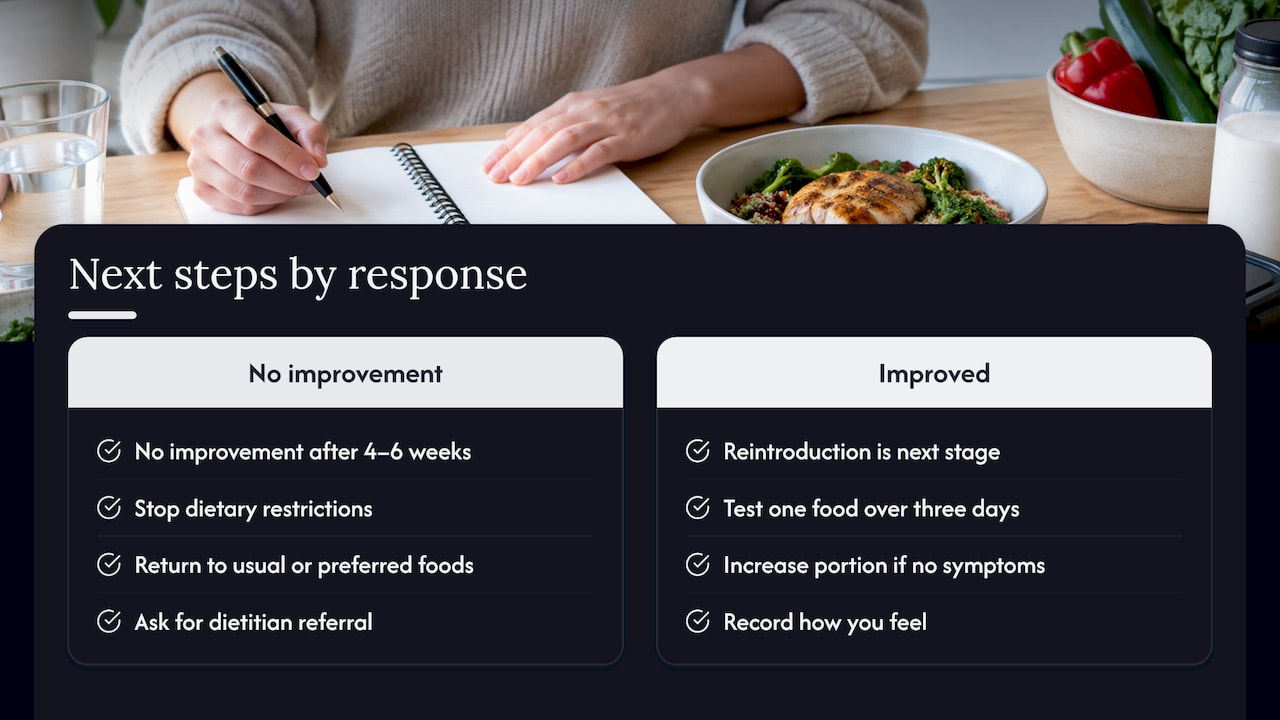
If you saw no improvement after four to six weeks, the Southampton leaflet says to stop the dietary restrictions and go back to your usual or preferred foods. The BDA similarly advises that if symptoms persist after general lifestyle and dietary advice, foods you cut out should be reintroduced, and you should ask your doctor for referral to a dietitian or other professional with dietary-management expertise.
If you did improve, reintroduction is the next stage. The Southampton leaflet suggests testing high FODMAP foods one at a time over three days, increasing the portion if you have no symptoms, and recording how you feel. A Gloucestershire NHS reintroduction guide adds that you should only begin a challenge after at least three days of minimal symptoms, keep other triggers such as caffeine and alcohol low, and use the same food on all three challenge days.
Step 2: Book a GP appointment
Persistent symptoms should be checked. NICE says people who meet IBS criteria should be assessed for cancer indicators and inflammatory markers for inflammatory bowel disease, and referred to secondary care if either is present. Tests to exclude other diagnoses include a full blood count, ESR or plasma viscosity, CRP and coeliac antibodies. A UK primary-care pathway also lists thyroid function, and faecal calprotectin or FIT where indicated.
See your GP promptly if you notice unexplained weight loss, blood in your stool, persistent changes in bowel habit, night-time symptoms or a family history of bowel or ovarian cancer or coeliac disease. If you think coeliac disease is possible, keep eating gluten until you’ve been tested, as cutting it out first can affect the result. Our page on gluten intolerance and coeliac disease explains the difference.
Step 3: Ask about a dietitian
The NHS says a GP may refer you to an NHS dietitian when general diet and lifestyle changes haven’t helped, and that a dietitian may recommend a low FODMAP diet. The 2016 BDA guideline update describes general healthy-eating advice as first-line and low FODMAP advice as second-line dietary management to be delivered by a dietitian.
UK dietetic consensus stresses personalisation rather than permanent avoidance. The goal is to find your own triggers while keeping your diet varied and nutritionally adequate.
Step 4: Look beyond FODMAPs
Once you have medical advice, you can explore other triggers. Many of our customers tell us they feel stuck at this point: FODMAPs didn’t help, and they don’t know where to look next. Our IBS page lists the symptoms and common patterns we see. If you decide to run an elimination diet, our elimination diet checklist and step-by-step diet optimisation guide show how to do it in a structured, safe way.
A simple diary template
A diary doesn’t need to be fancy. Use a notes app or a paper notebook and record:
- What and when you ate, including portion sizes, drinks and snacks.
- Symptoms and timing: bloating, pain, wind, stool type, urgency.
- Context: stress, poor sleep, exercise, medication, and where you are in your cycle if relevant.
- Rating: score symptoms from 0 to 10 so patterns are easier to spot.
Take two weeks of entries to your GP or dietitian. They are far more useful than memory.
Our perspective on a stalled low FODMAP diet
We hear from people every week who feel frustrated that a low FODMAP diet hasn’t delivered. Our first message is always the same: it isn’t your fault, and it doesn’t mean nothing can be done.
FODMAPs are one family of possible triggers. Plenty of people react to individual foods, to combinations, or to things such as dairy and wheat that overlap with FODMAPs without being the whole story. That is why we built our tests to look at a wide panel of items, up to 1,450 on our largest report, so you have a list of foods to focus on when you start an elimination diet instead of guessing.
Our at-home test uses a hair sample and bioresonance technology. It is a non-invasive screening tool for intolerance and sensitivity, not a medical diagnosis, and it doesn’t replace seeing your GP, particularly if your symptoms are persistent or worrying. What it can do is give you a clear, practical starting point and a fast digital report, usually within 48 to 72 hours, processed by a UK-based laboratory.
Our advice is to use it alongside professional support: rule out medical causes, work with a dietitian if you can, and use your results to plan a careful, structured elimination and reintroduction. You deserve clarity, and a plan you can actually follow.
Rob
Looking for other triggers? How our tests can help
If your low FODMAP trial hasn’t given you answers and your GP has ruled out other causes, a sensitivity screening can help you decide where to start. We offer at-home hair-sample tests that report on food and environmental sensitivities, with guidance for using the results in an elimination diet. The Ultimate Plus Intolerance Test is £140.99 one-off per person. You can compare all options on our tests page, or read Core vs Ultimate to choose the right fit.
The process is simple: you collect a small hair sample at home, post it to our UK laboratory and receive a digital report within 48 to 72 hours. Our guide to non-invasive testing explains what to expect. Our tests are best suited to intolerance screening, and we are open about that. They sit alongside, not instead of, medical advice.
Make the next phase easier
Whichever route you take, a few habits help:
- Change one thing at a time. If you change five things together, you won’t know what helped.
- Eat regularly. Skipped meals and big evening meals both tend to aggravate symptoms.
- Keep variety. Aim to bring foods back as soon as you can. Our tips for managing food triggers and dietary adjustments guide offer practical ideas.
- Be kind to yourself. If food has started to feel frightening, tell your GP or dietitian. That is exactly what they are there for.
FAQ
How long should I give the low FODMAP diet before deciding it hasn’t worked?
UK NHS leaflets suggest four to six weeks of strict restriction. If you have seen no improvement by then, stop the restrictions and return to your usual foods. If you’ve followed it closely for six weeks without benefit, contact your GP or a dietitian.
Can I stay on the low FODMAP diet long term if it helps a bit?
It isn’t designed for that. The aim is to reintroduce foods one at a time and keep only those that trigger you. A 2023 UK review warns that long-term restriction may reduce nutrient intake and affect gut bacteria, so a dietitian should guide any longer plan.
Could something other than IBS be causing my symptoms?
Yes. Coeliac disease, inflammatory bowel disease, thyroid problems and other conditions can look similar. NICE recommends blood tests and checks for warning signs in people with suspected IBS, so ask your GP, especially if symptoms are new, worsening or come with weight loss or bleeding.
Will a food intolerance test replace seeing a dietitian?
No. Our test is a non-invasive screening tool that gives you a list of foods and environmental items to consider, and guidance for an elimination diet. It works best alongside medical advice and, where possible, dietitian support.
Sources
- Gentle low FODMAP diet, patient information (NHS Southampton)
- NICE guideline CG61: Irritable bowel syndrome in adults
- The low FODMAP diet in clinical practice (Proceedings of the Nutrition Society, 2023)
- Network meta-analysis of dietary interventions in IBS (Gut, 2022)
- Irritable bowel syndrome (IBS) and diet (British Dietetic Association)
- Diet and irritable bowel syndrome: an update from a UK consensus meeting
- Re-introduction of FODMAPs after exclusion (Gloucestershire Hospitals NHS)
- Low FODMAP diet sheet (Gloucestershire Hospitals NHS)
- Irritable Bowel Syndrome pathway (Remedy BNSSG ICB)
- Further help and support for IBS (NHS)
- Whey digestion and bloating: a 7 to 10 day routine










Leave a Reply
Want to join the discussion?Feel free to contribute!