

When people say cow’s milk protein intolerance, they usually mean cow’s milk protein allergy, or CMPA. This is an immune reaction to the proteins in milk. It is not the same as lactose intolerance, which is about milk sugar. In babies, the delayed (non-IgE) type often shows up as reflux, colic-like crying, loose or mucousy stools, constipation or eczema. The NHS route to a diagnosis is a supervised trial without cow’s milk, followed by a planned reintroduction. This guide explains each step in plain words, so you know what to look for, who to speak to and where an at-home intolerance test fits.
TL;DR
- CMPA is an immune reaction to milk protein. Lactose intolerance is a lack of the enzyme that digests milk sugar. They need different handling.
- Delayed (non-IgE) CMPA can appear 2 to 72 hours after milk, with symptoms such as reflux, irritability, stool changes and eczema. Many of these also have other causes.
- NHS guidance diagnoses non-IgE CMPA by removing cow’s milk for 2 to 4 weeks, then reintroducing it to confirm. Do this with your GP, health visitor or dietitian.
- Most children outgrow CMPA, many by around 2 to 3 years. Breathlessness, floppiness or a swollen face after milk is an emergency.
- For older children and adults looking at wider food triggers, our at-home intolerance screening can help you plan an elimination diet.
Table of Contents
- What cow’s milk protein intolerance actually means
- Symptoms to look out for
- Baby reflux and dairy
- How CMPA is diagnosed
- The elimination diet, step by step
- Does CMPA go away?
- When to get medical help
- Our perspective
- Where an at-home intolerance test fits
- Making an elimination diet work in daily life
- FAQ
- Sources
What cow’s milk protein intolerance actually means
The phrase mixes up two different things, and sorting them out is the first useful step.
CMPA (cow’s milk protein allergy) is an immune-mediated reaction to one or more proteins in cow’s milk. According to the Canadian Paediatric Society, it can involve more than one organ system. Anaphylaxis UK and other charities describe it as the immune system wrongly treating milk protein as a threat.
Lactose intolerance is different. The Healthier Together NHS page explains that it comes from a lack of lactase, the enzyme that digests lactose. It is uncomfortable but not dangerous, and it does not cause rashes or anaphylaxis.
A quick comparison:
| CMPA | Lactose intolerance | |
|---|---|---|
| What is involved | Immune system reacting to milk protein | Shortage of the enzyme lactase |
| Typical age | Common in infancy | Rare in young babies |
| Possible symptoms | Digestive, skin, breathing, sometimes severe | Digestive, such as wind, bloating and loose stools |
| Can it cause anaphylaxis? | Yes, in the IgE type | No |
One practical point matters here. The University Hospitals Sussex NHS Foundation Trust notes that lactose-free formulas still contain cow’s milk protein, so they are not suitable for babies with CMPA.
If you want to read more about how lactose and dairy intolerance relate, our page on lactose and dairy intolerance walks through it.
Symptoms to look out for
CMPA has two broad patterns. The IgE type is fast, usually within minutes to two hours. The non-IgE type is delayed. The North East London ICB guideline says non-IgE symptoms can start 2 to 72 hours after milk. That delay is why it is so hard to link a symptom to a feed.
The NENC guideline lists these non-IgE signs in infants:
- itching, redness or non-specific rashes
- vomiting
- discomfort or difficulty feeding
- reflux
- flecks or streaks of fresh blood in stools
- diarrhoea or constipation
- faltering growth
The Association of Breastfeeding Mothers adds persistent irritability labelled as colic, mucousy stools and persistent eczema. It advises raising suspicion when symptoms are multiple, persistent or severe and do not respond to other measures.
Why one symptom on its own rarely means CMPA
The same NENC guideline points out that most of these symptoms occur in many infants during the first few months. They may be normal variation, or linked to colic, reflux or constipation. A single spit-up or a fussy evening is not a diagnosis. A pattern of several symptoms that persists is what deserves a conversation with a professional.
Baby reflux and dairy
Reflux is the most common reason parents search this topic. The honest picture is that dairy can be one cause among several.
The Royal United Hospitals Bath guideline says a trial of milk exclusion is indicated when reflux distresses the baby and does not respond to smaller feeds and feed thickeners. The NHS Greater Glasgow and Clyde guideline lists repeated reflux that does not respond to first-line treatment as a possible sign. It also stresses that CMPA is only one of several possible explanations.
In practice, that means:
- Try the simple measures first, such as smaller, more frequent feeds and thickeners where advised.
- If your baby is still distressed, speak to your health visitor or GP.
- If a milk-free trial is suggested, follow the structure below rather than guessing.
How CMPA is diagnosed
This is where many parents are surprised. There is no single quick test for the delayed type.
The Royal United Hospitals Bath guideline states that diagnosing non-IgE milk allergy needs two things: an exclusion diet for 2 to 4 weeks that improves symptoms, and a reintroduction challenge to confirm or rule it out. The Healthier Together NHS page says allergy tests are usually negative for these delayed reactions.
If an IgE-type reaction is suspected, the picture is different. The ESPGHAN 2024 guideline summary says skin prick tests or specific IgE measurements are appropriate, and that results without symptoms indicate sensitisation rather than proof of allergy. It describes the oral food challenge as the cornerstone of diagnosis.
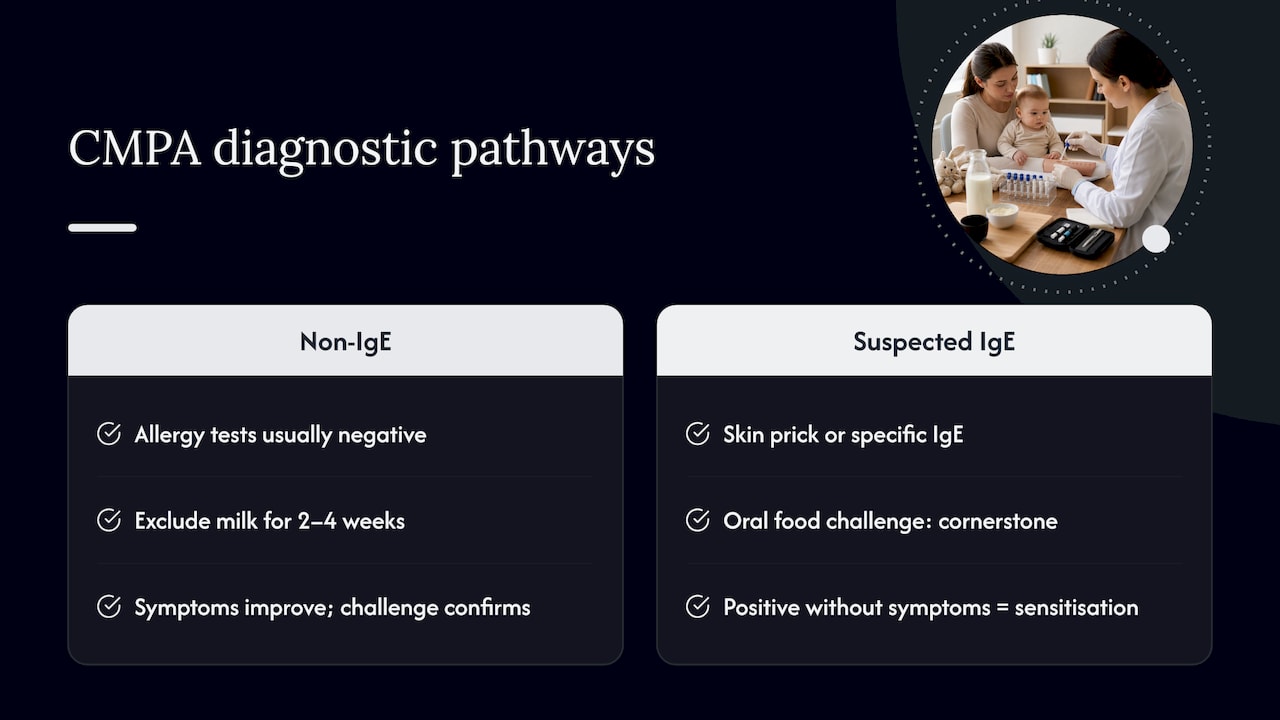
For the same reason, the Cow’s Milk-related Symptom Score used by some clinicians is only an awareness tool, according to that summary. It does not diagnose CMPA.
If you want to understand the wider difference between allergy testing and sensitivity testing, our guide to allergy and sensitivity test types sets it out.
The elimination diet, step by step
The goal of an elimination diet is to find out whether milk is behind the symptoms, without removing foods for longer than needed.
Step 1: Remove cow’s milk for 2 to 4 weeks
The NENC guideline says the trial should last at least 2 weeks and up to 4. For a formula-fed baby, it advises an extensively hydrolysed formula (EHF), prescribed by a clinician. For a breastfed baby, the feeding parent removes cow’s milk from their own diet when symptoms occur with breastfeeding alone.
The Derbyshire JAPC guideline also advises that breastfeeding mothers initially avoid key sources of soya. The North East London ICB guideline notes that some children with non-IgE CMPA also react to soya.
A note for breastfeeding parents
Do not cut dairy out without a reason. The Association of Breastfeeding Mothers says a nursing parent should not be advised to go dairy-free unless there is evidence the baby reacts through breast milk. The ESPGHAN summary agrees that unnecessary elimination diets should be avoided. If you do go dairy-free, the NHS Somerset guideline says a calcium supplement of 800 to 1000mg may be needed. It also says pregnant and breastfeeding women should take 10 micrograms of vitamin D a day.
Step 2: Watch what changes
Keep a simple diary: feeds, stools, skin, sleep, crying and vomiting. If nothing improves, the ESPGHAN summary says CMA should be ruled out. That is a useful result too, because it frees you to look at other causes.
Step 3: Reintroduce milk to confirm
Improvement alone is not enough. According to the Derbyshire JAPC guideline, a firm diagnosis needs symptoms to return when cow’s milk is reintroduced. The Royal United Hospitals Bath guideline describes the formula-fed method: replace one scoop in the first bottle of the day, then increase the next day. For breastfed babies, milk goes back into the maternal diet in increasing amounts over about a week.
Parents can understandably feel nervous about this. The NENC guideline recognises that, and explains that a re-challenge ensures the right treatment and helps with the move to solid foods. Never re-challenge if an IgE-type reaction is suspected. The Derbyshire guideline says those infants should be referred to an allergy clinic or dietitian.
Does CMPA go away?
For most children, yes. The Derbyshire JAPC guideline says most children outgrow it by 2 to 3 years. The Canadian Paediatric Society says non-IgE CMPA usually resolves between 1 and 6 years of age.
The Derbyshire guideline says infants with non-IgE CMA can start the milk ladder once they are established on a wide range of family meals, usually around 9 to 10 months. The milk ladder is a gradual, structured reintroduction of milk, usually with dietitian support. If you are working out when and how to move on to solids and allergenic foods, this guide on how to introduce new foods safely is a helpful companion.
The NHS Somerset guideline suggests a home milk challenge at one year of age, or after 6 months symptom-free, repeated every three months if milk is still not tolerated.
When to get medical help
The Alder Hey Children’s Hospital advice summarised in the research tells parents to see a doctor if there is:
- marked distress, feeding difficulty or faltering growth
- persistent projectile vomiting
- bile-stained vomiting, or blood in the vomit
- blood in the baby’s poo
- a fever in a baby under 3 months
If your child becomes breathless, faint or floppy soon after milk, go to A&E or call 999. The BSW Together guideline adds that severe symptoms or signs of an IgE-type allergy need referral to the local paediatric team for assessment and possible allergy testing.
Our perspective
We hear from parents and adults every week who are tired of guessing. The symptoms are real, the advice online is contradictory, and it is hard to know where to start.
Our view is simple. A baby with suspected CMPA belongs with a GP, health visitor or dietitian, and the supervised milk-free trial and reintroduction is the route to follow. We would never suggest anything else for an infant.
Where we can help is the wider picture. Many people living with bloating, skin flare-ups or low energy do not know which foods to remove first. Our at-home bio-resonance screening looks at over 1,000 foods and environmental items from a simple hair sample, analysed in a UK laboratory, with a digital report in 48 to 72 hours. It gives you a clear list to take into an elimination diet instead of cutting out everything at once.
It is designed for intolerance screening, not for diagnosing allergy or CMPA, and we are open about that. Used alongside professional advice, we believe it gives you a calm, structured starting point.
Rob
Where an at-home intolerance test fits
If you are an adult, or a parent of an older child, wondering which foods may be affecting wellbeing, our tests give you an organised place to begin. You collect a hair sample at home, send it to our UK laboratory and receive a digital report within 48 to 72 hours. Our report is designed to guide an elimination diet, so you can remove likely triggers in a planned way.
Our Ultimate Plus Intolerance Test is £140.99 one-off per person, and you can see it on our home page. Our other human and pet options are on our tests page.

Not sure about collecting the sample? Our hair sample collection guide walks you through it. For children, see our parent’s guide to child intolerance testing. If dairy is your main concern, our page on dairy intolerance is a good next read.
Making an elimination diet work in daily life
Whether you follow a clinician’s plan or a screening report, the same habits help:
- Read labels every time. Milk protein hides in bread, sauces, crisps and sweets, often listed as whey, casein or milk solids.
- Change one thing at a time. It makes the diary easier to read.
- Plan replacements. Calcium and vitamin D matter, especially for growing children and breastfeeding parents, so ask a dietitian about suitable alternatives.
- Do not stay on a restricted diet longer than needed. The Canadian Paediatric Society warns about the nutritional risks of prolonged eliminations in non-IgE allergy.
- Set a review date. Decide in advance when you will reintroduce or reassess.
Our step-by-step diet optimisation guide covers this in more detail for UK adults and parents.
FAQ
Is cow’s milk protein intolerance the same as lactose intolerance?
No. CMPA is an immune reaction to milk protein, while lactose intolerance is a lack of the enzyme that digests milk sugar. The Canadian Paediatric Society notes the lactase problem is rare in infancy and limited to the gut. CMPA can affect several parts of the body.
Can reflux in my baby be caused by dairy?
Sometimes, but not always. NHS guidelines say to try feed changes first and to consider CMPA if reflux is distressing and does not respond. Speak to your health visitor or GP before changing your baby’s milk or your own diet.
Is there a test for milk protein intolerance?
For the delayed type, NHS guidance says diagnosis rests on a 2 to 4 week milk-free trial followed by reintroduction. IgE-type allergy can be assessed with skin prick or blood tests through a clinician. Our home test is an intolerance screening tool that helps plan an elimination diet, not a diagnosis of allergy.
Does CMPA go away?
For most children it does. The Derbyshire guideline says most outgrow it by 2 to 3 years, and the Canadian Paediatric Society puts resolution between 1 and 6 years for non-IgE CMPA. A dietitian can guide the timing of reintroduction.
Sources
- Cow’s milk protein allergy in infants and children, Canadian Paediatric Society
- Cow Milk Allergy, Healthier Together NHS
- Managing Cow’s Milk Protein Allergy, University Hospitals Sussex NHS Foundation Trust
- NENC guidelines for non-IgE cow’s milk allergy in infants
- CMPA guideline, North East London ICB
- CMPA and Lactose Intolerance, Association of Breastfeeding Mothers
- Milk allergy guideline, Royal United Hospitals Bath
- Cow’s milk protein allergy in infants, NHS Greater Glasgow and Clyde
- Cow’s Milk Protein Allergy: ESPGHAN 2024 Guideline Summary
- Derbyshire JAPC cow’s milk allergy guideline
- NHS Somerset guidance on breastfed infants with suspected CMPA
- BSW Together CMPA guideline update










Leave a Reply
Want to join the discussion?Feel free to contribute!