

Bloating after oats is common, and it rarely means you must give them up. The usual causes are a quick rise in fibre, the fermentable carbohydrates in oats (if you have IBS), or, less often, coeliac disease or a reaction to the oat protein avenin. This guide helps you work out which one fits your pattern, what to try first and when to see a professional.
TL;DR
- Oats are rich in soluble fibre. Bloating is a normal result when you increase fibre suddenly, so build up slowly over several weeks.
- If you have IBS, the fermentable carbohydrates (FODMAPs) in oats may be the trigger. Portion size and how the oats are processed both matter.
- If you have coeliac disease, only oats labelled gluten free are suitable, and a small minority react to avenin itself.
- Persistent or frequent bloating needs a GP, not just a diet change. Home tests, ours included, are a screening aid and not a diagnosis.
Table of Contents
- Why oats can make you bloated
- Cause 1: a sudden rise in fibre
- Cause 2: IBS and FODMAPs
- Cause 3: coeliac disease and oat contamination
- Cause 4: avenin sensitivity
- Is it an oat intolerance? What the symptoms look like
- A simple 3-week oat experiment
- What we think about oats and testing
- Oat sensitivity testing: what to expect from a home test
- Quick fixes that often help
- FAQ
- Sources
Why oats can make you bloated
Bloating is the feeling that your tummy is full and uncomfortable. The NHS says it is very common, and it advises seeing a GP if you feel very bloated, are often bloated or it does not go away.
Oats are a mixed bag for the gut. The NHS actually suggests eating oats such as porridge regularly to help ease bloating, cramps and wind in IBS. Yet the same food can leave other people puffy and gassy. The difference usually comes down to one of five things:
- How much fibre you were eating before you started.
- How big your portion is.
- Whether you have IBS and are sensitive to FODMAPs.
- Whether gluten contamination or avenin is involved (coeliac disease).
- What else is in the bowl: protein powder, dried fruit, milk, sweeteners.
That last point is easy to miss. If your oats are topped with sweetened yoghurt, milk or a scoop of protein powder, the oats may be innocent. Plain oats with water for a week is a simple way to find out.
Cause 1: a sudden rise in fibre
This is the most common and the most fixable. The NHS notes that a sudden increase in fibre is a common cause of gas and bloating, and recommends raising intake gradually over several weeks. The British Dietetic Association gives the same advice for fibre-rich diets: a sudden increase may cause gas, bloating and changes in bowel habits.
If you have just started a “healthy” breakfast routine, this is the first suspect. Try this:
- Halve your usual portion for a week.
- Add a little more every few days.
- Drink water through the day, since soluble fibre works best with fluid.
- Eat slowly, sitting down, without rushing.
The BDA says that for many people the answer is gradual adjustments such as drinking more water, increasing fibre slowly and eating in a calm environment, not cutting the food out completely.
Cause 2: IBS and FODMAPs
Oats contain fermentable carbohydrates. Monash University, which developed the low FODMAP approach, explains that FODMAPs are rapidly fermented by gut bacteria and pull more water into the gut, producing gas, bloating and distension. In people with IBS, that can show up within hours of a large bowl of porridge.
A low FODMAP diet is a recognised strategy. A systematic review and meta-analysis of 13 randomised trials found it ranked first for reducing bloating and distension compared with other dietary advice. But it is not a do-it-yourself fix:
- It is meant to be a short, structured process, followed by reintroduction.
- Over-restriction can lead to nutritional gaps.
- The BDA stresses the importance of confirming a formal diagnosis and ruling out coeliac disease or IBD before making significant, long-term dietary changes.
If you do go down this route, work with a registered dietitian. Some clinics also offer nutritional counselling alongside other care, but check the practitioner’s qualifications first, and speak to your GP before restricting foods.
Does the way you prepare oats matter?
Often, yes. Monash’s low FODMAP overnight oats recipe pulses the oats in a food processor first, and Monash advice is that smaller portions and processing can make oats easier to handle. Many people find that blending oats into flour, or using quick oats rather than rolled, feels gentler. This is practical experience rather than a guarantee, so treat it as something to test, one change at a time.

Cause 3: coeliac disease and oat contamination
Oats do not contain gluten, but they are often grown, milled or transported alongside wheat, barley and rye. Coeliac UK says only oats labelled gluten free are suitable for people with coeliac disease because of that contamination risk.
If you have bloating after oats and have not been tested for coeliac disease, do not simply switch to gluten-free oats and hope. Ask your GP about testing first, while you are still eating gluten. Going gluten free beforehand can make blood tests unreliable.
Cause 4: avenin sensitivity
Oats contain a protein called avenin, similar to gluten. Coeliac UK explains that some people with coeliac disease cannot tolerate it. The NHS likewise says there is some evidence that a very small number of people with coeliac disease react to oats even when uncontaminated.
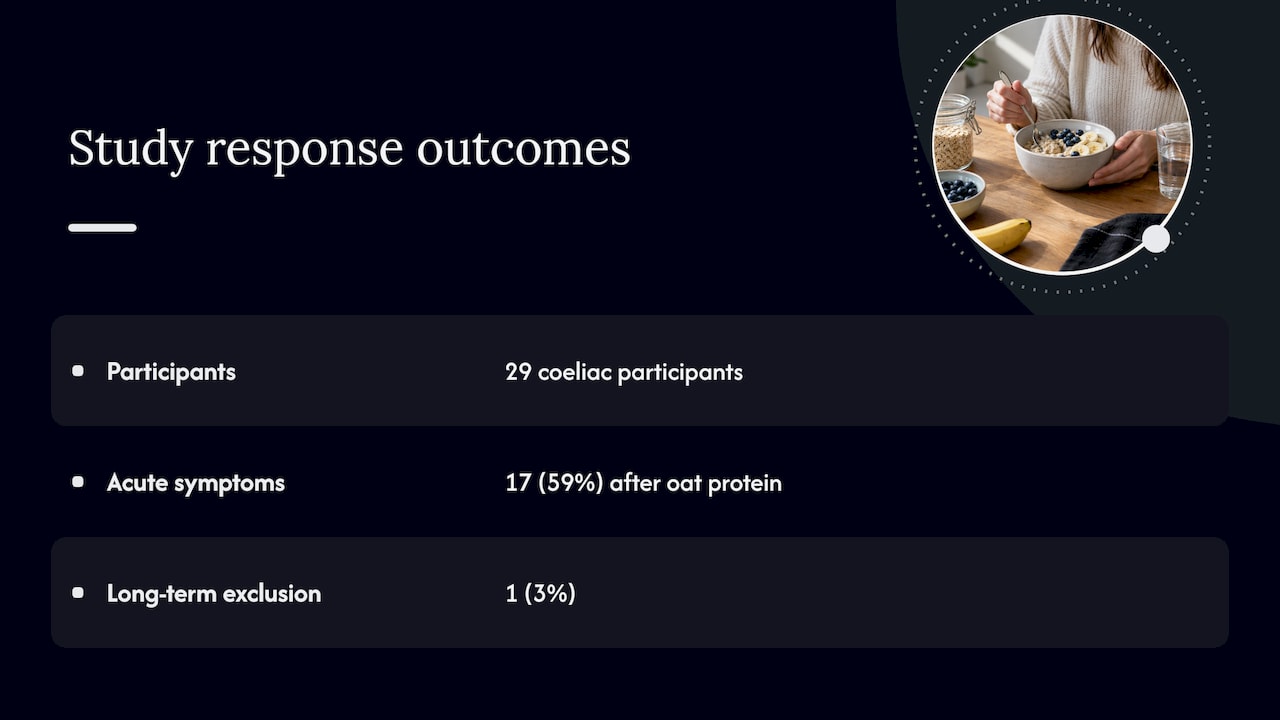
A 2025 study in Gut looked at this closely. Among 29 coeliac participants, 17 (59%) had acute symptoms after purified oat protein, but only one (3%) reacted strongly enough to need long-term exclusion. The takeaway is reassuring: a short-term reaction does not automatically mean oats are off the menu for good. If you still have symptoms on certified gluten-free oats, speak to your GP or gastroenterologist rather than deciding alone.
Is it an oat intolerance? What the symptoms look like
“Oat intolerance” is not a formal diagnosis in the way coeliac disease is. People use it to describe digestive symptoms that keep returning after oats. Common patterns include:
- Bloating and trapped wind within a few hours of eating
- Stomach cramps or rumbling
- Loose stools or constipation
- Feeling heavy or sluggish after breakfast
Intolerance reactions are usually dose related and can be delayed, which is why they are hard to pin down. This is different from an allergy, where symptoms such as hives, swelling of the lips or face, or difficulty breathing can appear quickly. Those need urgent medical help, so call 999 if breathing is affected.
See your GP promptly if you notice blood in your stools, unexplained weight loss, persistent vomiting, or bloating that does not settle. Those are not things to manage with diet experiments.
A simple 3-week oat experiment
Before you spend anything, a structured trial gives you more information than guessing. Keep a short diary.
| Week | What to do | What to note |
|---|---|---|
| 1 | Eat your usual breakfast, oats included, and log symptoms | Timing, severity, other foods, stress, sleep |
| 2 | Swap oats for another breakfast you tolerate, such as eggs or rice-based options | Whether bloating changes |
| 3 | Reintroduce a small portion of plain oats with water, then build up | Dose at which symptoms return |
If you are still bloated in week 2 without oats, the oats probably were not the issue. If bloating drops in week 2 and returns in week 3 in a small portion, that is a useful clue to take to a GP or dietitian.
We also have a practical guide on dietary adjustments for food sensitivity that explains how to run an elimination diet without cutting out too much.
What we think about oats and testing
We hear from many people who say, “I eat healthily, so why do I feel bloated?” Oats are a classic example. They are good for most people, and yet the same bowl can feel very different from one person to the next.
Our view is that a diary and a calm, stepwise approach come first. A home test can be a helpful extra piece of information, particularly if you have been going round in circles. We offer non-invasive bio-resonance testing from a hair sample, analysed at a UK-based laboratory, with a digital report in 48 to 72 hours. It is designed for intolerance screening, and we are open about its limits.
The NHS is clear that commercial home food intolerance tests often lack scientific evidence and can lead to unnecessary food avoidance. We take that seriously. That is why we say the report is a starting point for an elimination diet and a conversation, never a diagnosis, and never a reason to drop whole food groups for good. If you have symptoms that worry you, a GP comes first. You can read more about our approach in our bio-resonance methodology and research and our honest guide to the risks and real benefits of at-home tests.
— Rob
Oat sensitivity testing: what to expect from a home test
If you are searching for oat sensitivity testing, it helps to know what each type of test can and cannot tell you.
| Route | What it can show | What it cannot show |
|---|---|---|
| GP coeliac blood test | Whether coeliac disease is likely | Oat-specific intolerance |
| Allergy testing via the NHS | IgE-mediated allergy to oats | Delayed intolerance |
| Dietitian-led elimination and reintroduction | Your personal triggers and doses | Nothing quick, but it is the reference approach |
| Home bio-resonance screening | Items to explore in an elimination diet | A medical diagnosis |
We would always suggest ruling out coeliac disease through your GP first. After that, a home screening report can help you choose what to look at in your elimination diet, particularly if you are testing several foods at once.
Our Ultimate Plus Intolerance Test costs £140.99 one-off per person. If you want to compare other panel sizes, our full test range is on one page. To see what is covered, take a look at the items tested, and for the steps involved, our at-home testing workflow is a clear walk-through.
If your child bloats after oats
Children can be harder to read because they cannot always describe what they feel. Introduce foods one at a time, in small amounts, and keep notes. This guide on introducing new foods safely is a sensible starting point, and our own steps for testing children at home explain what is involved if you consider a screening test. Speak to your GP or health visitor before removing major foods from a child’s diet.
Quick fixes that often help
While you investigate, these small changes are low risk for most people:
- Smaller bowl. Start with two tablespoons of dry oats and build up.
- Finer texture. Blend or pulse the oats, or choose quick oats.
- Plain first. Strip out protein powder, dried fruit, honey and sweeteners for a week.
- Try lactose-free milk or water to see whether the dairy is the culprit.
- Soak overnight if cooked porridge sits heavily.
- Check the label. If you need gluten-free, buy oats clearly labelled as such.
- Move after eating. A short walk can ease trapped wind.
If none of this helps within a few weeks, that is the moment for professional input rather than more guessing.
FAQ
Why do I get bloated after eating oats?
The most likely reasons are a recent jump in fibre, a portion that is too large, or IBS-related sensitivity to FODMAPs. Less often, coeliac disease or avenin is involved. Reduce the portion, build up slowly and see your GP if symptoms persist.
What are the symptoms of oat intolerance?
Typical signs are bloating, wind, cramps and changes in bowel habit within hours of eating oats. There is no single confirmed test for oat intolerance, so a food and symptom diary is the best first step. Facial swelling or breathing difficulty suggests an allergy and needs urgent medical help.
Are gluten-free oats less likely to cause bloating?
They help if contamination with wheat, barley or rye is the problem, which matters mainly for coeliac disease. They do not remove fibre or FODMAPs, so they may still cause bloating if those are your trigger.
Can a home test tell me if I am intolerant to oats?
A home bio-resonance test can flag items to explore in an elimination diet, but it cannot diagnose a condition. The NHS cautions that home intolerance tests may lack evidence, so use results as a guide and confirm findings with a reintroduction trial and your GP or dietitian.
Sources
- NHS: Bloating
- NHS: Diet, lifestyle and medicines for IBS
- NHS: Food intolerance
- NHS: Coeliac disease treatment
- BDA: Mediterranean diet fibre advice
- BDA: Irritable bowel syndrome and diet
- BDA: IBS and diet (PDF)
- Monash FODMAP: FAQs
- Monash FODMAP: Low FODMAP overnight oats
- Gut: low FODMAP diet meta-analysis
- Gut: purified oat protein in coeliac disease
- Coeliac UK: gluten free diet guidelines
- Coeliac UK: oats factsheet









Leave a Reply
Want to join the discussion?Feel free to contribute!