

TL;DR:
- Food sensitivities are non-immune reactions that cause delayed symptoms like bloating, fatigue, and skin issues. Proper diagnosis relies on detailed food diaries and supervised elimination, not broad commercial tests that can mislead or cause harm.
If you’ve been feeling bloated, tired, or just “off” after eating, food sensitivities are a reasonable place to start looking. The term covers what clinicians more precisely call food intolerances: non-immune reactions where your body struggles to digest or process certain foods, leading to delayed symptoms that can affect your gut, skin, joints, and energy levels. The NHS defines food intolerance as difficulty digesting certain foods, with symptoms typically appearing a few hours after eating.
The safest first steps for a beginner are:
- Start a simple food-and-symptom diary, noting what you eat and when symptoms appear
- Avoid buying broad commercial test panels before speaking to a clinician
- Book a GP appointment if symptoms are persistent, severe, or affecting your nutrition
- Ask your GP about referral to a dietitian or allergy clinic for supervised support
BSACI, NICE, and RCPath all agree: no single test confirms a food intolerance, and clinical history remains the foundation of any proper assessment.
Table of Contents
- What is the difference between a food allergy and a food intolerance?
- What are the common symptoms of food sensitivities?
- When should you see your GP or seek urgent care?
- How do you safely identify your trigger foods?
- Which tests are useful in the UK, and which should you avoid?
- How do you manage food sensitivities day to day?
- What are the red flags that need emergency care?
- Key takeaways
- A practical perspective on food sensitivities
- Ukfoodintolerance: at-home sensitivity testing to support your next steps
- Useful sources and further reading
What is the difference between a food allergy and a food intolerance?
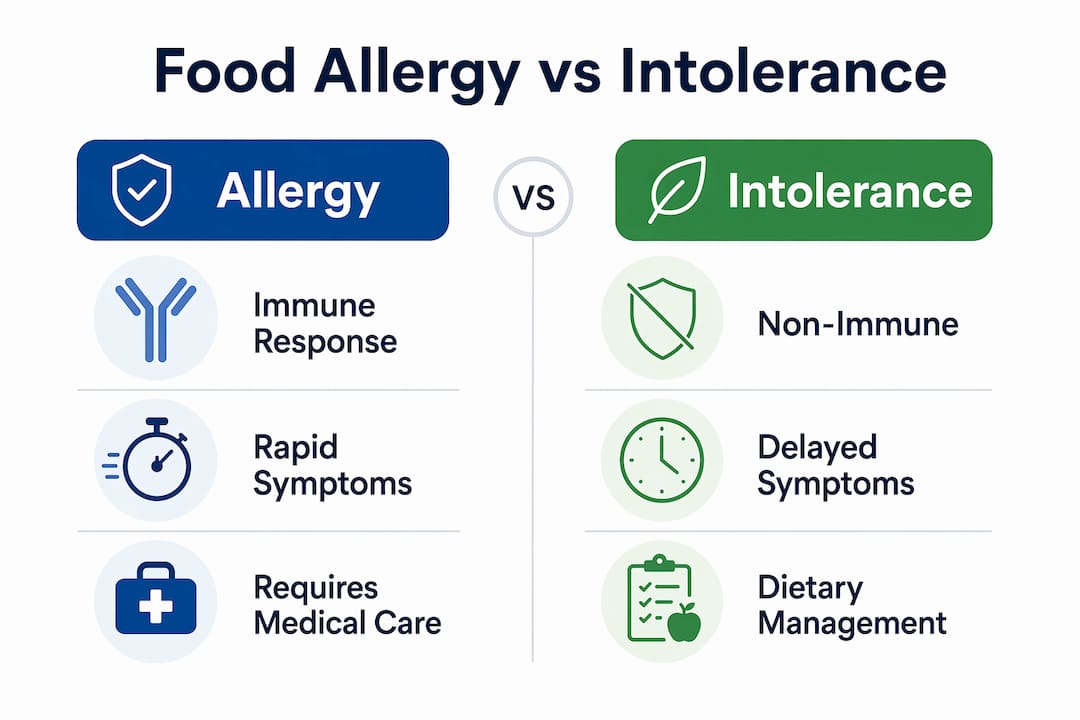
The British Dietetic Association puts it plainly: allergy involves the immune system; intolerance does not. That single distinction shapes everything, from how you are tested to how you manage your diet.

Food allergy is an immune-mediated response, often involving IgE antibodies. Symptoms typically appear within minutes to two hours of eating the trigger food and can affect multiple body systems simultaneously: skin, throat, gut, and airways. IgE-mediated allergy carries a risk of anaphylaxis, a life-threatening reaction requiring emergency treatment.
Food intolerance is a non-immune reaction. It may stem from enzyme deficiencies (lactase deficiency causing lactose intolerance is the classic example), pharmacological reactions to substances like caffeine or tyramine, or unknown mechanisms involving food additives. Symptoms are usually delayed, appearing hours or even a day or two after eating, and tend to be dose-dependent: small amounts may cause no problem at all.
Pro Tip: Think of it this way. You eat cheese at dinner and wake up bloated the next morning? That delayed, dose-related pattern points toward intolerance. You eat a prawn and your lips swell within 20 minutes? That immediate, reproducible reaction points toward allergy. The timing is your first clue.
NICE guidance instructs clinicians to take an allergy-focused clinical history and use it to decide whether to offer skin prick tests, specific IgE blood tests, or an elimination trial. The approach differs because the conditions differ.
What are the common symptoms of food sensitivities?
Food intolerance symptoms are wide-ranging, which is partly why they are so easy to miss or misattribute. According to Allergy UK, symptoms commonly affect the digestive, skin, and respiratory systems.
The most frequently reported symptoms include:
- Bloating and abdominal pain
- Diarrhoea or constipation
- Nausea and stomach cramps
- Fatigue and low energy
- Headaches
- Skin flushing, urticaria (hives), or eczema flares
- Joint pain
- Rhinitis or mild breathing difficulties
What makes intolerances particularly tricky is the delay. You might eat a trigger food on Monday and not feel the full effect until Tuesday afternoon. Symptoms can also last for hours or days, and multiple body systems may be affected at once, making it genuinely hard to connect cause and effect without a diary.
Several other conditions share these symptoms. Irritable bowel syndrome (IBS), inflammatory bowel disease (IBD), and coeliac disease can all mimic intolerance patterns. Coeliac disease in particular requires separate investigation and must not be assumed to be a simple gluten intolerance.
When should you see your GP or seek urgent care?
Self-management with a food diary is a reasonable starting point, but certain situations call for professional input quickly.
See your GP if:
- Symptoms are persistent (more than a few weeks) or getting worse
- Multiple body systems are affected at the same time
- A child shows faltering growth alongside gut symptoms
- You are already restricting several food groups and worry about nutrition
- You suspect coeliac disease (do not remove gluten before testing)
Your likely NHS pathway: GP assessment, followed by referral to a dietitian or allergy clinic for supervised testing. Private consultations are available faster but carry a cost; your GP can advise on local waiting times and whether a private referral is appropriate.
Bring your food diary and a written list of symptom timings to every appointment. RCPath guidance is clear that clinical history directs which tests, if any, are ordered. A well-kept diary makes that history far more useful.
Red flags requiring emergency care (call 999 or go to A&E immediately):
- Difficulty breathing or swallowing
- Swelling of the throat, tongue, or face
- Sudden dizziness, collapse, or loss of consciousness
- Rapid deterioration after eating a suspected allergen
These signs indicate possible anaphylaxis, a medical emergency. If you carry a prescribed adrenaline auto-injector (such as an EpiPen), use it immediately and still call 999.
How do you safely identify your trigger foods?
The evidence-based method for identifying food sensitivities is elimination followed by structured reintroduction. NICE recommends a trial elimination of normally 2–6 weeks where non-IgE-mediated food allergy or intolerance is suspected, followed by reintroduction under dietitian guidance.
Step-by-step workflow:
- Prepare. Keep a detailed food-and-symptom diary for at least one to two weeks before changing anything. Note foods eaten, portion sizes, and symptom timing.
- Identify one suspect food. Based on your diary patterns, choose the most likely trigger. Avoid eliminating multiple food groups at once without dietitian support.
- Eliminate for 2–6 weeks. Remove the suspect food completely. Read labels carefully; many foods contain hidden ingredients.
- Record your response. Note whether symptoms improve, stay the same, or worsen. No change suggests that food may not be the issue.
- Reintroduce in a controlled way. Reintroduce the food in a small amount on a single day, then wait 48–72 hours before eating it again. Record any returning symptoms.
- Confirm the pattern. A reproducible reaction on reintroduction is how a food intolerance diagnosis is made.
Dos and don’ts:
- Do seek dietitian support before cutting out major food groups such as dairy or wheat
- Do keep records consistent enough to show a pattern
- Do discuss results with your GP before making permanent dietary changes
- Don’t start a gluten-free diet before coeliac testing; NICE advises eating gluten in more than one meal daily for six weeks before blood tests, as stopping beforehand makes results inaccurate
For practical help building a safe, balanced plan around your findings, the sensitivity-friendly diet guide from Ukfoodintolerance is a useful next read.
Which tests are useful in the UK, and which should you avoid?
UK clinical practice uses a targeted, history-led approach to testing. The tests below are used in NHS and specialist settings:
| Test | When used | What it shows | Main limitation |
|---|---|---|---|
| Specific IgE blood test | Suspected IgE-mediated allergy, guided by history | Sensitisation to a specific allergen | Sensitisation is not the same as clinical allergy; must match history |
| Skin prick test | Specialist allergy clinic, history-guided | Immediate hypersensitivity response | Requires trained staff; antihistamines must be stopped beforehand |
| Supervised oral food challenge | Confirming or ruling out allergy | Gold standard for clinical allergy diagnosis | Must be done in a clinical setting with emergency cover |
| Coeliac serology (tTG-IgA) | Suspected coeliac disease | Immune markers for coeliac | Patient must be eating gluten for six weeks before testing |
| Hydrogen breath test | Suspected lactose or fructose malabsorption | Fermentation pattern suggesting malabsorption | Limited to specific intolerances |
NWL Pathology guidance is explicit: specific IgE tests are sensitive but not specific. A positive result shows sensitisation, not necessarily clinical allergy. Interpretation must always be tied to the clinical history.
Tests to avoid: BSACI’s Choosing Wisely statement warns that no single test confirms food allergy or intolerance, and that alternative tests including IgG panels lack proven benefit and may cause harm through misdiagnosis. NHS dietetics guidance similarly cautions that many commercial tests have not been scientifically proven accurate.
Broad screening panels increase false positive rates, which can lead to unnecessary food restrictions and nutritional deficiencies. For more on which tests are supported by evidence, the food testing science guide from Ukfoodintolerance explains the evidence base clearly.
How do you manage food sensitivities day to day?
Once you have identified a trigger food, the practical work begins. Managing sensitivities well means avoiding triggers without creating new nutritional problems.
Practical strategies:
- Read ingredient labels every time, even for familiar products; recipes change
- Learn the legal names of common allergens (e.g., “casein” and “whey” both indicate dairy)
- Plan substitutions before you eliminate: oat milk for dairy, gluten-free oats for wheat-based porridge
- Tell restaurants and cafés about your needs when booking, not just on arrival
- Keep a small safe snack with you to avoid accidental exposure when eating out
Cutting out whole food groups carries real nutritional risk. Removing dairy without replacing calcium and vitamin D, or avoiding wheat without maintaining adequate fibre and B vitamins, can create deficiencies over time. The BDA emphasises that dietitian involvement is particularly important for children, pregnant people, and anyone managing multiple restrictions simultaneously.
Pro Tip: When you see a dietitian, bring your food diary and a list of the foods you have already cut out. A good dietitian will check your current intake for gaps before suggesting further eliminations, not after.
The social and psychological side of dietary restriction is real and often underestimated. Eating differently from friends and family, navigating social events, and the constant vigilance of label-reading can be exhausting. Connecting with others in similar situations through charities such as Allergy UK or online communities can reduce that sense of isolation. For women whose symptoms also fluctuate with their cycle, hormone-related dietary strategies may offer additional context worth exploring with your GP.
What are the red flags that need emergency care?
Some reactions are not intolerances. They are medical emergencies. If you or someone with you experiences any of the following after eating, act immediately.
Call 999 or go to A&E if you notice:
- Difficulty breathing, wheezing, or a hoarse voice
- Swelling of the throat, tongue, lips, or face
- Sudden dizziness, confusion, or loss of consciousness
- Rapid heartbeat combined with a severe drop in blood pressure
Emergency action steps:
- Use a prescribed adrenaline auto-injector (EpiPen or Jext) immediately if available
- Call 999 and state you suspect anaphylaxis
- Lay the person flat with their legs raised, unless they are having difficulty breathing
- Stay with them and monitor until emergency services arrive
- Seek emergency care even if symptoms appear to improve after the auto-injector; a second wave of symptoms can follow
If you have previously had a severe reaction, tell every new clinician you see. Prior reactions are a key factor in whether you are referred to an allergy specialist.
Key takeaways
Food sensitivities (intolerances) are non-immune reactions best identified through a structured food diary, GP assessment, and a supervised elimination and reintroduction plan, not through broad commercial test panels.
| Point | Details |
|---|---|
| Start with a food diary | Record foods eaten and symptom timing for at least one to two weeks before making any changes. |
| Allergy vs intolerance | Allergy is immune-mediated and often immediate; intolerance is non-immune and usually delayed by hours or days. |
| Avoid unvalidated tests | BSACI and NHS guidance warn that IgG panels and broad screening tests are not proven and can cause harm through false positives. |
| Elimination takes several weeks | NICE recommends an elimination trial of suitable duration for suspected non-IgE reactions, with dietitian oversight for nutritional safety. |
| Ukfoodintolerance at-home testing | Ukfoodintolerance offers hair-sample sensitivity tests covering over 1,450 items, useful for informing lifestyle steps alongside GP and dietitian support. |
A practical perspective on food sensitivities
The part most guides skip is this: the process of identifying food sensitivities is genuinely slow, and that slowness is not a flaw. It is the method. Delayed reactions, dose-dependent thresholds, and symptom overlap with conditions like IBS mean that a rushed elimination or a single commercial test result will almost always mislead you.
What tends to work is patience combined with structure. A consistent diary, a single suspect food eliminated at a time, and a clinician who can interpret the pattern alongside your history. That combination is not glamorous, but it is what NICE, BSACI, and RCPath all point toward for good reason.
The instinct to find a quick answer through a broad test panel is completely understandable when you feel unwell and want clarity. But a long list of flagged foods from an unvalidated panel often creates more anxiety and more unnecessary restriction, not less. The evidence for IgG testing in particular is clear: it does not diagnose intolerance, and acting on those results can lead to nutritional harm.
At-home sensitivity testing, used thoughtfully and as a starting point rather than a final verdict, can still have a place in this process. The key is taking any results to your GP or dietitian for context, rather than acting on them alone.
Ukfoodintolerance: at-home sensitivity testing to support your next steps
Waiting for NHS referrals can take time, and sometimes you want a clearer starting point before your appointment. Ukfoodintolerance offers non-invasive, at-home sensitivity testing using hair samples analysed at a UK laboratory. Reports cover over 1,450 food, environmental, and nutritional items, and are delivered digitally within 48–72 hours.

The results are designed to help you have a more focused conversation with your GP or dietitian, not to replace that conversation. Think of the report as a structured shortlist of foods to consider for sensitivities, which you can then explore through a proper elimination and reintroduction plan with professional support.
Tests are available to view and order via the intolerance test range on the Ukfoodintolerance website. If you want to understand how results translate into practical diet changes, the at-home testing workflow guide walks you through each step clearly.
This article is general information, not medical advice. Always confirm your situation with your GP, a registered dietitian, or a qualified allergy specialist.
Useful sources and further reading
These are the primary UK sources referenced throughout this guide. Each is worth bookmarking before your GP appointment.
- NHS: Food intolerance — patient-facing definition, common symptoms, and when to seek help
- NHS: Food allergy — explains allergy symptoms, diagnosis, and emergency management
- NICE: Diagnosing non-IgE-mediated food allergy — quality statement on elimination and reintroduction with dietitian oversight
- NICE: Coeliac disease testing — why you must keep eating gluten before blood tests
- NICE: Food allergy in under 19s — clinical guideline on history-led assessment and test selection
- BSACI Choosing Wisely — professional caution against IgG panels and unvalidated alternative tests
- RCPath: Laboratory allergy testing in primary care — best practice guidance on targeted, history-directed testing
- Allergy UK: Food intolerance — clear explanation of intolerance diagnosis and the role of elimination diets
- BDA: Food allergy and food intolerance — dietitian-led overview of the allergy/intolerance distinction and management










Leave a Reply
Want to join the discussion?Feel free to contribute!