

TL;DR:
- Ukfoodintolerance offers UK-based bioresonance hair analysis testing that delivers digital sensitivity reports within 48 to 72 hours. The tests analyze hair samples for food, environmental, and nutritional sensitivities, providing scores, color-coded bands, and guidance for next steps. Results should be interpreted as signals for investigation, not definitive medical diagnoses, and professional consultation is recommended for major diet changes.
When you order an at-home sensitivity test from Ukfoodintolerance, your hair sample is sent to a UK-based laboratory where bioresonance analysis converts it into a digital report listing your potential food, environmental and nutritional sensitivities. The whole process, from the lab receiving your sample to you reading your results, typically takes 48–72 hours.
Here is what that means in practice:
- Sample handling: your hair is processed entirely within the UK, not shipped abroad.
- Turnaround: results arrive digitally within a few days of the lab accepting a valid sample.
- Report elements: a sensitivity score for each item tested, colour-coded bands, nutritional flags, and guidance for next steps.
Quick trust checks before you order:
- UK-based processing confirmed
- Core Single Intolerance Test covers several hundred items; Ultimate Single Intolerance Test covers more than a thousand items
- Interpretation support and educational resources included
Table of Contents
- What happens to your hair sample inside a UK laboratory?
- How to collect and post a hair sample that gives the lab usable results
- What your digital report contains and how to read each part
- Typical turnaround times and how the product tiers compare
- Accuracy, scientific limitations and safe interpretation
- How your sample and personal data are handled in the UK
- How to act on results safely after receiving your report
- Why choose Ukfoodintolerance: what the service offers and who it suits
- Key takeaways
- Why I think these tests are most useful when you treat them as a starting point
- Ready to order your Ukfoodintolerance hair test?
- Useful sources and further reading
What happens to your hair sample inside a UK laboratory?
Understanding the lab workflow helps you trust the process and know what each stage produces.
1. Receipt and intake
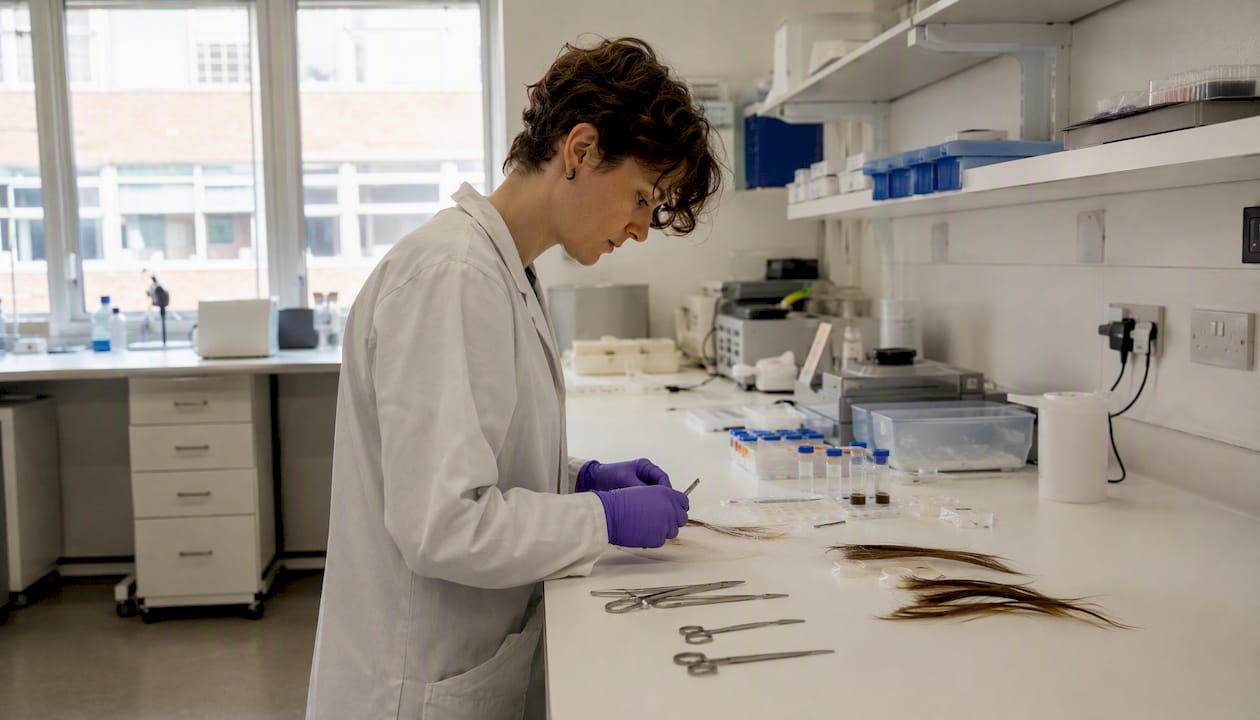
The lab logs your sample against the kit barcode, checks the envelope is sealed and the hair is intact, and assigns it a unique sample ID. Any sample that fails the integrity check triggers a retest request.
2. Sample preparation
Technicians inspect the hair strands, trim them to the required length, and position them correctly for the analysis device. Contaminated or too-short samples are flagged at this point.
3. Bioresonance analysis
The prepared sample is placed in the bioresonance device. The device reads the energetic frequencies associated with the hair and compares them against a reference panel of food, environmental and nutritional items. Each comparison produces a signal reading that the system translates into a numerical score.
4. Scoring and report generation
Scores are mapped to colour-coded sensitivity bands. An algorithm then generates the item list, flags nutritional imbalances, and structures the output into the digital report format. You can read more about the technology behind this on the bioresonance educational guide.
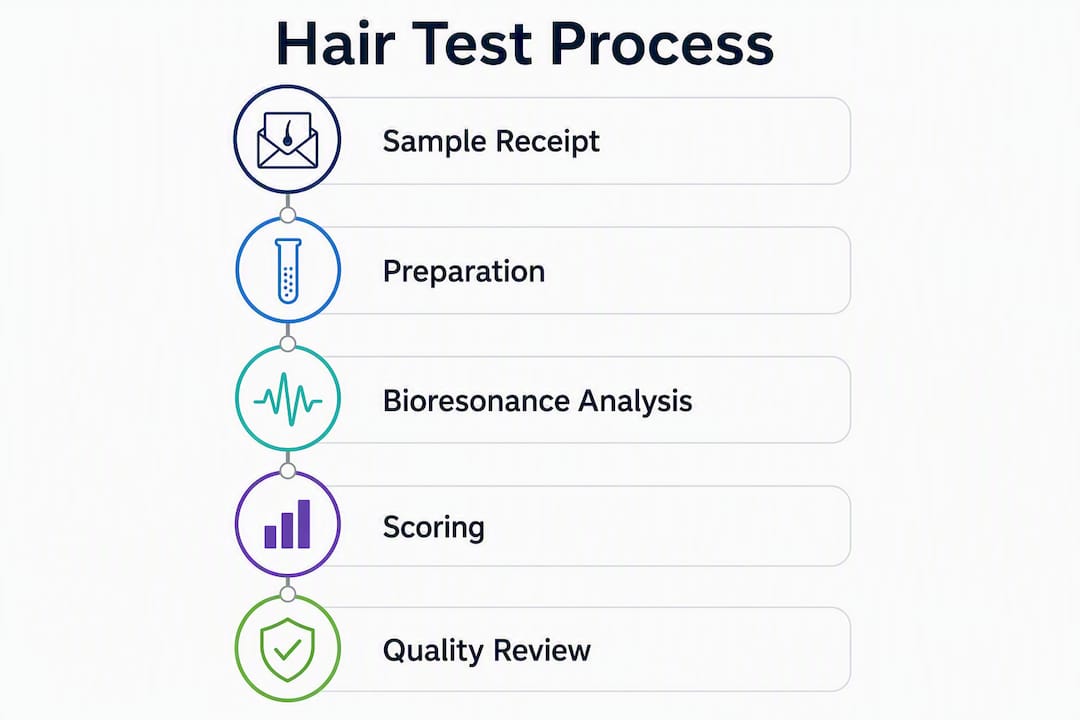
5. Quality review
Before the report is released, an automated review checks that all items have been scored and that no data fields are missing. The completed report is then delivered to your account digitally.
How to collect and post a hair sample that gives the lab usable results
Getting the collection right is the single biggest factor in whether your sample passes the lab’s intake check. Follow the step-by-step workflow below.
- Choose the right hair. Take strands from the back of the head where possible. The root end should be visible.
- Collect enough. A small clump of several strands is needed. A single strand is not sufficient.
- Check the length. Strands should be of adequate length as specified in your kit instructions. Very short clippings are routinely rejected.
- Avoid treated hair where possible. Heavily bleached or chemically processed hair can affect the reading. Use untreated hair if you have it.
- Keep it dry. Wet or damp hair degrades during transit. Let it dry fully before packaging.
- Label clearly. Use the labelled envelope or collection sheet included in your kit. Write your name and order reference exactly as shown.
- Seal securely. Place the hair in the provided sample bag, seal it, and put it inside the return envelope. Do not use additional tape that could contaminate the sample.
- Post promptly. Use Royal Mail first class or the prepaid return label if one is included. The sooner the lab receives the sample, the sooner your results arrive.
Common mistakes to avoid:
- Sending hair that is too short or lacks a visible root
- Mixing hair from multiple people in one envelope
- Posting a wet or product-coated sample
Pro Tip: When collecting hair from a young child or a pet, take strands from the nape of the neck where the hair is least likely to have been treated or contaminated by grooming products. Place the strands immediately into the dry sample bag to preserve integrity.
What your digital report contains and how to read each part
Your report is structured so you can scan it quickly and then dig into the detail. Ukfoodintolerance provides expert guidance on interpreting your results alongside the report itself.
Typical report sections:
- Summary page: a headline overview of the number of items flagged and the highest sensitivity categories.
- Item list with scores: every tested item shown with a percentage score and a colour band (for example, green for low, amber for moderate, red for elevated).
- Nutritional flags: indicators for potential vitamin and mineral imbalances based on the hair analysis.
- Suggested next steps: plain-language guidance on which items to consider reducing first and how to approach an elimination phase.
What a sensitivity percentage means in plain language: a higher percentage indicates a stronger signal from the bioresonance device for that item. It does not confirm a clinical allergy or a medical diagnosis. Think of it as a signal strength reading, not a test result in the clinical sense.
Example report layout (column structure only):
| Item tested | Sensitivity score (%) | Colour band | Suggested action |
|---|---|---|---|
| [Food or environmental item] | — | Green / Amber / Red | [Guidance text] |
A sensitivity flag is not a diagnosis. If a result causes concern, or if you have symptoms that affect your daily life, speak to your GP before making significant dietary changes.
Typical turnaround times and how the product tiers compare
Most samples are processed and reported within 48–72 hours of arriving at the UK laboratory. Several factors can extend that window:
- Sample problems: a rejected sample requires you to collect and post a replacement, adding several days.
- Shipping delays: bank holidays or postal disruption can delay arrival at the lab.
- Peak demand: high order volumes occasionally extend processing by a day.
Ukfoodintolerance offers two main product tiers. The Core Single Intolerance Test covers around 500 items, while the Ultimate Single Intolerance Test covers 1,100+ items. A broader panel gives you more data points but the turnaround time remains the same.
| Core Single Intolerance Test | Ultimate Single Intolerance Test | |
|---|---|---|
| Items tested | ~500 | 1,100+ |
| Turnaround | 48–72 hours | 48–72 hours |
| Support & interpretation | Self-help guidance and report walkthrough | Full report walkthrough plus access to paid interpretation support |
| Best for | Budget-conscious first-time testers | Those wanting the broadest panel and deeper support |
If your sample is rejected, Ukfoodintolerance’s support team can advise on retest options. Check the current policy on the product page at the time of ordering.
Accuracy, scientific limitations and safe interpretation
These tests are not a clinical allergy diagnosis. Bioresonance hair analysis is not validated by mainstream clinical bodies, and the British Association of Dermatologists has highlighted that many private intolerance tests use unvalidated methods. In a 2020 review of 18 brands, only one used an ISO 15189-accredited laboratory.
Investigative reporting has also noted that percentage scores and colour-coded bands, common features of bioresonance reports, should be interpreted with caution rather than treated as clinical findings.
Safe interpretation rules:
- Use the report as a starting hypothesis, not a final answer.
- Confirm any significant dietary change with your GP or a registered dietitian.
- Never eliminate entire food groups without professional supervision.
- If you suspect a true allergy (anaphylaxis, hives, breathing difficulty), seek NHS allergy testing, not a hair sensitivity test.
Pro Tip: Treat your report as a hypothesis generator. Pick the two or three highest-scoring items, remove them one at a time for two weeks each, and note whether symptoms change. This structured approach gives you real evidence rather than a sweeping restriction.
This article is general information, not medical advice. Confirm any clinical decisions with your GP or a qualified health professional.
How your sample and personal data are handled in the UK
Sample custody:
- Each sample is logged against a unique ID on arrival, keeping it separate from personal identifiers during analysis.
- Samples are retained only for the period needed to complete analysis and any quality review.
- After that window, samples are disposed of securely. Check the lab’s current retention policy in the privacy section of the Ukfoodintolerance website.
Personal data handling:
- Ukfoodintolerance operates under UK GDPR, meaning your personal data is collected only for the stated purpose, stored securely, and not shared without consent.
- Your report data is pseudonymised during lab processing so the analysis stage does not require your full personal details.
- You have the right to request access to, or deletion of, your personal data at any time via the site’s privacy contact.
Trust checks you can do right now:
- Confirm the lab location is stated as UK-based on the product page.
- Read the privacy policy before ordering to understand data retention periods.
- Check there is a clear contact route for data requests.
- Ask whether any residual sample is retained for audit purposes and for how long.
How to act on results safely after receiving your report
Receiving your report is the start of the process, not the end. Here is a clear sequence to follow:
- Read the full report before making any changes. Note which items score highest and which nutritional flags appear.
- Keep a food and symptom diary for one to two weeks alongside your current diet. This gives you a baseline to compare against.
- Identify your top priorities. Focus on the two or three items with the highest sensitivity scores rather than trying to change everything at once.
- Consult your GP or a registered dietitian before removing major food groups. A professional can rule out clinical conditions and help you plan safely.
- Start a structured elimination phase. Remove one item at a time, wait two weeks, then reintroduce it and note any change in symptoms.
- Reintroduce gradually. Sudden reintroduction of a food after a long gap can cause a stronger reaction. Reintroduce in small amounts over several days.
- Use the interpretation support. Ukfoodintolerance provides diet planning guidance to help you translate scores into practical meal changes.
When to seek clinical referral:
- Symptoms are severe or worsening
- You suspect a true IgE-mediated allergy
- Nutritional flags suggest a significant deficiency
Pro Tip: Combine your report with a simple symptom diary app or even a paper notebook. Log what you eat, when symptoms appear, and their severity. After two weeks of targeted elimination, patterns become much clearer and you have something concrete to show a dietitian.
Why choose Ukfoodintolerance: what the service offers and who it suits
Ukfoodintolerance provides at-home food intolerance testing built around three core features: non-invasive hair sample collection, UK-based laboratory analysis, and clear digital reports with practical guidance.
What the service includes:
- A home test kit with collection materials and return packaging
- UK laboratory bioresonance analysis of your hair sample
- A digital report delivered within 48–72 hours
- Educational resources, FAQs and interpretation support pages
- Access to paid interpretation consultations (Ultimate tier)
| Core Single Intolerance Test | Ultimate Single Intolerance Test | |
|---|---|---|
| Items tested | ~500 | 1,100+ |
| Turnaround | 48–72 hours | 48–72 hours |
| Support | Self-help guidance | Full walkthrough + paid consultation |
| Suitable for | First-time testers, tighter budgets | Broader investigation, more support needed |
Who these tests suit best:
- UK consumers experiencing unexplained digestive symptoms, skin issues or low energy who want a non-invasive starting point.
- Parents wanting to investigate potential sensitivities in children without a blood draw.
- Pet owners seeking sensitivity insights for dogs or cats.
Who should use NHS or clinical routes instead:
- Anyone with symptoms suggesting a true allergy (anaphylaxis, severe reactions).
- Those needing a medically validated diagnosis for clinical or legal purposes.
For readers ready to order, the full range is available on the intolerance test kits page. For background on how testing fits within UK healthcare, the role of intolerance testing in UK healthcare page is a useful starting point.
Key takeaways
UK-based laboratory analysis for bioresonance hair tests means your sample is processed entirely within the UK, with a digital sensitivity report delivered within 48–72 hours and practical guidance included.
| Point | Details |
|---|---|
| UK-based processing | Your hair sample is analysed in a UK laboratory, not sent abroad. |
| 48–72 hour turnaround | Results arrive digitally within 48–72 hours of the lab receiving a valid sample. |
| Not a clinical diagnosis | Sensitivity scores are signals, not medical findings; consult a GP before major diet changes. |
| Two product tiers | Core covers several hundred items; Ultimate covers more than a thousand items with broader support options. |
| Ukfoodintolerance | Offers both tiers with at-home collection, UK lab analysis, and interpretation guidance included. |
Why I think these tests are most useful when you treat them as a starting point
There is a tendency to either dismiss bioresonance hair tests entirely or to treat every flagged item as a confirmed problem. Neither approach serves you well.
The honest position sits in the middle. Professional bodies are right to caution that these tests are not clinically validated, and anyone with serious symptoms should pursue NHS routes. That is not a reason to dismiss the reports outright, though. For many people, the value is not in the score itself but in the structure it provides. A report gives you a shortlist of candidates to investigate systematically, which is far more useful than trying to eliminate foods at random based on guesswork.
The key is pairing the report with a symptom diary and, ideally, a conversation with a dietitian. Used that way, it becomes a practical tool for narrowing down what to investigate rather than a verdict on what you can and cannot eat.
Ready to order your Ukfoodintolerance hair test?
Getting started takes minutes. Choose your test online, receive your kit by post, collect a small hair sample at home, and return it to the UK laboratory using the prepaid envelope. Your digital report arrives within 48–72 hours, complete with sensitivity scores, nutritional flags, and clear guidance on next steps.
The Core Single Intolerance Test covers around 500 items and suits those testing for the first time or working to a tighter budget. The Ultimate Single Intolerance Test covers 1,100+ items and includes access to deeper interpretation support, making it the better fit if you want the broadest picture. Both tests are processed in the UK and delivered digitally.
Browse the full range on the intolerance tests page or go straight to the home test kits to place your order. If you have questions before ordering, the support team is available via the contact page.
Useful sources and further reading
Independent critiques and regulatory perspectives:
- Skeptic Research Centre: bioresonance and hair analysis critique — investigative analysis of how these tests work and their scientific limitations.
When reading external critiques, note whether the author is reviewing the category broadly or a specific product. Regulatory warnings about unvalidated methods apply to the sector as a whole; they are worth reading before you order so you can set realistic expectations.
Ukfoodintolerance resources for practical next steps:
- How bioresonance technology works — plain-language explanation of the methodology.
- Interpreting your intolerance report — step-by-step guidance on reading scores and planning diet changes.
- Food intolerance and diet planning guide — practical advice on using results safely alongside professional support.









Leave a Reply
Want to join the discussion?Feel free to contribute!