

If you have delayed bloating, wind and recurring skin flares after meals, non-allergic soy intolerance is a plausible cause, and it’s best investigated with a diary and a structured elimination and reintroduction. At-home tests can offer useful pointers, but they aren’t definitive on their own. Start simple: track what you eat and how you feel, before reaching for any kit.
TL;DR:
- At-home tests for soy intolerance, such as blood or hair analyses, are unlikely to provide a definitive diagnosis without confirmation from a structured elimination and reintroduction diet.
- Symptoms usually start in the gut and can appear hours after eating, with systemic signs like headaches or skin rashes often taking longer to manifest and persist for days.
- Severe allergic reactions, including swelling or difficulty breathing, require immediate emergency care, while intolerance symptoms do not pose immediate danger but still warrant careful investigation.
- Keeping a detailed food and symptom diary over one to two weeks is the most reliable way to identify whether soy triggers symptoms before trying an elimination diet.
- Avoid removing multiple foods simultaneously and reintroduce them one at a time in plain form, especially during stable health periods, to accurately determine triggers.
Table of Contents
- What soy intolerance commonly looks like: digestive and systemic symptoms
- How to rule out an allergy and when to get urgent help
- How to investigate suspected soy intolerance at home: diary, elimination and reintroduction
- What at-home intolerance tests measure, their limits, and how to use results sensibly
- Interpreting findings and safe next steps: short trials, nutrition and referrals
- Author perspective: a practical, cautious approach to suspected intolerances
- When an at-home test may help: our testing options and next steps
- FAQ
- Sources
What soy intolerance commonly looks like: digestive and systemic symptoms
Soy intolerance symptoms usually start in the gut. Non-allergic food intolerance often causes bloating, excess gas, abdominal cramping, diarrhoea or constipation, and these symptoms tend to build gradually rather than hit all at once.
The timing is a useful clue. Unlike an allergic reaction, intolerance symptoms often appear a few hours after eating and can linger for hours or even days, which makes it genuinely hard to connect a Tuesday lunch to a Tuesday evening headache without writing anything down.
Common digestive signs include:
- Bloating and a feeling of fullness that builds after meals.
- Excess wind or gas, sometimes with audible gurgling.
- Cramping or dull abdominal pain.
- Diarrhoea, constipation or an unpredictable mix of both.
Soy intolerance isn’t only a gut issue. Systemic symptoms such as headaches, fatigue, joint pain and skin rashes are frequent and can become chronic, which is exactly why they’re so easy to blame on stress, poor sleep or ageing instead of diet.
Pointer: symptoms linked to food intolerance often appear a few hours after eating and may persist for several hours or days, so a same-day symptom check is rarely enough to confirm or rule out soy as the trigger.
How to rule out an allergy and when to get urgent help
Soy intolerance and soy allergy are different conditions, and confusing them can be dangerous. Reactions involving hives, facial or throat swelling, wheeze or difficulty breathing point to an IgE-mediated allergy, which typically develops within minutes, not hours.
Call 999 or go to A&E immediately if you notice:
- Swelling of the lips, tongue, throat or face.
- Wheezing, breathlessness or a tight chest.
- Dizziness, fainting or a sudden drop in alertness.
- Widespread hives appearing within minutes of eating soy.
If you’re booking a GP appointment instead, bring notes on what you ate, how long symptoms took to start, how long they lasted and anything that made them better or worse. That detail speeds up the conversation considerably.
How to investigate suspected soy intolerance at home: diary, elimination and reintroduction
A food and symptoms diary is the practical starting point, and it costs nothing but a few minutes a day. Clinical charities and dietitians recommend detailed diaries as part of the diagnostic process, because patterns that feel invisible day to day often become obvious once they’re written down.
- Record the time, meal, portion size and exact ingredients for everything you eat.
- Note any symptoms, how severe they are and how long they last.
- Log exercise, sleep, stress levels and any medication you’ve taken.
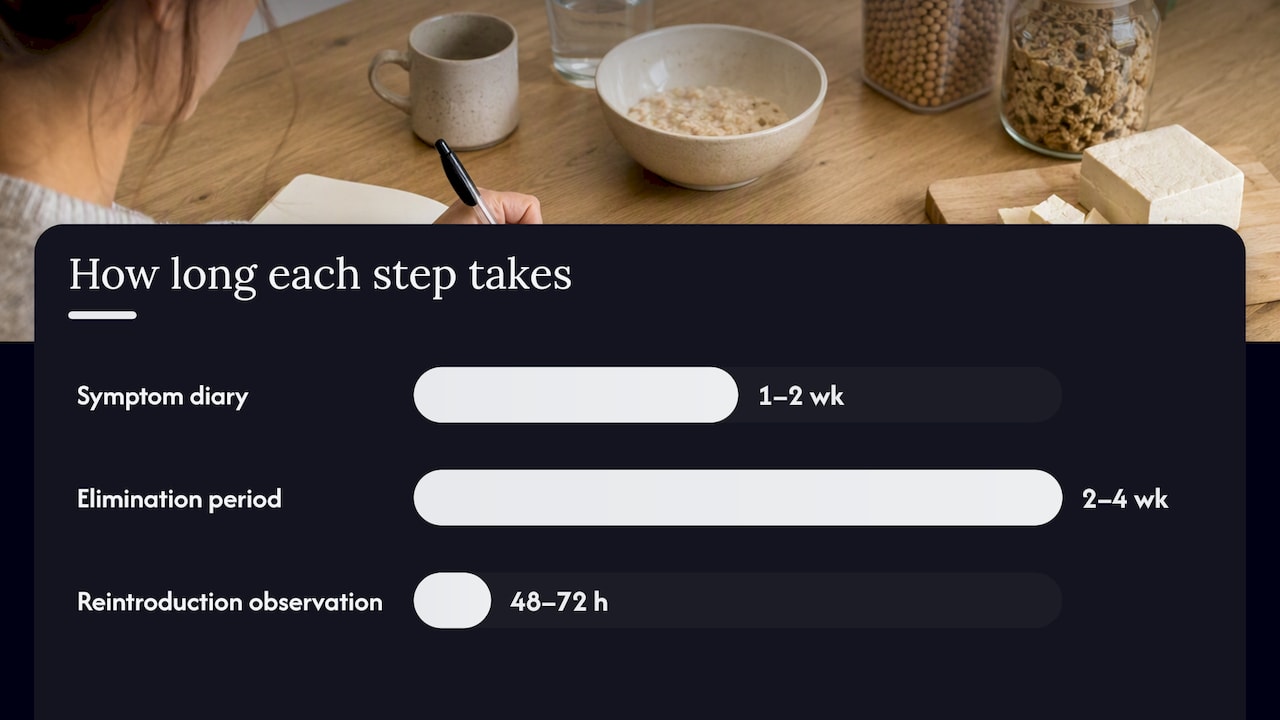
- After one to two weeks, remove soy and soy-derived ingredients completely for a set window.
- Reintroduce soy in its pure form, in a normal portion, then watch for 48 to 72 hours before drawing conclusions.
Structured elimination diets commonly run for around two to four weeks for adults before symptoms meaningfully shift, and some conditions need a longer supervised version with specialist input. Our guide to the food elimination process walks through a safe version of this step by step.
The most common mistake is changing several foods at once, which makes it impossible to tell which one mattered. A close second is calling it quits after a single clean cycle: reliable self-led identification usually needs at least two elimination and reintroduction cycles plus a disciplined diary, because one good or bad week can easily be coincidence.
Pro Tip: Reintroduce only one food at a time, in its plain form, and avoid testing during a cold, a stressful week or a change in medication, since any of these can mimic or mask a reaction.
If symptoms are severe, persistent or affecting a child, loop in a GP or registered dietitian before you start removing food groups.
What at-home intolerance tests measure, their limits, and how to use results sensibly
At-home tests fall into a few categories: IgG blood tests, various finger-prick or saliva kits, and bio-resonance hair tests, each claiming to flag foods your body may react to. None of them replace a proper diagnostic process.
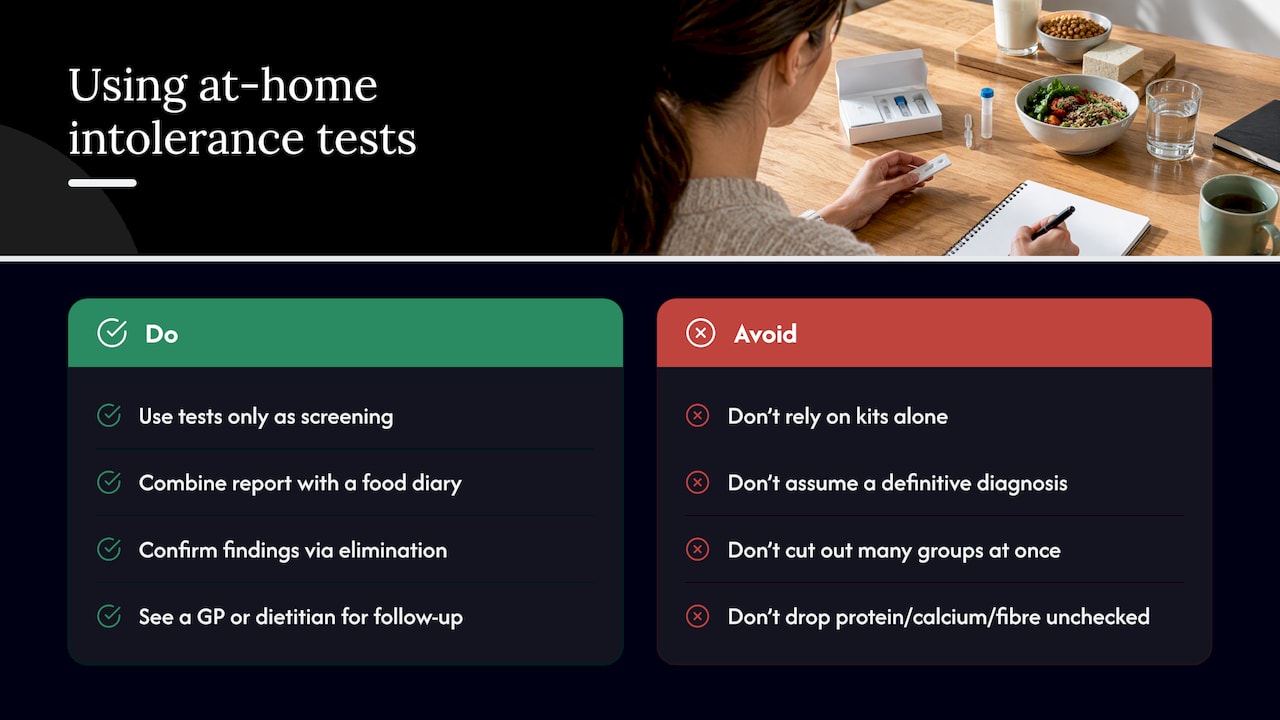
There is no single lab test that definitively diagnoses non-allergic food intolerance; elimination and reintroduction, ideally with GP or dietitian supervision, remains the standard. Dietitians have warned that home allergy and intolerance kits can do more harm than good when a long list of “intolerances” leads someone to cut out multiple food groups without professional guidance.
Home kits may generate broad lists of possible intolerances, and professionals caution these can encourage unnecessary restriction without support.
We use a hair sample collected at home, processed at a laboratory, with a digital report delivered within a few days covering a wide range of food and non-food items (see our full test panels). We’re upfront that this kind of screening works best alongside your diary evidence, not instead of it: a report can point you towards items worth testing through proper elimination, which is where the diary does the real confirming.
Common sense matters here too. Dropping soy, wheat and dairy simultaneously on the strength of a report, without checking your intake of protein, calcium or fibre, risks nutritional gaps that outweigh any relief from the original symptom. That’s a good moment to bring in a dietitian rather than push on alone.
Interpreting findings and safe next steps: short trials, nutrition and referrals
Treat a test report as a shortlist, not a verdict. Weigh it against what your diary actually shows: if soy appears in both, that’s a reasonable candidate for a formal elimination trial; if only the report flags it and your diary shows nothing, it’s worth a lower priority.
- Remove the suspected food for two to four weeks, then reintroduce it in a single clean trial.
- Watch calcium, protein and iodine intake if soy is a regular part of your diet, since cutting it without a plan can leave gaps.
- Ask a registered dietitian about supplement or food-swap options if you’re removing soy from an otherwise plant-based diet.
- Refer to a GP or allergy specialist if symptoms are severe, if weight loss or nutritional deficiency develops, or if the pattern doesn’t resolve despite a careful trial.
Our guide on turning a test report into a workable diet covers this interpretation step in more detail.
Author perspective: a practical, cautious approach to suspected intolerances
We’d always rather see someone run a proper diary and a supervised elimination before cutting out a food group permanently. A report can narrow the search, but it’s the reintroduction trial that actually tells you whether soy is the problem or just a coincidence. If you’re removing a major food group long term, get a dietitian involved: it protects your nutrition while you work out what’s really going on.
— Rob
When an at-home test may help: our testing options and next steps
Once your diary points towards a handful of suspects, or you want a broader screening report to guide where to start, our tests give you a practical shortcut. We collect a hair sample at home, send it to a laboratory, and return a digital report within a few days covering a wide panel of food and non-food items, so you’re not guessing which foods to prioritise in an elimination trial.

- Use a test after a few weeks of diary tracking, when you need a broader list of candidates to narrow down.
- Pair any result with a structured elimination and reintroduction, not as a replacement for it.
- Bring the report to a dietitian if you’re considering removing more than one food group.
| Test | Best suited for |
|---|---|
| Core Test | A focused first screen |
| Essential Test | Wider everyday food coverage |
| Premium Test | Broader panel for persistent symptoms |
| Ultimate Test | Maximum panel coverage |
| Ultimate Plus Intolerance Test | Our most comprehensive single-person option, a one-off fee for the Ultimate Plus Intolerance Test |
Browse the full range of intolerance tests to find the panel that matches where you are in your investigation.
This article is general information, not a substitute for advice from a qualified doctor. Consult a qualified healthcare professional about your own circumstances before acting on anything here.
FAQ
What are the first signs of soy intolerance?
The first signs are usually digestive: bloating, wind, cramping and changes in bowel habit that appear a few hours after eating soy rather than immediately. Some people also notice headaches, fatigue, joint pain or skin rashes alongside the digestive symptoms.
How is soy intolerance different from a soy allergy?
Soy intolerance causes delayed, largely digestive symptoms, while an allergic reaction to soy involves the immune system and causes rapid symptoms such as hives, swelling or breathing difficulty within minutes. Allergic reactions need urgent medical attention; intolerance symptoms, while uncomfortable, aren’t medically dangerous in the same way.
Can an at-home test confirm soy intolerance on its own?
Not reliably on its own. No single lab test can definitively diagnose non-allergic food intolerance, so a report works best as a starting point that you confirm with a diary and a structured elimination and reintroduction trial.
How long does an elimination diet for soy take to show results?
Most adults need roughly two to four weeks of elimination before judging a change, followed by a single clean reintroduction and a 48 to 72 hour observation window. Some conditions need a longer, specialist-supervised version of the diet.
When should I see a GP about suspected soy intolerance?
See a GP if symptoms are severe, persistent despite a careful elimination trial, or if you’re losing weight or struggling to eat a balanced diet. A GP or registered dietitian can also help if you’re removing more than one food group and want to avoid nutritional gaps.
Sources
- Food intolerance | NHS
- Food intolerance | Allergy UK
- Home allergy testing kits — more harm than good | British Dietetic Association
- BDA EoE four food elimination diet (patient leaflet)










Leave a Reply
Want to join the discussion?Feel free to contribute!