

TL;DR:
- Sensitivity testing identifies foods or substances causing adverse reactions and helps distinguish allergies from intolerances. Choosing validated NHS methods like skin prick tests, IgE blood tests, and elimination diets provides accurate diagnoses, while unvalidated tests such as IgG panels and bio-resonance lack scientific support. Medical guidance and systematic dietary reintroduction are essential for safe, reliable intolerance management and avoiding nutritional deficiencies.
Sensitivity testing is defined as a process of identifying which foods or environmental substances trigger adverse reactions in your body. Knowing how to choose a sensitivity test in 2026 matters more than ever, because over 1 in 4 people in the UK have allergies requiring medical diagnosis to differentiate from intolerances. The distinction is critical. An allergy involves an immune response that can be life-threatening, while an intolerance typically causes digestive discomfort without immune activation. Getting this wrong leads to unnecessary food restrictions, nutritional gaps, and ongoing symptoms.
How to choose a sensitivity test in 2026: understanding your options
The UK testing market in 2026 offers more choice than ever, but not all tests carry equal scientific weight. Knowing what each method measures, and what it cannot tell you, is the foundation of good sensitivity test selection.
IgE allergy testing
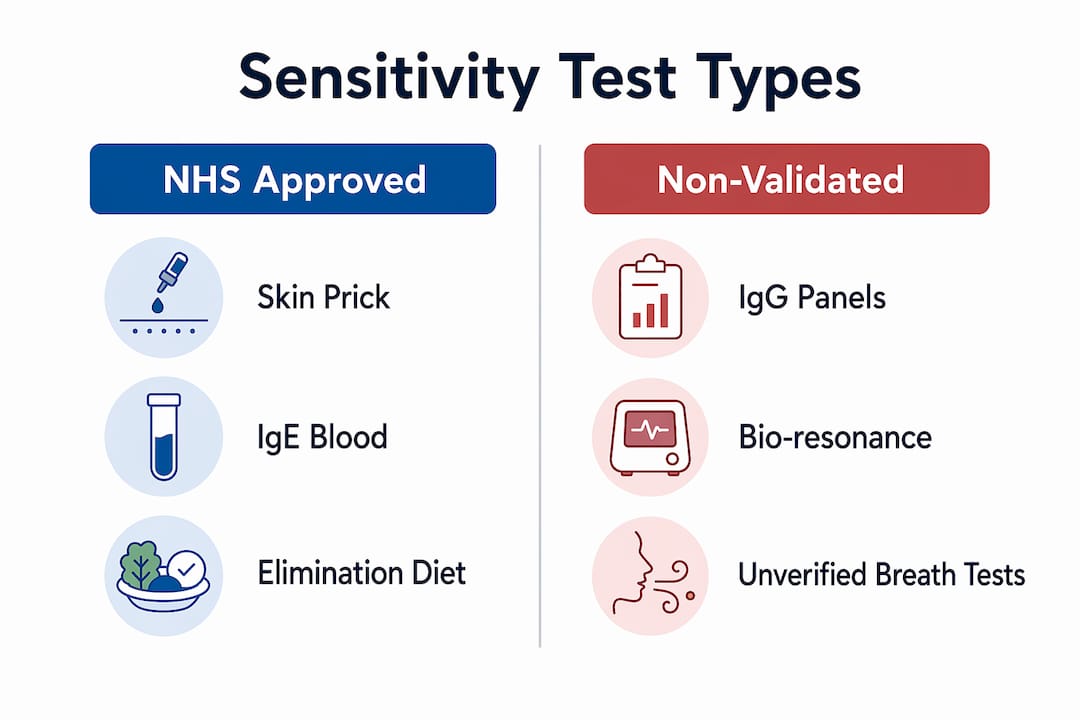
Skin prick testing and specific IgE blood testing are the validated, NHS-approved methods for diagnosing true allergies. These tests measure IgE antibodies, which are immune proteins your body produces in response to specific allergens. A positive result, combined with your clinical history, confirms an allergy. IgE testing is strongly regulated and requires clinical interpretation, because sensitisation does not always mean you will have a reaction.
IgG food intolerance panels
IgG panels are widely marketed as food sensitivity tests, often available as home kits costing between £149 and £399. They measure IgG antibodies, which reflect general immune exposure to foods rather than a true intolerance response. The British Society for Allergy and Clinical Immunology (BSACI), the British Dietetic Association (BDA), NICE, and the European Academy of Allergy and Clinical Immunology (EAACI) do not recommend IgG panels due to lack of clinical validation. High IgG levels often appear for foods you eat regularly, producing false positives that lead to unnecessary elimination.

Elimination and reintroduction diets
The NHS-approved gold standard for diagnosing food intolerance is a supervised elimination and reintroduction diet. You remove suspected trigger foods for a set period, then reintroduce them one at a time while monitoring symptoms. This method produces reliable, personalised results when conducted properly. It requires patience and professional oversight, but it remains the most clinically credible approach available.
Breath tests
Breath tests measure hydrogen or methane gas produced when undigested carbohydrates ferment in the gut. They are used to diagnose lactose intolerance and small intestinal bacterial overgrowth (SIBO). NHS gastroenterology departments offer these tests, and they carry strong scientific backing for specific malabsorption conditions.
Bio-resonance testing
Bio-resonance testing uses non-validated methodologies and lacks peer-reviewed scientific support. It is marketed in some UK home test kits, including those using hair samples, as a way to detect sensitivities to hundreds of items simultaneously. Mainstream clinical bodies do not endorse it as a diagnostic tool. Some people use it as a starting point for dietary investigation, particularly when NHS waiting times are long, but results should always be followed up with professional guidance.
| Method | What it measures | NHS endorsed | Best used for |
|---|---|---|---|
| Skin prick / IgE blood test | IgE immune response | Yes | True allergies |
| Elimination diet | Symptom response to foods | Yes | Food intolerance |
| Breath test | Gas from malabsorption | Yes | Lactose intolerance, SIBO |
| IgG panel | General immune exposure | No | Not clinically recommended |
| Bio-resonance | Electromagnetic signals | No | Preliminary investigation only |
What symptoms should guide your test choice?
Distinguishing allergy from intolerance symptoms is the first step toward choosing the right test. Misidentifying the two leads to misdiagnosis and nutritional risks from unnecessary food elimination.
Allergy symptoms typically appear within minutes to two hours of exposure and can include:
- Hives, swelling, or itching
- Difficulty breathing or throat tightening
- Anaphylaxis in severe cases
- Vomiting or diarrhoea immediately after eating
Intolerance symptoms are slower and less dramatic. They usually appear hours after eating and include bloating, wind, stomach cramps, loose stools, or fatigue. They are dose-dependent, meaning small amounts of a trigger food may cause no reaction at all.
Coeliac disease, IBD, and thyroid dysfunction all produce symptoms that overlap with food intolerance. These conditions must be excluded before you begin any dietary intervention. A GP can arrange blood tests for coeliac antibodies and thyroid function, and refer you for further investigation if needed. Skipping this step risks misattributing serious medical conditions to food triggers.
Pro Tip: Before booking any private sensitivity test, ask your GP to rule out coeliac disease, thyroid dysfunction, and inflammatory bowel disease. These conditions require medical treatment, not dietary elimination.
Step-by-step guide to selecting and running a sensitivity test
A clear process prevents wasted money and avoids the health risks of unguided testing. Follow these steps to make a well-informed choice.
-
See your GP first. Describe your symptoms in detail, including timing, frequency, and any foods you suspect. Your GP can refer you to an NHS allergy clinic or dietitian, and arrange initial blood tests to rule out coeliac disease or other conditions.
-
Identify whether you need allergy or intolerance testing. If your symptoms are immediate and severe, allergy testing via skin prick or specific IgE blood test is the right route. If symptoms are delayed and digestive, intolerance investigation through an elimination diet is more appropriate.
-
Request an NHS referral where possible. NHS allergy clinics provide validated IgE testing at no cost. NHS dietetic services can supervise elimination diets, though waiting times vary and can extend to several weeks or months. Factor this into your planning.
-
Consider private options if waiting times are prohibitive. Private IgE allergy panels are available from accredited laboratories. If you choose a home kit for preliminary investigation, select one that is transparent about its methodology and limitations. Ukfoodintolerance offers at-home intolerance tests that cover a wide range of food and environmental items, with clear guidance on interpreting results.
-
Prepare correctly before testing. For skin prick tests, stop antihistamines at least 72 hours beforehand. For elimination diets, keep a detailed food and symptom diary for two weeks before you begin. For breath tests, follow the specific dietary preparation your clinic provides.
-
Interpret results with professional support. No test result should lead to permanent food elimination without clinical confirmation. Specific IgE results require clinical history for accurate diagnosis, because sensitisation does not always correlate with clinical allergy.
-
Reintroduce foods systematically. After an elimination phase, reintroduce one food at a time over three to five days, monitoring symptoms carefully. This step confirms which foods genuinely trigger your symptoms.
Pro Tip: Keep a written symptom diary throughout any elimination diet. Patterns become clear over time, and a diary gives your dietitian concrete data to work with rather than relying on memory.
How to interpret your results and build a dietary plan
Test results are a starting point, not a final verdict. Supervised elimination and reintroduction diets remain the clinical gold standard for intolerance diagnosis precisely because they confirm results through real-world symptom tracking, not just laboratory markers.
The risks of acting on unvalidated results are real. Unnecessary food elimination causes nutritional deficiencies, particularly in calcium, fibre, and B vitamins, when major food groups are removed without cause. Professional dietitian guidance is critical to navigating elimination diets safely and maintaining a balanced diet throughout.
When working with results, keep these principles in mind:
- A positive IgG result does not confirm intolerance. Most professional allergy societies explicitly recommend against acting on IgG panels due to the risk of false positives.
- A positive IgE result confirms sensitisation, not necessarily a clinical allergy. Always discuss results with an allergist before making dietary changes.
- Symptom resolution during elimination confirms a trigger. Symptom return on reintroduction confirms it again. Both steps are required for a reliable conclusion.
- Long-term management may involve partial restriction rather than total elimination. Many people with lactose intolerance, for example, tolerate small amounts without symptoms.
Working with an HCPC-registered dietitian gives you a structured plan that accounts for your nutritional needs, lifestyle, and the severity of your reactions. You can find further guidance on intolerance testing and diet planning to support this process.
Key takeaways
The most reliable approach to sensitivity test selection in 2026 combines NHS-validated methods, professional supervision, and systematic dietary investigation rather than relying on a single commercial test.
| Point | Details |
|---|---|
| Allergy vs intolerance | Distinguish symptoms before choosing a test, as each requires a different testing method. |
| IgG panels lack validation | BSACI, BDA, NICE, and EAACI do not recommend IgG tests due to false positives and no clinical benefit. |
| Elimination diet is gold standard | NHS-supervised elimination and reintroduction diets provide the most reliable intolerance diagnosis. |
| Rule out medical conditions first | Coeliac disease, IBD, and thyroid dysfunction must be excluded before dietary interventions begin. |
| Professional support is non-negotiable | HCPC-registered dietitians protect nutritional balance and confirm results through structured reintroduction. |
Why I think most people choose the wrong test first
The most common mistake I see is people reaching for a commercial IgG panel before they have spoken to a GP. The appeal is understandable. You get a long list of results, a sense of control, and a clear-looking action plan. The problem is that the list is often clinically meaningless. Foods you eat every day will show elevated IgG levels simply because your immune system has been exposed to them. That is normal immune function, not intolerance.
What I have found genuinely useful is treating home tests as a prompt for investigation, not a diagnosis. If a bio-resonance or IgG test flags wheat and dairy, that is worth discussing with a GP or dietitian. It is not worth eliminating both foods for six months without guidance. The non-invasive testing options available in 2026 are more accessible than ever, and that accessibility is genuinely valuable for people who have been struggling with unexplained symptoms for years.
The uncomfortable truth is that the elimination diet, the method that takes the most time and effort, remains the most reliable tool we have for intolerance diagnosis. No blood test, breath test, or hair sample analysis replaces the clarity of removing a food and watching your symptoms disappear. Use modern testing to narrow your focus, then confirm with the method that actually works.
— Rob
Sensitivity testing made clearer with Ukfoodintolerance
Choosing where to start with sensitivity testing does not need to feel complicated. Ukfoodintolerance provides a range of food intolerance tests designed for people who want clear, fast results from the comfort of home.

The process is simple. You collect a small hair sample, post it to a UK-based laboratory, and receive a detailed digital report within 48–72 hours covering food and environmental items. The Ultimate Single Intolerance Test covers over 1,100 items, while the Core Single Intolerance Test covers 500 items at a lower price point. Both come with guidance on using results to support an elimination diet. You can also browse the full range of tests available to find the option that fits your needs and budget.
FAQ
What is the difference between an allergy test and an intolerance test?
An allergy test measures IgE antibodies linked to immune responses, while an intolerance test investigates non-immune reactions, typically through elimination diets or IgG panels. Allergy tests are NHS-validated; IgG intolerance panels are not endorsed by BSACI, BDA, or NICE.
Are IgG food sensitivity tests worth doing?
IgG tests are not recommended by major clinical bodies due to high rates of false positives and no proven clinical benefit. They can be useful as a starting point for dietary investigation, but results should always be reviewed with a GP or registered dietitian.
How long does an elimination diet take?
A standard elimination diet runs for two to six weeks of restriction, followed by a structured reintroduction phase of several weeks. The full process typically takes two to three months when conducted properly under dietitian supervision.
Can I get sensitivity testing on the NHS?
The NHS provides IgE allergy testing through allergy clinics and dietitian-supervised elimination diets through dietetic services. Waiting times vary and can extend to several months, which leads many people to consider private or home-based options in the interim.
Is bio-resonance testing scientifically valid?
Bio-resonance testing lacks peer-reviewed scientific validation and is not endorsed by NHS clinical bodies. It is used by some people as a preliminary screening tool, but results should not be used to make permanent dietary changes without professional confirmation.










Leave a Reply
Want to join the discussion?Feel free to contribute!