

Countless British adults struggle with digestive issues that seem to appear without warning, making daily life uncomfortable and unpredictable. For those seeking to uncover the root causes, non-invasive food intolerance testing offers a hopeful path. Over 60 percent of people reporting stomach complaints never discover their true dietary triggers. This guide explores modern intolerance testing in British healthcare and highlights how targeted testing could help you take back control of your wellbeing.
Table of Contents
- Defining Intolerance Testing In UK Healthcare
- Types Of Intolerance Testing Available
- How Non-Invasive Home Tests Work
- Legal Status And NHS Perspective
- Costs, Limitations, And Alternative Approaches
Key Takeaways
| Point | Details |
|---|---|
| Emerging Diagnostic Approach | Food intolerance testing is becoming a key method in British healthcare to identify non-immune reactions to foods causing health issues. |
| Recognition of Testing Methods | Only certain tests, such as Hydrogen Breath Testing and professionally managed elimination diets, are recognised by the NHS for their scientific reliability. |
| Caution with Home Tests | Many home intolerance tests lack scientific validation; users should approach results with scepticism and consult with professionals. |
| Professional Consultation Recommended | Engaging with healthcare professionals ensures users receive accurate and evidence-based dietary advice, avoiding the pitfalls of commercial testing. |
Defining intolerance testing in UK healthcare
Food intolerance testing represents an emerging diagnostic approach in British healthcare, focusing on understanding how specific foods might trigger adverse bodily reactions. Unlike traditional medical assessments, these tests aim to identify non-immune responses that can cause significant digestive discomfort and overall health challenges.
According to the National Health Service guidelines, food intolerance involves difficulty digesting certain foods or ingredients, resulting in symptoms like bloating, stomach pain, and digestive irregularities. These reactions differ fundamentally from food allergies, which engage the immune system more directly. The British healthcare perspective emphasises careful, systematic investigation rather than blanket diagnostic approaches.
Typically, intolerance testing involves comprehensive screening methods that analyse an individual’s potential reactive responses to various food groups. The British Dietetic Association highlights that these tests examine non-immune-mediated adverse food reactions, providing insights into potential dietary triggers that might compromise an individual’s digestive wellness. By identifying specific food sensitivities, healthcare professionals can develop targeted dietary management strategies.
Modern intolerance testing often incorporates advanced diagnostic techniques, including blood analysis, elimination diets, and specialised laboratory screenings. These methods help individuals understand their unique physiological responses to different nutritional components, enabling more personalised dietary interventions.
Pro tip: Consider maintaining a detailed food diary alongside professional testing to track potential intolerance symptoms and provide your healthcare provider with comprehensive contextual information.
Types of intolerance testing available
Food intolerance testing encompasses a diverse range of diagnostic approaches, each with varying levels of scientific credibility and clinical recognition within the United Kingdom’s healthcare system. Understanding these different testing methods is crucial for individuals seeking accurate insights into their potential dietary sensitivities.
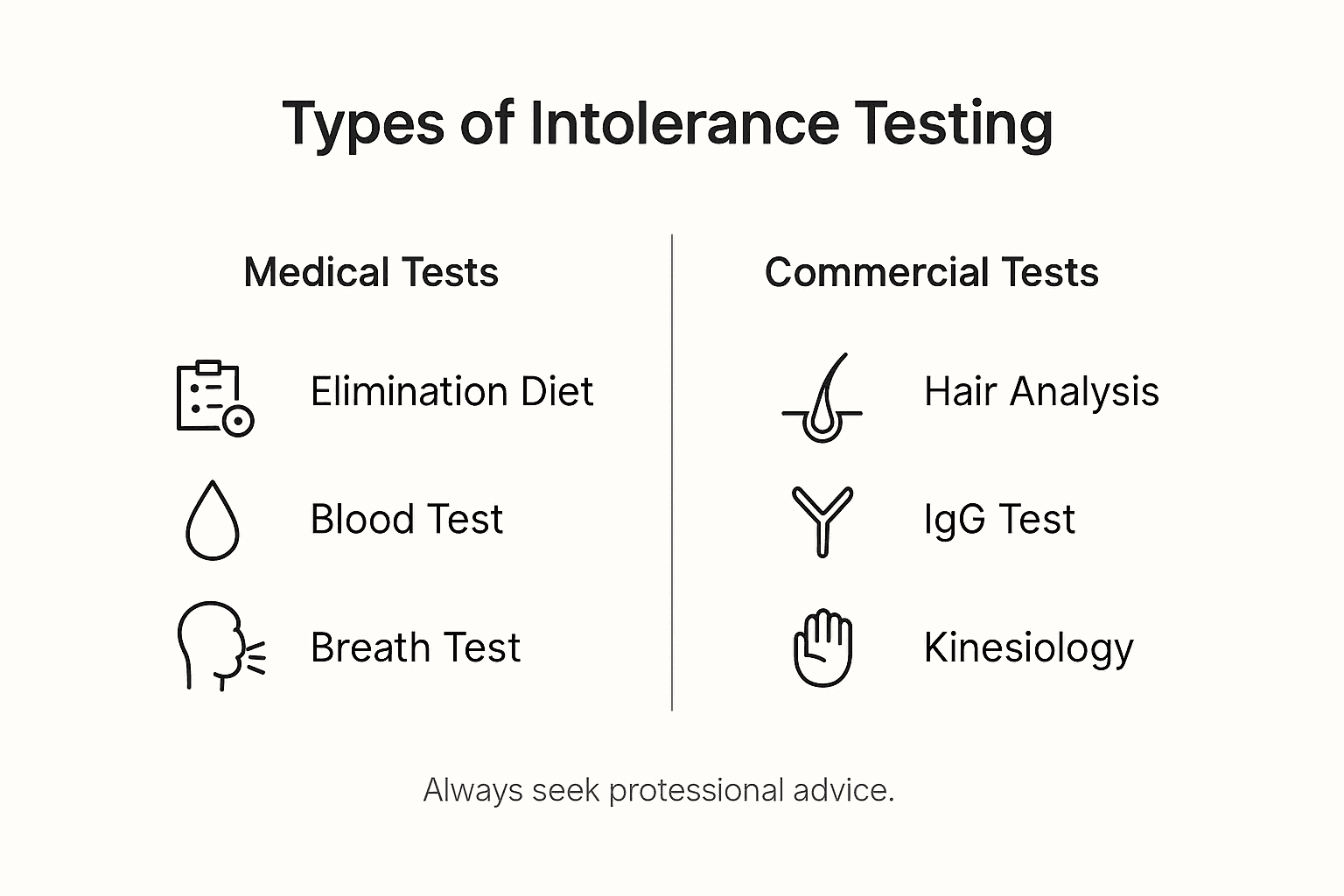
Guts UK notes that while numerous commercial food intolerance tests exist, not all are scientifically validated. The primary testing methods include:
- Hydrogen Breath Testing: A medically recognised technique for detecting specific intolerances like lactose and fructose
- Elimination Diets: Professionally supervised dietary protocols that systematically identify food triggers
- Blood Analysis: Including specific tests like IgE blood tests for allergic responses
The British Dietetic Association highlights that commercially available tests such as hair analysis, applied kinesiology, and IgG antibody panels are widely marketed but lack robust scientific endorsement. These alternative methods are not recommended by official UK healthcare bodies due to insufficient empirical evidence.
Moreover, professional healthcare practitioners typically emphasise medically supervised testing methods that provide reliable, reproducible results. This approach ensures patients receive accurate diagnostic insights while avoiding potentially misleading or unsubstantiated testing techniques.
Here is a comparison of recognised and commercial food intolerance testing methods in UK healthcare:
| Testing Method | Recognised by NHS | Scientific Evidence | Typical Sample Type |
|---|---|---|---|
| Hydrogen Breath Test | Yes | Strong | Breath |
| Professionally Managed Diet | Yes | Strong | Food intake diary |
| IgE Blood Analysis | Yes (for allergy) | Moderate | Blood |
| Hair Analysis | No | Lacking | Hair |
| IgG Antibody Panel | No | Lacking | Blood |
| Applied Kinesiology | No | Lacking | Physical examination |
Pro tip: Always consult with a registered dietitian or healthcare professional before undertaking any food intolerance testing to ensure you select a scientifically validated and clinically appropriate diagnostic method.
How non-invasive home tests work
Home intolerance testing offers individuals a convenient method to explore potential dietary sensitivities without traditional clinical interventions. These non-invasive approaches typically involve collecting biological samples such as hair, saliva, or blood from the comfort of one’s home, which are then sent to specialised laboratories for comprehensive analysis.
The testing process generally follows a standardised sequence:
- Sample Collection: Individuals receive a home testing kit with specific instructions for collecting their biological sample
- Sample Submission: The collected sample is carefully packaged and mailed to a designated laboratory
- Laboratory Analysis: Technicians conduct detailed screening using various methodological approaches
- Results Generation: A comprehensive digital report is produced and transmitted to the participant
The NHS cautions that many home intolerance tests lack robust scientific validation, emphasising that not all commercial testing methods provide reliable diagnostic insights. While some tests claim to measure antibody responses or utilise bioresonance technologies, healthcare professionals recommend approaching these results with measured scepticism.

Despite the limitations, home testing can serve as an initial screening tool, potentially highlighting areas warranting further professional investigation. However, these tests should never replace comprehensive medical consultation or professional dietary assessment.
Pro tip: Always discuss your home test results with a registered healthcare professional who can provide contextual interpretation and guide appropriate next steps.
Legal status and NHS perspective
The legal landscape surrounding food intolerance testing in the United Kingdom remains complex and largely unregulated, with significant concerns raised about the scientific validity of commercial testing approaches. Existing consumer protection and medical device regulations provide minimal oversight for these diagnostic tools, leaving consumers potentially vulnerable to misleading or unsubstantiated claims.
Key regulatory considerations include:
- Limited Legal Framework: No unified regulatory mechanism specifically governing food intolerance tests
- Consumer Protection: Basic protections exist under general medical device and consumer health regulations
- Professional Guidance: Clear recommendations against unvalidated testing methods
The British Dietetic Association and NHS maintain a consistently cautious stance, explicitly advising against commercial intolerance tests that lack robust scientific evidence. Healthcare professionals emphasise that only professionally supervised, evidence-based diagnostic approaches—such as carefully managed elimination diets or specific breath tests—are considered medically appropriate.
This regulatory uncertainty creates significant challenges for consumers seeking reliable information about potential food sensitivities. While commercial testing continues to proliferate, medical institutions remain steadfast in recommending comprehensive professional assessment over potentially unreliable home testing methods.
Pro tip: Prioritise professional medical consultation and evidence-based diagnostic techniques when investigating potential food intolerances, rather than relying solely on commercial testing products.
Costs, limitations, and alternative approaches
Commercial intolerance tests present significant financial challenges for patients seeking dietary sensitivity insights, often representing substantial expenditure without delivering reliable or actionable health information. These tests typically range from £50 to £250, creating a considerable financial burden for individuals hoping to understand their potential food sensitivities.
Key limitations of commercial intolerance testing include:
- Scientific Unreliability: Most private-sector tests lack robust scientific validation
- Potential Nutritional Risks: Unsupervised dietary restrictions may lead to potential nutrient deficiencies
- Financial Inefficiency: Significant cost without guaranteed diagnostic clarity
Professionally recommended alternative approaches focus on evidence-based diagnostic methods. These include:
- Supervised Elimination Diets: Professionally guided dietary trials that systematically identify potential food triggers
- Detailed Medical History: Comprehensive patient consultation examining symptoms and dietary patterns
- Breath Hydrogen Testing: Validated diagnostic technique for specific intolerances like lactose malabsorption
Healthcare professionals consistently emphasise that comprehensive medical assessment provides more accurate and cost-effective insights compared to commercial testing. The goal remains identifying genuine dietary sensitivities while maintaining optimal nutritional balance and overall health.
The following table outlines factors affecting the cost and value of food intolerance testing in Britain:
| Factor | Commercial Tests | NHS/Professional Methods |
|---|---|---|
| Average Price Range | £50–£250 | Usually covered by NHS |
| Scientific Reliability | Low for most | High for validated tests |
| Nutritional Guidance | Rarely included | Provided by professionals |
| Actionable Results | Often unclear | Clear and supervised |
Pro tip: Consult a registered dietitian or nutritionist who can provide personalised, evidence-based guidance tailored to your specific health needs and potential dietary sensitivities.
Take Control of Your Wellbeing with Reliable Intolerance Testing in the UK
Navigating the complex world of food intolerance testing in UK healthcare can be overwhelming, especially when many commercial tests lack scientific validation. If you experience unexplained digestive discomfort, inflammation, or suspect dietary triggers but feel uncertain about where to turn, UK Food Intolerance offers a trusted and non-invasive solution. Using advanced bio-resonance technology, our home testing kits provide clear insights into over 1,100 potential food and environmental sensitivities. This empowers you to make informed decisions about your health with the support of comprehensive digital reports and expert guidance.
Discover how simple it is to take a hair sample in your own home and receive detailed results analysed in a UK-based laboratory within 72 hours. Choose between our Ultimate Single Intolerance Test for wide-ranging coverage or the more affordable Core Single Intolerance Test to jumpstart your journey. Don’t let uncertainty limit your quality of life. Visit UK Food Intolerance today to explore our at-home testing options and gain clarity on your dietary health. Start identifying your triggers now and move confidently towards improved wellbeing.
Frequently Asked Questions
What is food intolerance testing?
Food intolerance testing aims to identify specific foods that may trigger adverse bodily reactions, focusing on non-immune responses that cause symptoms like bloating and digestive discomfort.
What methods are used for food intolerance testing in UK healthcare?
Common methods include hydrogen breath testing, elimination diets, and IgE blood analysis. Some commercial tests, like hair analysis and IgG antibody panels, lack scientific validation and are not recommended by healthcare professionals.
How do home intolerance tests work?
Home intolerance tests involve collecting biological samples, which are sent to laboratories for analysis. However, many of these tests lack scientific validation, and results should be interpreted with caution.
What are the limitations of commercial food intolerance tests?
Commercial tests often lack scientific reliability and can lead to unnecessary dietary restrictions, potentially resulting in nutrient deficiencies. Consult a healthcare professional for evidence-based alternatives.










Leave a Reply
Want to join the discussion?Feel free to contribute!