

Yes, for some people, certain foods can trigger a migraine attack, but food is rarely the whole story. Start a structured headache and food diary for at least eight weeks, and speak to your GP before cutting out entire food groups. Alcohol, aged cheese, cured meats, and chocolate are the most commonly reported triggers, though the evidence behind each varies enormously from person to person.
TL;DR:
- Food triggers like aged cheese, cured meats, and alcohol are common but vary greatly between individuals, making personalized testing essential.
- A validated elimination process requires at least eight weeks of food and migraine tracking, with three attacks showing a consistent pattern before identifying triggers.
- Blood sugar fluctuations and premonitory cravings often cause migraine attacks, so timing and symptom context are crucial for accurate attribution.
- IgG-based elimination diets show some promise but are based on limited research and should be guided by healthcare professionals.
- Routine lifestyle habits such as regular meals, hydration, and moderate alcohol and caffeine intake have a significant impact on reducing migraine risks.
Table of Contents
- Migraines and food intolerance: how foods may set off an attack
- Common foods people report as migraine triggers
- What does the evidence actually show?
- How to find out if food is triggering your migraines
- Everyday changes that lower your risk
- When it’s time to speak to a doctor or dietitian
- The uncomfortable truth about migraine trigger lists
- Where at-home testing fits into your identification plan
- Sources
- FAQ
Migraines and food intolerance: how foods may set off an attack
The link between migraines and food intolerance is real but messier than most headlines suggest. Several distinct mechanisms overlap, which is exactly why one person’s “trigger food” leaves another person unaffected.
Vasoactive amines sit at the centre of the theory. Histamine and tyramine build up in foods as they age, ferment, or sit in storage. Once these amines form, cooking does not remove them, so a well-cooked meal made from stored ingredients can carry just as much amine load as a raw one, according to guidance from Plymouth Hospitals on vasoactive amine sensitivity. Symptoms in sensitive people can appear within a few hours of eating, which is part of why aged cheese and cured meats keep coming up in migraine questionnaires.
Caffeine and alcohol behave in almost opposite ways. A regular coffee habit can mask a withdrawal headache as a “trigger”, when the real issue is skipping your usual dose. Alcohol, particularly red wine and strong beer, contains its own amine and sulphite load on top of its direct vascular effects, so the timing of an attack after drinking often depends on the drink, the dose, and how dehydrated you already were.

Blood sugar matters more than most people expect. Long gaps between meals, or skipping breakfast, can trigger attacks independent of what you actually ate. This is one reason clinical guidance from NICE on headache management puts regular eating ahead of specific food exclusions.
The premonitory phase is the trickiest confounder of all. Migraine often begins with a pre-headache phase lasting hours, sometimes a day, during which cravings (chocolate is the classic example) can appear as an early symptom rather than a cause. The National Migraine Centre’s factsheet on migraine and food flags this directly: you reach for chocolate because your brain is already shifting into attack mode, not the other way round.
- Vasoactive amines in aged, fermented, or stored foods can provoke symptoms within hours
- Caffeine withdrawal, not caffeine itself, is often the true trigger
- Alcohol combines direct vascular effects with its own amine content
- Skipping meals or long fasting gaps can trigger attacks on their own
- Premonitory cravings are frequently mistaken for causes
There’s also a long-running theory involving IgG food antibodies and low-grade inflammation, but this remains the most contested mechanism in the whole field, and the evidence behind it deserves its own scrutiny later in this article.
Pro Tip: When a “trigger” keeps showing up, check what you were doing 24 hours beforehand, not just what you ate an hour before the headache started. Premonitory cravings almost always point backwards, not forwards.
Common foods people report as migraine triggers
Patient surveys and clinical experience point to a fairly consistent shortlist, even though the underlying evidence quality differs from item to item.
- Alcohol, especially red wine and strong beers. Combines vasoactive amines, sulphites, and dehydration in one drink.
- Chocolate. Frequently reported, but strongly confounded by premonitory cravings rather than a proven causal trigger.
- Aged cheese. Cheddar, Stilton, and other matured cheeses accumulate tyramine as they ripen.
- Cured and processed meats. Bacon, salami, and ham contain nitrates and nitrites alongside amines from curing and ageing.
- Citrus fruit. Reported by some, though the mechanism is less clear than with amine-rich foods.
- Caffeine, in excess or in withdrawal. Both too much and too little can be implicated, depending on your usual intake.
- Fermented and pickled foods. Sauerkraut, soy sauce, and some pickles carry a similar amine profile to aged cheese.
- Artificial sweeteners and certain additives. Aspartame and monosodium glutamate appear in some individual reports, though population-level evidence is thin.
Storage and ageing are the common thread running through most of this list. A fresh chicken breast carries a fraction of the amine load of the same cut left in the fridge for several days, or turned into a stock cube or cured product. That’s the practical logic behind advice to favour freshly prepared food over stored, fermented, or aged items when you suspect a sensitivity.
Individual variation is large, and food combinations complicate things further. A glass of wine on its own might do nothing; the same glass alongside a matured cheese and a late dinner might tip you into an attack. This is precisely why single-food elimination trials, tackled one at a time under supervision, tend to produce clearer answers than vague “avoid trigger foods” advice.
What does the evidence actually show?
The honest answer: promising in places, but far from conclusive. Migraine and food intolerance research suffers from small samples, inconsistent designs, and a wide range of diets tested against a genuinely variable condition.
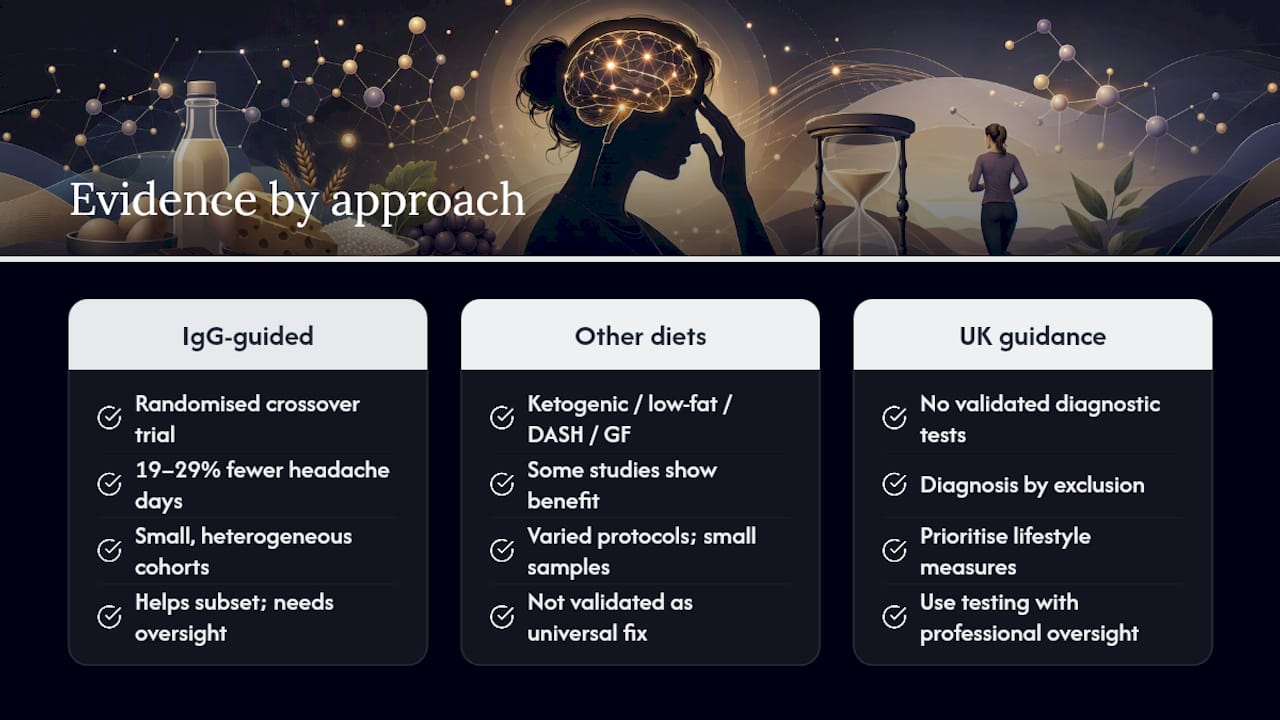
The strongest data comes from IgG-guided elimination diet trials. A randomised, double-blind crossover study found that patients following an elimination diet based on their IgG antibody results experienced significantly fewer headache days than during the control period, as reported in the IgG-guided elimination diet crossover trial. Broader analysis of similar trials has reported headache day reductions in the region of 19% to 29% in specific migraine cohorts, though the studies involved were small and used varied protocols, which limits how confidently those figures generalise.
IgG-based elimination approaches have shown measurable reductions in headache frequency in controlled trials, but the trials involved only small cohorts with heterogeneous designs, and IgG antibody presence itself is not proof of a causal food trigger. Reviewers are consistent on one point: promising signal, insufficient scale.
Wider diet research tells a similarly mixed story. A review of dietary interventions for migraine found that approaches including ketogenic, low-fat, DASH, and gluten-free diets each showed some signal for reducing migraine frequency or severity in individual studies, according to a systematic review of diet as a treatment for migraine. None of these approaches has been validated as a universal fix, and the same review calls for larger, better-designed trials before any single diet can be recommended broadly.
UK clinical guidance takes a notably cautious line on formal testing. NHS guidance on food intolerance states plainly that there are no validated, reliable diagnostic tests for chemical sensitivity to vasoactive amines. Diagnosis remains clinical, built on symptom improvement after exclusion rather than a blood test or panel result. NICE’s headache treatment guidance echoes this by prioritising lifestyle stability over blanket food exclusion, recommending regular meals, adequate hydration, and consistent sleep as the first-line, evidence-backed intervention, per NICE’s headache treatment summary.
Put together, the picture is this: elimination approaches guided by testing can help a genuine subset of people, and the trial data backs that up in a limited way. But the National Migraine Centre and NHS both frame testing and diet change as tools that work best alongside professional oversight, not as a replacement for the basics, and not as something to attempt without a plan for reintroduction.
How to find out if food is triggering your migraines
Identifying migraine food sensitivities properly takes weeks, not days, and the process matters as much as the conclusion.
- Start a structured headache and food diary. Record every meal and drink with timestamps, alongside sleep, stress levels, menstrual cycle stage if relevant, and any medication taken. NICE-aligned guidance recommends keeping this diary for a minimum of eight weeks to capture enough attacks for a reliable pattern. Our own guide to tracking food and symptom triggers breaks this down step by step.
- Apply a three-day lookback whenever you review an attack. Rather than asking “what did I eat an hour ago,” look at everything consumed over the previous three days, and note anything unusual: skipped meals, travel, poor sleep, a new supplement. The National Migraine Centre’s factsheet recommends this window specifically because premonitory cravings distort same-day recall.
- Wait for at least three attacks before drawing conclusions. One coincidence is not a pattern. Three or more attacks following the same food, on separate occasions, is a far stronger signal.
- Run a single-food elimination trial, not a blanket ban. Remove one suspected food for two to eight weeks, track symptoms against your baseline diary, then reintroduce it deliberately and note any change. Testing several foods at once makes it impossible to know which one, if any, mattered.
- Understand what testing can and cannot tell you. IgE allergy testing, done through an allergy clinic, identifies true allergic reactions and is a different pathway from intolerance work. IgG panels and bioresonance-style screening tools can flag foods worth investigating through diary and elimination, but neither replaces clinical interpretation, particularly given the NHS’s own position that no validated test exists for chemical sensitivity.
Pro Tip: Photograph your meals as you go rather than relying on memory at the end of the day. A diary filled in from memory tends to miss the small, repeated details, like a splash of soy sauce or a second coffee, that later turn out to matter.
Do not self-impose broad, multi-food restriction without dietetic input. Cutting dairy, gluten, caffeine, and alcohol simultaneously might feel proactive, but it makes cause and effect impossible to untangle, and it carries a genuine risk of nutritional shortfall if sustained for months. If you’re weighing up whether a screening test fits into this process, our guide on what to do after receiving your results covers how to turn a report into a safe, structured trial rather than a permanent ban list.
Everyday changes that lower your risk
Reducing diet-related migraine risk usually has less to do with cutting out foods and more to do with stabilising your daily routine.
- Eat regularly, roughly every four hours, and never let a gap stretch beyond fifteen hours without food. A breakfast with some starch and fibre, porridge or wholegrain toast rather than nothing at all, keeps blood sugar steadier through the morning.
- Stay hydrated, aiming for around two litres of water a day, more if you’re active or the weather is warm. Dehydration is one of the most consistently reported migraine triggers across patient surveys.
- Moderate alcohol and caffeine rather than eliminating either outright, unless a personal pattern clearly points to one. Pair each alcoholic drink with a glass of water, and avoid mixing different types of alcohol in one session.
- Favour freshly prepared food over aged, stored, or fermented items if you suspect amine sensitivity. That means choosing a fresh cut of meat over a cured one, and a young cheese over a matured one, when you have the option.
- Plan around your social life rather than withdrawing from it. Swapping the wine for a soft drink at dinner, or choosing a milder cheese on a shared platter, keeps you eating normally without isolating you from ordinary meals out. This kind of substitution based approach, alongside sensible planning while travelling, is covered well by Wild Foodz’s tips for eating healthily on holiday.
Our own practical guide to managing food triggers walks through meal planning and preparation habits that support this in more detail. None of this requires perfection. The goal is consistency across most days, with occasional flexibility, rather than a rigid list of forbidden foods that becomes its own source of stress.
When it’s time to speak to a doctor or dietitian
Certain patterns warrant more than a diary. Sudden, severe headache unlike any you’ve had before, neurological symptoms such as slurred speech, vision loss, or weakness, or a headache pattern that’s steadily worsening all need urgent medical assessment, not a wait-and-see approach.
For everyday migraine management, your GP is the right first stop. They can confirm the diagnosis, review any medication you’re taking (including whether it’s contributing to the problem through overuse), and refer you on to a neurologist or dietitian if the pattern warrants it. Allergy clinics specifically test for IgE-mediated allergy, a different condition from intolerance, so if a true allergy is suspected, that’s a distinct referral pathway.
If you do pursue an elimination diet, doing it with dietetic supervision matters, particularly if you’re removing more than one or two food groups. A registered dietitian can help you avoid the nutritional gaps that come from unsupervised, long-term restriction.
The uncomfortable truth about migraine trigger lists
Most of what gets shared as migraine trigger advice is anecdote dressed up as certainty. The research doesn’t support tidy “avoid these ten foods” lists, because the trial evidence is small, varied, and often specific to particular cohorts rather than migraine sufferers generally.
What the data does support is patience. Genuine identification of migraine food sensitivities takes an eight-week diary, honest three-day lookbacks, and single-food trials, not a quick elimination of everything that sounds suspicious. That’s slower and less satisfying than a definitive list, but it’s the version that actually holds up when you test it against your own attacks.
Work with your GP or a dietitian if you’re removing more than one food group. Data beats memory every time, and a clinician can catch what a spreadsheet alone will miss.
— Rob
Where at-home testing fits into your identification plan
If your diary points to several possible culprits and you want a structured starting point, an at-home sensitivity screen can narrow the field before you commit to weeks of single-food trials. Some companies offer hair-sample bioresonance screening processed at UK laboratories, with digital reports delivered in 48 to 72 hours covering panels of various sizes, giving you a broad shortlist to test against your own diary rather than guessing where to start.

These screens are a starting point for investigation, not a diagnosis, and they work best alongside the diary and elimination approach covered above, never as a replacement for medical advice on red-flag symptoms. Browse the full range of tests to compare panel sizes, or see the items covered across each panel before choosing. Once your report arrives, our guide on collecting your hair sample correctly and our elimination diet checklist will help you turn the results into a safe, structured trial. If you want the most extensive screen currently available, the Ultimate Plus Intolerance Test is priced at £140.99 as a one-off per person.
This article is general information, not a substitute for advice from a qualified doctor. Consult a qualified healthcare professional about your own circumstances before acting on anything here.
Sources
- Randomised crossover study of IgG-guided elimination diet in migraine
- NHS: Food intolerance
- National Migraine Centre: Migraine and food
FAQ
What are five foods that commonly trigger migraine headaches?
Alcohol (particularly red wine), aged cheese, cured or processed meats, chocolate, and caffeine (through excess or withdrawal) are the most frequently reported migraine triggers, though individual sensitivity varies widely.
Can a migraine cause digestive issues like nausea or stomach pain?
Yes. Migraine commonly involves nausea, vomiting, and abdominal discomfort as part of the attack itself, driven by the same neurological changes that cause head pain, rather than by anything eaten beforehand.
What are three symptoms of food intolerance?
Common symptoms include bloating or digestive discomfort, headaches or fatigue, and skin reactions such as rashes, typically appearing hours after eating rather than immediately.
Why do some fast-food meals seem to ease a migraine?
This usually reflects blood sugar recovery after a long gap without food, or caffeine intake if the meal included a caffeinated drink, rather than any specific ingredient easing the headache directly.
How long should I keep a food and migraine diary before drawing conclusions?
Clinical guidance recommends at least eight weeks of consistent tracking, capturing multiple attacks with a three-day lookback each time, before identifying a reliable pattern.
Can an at-home sensitivity test tell me exactly what causes my migraines?
An at-home test such as those from Ukfoodintolerance can highlight items worth investigating through diary and elimination, but it works as a screening tool alongside clinical advice, not as a standalone diagnosis.










Leave a Reply
Want to join the discussion?Feel free to contribute!