

Most unsettled babies don’t need their mother to change what she eats. An elimination diet is only appropriate when an exclusively breastfed baby shows clear signs of a food allergy, such as blood in the stool or persistent eczema. If that’s the case, removing cow’s milk for 2–4 weeks, then reintroducing it under clinical guidance, is the standard first step.
TL;DR:
- An elimination diet is only necessary if a breastfed baby shows clear signs of food allergy, such as blood in stool or persistent eczema.
- Removing cow’s milk first and sticking to a staged process helps identify the specific trigger, with 2–4 weeks the typical trial period.
- Dairy includes all mammalian milk and products derived from cow, goat, sheep, and buffalo, often hidden in processed foods and medications.
- Breastfeeding mothers need around 1,250 mg of calcium daily, which requires careful dietary planning and supplementation if dairy is eliminated.
- Reintroduction of foods should be done gradually and under supervision to confirm a food allergy, avoiding indefinite restrictions.
Table of Contents
- How do you know if your baby’s symptoms point to food in breast milk?
- When and how do clinicians recommend starting an elimination trial?
- What do you actually need to cut out, and where does dairy hide?
- How do you protect your own nutrition while restricting foods?
- How do you reintroduce foods to confirm the diagnosis?
- When should you seek urgent help or a specialist referral?
- Can at-home sensitivity testing support this process?
- What the evidence actually supports
- How Ukfoodintolerance fits alongside your GP’s advice
- Sources
- FAQ
How do you know if your baby’s symptoms point to food in breast milk?
Colic, cluster feeding, and evening grizzling are exhausting, but they’re rarely a sign that anything in your diet is the problem. Most babies who cry a lot are simply babies who cry a lot. What separates ordinary unsettledness from something worth investigating is a specific set of red flags, and it’s worth knowing them before you start cutting foods out.
Signs that genuinely warrant a closer look include:
- Visible blood or mucus in your baby’s stool, even in small streaks
- Repeated, forceful vomiting rather than the occasional milky spit-up
- Poor weight gain or falling off their growth centile
- Eczema that’s persistent, widespread, or doesn’t respond to standard skincare
- Wheezing, noisy breathing, or other respiratory symptoms alongside feeding
A baby who feeds well, gains weight steadily, and settles eventually, even if it takes a while, is very unlikely to be reacting to something in your milk. Before you change anything about your diet, keep a simple diary of feeds and symptoms for a few days and speak to your GP or health visitor. That record often makes patterns (or the lack of them) obvious in a way memory alone never does.
When and how do clinicians recommend starting an elimination trial?
Clinicians reserve elimination trials for babies with clear symptoms while exclusively breastfed, not for general fussiness. If your baby fits that picture, the approach tends to follow a set order.
- Confirm the trigger picture. Your GP or health visitor should rule out other causes (reflux, infection, tongue tie) before you start restricting your diet.
- Remove cow’s milk first. This is the most common allergen behind allergic proctocolitis in breastfed infants, and it’s where nearly every clinical protocol starts.
- Hold the trial for 2–4 weeks. Some babies improve within 72 to 96 hours, but gut healing often lags behind the disappearance of the allergen from your milk, so stopping early can give a false negative.
- Only expand if needed. If cow’s milk removal doesn’t help, soya and egg are the next most likely candidates, added one at a time rather than all at once.
This staged approach mirrors the ABM’s clinical protocol for allergic proctocolitis, which recommends single-food elimination precisely because removing several foods at once makes it almost impossible to know which one, if any, was responsible.
What do you actually need to cut out, and where does dairy hide?
Once you’ve decided to try a breastfeeding elimination diet, strictness matters more than most people expect. Removing cow’s milk means removing all mammalian milk, because goat and sheep milk contain proteins similar enough to provoke the same reaction. Swapping cow’s milk for goat’s milk isn’t a workaround; it’s usually just the same problem in a different bottle.
Foods and ingredients to watch for:
- All cow, goat, sheep, and buffalo milk and anything made from them
- Casein, whey, and lactose listed on ingredient panels, often in unexpected products
- Ready meals, sauces, and gravies that use milk powder as a thickener or flavour base
- Some vitamin tablets and medications that use lactose as a filler
- Baked goods and processed snacks where “may contain milk” warnings hide real quantities
If soya is also suspected, guidance generally suggests removing major soya sources for 4–6 weeks because of cross-reactivity in some infants, though soya lecithin in small amounts is usually fine unless your clinician says otherwise.
Pro Tip: Read every label, every time, even on products you’ve bought a hundred times before. Manufacturers reformulate more often than you’d think, and a “usually safe” brand can catch you out without warning.
For swaps that make this easier day to day, a guide to dairy-free alternatives can help you find fortified options that don’t leave gaps in your diet.
How do you protect your own nutrition while restricting foods?
Cutting dairy without a plan is one of the fastest ways to under-eat calcium at exactly the point your body needs more of it. Breastfeeding women are advised to aim for roughly 1,250 mg of calcium a day, a target that’s easy to hit with dairy in your diet and much harder without it.
To close that gap:
- Choose calcium-fortified oat, pea, or almond milk rather than unfortified versions
- Eat plenty of leafy greens, canned sardines with bones, and fortified breakfast cereals
- Consider a calcium supplement if your intake still falls short
- Take a vitamin D supplement of 10 µg a day, in line with general public health advice for breastfeeding mothers
A quick figure worth remembering: 1,250 mg of calcium a day is roughly 400 mg more than a typical non-breastfeeding adult target, so a dairy-free diet has real ground to make up.
If you’ve removed more than one food group, or you’re worried about your own or your baby’s weight, ask your GP for a referral to a paediatric dietitian sooner rather than later. A structured diet optimisation approach can help you keep nutrition balanced while you work through the trial.
How do you reintroduce foods to confirm the diagnosis?
Reintroduction is what turns a guess into an answer. Without it, you risk staying on a restrictive diet indefinitely for a food that was never the real problem, and that’s a genuine risk, not a hypothetical one.
- Wait until symptoms have fully settled, then reintroduce the suspected food while keeping everything else in your diet unchanged.
- Reintroduce one food at a time, in a small amount, and watch closely over the following days rather than hours.
- Ask for a supervised challenge if your clinician recommends one, particularly if the original reaction was severe.
If symptoms return, that food is very likely the cause, and you have your answer. If nothing happens, you can resume a normal diet without further restriction. This is the diagnostic step NHS milk-free guidance treats as essential, not optional, and it’s also the step families most often skip out of caution.
Pro Tip: Reintroduce on a day when you can watch your baby closely for 48 hours, not a day packed with appointments or travel. Subtle reactions are easy to miss if you’re distracted.
For a similar approach to introducing new foods once your baby starts solids, this guide to introducing foods and allergies safely is a useful companion resource.
When should you seek urgent help or a specialist referral?
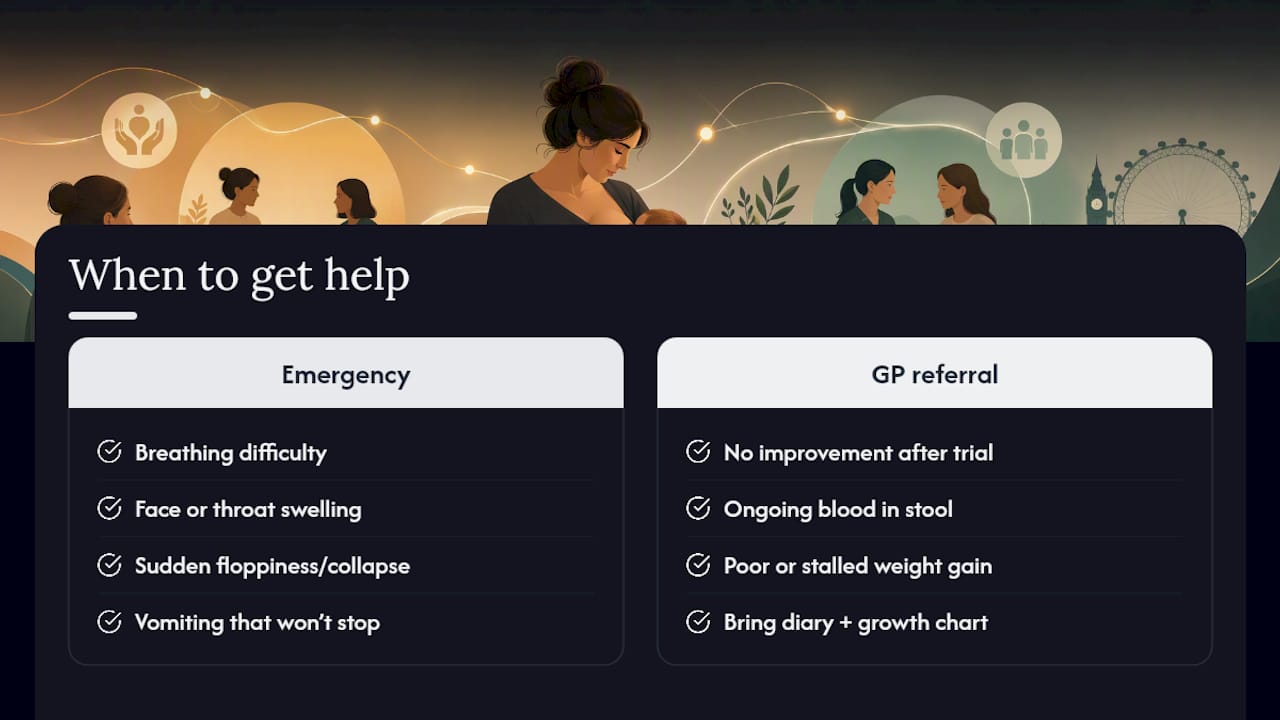
Call 999 or go to A&E immediately if your baby has breathing difficulty, swelling of the face or throat, sudden floppiness or collapse, or vomiting that won’t stop.
Ask your GP for a paediatric or dietetic referral if there’s no improvement after a full elimination trial, if bleeding in the stool continues, or if weight gain stalls. Bring a written food and symptom diary and any growth chart notes to the appointment. Clinicians rely on that record far more than a verbal account from memory, and it usually speeds up the assessment considerably.
Can at-home sensitivity testing support this process?
Some families want more data points while they work through an elimination diet, and that’s where testing services can sit alongside, never instead of, clinical care. Testing services offer at-home hair-sample tests analysed in UK laboratories, with digital reports typically ready within 48 to 72 hours.
- Results can suggest possible dietary patterns worth discussing with a professional
- They are not a substitute for a supervised reintroduction challenge or paediatric diagnosis
- Any result should be reviewed with your GP or a paediatric dietitian before you change your baby’s feeding or your own diet further
Testing can add information. It can’t replace the clinical steps of trial and reintroduction that actually confirm a food allergy.
What the evidence actually supports
The research on breastfeeding elimination diets tells a more restrained story than most parenting forums suggest. Cow’s milk elimination, done properly for 2–4 weeks with a genuine reintroduction afterwards, is well supported. What’s far less supported is the drift towards eliminating five or six foods at once out of anxiety, which happens more often than clinical guidance would ever recommend.
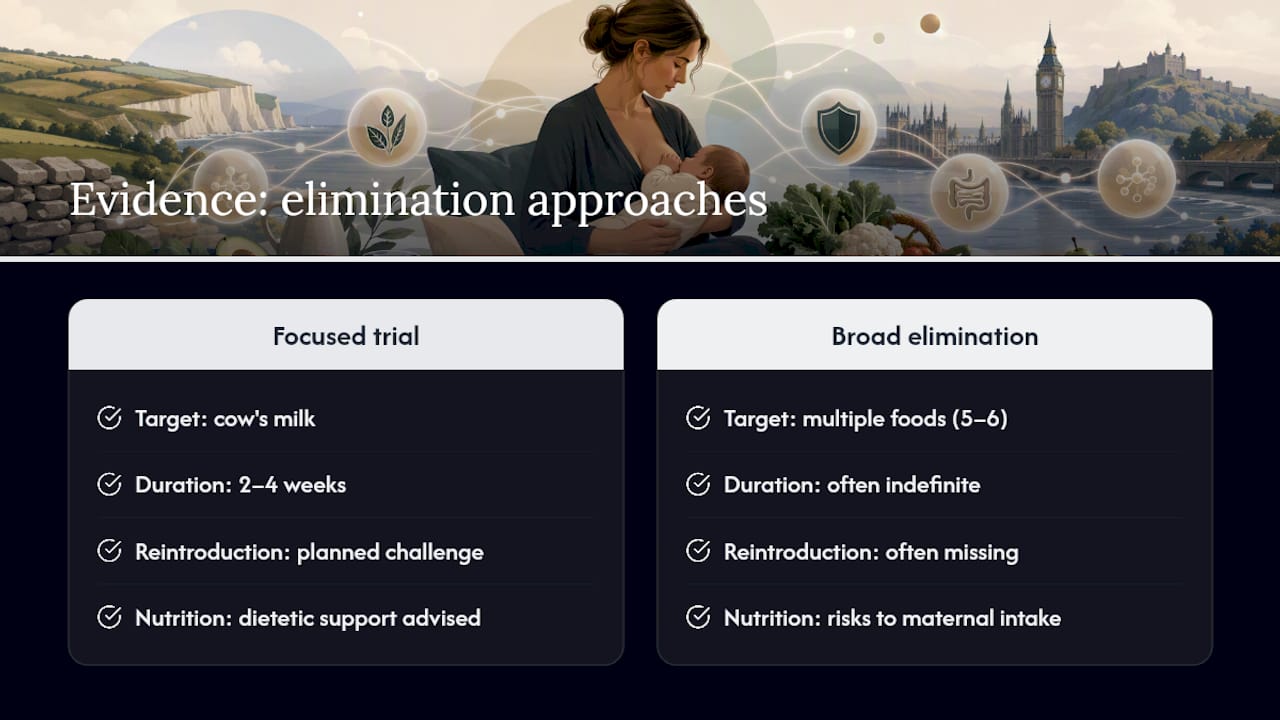
The conventional advice online tends to underplay reintroduction. Plenty of guides explain how to remove foods in detail and then go quiet on what happens next, as though the diet itself were the destination rather than a diagnostic tool. That’s backwards. The removal phase only has value if it’s paired with a challenge that confirms or rules out the suspected trigger; otherwise you’re just restricting indefinitely on a hunch.
If there’s one thing worth prioritising above all else, it’s keeping your own nutrition intact while you do this. A mother who’s calcium-deficient and exhausted isn’t better placed to care for a baby than one who’s eating well on a slightly less restrictive diet. Dietetic support isn’t a last resort. It’s the difference between a well-run trial and a diet that quietly does more harm than good.
— Rob
How Ukfoodintolerance fits alongside your GP’s advice
If you’re already tracking symptoms and wondering whether wider sensitivities, beyond cow’s milk, might be worth investigating for yourself or your family, Ukfoodintolerance offers at-home tests built for exactly that kind of curiosity, without needing a clinic appointment just to get started.

The Ultimate and Core Intolerance Tests cover well over a thousand food and non-food items, and results arrive as a digital report within 48 to 72 hours, so you’re not left waiting weeks for information while you’re already managing a tricky feeding period. Browse the full range of intolerance tests to see which suits your situation, and use the accompanying guidance to understand what a result might mean for your own diet. Whatever you learn, take it to your GP or paediatric dietitian before making changes, particularly while you’re breastfeeding. Testing gives you a starting conversation, not a final answer.
Sources
For further reading, the ABM clinical protocol and NHS milk-free leaflet cover this in full. Contact your local NHS service for a personalised pathway.
- Elimination Diets in Lactating Mothers of Infants with Food Allergy (narrative review)
- Milk-free breastfeeding leaflet (regional NHS patient information)
- Vitamin D guidance (UK Department of Health / regional NHS guidance)
FAQ
What should you eat on a breastfeeding elimination diet?
Focus on naturally dairy-free whole foods, calcium-fortified plant milks, leafy greens, and fortified cereals, while checking labels for hidden milk ingredients like casein and whey in processed foods.
Are there foods that reduce breast milk supply?
There’s no strong evidence that specific foods reliably dry up milk supply; low intake, stress, and infrequent feeding are far more common causes than diet alone.
How long does it take for food to clear from breast milk?
Food proteins can clear from breast milk within a day or two, but your baby’s gut may take the full 2–4 week trial period to heal and show improvement, so don’t judge results too early.
How do you safely stop breastfeeding if needed?
Reducing feeds gradually, rather than stopping abruptly, is generally advised to protect your comfort and your milk supply; discuss timing with your GP or health visitor if you’re considering this alongside dietary changes.










Leave a Reply
Want to join the discussion?Feel free to contribute!