

Dietary changes guided by an at-home bioresonance test are worth considering if you’ve had recurring, unexplained symptoms for weeks or months and standard checks haven’t given you an answer. Used properly, a bioresonance test paired with a tracked elimination diet can help you spot patterns between food and how you feel, giving you a structured starting point rather than months of guesswork.
That said, no test or diet replaces urgent medical care. NHS guidance is clear that some home tests aren’t recommended on their own, and cutting foods without a GP or registered dietitian’s input can cause harm, particularly in children. If you have a severe or rapid reaction, treat it as a medical emergency rather than relying on dietary changes. Digital reports from client-based UK laboratories typically arrive within 48 to 72 hours, giving you a fast starting point. The step-by-step elimination and reintroduction checklist further down this article shows you exactly how to use that report safely.
Key Takeaways
Test-led dietary changes work when a bioresonance report is combined with a disciplined elimination, tracking, and staged reintroduction protocol, not used alone.
| Point | Details |
|---|---|
| Test first, act second | Use your report to prioritise two to four candidate foods based on symptoms and frequency of consumption. |
| Track everything | Log food, portion, timing, and symptom severity daily; without a diary, patterns are nearly impossible to confirm. |
| Reintroduce with a washout | Test one food at a time with a same-day dose increase, then wait three days before the next challenge. |
| Watch your nutrients | Replace calcium, fibre, B-vitamins, or omega-3s deliberately when cutting dairy, grains, or fish. |
| Start with Ukfoodintolerance | The Ultimate and Core Single Intolerance Tests give a hair-sample-based starting map, with UK lab results in 48 to 72 hours. |
Table of Contents
- Who should consider test-led dietary changes, and who needs urgent care first?
- What can at-home bioresonance tests actually tell you?
- How do you run a test-led elimination diet, step by step?
- How do you avoid nutritional gaps while restricting foods?
- How do you read your report and plan what comes next?
- What quick tools and red flags help you stay safe day to day?
- Why a tested, tracked approach makes sense
- Ready to start? Here’s how the testing process works
- Sources
Who should consider test-led dietary changes, and who needs urgent care first?
A test-led elimination diet suits people with recurring, unexplained symptoms, things like bloating, brain fog, fatigue, or skin flare-ups, where obvious causes have already been ruled out or aren’t a good fit. If you’re the kind of person who’s tried cutting one or two foods informally and seen a pattern but never confirmed it, this approach gives you the structure to do it properly.
Some symptoms need medical assessment first, not a home test. Seek urgent help for:
- Anaphylaxis or facial/throat swelling
- Unexplained, significant weight loss
- Blood in stools or vomit
- Persistent high fever
- Neurological symptoms such as confusion or slurred speech
For children, speak to a paediatrician before making any dietary changes. For anything sudden or severe, go to A&E. Testing also isn’t a good fit for pure curiosity. If you’re not ready to commit to tracking symptoms and adjusting your diet based on the results, the exercise won’t tell you much.
What can at-home bioresonance tests actually tell you?
Ukfoodintolerance runs two at-home bioresonance tests, using a hair sample sent to a UK laboratory. The Ultimate Single Intolerance Test screens over 1,100 items, while the Core Single Intolerance Test covers 500 items at a lower price point. Both come back as a digital report within 48 to 72 hours.
What you get is a broad sensitivity pattern across a long list of foods and environmental items, useful as a starting map for an elimination diet. What you don’t get is a clinical allergy diagnosis. Bioresonance results should never replace tests like skin prick testing or coeliac serology, which measure different biological mechanisms entirely.
A few limitations are worth knowing upfront:
- False positives can occur, so results work best as a hypothesis to test, not a final answer.
- Some home sensitivity tests on the market lack robust clinical validation, which is why combining results with a tracked elimination diet matters more than the report alone.
- Results are most useful alongside, not instead of, clinical advice.
If you have ongoing symptoms, it’s worth sharing your report with a GP or dietitian, especially before removing multiple food groups long term.
How do you run a test-led elimination diet, step by step?
Start with your test report, not a hunch. Cross-reference the highest-scoring items against foods you eat regularly and symptoms you actually experience. Read labels carefully at this stage: many reactions trace back to a specific additive, like a preservative or sulphite, rather than the whole food group, so ingredient-level detail matters before you commit to cutting an entire category.
- Plan. Pick two to four candidate foods based on your report and symptom history. Check labels for hidden sources.
- Eliminate. Remove those foods completely for a defined period. Clinical guidance generally recommends somewhere between 2 and 8 weeks, and Cleveland Clinic suggests 4 to 8 weeks is typical for symptoms to settle. Substitute nutritionally, not just remove.
- Track daily. Log everything using a food and symptom diary throughout.
- Reintroduce one food at a time. Increase the quantity of a single food across one day, then stop.
- Wash out. Cambridge University Hospitals recommends a mandatory washout period of several days, before starting the next challenge, since reactions can be delayed.
- Decide. If symptoms return, that food stays out for now. If not, it’s likely safe to keep.
Your food and symptom diary needs to capture food and portion, time eaten, symptom type, timing and severity, plus sleep and any medication, since sleep and medication can muddy the picture.
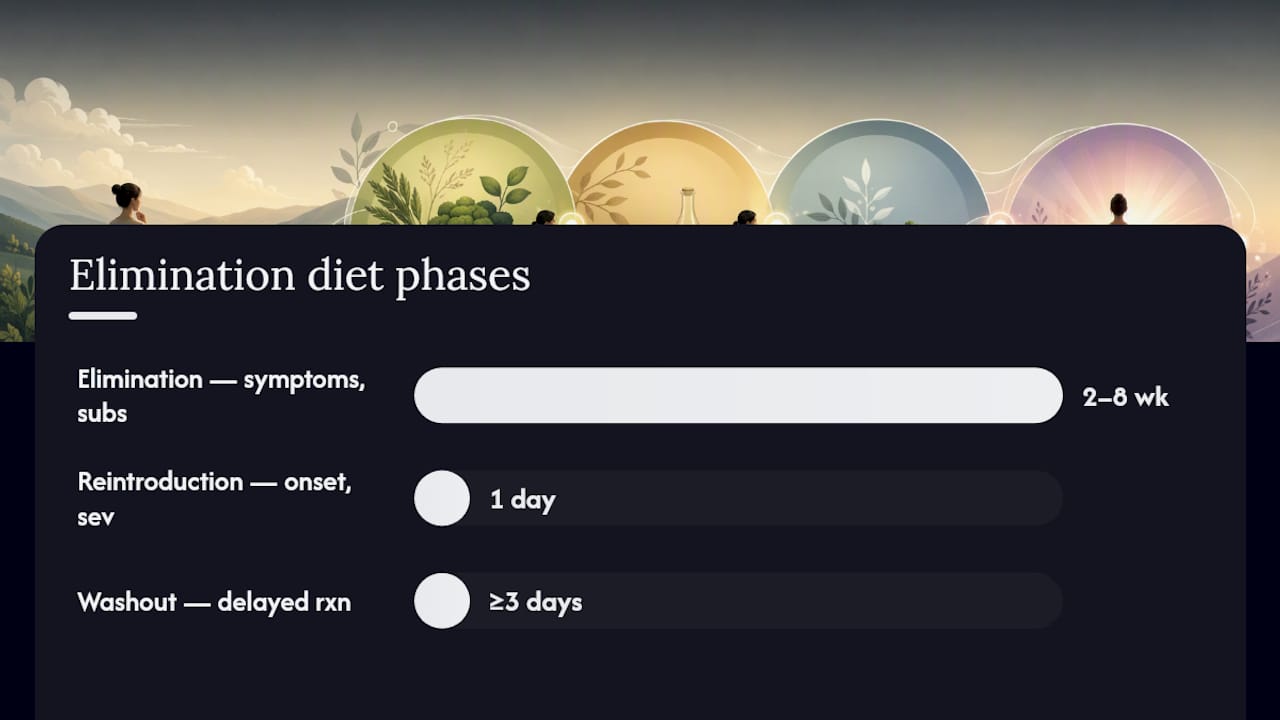
| Phase | Typical duration | What to log |
|---|---|---|
| Elimination | 2 to 8 weeks | Symptoms daily, substitutions used |
| Reintroduction (per food) | 1 day dose escalation | Symptom onset time and severity |
| Washout | 3 days minimum | Any delayed reaction before next challenge |
Stop and consult a GP or dietitian if symptoms worsen, if you’re removing more than two or three food groups, or if progress stalls after several weeks.
How do you avoid nutritional gaps while restricting foods?
Cutting whole food groups without planning is where most elimination diets go wrong. Removing dairy risks shortfalls in key nutrients such as calcium and vitamin D, while cutting gluten or grains can reduce fibre and B-vitamin intake unless you replace them deliberately. Dropping fish or red meat needs attention to protein and omega-3 intake too.
Sensible substitutions keep you covered:
- Fortified plant milks or a lactose-free protein powder in place of dairy.
- Pulses, nuts, and permitted wholegrains for fibre and B-vitamins.
- Seeds and oily fish alternatives for omega-3s where fish is excluded.
If you’re removing more than one major food group, ask your GP about basic bloods, iron studies, vitamin D, and B12 are common starting points, and loop in a registered dietitian for anything longer term. Tailoring the protocol in phases rather than removing everything at once tends to reduce this risk considerably.
Pro Tip: Don’t let one flagged item on your report justify cutting an entire food group permanently. Test it properly first, and watch for a history of disordered eating, which makes strict restriction riskier than it looks on paper.
How do you read your report and plan what comes next?
Work through your report by relevance, not by list order. Prioritise items with the highest scores that you eat often and that plausibly match your symptoms; a rarely eaten food scoring high matters less than a daily staple scoring moderately.
Once you’ve picked your candidates:
- Start elimination on your top two or three matches, keeping the diary running throughout.
- Set reintroduction dates in advance so the process doesn’t drift.
- Consider retesting after three to six months, since tolerance to a food can genuinely change over time as gut and immune responses shift.
- Share your report and diary with a GP, gastroenterologist, or dietitian if symptoms persist, if you suspect coeliac disease, or if you’re testing on behalf of a child.
Keep copies of every report and diary entry. If you do end up in a clinical review, that record becomes the evidence your clinician actually needs. Our guidance on interpreting reports walks through this in more depth.
What quick tools and red flags help you stay safe day to day?
A simple diary template covering food, portion, time, symptom, and severity is enough to start; our elimination diet checklist gives you a ready-made version. Batch-cook where you can, keep packaged food simple, and photograph labels so you can check ingredients later without hunting through bins.

Watch for escalating symptoms or anything new after a reintroduction; that’s your cue to stop and log details.
Pro Tip: Stick with tracking for the full minimum period, even on good days. Gaps in your diary are the most common reason a food/symptom pattern never becomes clear.
Why a tested, tracked approach makes sense
I’d rather see someone run a proper elimination and reintroduction protocol against test results than chase symptoms one Google search at a time. Bioresonance testing gives you a starting map; the diary and staged reintroduction turn that map into evidence. Ukfoodintolerance’s research and interpretation resources exist to help you use a report properly, not as a substitute for your GP when things need clinical attention.
Ready to start? Here’s how the testing process works
If you’re ready to move from guesswork to a structured plan, Ukfoodintolerance’s Ultimate Single Intolerance Test and Core Single Intolerance Test give you a genuine starting point rather than another vague symptom checklist. Both use a simple hair sample collected at home, sent to a UK laboratory, with digital results back within 48 to 72 hours.

Ordering is straightforward: choose your test based on how many items you want screened (1,100+ for the Ultimate test, 500 for the Core test), collect your sample following the instructions provided, and post it off. Your report arrives with items tested, suggested elimination candidates, and nutrition notes to help you plan substitutions.
Share your report with your GP or dietitian if you’re removing multiple food groups or dealing with ongoing symptoms. Browse the full range of intolerance tests to find the right starting point for your situation.
Sources
- Food intolerance | NHS
- Food allergy, intolerance or sensitivity: What’s the difference, and why does it matter? | Harvard Health
- Elimination diet & how to start | Cleveland Clinic
- Reintroducing fermentable carbohydrates | Cambridge University Hospitals NHS Foundation Trust (CUH)
These informed the elimination format, nutritional risk guidance, reintroduction timing, and the emphasis on symptom diaries throughout this article.
This article is general information, not a substitute for advice from a qualified doctor. Consult a qualified healthcare professional about your own circumstances before acting on anything here.










Leave a Reply
Want to join the discussion?Feel free to contribute!