

Elimination diets can deliver real, measurable health benefits — but only for specific conditions, and only when the process is structured correctly. The strongest evidence supports their use in managing irritable bowel syndrome (IBS) via a low-FODMAP protocol, diagnosing non-IgE-mediated food allergy in children, and treating eosinophilic oesophagitis. There is limited but credible evidence for selected skin conditions and migraine subsets. Claims around general weight loss, detoxification, or broad energy improvements are not supported by clinical trials.
Before you start, three safety points matter most:
- Nutritional risk is real. Removing major food groups without planning can cause deficiencies in calcium, iodine, vitamin D, iron, fibre, and B vitamins.
- Children, pregnant people, and those with eating disorders should not attempt unsupervised restriction. The NHS advises against cutting foods from a child’s diet without GP or dietitian guidance.
- Reintroduction is not optional. An elimination diet without a structured reintroduction phase has no diagnostic value and risks unnecessary long-term restriction.
Key takeaways
Elimination diets deliver real health benefits for specific, evidence-supported conditions when both the elimination and reintroduction phases are completed under appropriate supervision.
| Point | Details |
|---|---|
| Benefits are condition-specific | Strongest evidence exists for IBS (low-FODMAP), non-IgE food allergy in children, and eosinophilic oesophagitis. |
| Reintroduction is non-negotiable | Without a structured reintroduction phase, the diet has no diagnostic value and risks permanent unnecessary restriction. |
| Nutritional risk is real | Removing dairy, gluten, or multiple food groups without planned substitutions can cause deficiencies in calcium, iodine, iron, and B vitamins. |
| Children need professional oversight | NHS and BDA guidance is clear: do not restrict a child’s diet without GP or registered dietitian involvement. |
| At-home tests inform, not diagnose | Test results should guide which foods to investigate first; a dietitian-led elimination plan validates the findings. |
Table of Contents
- What is an elimination diet, and what types exist?
- How elimination diets work: phases, mechanisms, and what to track
- Evidence-backed health benefits of elimination diets, by condition
- Risks and downsides: nutritional, psychological, and diagnostic pitfalls
- Who should consider an elimination diet, and who should avoid it?
- How to run an elimination diet safely: a UK practical checklist
- How to interpret your results and choose next steps
- At-home commercial tests and intolerance testing: what UK guidance says
- What the research actually says: evidence strength and open questions
- Sources
What is an elimination diet, and what types exist?
An elimination diet is a temporary, structured removal of one or more suspected foods from your diet, followed by a systematic reintroduction phase to test whether symptoms return. It is a diagnostic tool first and a treatment second. The goal is to identify which specific foods, if any, are driving your symptoms — not to restrict permanently.
There are four main types you are likely to encounter in UK clinical practice:
Targeted single-food elimination removes one suspected trigger (for example, cow’s milk or wheat) while keeping everything else the same. This is the most straightforward approach and the easiest to interpret.
Multiple-food elimination (oligoantigenic diet) removes several common allergens simultaneously — typically dairy, gluten-containing cereals, eggs, soy, nuts, and sometimes fish. It is used when symptoms are complex or when a single trigger is not obvious.
Low-FODMAP elimination removes fermentable carbohydrates (Fermentable Oligosaccharides, Disaccharides, Monosaccharides and Polyols) found in foods such as onions, garlic, wheat, apples, and legumes. This protocol was developed at Monash University and is now widely used in UK dietetic practice for IBS.
Broad exclusion diets remove a wide range of foods and are generally reserved for specialist clinical settings, such as managing eosinophilic oesophagitis, where a six-food elimination protocol is sometimes used.
NICE recommends a trial elimination of typically 2–6 weeks followed by reintroduction, with dietitian input, for suspected non-IgE-mediated food allergy. This timeframe applies to most diagnostic protocols in UK clinical guidance.
Pro Tip: Choose the narrowest elimination type that fits your symptom pattern. A targeted single-food removal is far easier to interpret than a broad exclusion, and it carries a lower nutritional risk. Start small, then widen the scope only if results are unclear.
How elimination diets work: phases, mechanisms, and what to track
Two phases make an elimination diet work: the elimination phase (avoiding the suspected food) and the reintroduction phase (adding it back in a controlled way). Both are essential. Without reintroduction, you cannot confirm whether the food was the actual cause of your symptoms.

The biological mechanisms
Reduced antigen exposure is the primary driver of symptom change. When a food that triggers an immune or gut response is removed, the inflammatory signal decreases and symptoms often improve. For FODMAPs specifically, the mechanism is different: removing fermentable carbohydrates reduces gas production and osmotic load in the gut, which directly eases bloating, cramping, and altered bowel habits.
There is also a behavioural mechanism worth acknowledging. StatPearls notes that keeping a structured food and symptom diary materially improves diagnostic accuracy, and that some of the perceived benefit from an elimination diet comes from increased self-monitoring rather than food removal alone. That is not a reason to dismiss the approach — it is a reason to keep your diary consistently so you can distinguish real food reactions from background noise.
What to track
Keep a daily food and symptom diary from day one. Record everything you eat, portion sizes, timing, and any symptoms (type, severity, timing after eating). This record becomes your evidence base during reintroduction.
A practical phase structure
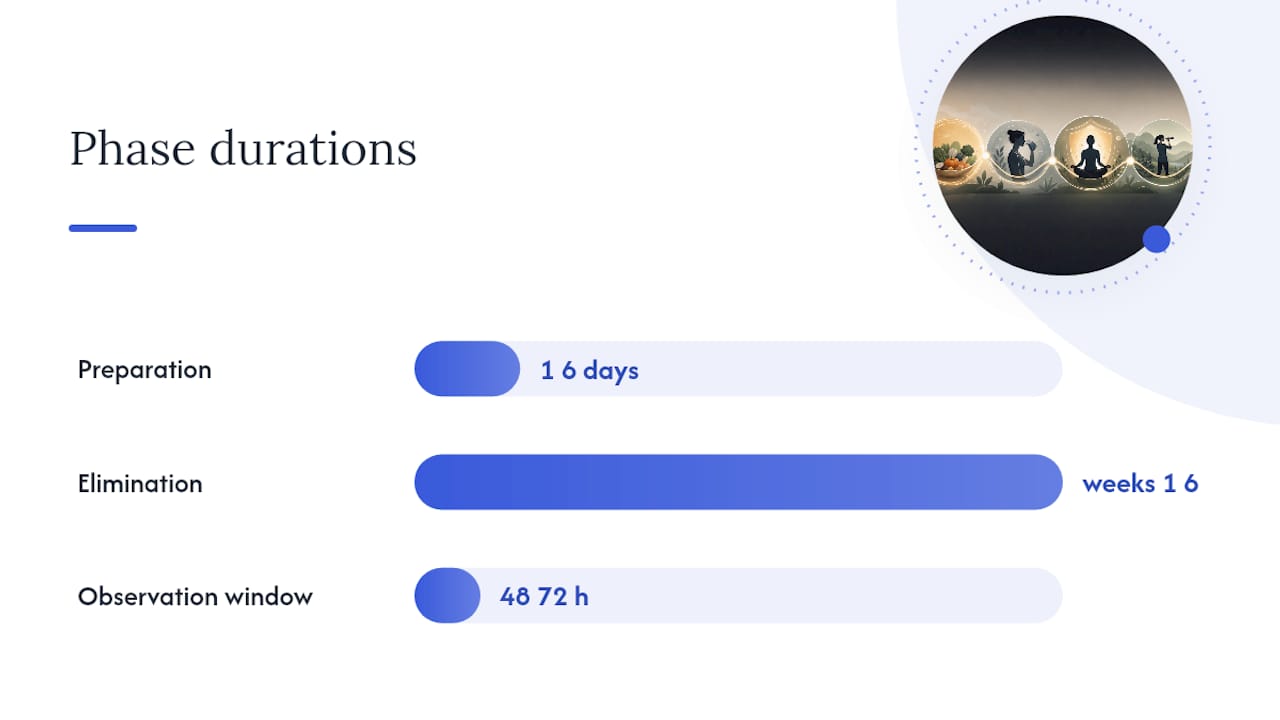
- Preparation (days 1–7): Establish a baseline diary. Note current symptoms before any changes. Check whether any medications contain the foods you plan to remove (some tablets contain lactose, for example). Speak to your GP or a registered dietitian if you have complex health needs.
- Elimination phase (weeks 1–6): Remove the target food or foods completely. Read ingredient labels carefully. Aim for consistency — even small exposures can confound results.
- Reintroduction phase (from week 3 or 6 onwards): Reintroduce one food at a time. Observe for 48–72 hours before introducing the next item. Clinical guidance recommends a 2–3 day observation window between single-food challenges to isolate reactions clearly.
- Interpretation: Compare symptom patterns across the diary. Foods that consistently trigger symptoms on reintroduction are likely contributors; those that do not are probably safe to return to your diet permanently.
Pro Tip: Reintroduce foods in order of nutritional importance. Dairy, for example, is a major source of calcium and iodine — if it causes no symptoms on reintroduction, return it to your diet quickly rather than leaving it out by default.
Evidence-backed health benefits of elimination diets, by condition
The health benefits of elimination diets are condition-specific. The approach is not a general wellness tool. Where evidence is strong, it is strong for a defined population and a defined outcome — usually symptom reduction or diagnostic confirmation, not cure.
Conditions with the strongest evidence
IBS and low-FODMAP diets represent the best-evidenced application in adults. Randomised and controlled trials provide moderate evidence that a structured low-FODMAP protocol reduces bloating, abdominal pain, and altered bowel habits in many people with IBS. A systematic review on PubMed confirms this, while noting that protocols and outcomes vary across trials. The benefit is real but not universal — roughly half to two-thirds of people with IBS respond, and long-term restriction of FODMAPs is not recommended without dietitian oversight.
Non-IgE-mediated food allergy in children is another area where elimination diets have clear diagnostic value. When correctly applied, they can produce clinically meaningful improvements in symptoms such as eczema, reflux, and gastrointestinal distress in infants and young children. Clinical review literature supports diagnostic trials in selected paediatric presentations, provided a registered dietitian monitors nutritional adequacy throughout.
Eosinophilic oesophagitis (EoE) is a condition where elimination diets — particularly the six-food elimination protocol — are used as both a diagnostic and therapeutic tool. This is a specialist area; EoE management should always involve a gastroenterologist and dietitian.
Conditions with limited or moderate evidence
Certain skin conditions, including atopic eczema in children with suspected food triggers, may respond to targeted elimination under clinical supervision. The evidence is more variable in adults, and unsupervised restriction is not recommended.
Migraine is an area where some people report benefit from removing specific triggers (commonly tyramine-rich foods, caffeine, or alcohol), but the evidence base is small and heterogeneous. A food diary is more useful here than a broad elimination, as triggers are highly individual.
Claims with weak or no clinical support
General weight loss, broad “detox” effects, improved energy, and resolution of brain fog are frequently cited as elimination diet advantages in popular media. None of these claims are supported by clinical trials. Weight change during elimination diets is typically a side effect of reduced calorie intake from food group removal, not a therapeutic mechanism.
What to expect and when: Most people with IBS notice symptom changes within 2–4 weeks of a low-FODMAP elimination. Skin changes in children with food allergy may take 4–6 weeks to become apparent. If you see no change after 6 weeks of strict elimination, the excluded food is unlikely to be the primary driver of your symptoms.
Risks and downsides: nutritional, psychological, and diagnostic pitfalls
The primary risks of elimination diets are nutritional deficiency, unnecessary long-term restriction, and a reduced quality of life — particularly when the process is unsupervised.
Specific nutrient risks by food group removed
- Dairy exclusion: reduced calcium, iodine, and vitamin D. Iodine is particularly overlooked; dairy is the main dietary source for most UK adults, and plant-based milks are not routinely fortified with iodine.
- Gluten-containing cereals (wheat, rye, barley): reduced fibre, iron, and folate. Many gluten-free products are lower in these nutrients than their standard equivalents.
- Multiple food group exclusions: compound B-vitamin deficiency risk, particularly B12 if animal products are also reduced.
The British Dietetic Association is clear that unsupervised elimination diets risk nutritional deficiencies, and that children are particularly vulnerable to growth and developmental impacts from prolonged restriction.
Psychological and social risks
Strict dietary restriction can increase food anxiety, reduce social participation around meals, and — in people with a history of disordered eating — reinforce harmful patterns. These risks are not hypothetical. They are documented in clinical literature and are a reason why blanket “clean eating” approaches that mimic elimination diets without clinical purpose can be harmful.
Diagnostic pitfalls
The most common mistake is reintroducing multiple foods at once, which makes it impossible to identify which food caused a reaction. Equally problematic is stopping the elimination phase too early, before symptoms have had time to stabilise.
The BDA warns that relying on commercially available intolerance tests without clinical integration risks unnecessary dietary restriction and nutritional harm. Test results should inform a dietitian-led elimination plan, not replace one.
Pro Tip: If you are removing dairy, switch to a fortified plant milk (oat or soy) that contains added calcium and vitamin D from day one — not as an afterthought. Check the label: look for at least 120mg of calcium per 100ml. Iodine is harder to replace; discuss supplementation with your dietitian if dairy is excluded for more than a few weeks.
Who should consider an elimination diet, and who should avoid it?
Not everyone is a suitable candidate for self-directed elimination. Knowing where you sit on that spectrum matters before you start.
Good candidates (with appropriate oversight)
- Adults with persistent IBS symptoms who have already had coeliac disease ruled out by their GP
- People with suspected non-IgE-mediated food allergy (delayed reactions, not anaphylaxis) identified through symptom history
- Adults with atopic eczema or chronic urticaria where a food trigger is clinically suspected
- People who have already kept a food diary and identified a pattern worth investigating
Who should avoid unsupervised restriction
- Young children: nutritional needs are high and growth can be affected quickly. NHS guidance is explicit — do not cut foods from a child’s diet without GP or dietitian advice.
- Pregnant and breastfeeding people: nutritional requirements are increased; restriction without oversight risks both maternal and foetal health.
- People with a history of eating disorders: elimination diets can reinforce restrictive behaviours and should only be considered under specialist supervision.
- People with complex medical needs or multiple medications: some medications interact with dietary changes; clinical review is needed first.
When to see your GP or an allergy clinic
- Severe or systemic reactions (hives, swelling, breathing difficulty) — these suggest IgE-mediated allergy, not intolerance, and require allergy clinic assessment
- Faltering growth or weight loss in a child
- History of anaphylaxis
- Symptoms that are worsening despite dietary changes
- Unclear or inconsistent symptom patterns after a properly structured elimination
A quick decision checklist
- Do your symptoms follow a consistent pattern linked to eating?
- Has coeliac disease been ruled out (if gluten is a suspect)?
- Are you nutritionally vulnerable (child, pregnant, underweight)?
- Do you have a history of disordered eating?
- Are you on medications that may be affected by dietary changes?
If you answered yes to any of the last three, speak to your GP before starting.
How to run an elimination diet safely: a UK practical checklist
Follow a clear plan, get baseline clinical advice when needed, and keep consistent records through both phases. That is the short version. Here is the full structure.
Step-by-step protocol
- Speak to your GP first if you have complex symptoms, are in a vulnerable group, or suspect coeliac disease. Coeliac screening requires gluten in your diet — do not exclude gluten before testing.
- Keep a baseline food and symptom diary for one week before changing anything. This gives you a reference point.
- Choose your elimination type based on your symptom pattern and, ideally, with dietitian input. For IBS, low-FODMAP is the evidence-based starting point. For suspected single-food allergy, targeted elimination is cleaner.
- Begin the elimination phase. For most diagnostic purposes, 2–6 weeks is the recommended window per NICE guidance. Stick strictly to the protocol — partial elimination produces ambiguous results.
- Read labels carefully. Dairy appears as whey, casein, and lactose. Gluten hides in soy sauce, malt vinegar, and some oats. The UK’s Food Information Regulations require the 14 major allergens to be listed clearly on pre-packed foods.
- Begin reintroduction one food at a time. Introduce a normal portion of one food, then observe for 48–72 hours before introducing the next. Clinical literature is consistent on this: isolated reintroductions with multi-day windows are the only way to draw reliable conclusions.
- Record every reintroduction and its outcome in your diary. Note symptom type, severity, and timing.
- Review with a dietitian or GP once reintroduction is complete. Do not make permanent dietary decisions based on your diary alone.
Typical timelines
| Phase | Recommended duration | Notes |
|---|---|---|
| Baseline diary | 1 week | Before any changes |
| Elimination | 2–6 weeks | Per NICE/BDA guidance |
| Reintroduction (per food) | 48–72 hours observation | One food at a time |
| Full reintroduction cycle | 6–12 weeks | Depends on number of foods tested |
Sample nutrient-preserving swaps
- Dairy removed: fortified oat or soy milk (calcium, vitamin D); eggs or sardines for iodine if tolerated
- Wheat/gluten removed: quinoa, buckwheat, and certified gluten-free oats for fibre and iron; lentils for folate
- Eggs removed: tofu, legumes, and seeds for protein and B vitamins
For a printable step-by-step resource, the elimination diet checklist from Ukfoodintolerance walks you through each phase in a clear, practical format.
Pro Tip: Keep your portion sizes consistent during reintroduction challenges. A reaction to a large portion of a food may not reproduce with a normal serving — and vice versa. Use the same portion you would eat in a typical meal.
How to interpret your results and choose next steps
Positive, reproducible symptoms on reintroduction — appearing consistently each time you eat that food — suggest a real sensitivity. Absence of symptoms on reintroduction usually rules that food out as the cause. That is the core interpretive principle.
When results are ambiguous
- Variable symptoms across reintroductions: repeat the single-food challenge on a separate occasion before drawing conclusions. One positive and one negative result is inconclusive.
- Multi-food reactions: if several foods seem to trigger symptoms, lengthen your observation windows and consider specialist dietitian input. Multiple simultaneous sensitivities are possible but less common than people assume.
- No change during elimination: if symptoms did not improve during the elimination phase, the excluded food is unlikely to be the driver. Consider other causes with your GP.
Next actions based on your results
- Clear trigger identified: discuss long-term management with a registered dietitian, including safe substitutions and nutritional monitoring. Do not restrict permanently without professional support.
- Gluten suspected: speak to your GP about coeliac disease screening before excluding gluten. Coeliac disease affects roughly 1 in 100 people in the UK and requires a specific blood test and biopsy while gluten is still in the diet.
- Suspected IgE-mediated allergy (rapid, systemic reactions): seek allergy clinic referral rather than continuing self-directed elimination.
- Inconclusive results: a registered dietitian can help redesign the protocol or refer you for specialist testing.
For practical guidance on translating your results into dietary decisions, the intolerance results interpretation guide from Ukfoodintolerance offers clear, step-by-step support.
At-home commercial tests and intolerance testing: what UK guidance says
Commercial intolerance tests may provide useful clues about potential food sensitivities, but they are not diagnostic on their own. Professional interpretation is essential before making any dietary changes based on a test result.
The BDA and NHS are both clear on this point. The BDA’s guidance on food allergy and intolerance testing recommends avoiding reliance on unvalidated alternative tests without clinical integration. A test result should inform a dietitian-led elimination and reintroduction plan — it should not replace one.
The BDA advises that commercially available intolerance tests should not be used as the sole basis for dietary exclusion. Results carry nutritional risk if acted upon without dietitian oversight, particularly when multiple foods are flagged.
How to use at-home test results practically
- Treat the report as a starting point, not a diagnosis. Use it to prioritise which foods to investigate first in a structured elimination.
- Validate findings with a symptom diary and controlled single-food reintroductions before concluding that a flagged food is genuinely problematic.
- Share results with your GP or registered dietitian, who can help you design an appropriate protocol and monitor nutritional adequacy.
- Seek medical follow-up if results flag a food you eat frequently and in large quantities, or if you have existing health conditions.
At Ukfoodintolerance, our at-home sensitivity tests analyse over 1,450 items using bioresonance technology and deliver a detailed digital report within 48–72 hours. The report is designed to be used alongside a structured elimination protocol, not as a standalone answer. Our intolerance testing and diet planning guide explains how to combine test output with a safe, step-by-step elimination process.
What the research actually says: evidence strength and open questions
The evidence base for elimination diets is genuinely useful in some areas and genuinely thin in others. Here is an honest summary.
Evidence strength by condition
| Condition | Evidence strength | Key limitation |
|---|---|---|
| IBS (low-FODMAP) | Moderate | Variable protocols; outcomes differ across trials |
| Non-IgE food allergy (children) | Moderate | Small sample sizes; mostly paediatric data |
| Eosinophilic oesophagitis | Moderate | Specialist setting; limited adult RCT data |
| Atopic eczema (children) | Limited | Heterogeneous populations; confounders |
| Migraine | Limited | Highly individual triggers; no large RCTs |
| General weight loss / detox | No clinical support | No controlled trial evidence |
Why the evidence has limits
- Small trial sizes are the most consistent problem. Many elimination diet studies involve fewer than 100 participants, which limits how confidently findings can be generalised.
- Variable reintroduction protocols make it difficult to compare results across studies. Some trials use open challenges; others use blinded food challenges. The methodology affects the outcome.
- Subjective endpoints such as self-reported bloating or fatigue are harder to measure reliably than objective markers.
- Publication bias means positive results are more likely to be published than null findings, which can make the evidence look stronger than it is.
A review on PubMed highlights methodological heterogeneity as a recurring limitation across elimination diet literature, noting that inconsistent protocols and small sample sizes restrict generalisability. A separate body of clinical literature spanning several decades documents both the preventive uses and adverse outcomes of restrictive diets, reinforcing the need for careful clinical oversight.
Where research needs to go
- Larger, well-controlled randomised trials with standardised reintroduction protocols
- Long-term follow-up data on nutritional outcomes in adults who restrict multiple food groups
- Better understanding of which IBS subgroups respond best to low-FODMAP versus other dietary interventions
- More adult data on elimination diets for skin conditions and migraine
A perspective on elimination diets and clinical caution
The gap between what elimination diets promise in popular health culture and what they actually deliver in clinical practice is significant. That gap is not a reason to dismiss the approach. It is a reason to use it precisely.
What strikes me most, looking at the evidence, is how often people skip the reintroduction phase. They feel better during elimination, assume the excluded food is the problem, and never go back to test that assumption. The result is unnecessary long-term restriction — sometimes of nutritionally important foods — based on a feeling rather than a finding. The elimination phase is only half the diagnostic process. Reintroduction is where the real answer lives.
At-home sensitivity testing, used well, can make the process more targeted. Knowing which foods are worth investigating first saves time and reduces the risk of over-restricting. But a test result is a hypothesis, not a verdict. The structured elimination and reintroduction process is what turns that hypothesis into something you can act on with confidence.
Sources
The sources below are the most authoritative references for elimination diets in a UK context. Each serves a different purpose.
- British Dietetic Association: Food allergy and intolerance testing
- Quality statement 3: Diagnosing non‑IgE‑mediated food allergy | NICE
- Food intolerance | NHS
- StatPearls: Elimination diets
- Pubmed
- Pubmed
- Pubmed
- Pubmed










Leave a Reply
Want to join the discussion?Feel free to contribute!