

TL;DR:
- Many commercial food sensitivity tests measure IgG antibodies, which reflect normal food exposure rather than true intolerance.
- Interpreting these reports requires comparing flagged foods with your symptoms and consulting healthcare professionals before making dietary changes.
You receive your sensitivity report and stare at a long list of foods flagged with numbers, colours, and levels you do not recognise. It is confusing, and for many people it leads to one of two outcomes: either cutting out dozens of foods unnecessarily, or dismissing the report entirely. Understanding sensitivity reports is the key to neither overreacting nor ignoring what could be genuinely useful information. This guide walks you through what these reports actually measure, what their results mean in practice, and how to use them safely to support better dietary health.
Table of Contents
- Key takeaways
- Understanding sensitivity reports: what do they actually measure?
- Common misconceptions about sensitivity reports
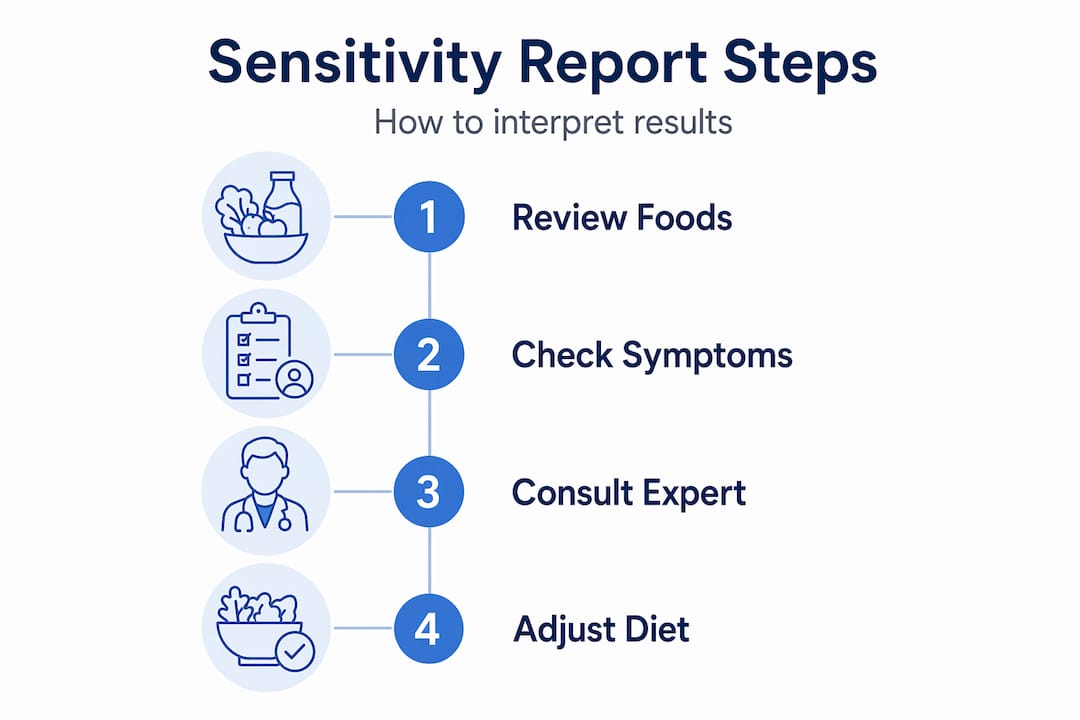
- How to read your sensitivity report step by step
- Evidence-based approaches to managing food sensitivities
- My honest view on interpreting sensitivity reports
- Start your sensitivity testing with Ukfoodintolerance
- FAQ
Key takeaways
| Point | Details |
|---|---|
| Know what is being measured | Most commercial tests measure IgG antibodies, which reflect food exposure rather than confirmed intolerance. |
| Avoid blind eliminations | Never remove foods from your diet based on test results alone without matching them to your actual symptoms. |
| Clinical context matters | A positive result on a sensitivity report requires professional evaluation before taking any dietary action. |
| Elimination diets are the gold standard | Supervised elimination and reintroduction remains the most reliable way to confirm a food sensitivity. |
| Use reports as a starting point | Treat your sensitivity report as one piece of evidence, not a definitive diagnosis. |
Understanding sensitivity reports: what do they actually measure?
Before you can interpret a sensitivity report, you need to know what kind of test produced it. Most people assume all food tests work the same way. They do not.
There are two primary types of antibody involved in food reactions:
- IgE antibodies are linked to immediate allergic reactions. Symptoms appear within minutes and can include hives, swelling, or anaphylaxis. IgE blood testing, such as ImmunoCAP, is clinically validated and used within the NHS to diagnose true food allergies.
- IgG antibodies are produced by your immune system in response to foods you eat regularly. They reflect normal exposure, not necessarily a problem. A positive IgG result simply means your body has encountered that food, which is expected.
- Skin prick tests (SPT) are the first-line clinical tool for suspected IgE-mediated allergies, though both SPT and serum IgE testing require clinical correlation before any diagnosis is confirmed.
The distinction matters enormously. A sensitivity report from a commercial at-home test almost always measures IgG antibodies. That is a different biological process from an allergy, and it tells a different story.
A typical sensitivity report will present a list of foods alongside antibody levels, often grouped by reaction level such as “mild”, “moderate”, or “elevated”. Some include colour coding. The visual format looks clinical and precise. But the numbers mean very little without understanding the science behind them and, crucially, without mapping them against your own symptom history.
Food intolerance itself sits in a separate category from both allergy and sensitivity. It typically involves digestive discomfort such as bloating or cramping, does not involve the immune system in the same way, and is usually dose-dependent. None of that is captured by a standard antibody panel.

Common misconceptions about sensitivity reports
This is where many people go wrong, and it is worth being direct about it.
The most widespread misunderstanding is that a high IgG result for a particular food means you are intolerant to it. It does not. IgG antibodies reflect normal immune response to food, and their presence is expected in anyone who eats a varied diet. Removing foods purely on the basis of elevated IgG levels risks unnecessary restriction and, in some cases, real harm to your nutritional status.
The NHS and NICE do not recommend IgG-based food intolerance tests for diagnosing food sensitivities. Neither do leading British allergy organisations. That is not because they are dismissive of people’s symptoms. It is because the tests simply have not been shown to reliably identify which foods are genuinely causing problems for a given individual.
“Broad panel tests that screen dozens or hundreds of foods at once carry a particular risk. False positives that do not match any clinical symptoms are common, and acting on them leads to dietary eliminations that serve no health purpose.”
The result can be people cutting out gluten, dairy, eggs, and other nutritious foods for months based on test results that do not reflect their actual biology. In children especially, unnecessary food eliminations carry real risks to growth and nutritional adequacy.
Pro Tip: Before acting on any sensitivity report, write down your three most troublesome symptoms and the foods you suspect most. If your report does not flag those foods, that discrepancy tells you something important.
IgE testing, by contrast, is a different matter. For peanut allergy specifically, IgE at or above 15 kUA/L corresponds to over 95% clinical reactivity probability. Even then, a positive result alone does not confirm a clinical allergy. An oral food challenge remains the gold standard confirmatory test. This level of clinical rigour simply does not exist in the IgG testing world.
How to read your sensitivity report step by step
Reading a sensitivity report well is not about finding which foods show the highest numbers. It is about asking the right questions at every stage.
-
Cross-reference with your symptoms. Go through the flagged foods and ask honestly: do I actually have symptoms after eating this? A result only becomes clinically relevant when it correlates with a real experience. You can use this guide to interpreting results to support that process.
-
Look for patterns, not isolated results. If five related foods such as various dairy products all appear elevated, and you regularly experience bloating after dairy consumption, that pattern is worth investigating. One isolated elevated result for, say, broccoli, is far less meaningful.
-
Understand the report’s antibody level ranges. Most reports divide results into bands. A table like the one below is common:
| Result level | What it typically indicates |
|---|---|
| Low or negative | Unlikely to reflect a true sensitivity |
| Mild elevation | Possible exposure; worth monitoring if symptomatic |
| Moderate elevation | Correlate with symptoms before considering exclusion |
| High elevation | Discuss with a healthcare professional before acting |
-
Avoid eliminating foods without symptoms. Targeted testing based on your clinical history is always preferred over removing a wide range of foods from a broad panel result. Removing foods unnecessarily can create new nutritional gaps and make your diet harder to sustain.
-
Seek professional input when needed. If your report flags a food you rely on heavily, or if your symptoms are severe or persistent, do not self-manage. A registered dietitian or GP can help you interpret the report alongside your full health picture. Find out what to do after receiving results to take the right next steps.
The importance of sensitivity reports lies not in the numbers themselves but in how thoughtfully they are used. A report is a prompt for further investigation, not a prescription.
Evidence-based approaches to managing food sensitivities
If you want reliable answers about which foods affect you, there are proven methods that work alongside or in place of commercial sensitivity reports.
-
Dietitian-led elimination and reintroduction diet. This is widely regarded as the gold standard approach for identifying food sensitivities. Under professional supervision, you remove suspected trigger foods for a set period (usually two to six weeks), then reintroduce them one at a time while monitoring symptoms carefully. It is methodical, protected, and grounded in real physiological response rather than antibody levels.
-
Food and symptom diaries. Keeping a detailed daily log of what you eat and how you feel is one of the most underused tools in sensitivity analysis techniques. Over two to four weeks, clear patterns often emerge that point to specific triggers far more reliably than a single test result.
-
Validated IgE allergy testing. If your symptoms suggest a true allergic reaction (rapid onset, skin involvement, breathing changes), you should speak to your GP about a referral for clinical allergy testing. Structured dietary approaches and professional guidance consistently outperform unvalidated commercial tests for managing these situations.
-
Working with a healthcare professional. A dietitian does not just look at test numbers. They integrate those results with your symptom history, your nutritional intake, your lifestyle, and your health goals. That holistic view is what makes interpretation meaningful. You can explore a step-by-step workflow for putting this into practice.
Pro Tip: When keeping a food diary, record not just what you eat but portion size, preparation method, and time of symptom onset. That level of detail can help a dietitian identify patterns that a short diary entry would miss.
Commercial sensitivity reports, including those based on bioresonance technology, work best when treated as a starting point that prompts you to look more closely at your diet. They are not a replacement for professional assessment. The most effective path to dietary clarity combines the broad scan of a sensitivity report with the precision of clinical evaluation and structured dietary changes.
My honest view on interpreting sensitivity reports
I have seen what happens when people receive a sensitivity report and immediately overhaul their entire diet based on it. The intention is right but the execution often causes more problems than it solves.
In my experience, the most common mistake is treating every elevated number as an urgent problem. A report that flags 40 foods does not mean you have 40 food intolerances. It almost certainly means your immune system has been exposed to 40 foods, which is perfectly normal for anyone eating a varied diet. Acting on all of them at once creates a restrictive diet that is hard to maintain, socially isolating, and nutritionally risky.
What I have found actually works is a different approach entirely. Take the report, sit with it for a day, and then compare it honestly against the three or four symptoms that actually bother you. Then look for overlap. That overlap is where the real investigation begins.
I also think people underestimate how much a food and symptom diary can reveal. It requires patience, but the data it produces is yours. It comes from your body, in real time, and no commercial panel can replicate that. Sensitivity reports are a useful lens, but your symptoms are the primary evidence.
Seek professional support before making major eliminations. Not because you cannot trust yourself, but because an expert can see patterns you might miss and protect you from restricting foods your body actually needs.
— Rob
Start your sensitivity testing with Ukfoodintolerance
If you are ready to move beyond guesswork and get a clearer picture of how your body responds to food, Ukfoodintolerance offers a straightforward starting point. Their at-home tests use a simple hair sample to screen a wide range of food and environmental items, with detailed digital reports delivered within 48 to 72 hours. The results are designed to be read alongside your symptom history, not in isolation. You can explore the full range of available intolerance tests to find the right option for your needs, or browse their comprehensive test options covering over 900 food and non-food items. Pair your report with expert guidance on interpreting your results to make every finding count.
FAQ
What is a sensitivity report?
A sensitivity report is a document produced by a food sensitivity or intolerance test that lists foods alongside immune response data, typically IgG antibody levels. It is intended to help identify potential dietary triggers but requires careful interpretation alongside your symptom history.
How do I read a sensitivity report accurately?
Cross-reference flagged foods with your actual symptoms rather than acting on elevated numbers alone. Food allergy profile results require clinical correlation, and positive results should be discussed with a healthcare professional before any dietary changes are made.
Are IgG sensitivity tests recommended by the NHS?
No. The NHS and NICE do not recommend IgG-based food intolerance tests because they measure normal immune exposure, not confirmed intolerance. Clinically validated IgE testing is used for diagnosing true food allergies within the NHS.
What is the most reliable way to identify a food sensitivity?
A dietitian-supervised elimination and reintroduction diet is the most reliable method for identifying true food sensitivities. It involves removing suspected trigger foods and reintroducing them systematically while monitoring symptoms under professional guidance.
Can I act on a sensitivity report without seeing a doctor?
You can use a report to guide initial dietary awareness, but you should not eliminate major food groups based on results alone. Seek professional advice, particularly if your symptoms are severe, persistent, or affect your quality of life significantly.










Leave a Reply
Want to join the discussion?Feel free to contribute!