

Struggling with ongoing bloating, fatigue, or stomach discomfort can quickly sap your energy and make everyday life more challenging. For many people across the UK, finding clear answers about food sensitivities feels elusive, especially when NHS appointments mean long waits. A sensitivity test offers a non-invasive way to pinpoint potential triggers using your own hair sample, helping you take practical steps towards a diet that truly supports your wellbeing. This guide clears up common myths and explains exactly what these tests measure, so you can make informed choices about your health.
Table of Contents
- Sensitivity Tests Defined And Common Myths
- Different Types Of Sensitivity Testing
- How At-Home Hair Analysis Works
- Benefits And Limitations For Users
- Comparing Sensitivity Tests And Alternatives
Key Takeaways
| Point | Details |
|---|---|
| Understanding Sensitivity Tests | Sensitivity tests differ from allergy tests, using bioresonance technology to identify potential food and environmental triggers. They do not provide definitive proof but serve as a guideline for dietary changes. |
| Myths About Test Results | Many believe that sensitivity tests are perfect indicators of food intolerances. In reality, they may yield false positives or negatives, necessitating personal verification through an elimination diet. |
| Types of Sensitivity Testing | Testing methods include elimination diets and biomarker testing, each with specific advantages. At-home hair analysis offers a balance of cost-effectiveness and quick results compared to clinic-based tests. |
| Combining Approaches for Best Outcomes | Combining sensitivity tests with careful symptom tracking and elimination diets allows for a more thorough understanding of personal triggers, enhancing the effectiveness of dietary adjustments. |
Sensitivity Tests Defined and Common Myths
A sensitivity test is a non-invasive screening method designed to identify whether your body reacts negatively to specific foods or environmental substances. Unlike allergy tests that measure immunological responses, sensitivity tests work through a different mechanism—bioresonance technology that analyses your hair sample to detect resonance patterns associated with various substances. This distinction matters because many people confuse food sensitivities with allergies, leading to incorrect assumptions about how their body responds to certain triggers. Understanding what a sensitivity test actually measures is the first step towards getting accurate results that you can genuinely act upon.
The science behind test validity hinges on two critical measures: sensitivity and specificity. Sensitivity refers to the ability of a test to correctly identify those with a condition, whilst specificity measures how accurately it identifies those without the condition. Think of sensitivity as the test’s ability to catch true positives (correctly flagging foods that genuinely trigger your symptoms), and specificity as its ability to avoid false alarms (not flagging foods that actually don’t affect you). Here’s where myths emerge. Many people believe a perfect sensitivity test exists—one that catches everything without error. The reality is messier. No test achieves 100% accuracy across both measures simultaneously. What matters for you is understanding the balance. A test might be highly sensitive but less specific, meaning it catches most triggers but occasionally flags foods you can actually tolerate. Alternatively, it might be highly specific but less sensitive, meaning what it flags you can trust, but it might miss some actual triggers.
Common myths about sensitivity testing often stem from misunderstanding these technical foundations. Some believe that sensitivity tests provide definitive proof of which foods you must avoid forever—they don’t. Results offer a starting point for an elimination diet, which lets you gather personal evidence about your own body. Others assume that because a test says you’re sensitive to something, your reaction will always be severe. Again, not necessarily true. Sensitivity exists on a spectrum. You might have a mild reaction to dairy, for example, that only appears after consuming large quantities or in combination with other triggers. Perhaps the biggest myth is that sensitivity tests replace proper medical evaluation. They work best as a complementary tool, especially for those experiencing unexplained digestive issues who want to take action without waiting months for NHS appointments. When combined with your own food diary observations and symptom tracking, testing provides valuable direction for dietary changes that many people find genuinely helpful.
The research emphasises that proper interpretation matters far more than the test itself. Understanding what different types of sensitivity tests measure helps you set realistic expectations and use your results effectively. Your test report isn’t a medical diagnosis—it’s a detailed map showing potential triggers worth investigating through an elimination diet. This reframing changes everything. Instead of viewing results as absolute truths, you’re viewing them as informed suggestions that guide you towards discovering your personal food triggers through structured experimentation.
Pro tip: When you receive your sensitivity test results, don’t eliminate all flagged foods simultaneously. Instead, remove 3-4 items at a time for two weeks, noting any symptom improvements—this reveals which triggers truly affect you and prevents unnecessary dietary restriction.
Different Types of Sensitivity Testing
When you decide to investigate your food sensitivities, you’ll encounter several distinct testing approaches. The main categories differ in methodology, cost, turnaround time, and what they actually measure. Understanding these differences helps you choose the right test for your situation and interpret results accurately. Broadly speaking, sensitivity testing falls into two camps: elimination diet testing (where you remove suspected foods and monitor your symptoms) and biomarker testing (where a laboratory analyses your sample to identify potential triggers). The elimination diet remains the gold standard for confirming sensitivities because it relies on your actual body’s response, but it requires time, discipline, and careful tracking. Biomarker testing like bioresonance analysis works differently, using your hair sample to detect resonance patterns associated with various substances. This approach is faster, non-invasive, and gives you a focused starting point rather than requiring you to guess which foods might be problematic.
Within biomarker testing, local sensitivity methods assess changes around specific points, whilst broader approaches examine patterns across wider parameters. For at-home sensitivity testing specifically, you’ll typically encounter two main options based on scope. The first is a core test covering around 500 common food and environmental items—sufficient for most people experiencing digestive issues or suspected sensitivities. This option provides good coverage without overwhelming you with results, making it ideal if you’re new to sensitivity testing and want to identify major triggers affordably. The second is a comprehensive test covering over 1,100 items, useful if you’ve already eliminated common suspects or suspect reactions to less typical foods. Some people also pursue targeted testing focusing on specific food families (dairy, gluten, nightshades) if they suspect particular problem areas. The choice depends on your budget, how many foods you suspect are problematic, and how detailed you want your results to be.
Another distinction exists between IgE allergy testing (which measures true allergic reactions involving immediate immune responses) and IgG or sensitivity testing (which identifies delayed reactions or intolerances). IgE tests show up within minutes and can be life-threatening; these are what you get through the NHS if you have a suspected nut allergy, for example. IgG and sensitivity testing, by contrast, may take hours or days to manifest and rarely cause severe reactions. Your body might react with bloating, fatigue, skin issues, or digestive discomfort rather than anaphylaxis. This explains why you can eat a food regularly without noticing problems until you’ve consumed it frequently. You might also encounter elimination diet protocols of varying strictness—some protocols remove just the top allergens, whilst others use a strict baseline diet removing most common triggers simultaneously, then reintroduce foods methodically. The strict approach takes longer but provides clearer data because you’re controlling more variables simultaneously.

The key is matching the testing type to your actual needs. Sensitivity analysis techniques vary in their assumptions and resource requirements, which is why selecting the right approach matters. For someone juggling work and family, a fast at-home biomarker test makes sense. For someone willing to invest time and wanting absolute confirmation, a structured elimination diet combined with careful symptom tracking provides the most reliable evidence. Many people combine approaches: using an at-home test to identify likely culprits, then running a mini elimination diet to confirm which ones actually affect them.
Pro tip: Whichever testing method you choose, keep a detailed food and symptom diary starting at least one week before your test and continuing throughout your elimination period—this creates a personal baseline that makes it far easier to spot genuine triggers versus coincidental symptoms.
How At-Home Hair Analysis Works
At-home hair analysis might sound like something from a science fiction film, but the process is grounded in well-established laboratory science. When you submit a hair sample for sensitivity testing, you’re providing your laboratory with a biological record of your body’s reactions to various substances. Hair grows from follicles beneath your scalp, and as it grows, it incorporates substances from your bloodstream. This means your hair acts like a timeline, capturing information about what your body has encountered over weeks and months. Unlike blood or urine tests that provide only a snapshot of your current state, hair analysis offers a longer detection window because the hair continues to grow and preserve that record. For sensitivity testing specifically, this extended history helps identify patterns you might otherwise miss because you’re not relying on remembering what you ate on one particular day.
The actual process begins with collection. You’ll receive instructions to cut a small sample of hair close to your scalp, typically about the thickness of a pencil lead and a few centimetres long. This matters because the hair nearest your scalp represents your most recent growth and therefore your current exposure patterns. Once you’ve collected your sample and posted it to the UK-based laboratory, the real analysis begins. Your hair undergoes preparation steps that remove surface contaminants whilst preserving the substances incorporated into the hair structure itself. The laboratory then uses advanced analytical techniques like gas chromatography-mass spectrometry to identify and measure specific compounds. These sophisticated methods can detect incredibly small quantities of substances, which is why hair analysis works so effectively for sensitivity testing. The laboratory isn’t looking for drugs or toxins like a forensic test would; instead, they’re identifying resonance patterns associated with various foods and environmental triggers using bioresonance technology. Your sample gets scanned against a comprehensive database of over 500 or 1,100 items depending on which test you’ve chosen, and the results show which substances your body appears to be reacting to.
What makes this approach genuinely useful for your situation is the non-invasive nature combined with fast results. You don’t need blood draws, appointments, or waiting weeks for NHS referrals. You collect your sample at home in five minutes, post it, and receive a detailed digital report within 48 to 72 hours. The report breaks down your results clearly, highlighting which foods and environmental substances showed sensitivity patterns. You then use this information as a starting point for an elimination diet, where you remove the flagged items and monitor whether your symptoms improve. Think of your test results as an informed suggestion rather than a diagnosis—they point you towards likely culprits that you then verify through your own experimentation. This personal verification matters because sensitivity affects everyone differently. One person might react strongly to wheat whilst another has only mild symptoms; your test shows the patterns, but only your own body can confirm the severity and actual impact.
Pro tip: Ensure your hair sample comes from close to the scalp and hasn’t been recently washed with heavy conditioners or treatments, as these can interfere with analysis; ideally, collect it 24 hours after a normal wash for clearest results.
Benefits and Limitations for Users
At-home sensitivity testing offers genuine advantages for people stuck in the frustrating gap between experiencing real symptoms and getting answers. The primary benefit is speed and accessibility. Rather than waiting months for NHS appointments, you can collect a sample at home, post it, and receive results within 48 to 72 hours. This matters enormously when you’re dealing with persistent bloating, fatigue, or digestive issues that affect your daily life. Another significant advantage is affordability. A comprehensive sensitivity test costs far less than multiple private GP consultations or specialist referrals, making it realistic for people on typical UK salaries to investigate their health concerns without financial strain. The non-invasive nature also removes barriers—no needles, no clinic visits, no uncomfortable procedures. You’re simply providing a small hair sample. For many people, this combination of speed, cost, and convenience enables them to take action on their health immediately rather than accepting months of uncertainty. Additionally, the results give you a structured starting point for dietary changes. Instead of randomly eliminating foods and hoping something works, you have a targeted list to test through elimination dieting, which is far more efficient than guessing.
However, understanding the limitations is equally important for using these tests effectively. Test accuracy claims can sometimes exceed what independent evaluations confirm, which is why healthy scepticism serves you well. No sensitivity test achieves perfect accuracy; all testing involves the possibility of false positives (flagging foods you don’t actually react to) and false negatives (missing foods that genuinely trigger symptoms). A false positive might lead you to unnecessarily eliminate a nutritious food from your diet, potentially creating nutritional gaps if you’re not careful. A false negative offers false reassurance, suggesting a food is safe when it actually triggers subtle symptoms you haven’t yet noticed. This is why your test results function best as a starting hypothesis rather than a final diagnosis. The test identifies patterns worth investigating, but only your own experimentation through elimination and reintroduction reveals what truly affects your body. Another limitation worth acknowledging is that test results require careful interpretation and supplementary measures to be genuinely useful. The test alone doesn’t prove anything; it simply narrows down candidates for your personal investigation.
The real power of at-home sensitivity testing emerges when you combine it with other evidence. Use your test results as a guide, but couple them with careful symptom tracking, a food diary, and systematic elimination dieting. Pay attention to patterns in how you feel after eating specific foods, not just whether the test flagged them. Some people find that certain flagged foods only cause problems in specific circumstances—perhaps dairy triggers symptoms only when consumed in large quantities, or wheat only affects them when eaten multiple days in a row. Your body’s individual responses matter more than any test result. Similarly, be cautious about over-interpreting results. If you’ve eliminated five foods and feel better, you won’t easily know which one actually made the difference without reintroducing them systematically. The test provides direction, but your personal experimentation provides proof.
The following table summarises key benefits and challenges of at-home sensitivity hair analysis:
| Benefit | Challenge | Best Use Case |
|---|---|---|
| Fast results (2–3 days) | May produce false positives/negatives | Needing quick dietary direction |
| Affordable compared to private tests | Interpretation requires caution | Limited healthcare access |
| Non-invasive, easy collection | Not a diagnostic tool | Starting elimination process |
| Tests wide substance range | Confirms trends, not severity | Monitoring multiple triggers |
Pro tip: Treat your test results as the beginning of investigation rather than the end; systematically reintroduce flagged foods one at a time after your elimination period to confirm which ones genuinely trigger your symptoms, as this personal evidence proves far more valuable than the test alone.
Comparing Sensitivity Tests and Alternatives
When you’re investigating food sensitivities, you have multiple pathways available, each with distinct advantages and trade-offs. Understanding how at-home bioresonance testing compares to alternatives helps you make a genuinely informed decision rather than defaulting to whatever option feels most familiar. The main alternatives include NHS allergy testing, private blood tests measuring IgG antibodies, elimination diets without prior testing, and keeping detailed food diaries. Each approach differs fundamentally in cost, timeline, invasiveness, and what information you actually receive. Rather than viewing these as competitors, it’s more helpful to see them as tools suited to different situations. Choosing between different tests involves evaluating sensitivity, specificity, turnaround time, and intended use cases, recognising that no single approach works universally for everyone.
NHS allergy testing through your GP focuses on true allergies rather than sensitivities. This means the testing looks for IgE immunological responses, which trigger immediate reactions ranging from mild itching to anaphylaxis. If you suspect a genuine nut allergy or severe reaction, NHS testing is appropriate and essential. However, if your symptoms are delayed—bloating appearing hours after eating, fatigue the next day, or skin issues developing over days—NHS allergy tests will likely return negative because they’re not designed to detect sensitivities. You’ll then be left with no answers and the frustration of still not knowing what’s triggering you. Private blood tests measuring IgG antibodies sit somewhere between NHS allergy testing and at-home bioresonance testing. They require a clinic visit or home phlebotomy appointment, cost more than at-home tests, and take longer to return results. Their advantage is that they measure delayed immune responses rather than immediate allergic reactions. However, they still require travelling to a clinic or hosting a phlebotomist, involve needles, and typically cost considerably more than an at-home hair analysis test.
A structured elimination diet without any prior testing remains the gold standard for identifying genuine triggers because it relies entirely on your actual body’s response. You remove suspect foods for two to three weeks, then reintroduce them systematically whilst monitoring symptoms. This approach costs nothing beyond the food you buy anyway, requires no testing, and provides absolute certainty about which foods affect you personally. The trade-off is that elimination diets demand significant time, discipline, and dietary knowledge. You must carefully track everything you eat and meticulously note your symptoms. Starting without guidance often means eliminating too many foods simultaneously, making it impossible to identify which one actually caused improvement. Additionally, comparing tests involves assessing analytical performance alongside practical factors such as reproducibility and clinical utility, which is why many people benefit from having structured direction before investing weeks in dietary experimentation.
At-home bioresonance testing offers a practical middle ground. It costs significantly less than private blood tests, involves no needles or clinic visits, delivers results in under three days, and provides a targeted list of foods worth investigating. Rather than eliminating hundreds of possible triggers, you focus on perhaps 20 to 40 flagged items, making your subsequent elimination diet far more manageable. The trade-off is that the results represent patterns to investigate rather than absolute proof. You still need to conduct your own personal verification through elimination and reintroduction. Many people find this combination optimal: use an at-home test to narrow possibilities, then conduct a focused elimination diet to confirm actual triggers. This approach gives you direction without overwhelming you, reduces uncertainty quickly, and keeps costs realistic. Some people also combine testing with food diaries, using the test results to guide what they watch most carefully in their diary rather than eliminating immediately.
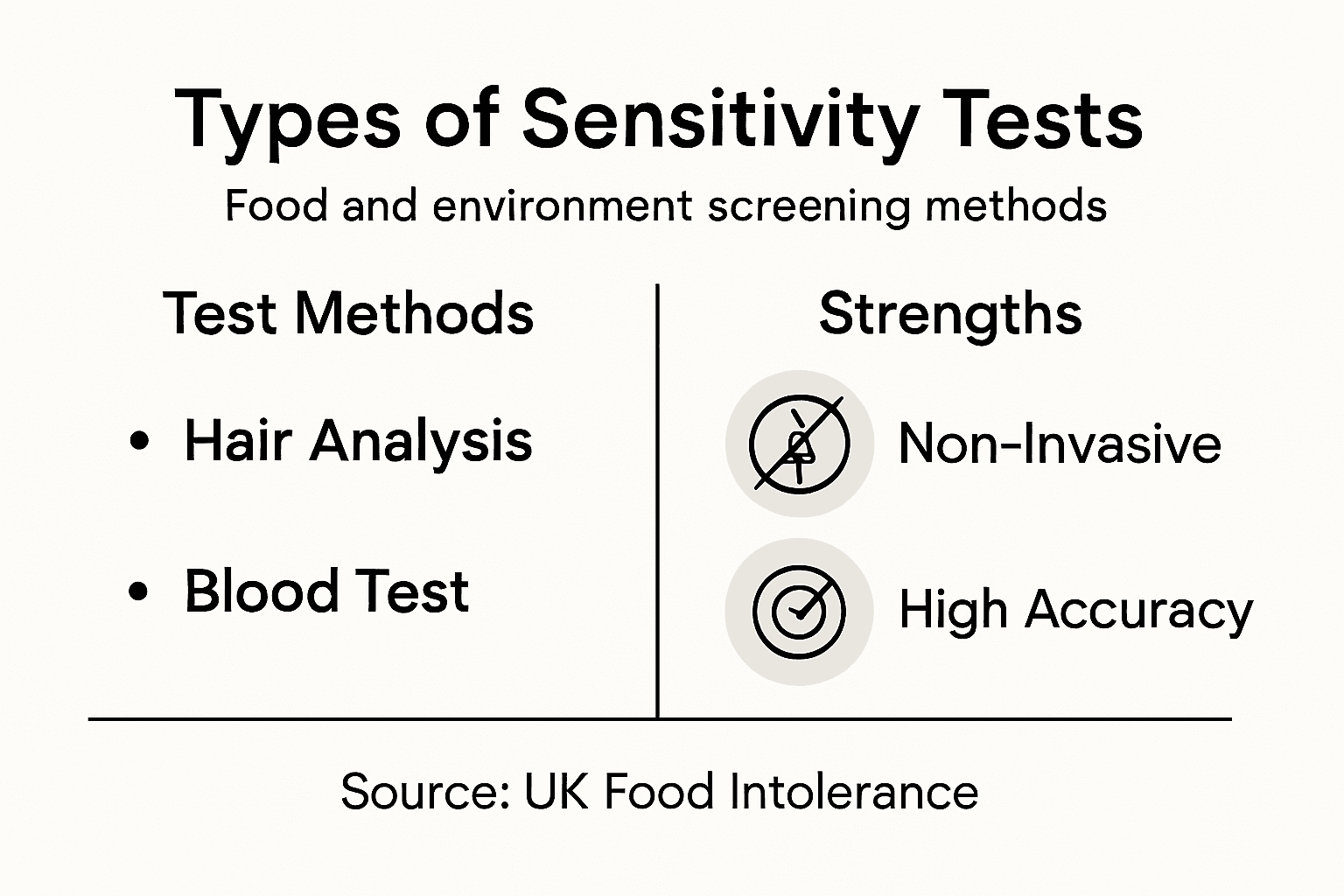
Here is a comparison of the most common sensitivity and allergy testing methods available in the UK:
| Test Method | Detection Window | Invasiveness | Suitable For | Cost Range |
|---|---|---|---|---|
| At-home hair analysis | Several weeks/months | Non-invasive (hair) | Suspected sensitivities, fast results | £45–£100 |
| NHS IgE allergy testing | Immediate/acute | Blood test or patch | True allergies, rapid reactions | Free (NHS) |
| Private IgG blood test | Delayed (hours/days) | Invasive (blood) | Possible intolerances, delayed symptoms | £140–£300 |
| Elimination diet alone | Ongoing (real time) | No test required | Unclear triggers, high accuracy | Cost of food only |
| Food diary monitoring | Ongoing (personal) | No test required | Spotting patterns, symptom tracking | Free |
Pro tip: If you’re uncertain which approach suits you, start with an at-home sensitivity test to identify candidates, then conduct a focused elimination diet on just the flagged foods for two weeks rather than eliminating everything simultaneously—this combination gives you speed, affordability, and personal confirmation without requiring months of guesswork.
Discover Your True Triggers with Reliable At-Home Testing
Struggling with unexplained digestive discomfort or persistent symptoms that disrupt your daily life can be overwhelming. This article highlights the challenge many face in distinguishing between food allergies and sensitivities and the importance of accurate, non-invasive tests to identify the real causes. If you are tired of guesswork, false positives, or lengthy NHS waiting times, our Core Single Intolerance Test or Ultimate Single Intolerance Test provide fast, precise insights into over 500 or 1,100 potential food and environmental triggers using simple hair sample analysis.

Take control of your wellbeing today by using UK Food Intolerance’s trusted bio-resonance technology. Our at-home tests come with clear guidance for interpreting results and starting effective elimination diets, so you can improve your health without unnecessary restrictions. Visit our Digestive Health Archives – UK Food Intolerance to learn more about how sensitivity testing can support your journey. Begin the process now with confidence at https://ukfoodintolerance.co.uk, where support and detailed resources await you. Don’t let uncertainties hold you back any longer—take the first step to feeling better today.
Frequently Asked Questions
What is a sensitivity test and how does it differ from an allergy test?
A sensitivity test is a non-invasive screening method that identifies negative reactions to specific foods or environmental substances. Unlike allergy tests that measure immediate immune responses (IgE), sensitivity tests assess delayed reactions through bioresonance technology using hair samples.
How accurate are sensitivity tests?
Sensitivity tests vary in accuracy and no test achieves 100% sensitivity and specificity. They may catch most triggers but can also produce false positives (flagging non-problematic foods) and false negatives (missing actual triggers). Results should be viewed as suggestions rather than absolute proof.
What are the different types of sensitivity testing available?
There are two broad types of sensitivity testing: elimination diet testing, which relies on removing suspected foods and monitoring symptoms, and biomarker testing, such as bioresonance analysis, which uses hair samples to identify potential triggers.
How can I interpret the results of my sensitivity test effectively?
To effectively interpret your sensitivity test results, combine them with personal symptom tracking and an elimination diet. Remove flagged foods one at a time for two to three weeks, noting any symptom changes. This helps confirm which foods genuinely affect you and avoids unnecessary dietary restrictions.










Leave a Reply
Want to join the discussion?Feel free to contribute!