

TL;DR:
- Interpreting food intolerance test results requires understanding antibody types, reaction classes, and personal symptom history to inform safe dietary decisions. A step-by-step approach emphasizes prioritizing high-class triggers, avoiding over-restriction, and seeking professional help when necessary. Combining test data with lived experience ensures targeted, effective dietary adjustments without unnecessary stress or nutritional gaps.
You finally have your food intolerance test results in front of you. But instead of feeling clarity, you feel overwhelmed. Numbers, class ratings, flagged items — it can feel like reading a foreign language when all you want is to know what to eat and what to avoid. Interpreting intolerance results step by step is the most reliable way to turn that data into decisions that actually help you feel better. This guide walks you through every stage, from understanding what the numbers mean to making safe dietary changes without unnecessary restrictions.
Table of Contents
- Key takeaways
- Understanding what your report actually says
- Your step-by-step intolerance analysis
- Common mistakes when reading your results
- Turning your results into real dietary changes
- When to seek professional help
- My honest take on what most people get wrong
- Get reliable testing and clear result support
- FAQ
Key takeaways
| Point | Details |
|---|---|
| Test results show sensitisation | A positive result confirms antibody presence, not a confirmed allergy or guaranteed reaction. |
| Follow a structured process | Work through your report systematically, prioritising highest-level triggers before addressing lower ones. |
| Context matters as much as numbers | Always correlate test findings with your personal symptom history for meaningful interpretation. |
| Avoid over-restriction | Eliminating too many foods at once can cause nutritional gaps and makes it hard to identify real triggers. |
| Know when to ask for help | Complex results or severe symptoms always warrant guidance from a qualified healthcare professional. |
Understanding what your report actually says
Before you can start reading food intolerance results with any confidence, you need to understand the language your report uses. Most reports include terms like IgG, IgE, antibody levels, sensitisation, and reaction class. These sound clinical, but each one has a straightforward meaning.
IgE refers to immunoglobulin E, the antibody involved in classic allergic reactions. Think of it as the body’s rapid-response system. IgG, on the other hand, relates to a different antibody associated with delayed sensitivities. IgG-mediated sensitivity symptoms can appear one to three days after eating a triggering food, which is precisely what makes them so difficult to identify without a test.
Most intolerance and allergy reports use a class system to rank reaction levels. IgE class ratings run from Class 0 (no detectable sensitisation) to Class 6 (extremely high antibody levels), with each step representing a higher antibody concentration. Higher class does not mean a more severe reaction will happen. It simply means more antibodies were detected.
Here is what you will commonly see in a report:
- Sensitisation: Your immune system has produced antibodies in response to a substance. It does not confirm you will have symptoms.
- Intolerance: A non-immune digestive response, often caused by enzyme deficiencies or food chemicals.
- Allergy: An immune-mediated reaction, typically IgE-driven, and potentially more immediate and severe.
- Wheal size: Used in skin prick tests. A wheal of 3mm or larger than the negative control is generally considered a positive result.
- False positive: A result that suggests reactivity when no true clinical allergy exists.
Pro Tip: Keep a symptom diary alongside your results. Symptoms and personal history are vital to properly interpret findings, since tests alone cannot confirm or exclude intolerances and allergies.
Understanding these terms is your foundation. Without it, the numbers mean very little.
Your step-by-step intolerance analysis
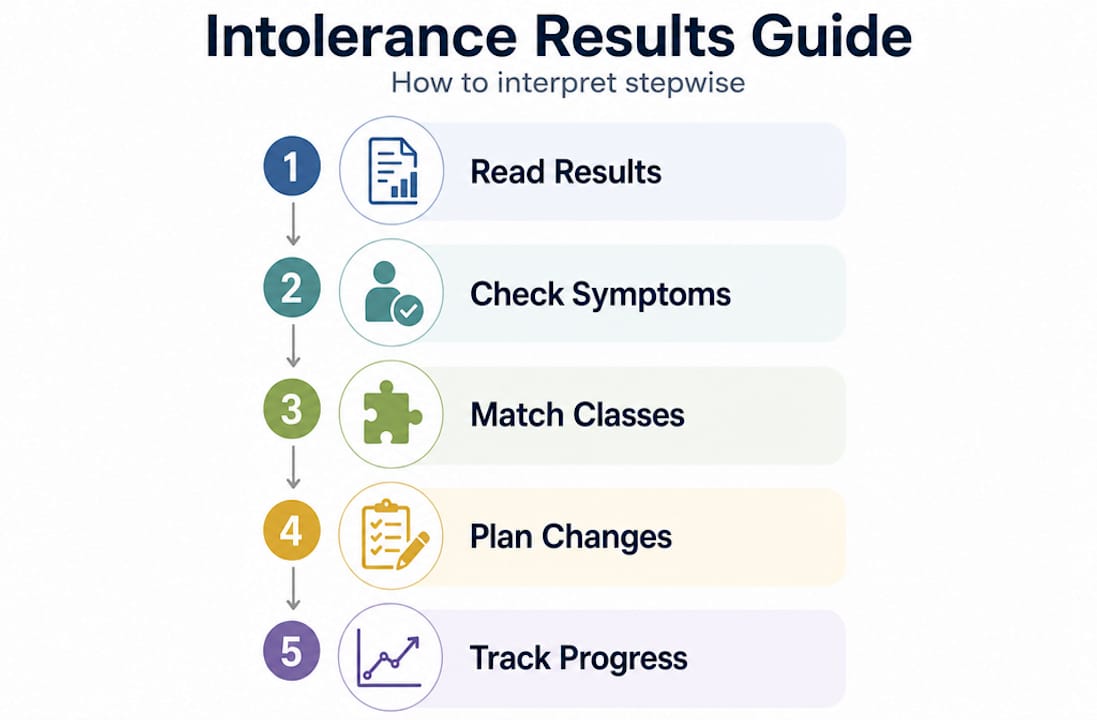
This is where things get practical. A step-by-step intolerance analysis helps you move through your report without becoming overwhelmed or jumping to conclusions. Follow this process from start to finish.
-
Gather your preparation materials. Before opening your report, have your symptom diary, a list of foods you regularly eat, and any relevant medical history ready. Context transforms raw data into personal insight.
-
Identify your highest-level triggers. Start at the top. Look for any items flagged at the highest reaction class in your report. These are your priority items, not because they will definitely cause harm, but because they are worth investigating first.
-
Look for patterns and clusters. Related foods often trigger together. If you react to cow’s milk, butter, and cream, that points toward a dairy sensitivity rather than isolated reactions. Grouping connected items helps you spot the real pattern beneath the individual flags.
-
Prioritise based on symptom relevance. Cross-reference each flagged item against your symptom diary. A high-class result for a food you rarely eat and never react to is less urgent than a moderate result for something you eat daily and always feel worse after consuming.
-
Distinguish between sensitisation and confirmed intolerance. This is critical. A positive result indicates sensitisation, not a clinical allergy. Antibody presence without matching symptoms is often biological noise, not a clinical problem.
-
Cross-check with known personal reactions. Think back. Have you noticed bloating after a particular meal? Skin flare-ups after eating something specific? Where your test results and lived experience align, you have your strongest leads.
-
Plan cautious initial dietary adjustments. Start by reducing, not completely eliminating, moderate-level triggers. For high-level items with matching symptoms, a short elimination trial makes sense. For low-level items without symptoms, there is often no need to change anything yet.
Here is a quick reference for prioritising your results:
| Reaction class | Symptom match | Suggested action |
|---|---|---|
| High (Class 3+) | Yes | Prioritise for elimination trial |
| High (Class 3+) | No | Monitor; discuss with a professional |
| Moderate (Class 2) | Yes | Reduce intake; track symptoms |
| Moderate (Class 2) | No | Low priority; review in context |
| Low (Class 0–1) | No | No action needed currently |
Pro Tip: Use the step-by-step testing guide from Ukfoodintolerance to support your analysis process alongside your results report.
Common mistakes when reading your results
Even with the best intentions, most people make at least one of these errors when interpreting allergy test results or intolerance reports. Knowing what to watch for saves you from weeks of unnecessary restriction.
- Treating every flagged item as an enemy. A positive flag is a prompt to investigate, not immediate proof of harm. Numeric test values show sensitisation level but do not predict how severe, or whether, a reaction will occur.
- Confusing sensitisation with clinical allergy. Experts consistently urge that positive results indicate sensitisation rather than confirmed allergy. Acting as though every sensitisation is a dangerous allergy leads to unnecessary fear and diet restriction.
- Ignoring delayed reactions. Because IgG-linked symptoms can appear days after eating a food, many people dismiss the connection entirely. The delayed onset of IgG-mediated reactions complicates identification and makes a diary essential.
- Over-restricting your diet too quickly. Removing ten foods at once makes it nearly impossible to identify the actual culprit. It also puts you at risk of nutritional gaps, particularly with food groups like dairy or gluten-containing grains.
- Misreading low-level results as significant. Low-class results without any symptom correlation rarely warrant dietary changes. Treating them as major triggers adds confusion without benefit.
- Not seeking professional input when needed. Some results are too complex to navigate alone. A registered dietitian or allergy specialist adds context that a test report simply cannot provide on its own.
“A negative IgE test reduces the likelihood of allergy but does not exclude it. False negatives are possible, and clinical correlation remains essential.” This is why your symptom history is always part of the picture.
Turning your results into real dietary changes
Once you have worked through your report carefully, the next stage is translating that understanding into safe, practical dietary adjustments. This is where your health can genuinely improve.

The most effective approach is an elimination and reintroduction plan. Remove one or two priority triggers for two to four weeks, then reintroduce them slowly while tracking how you feel. This structured method gives you clear, personal evidence rather than assumptions.
Here is how to approach it well:
- Track symptoms consistently. Use a simple diary. Note what you ate, when, and how you felt within 24 to 72 hours. Patterns become clear quickly when you write things down.
- Reintroduce foods one at a time. This is non-negotiable if you want reliable information. Reintroducing multiple foods simultaneously makes it impossible to identify which one caused a response.
- Support your digestive health broadly. Staying well hydrated, eating a varied diet rich in fibre, and managing stress all support gut function. Intolerance improvements rarely come from food avoidance alone.
- Consider combined sensitivities. Some people react to related food families together. If you are sensitive to wheat, rye may also cause issues. A knowledgeable dietitian can help you spot these connections.
- Consult a specialist if symptoms are complex. If you are managing multiple moderate-to-high results, or if your symptoms affect your quality of life significantly, a registered dietitian or allergy specialist will help you build a personalised plan.
Pro Tip: After receiving your results, the next steps guide from Ukfoodintolerance is a helpful starting point for building your elimination plan.
The goal is not a restrictive diet. It is a well-informed one. The more carefully you track and reintroduce, the more specific your answers will be.
When to seek professional help
Self-interpretation has clear limits, and recognising those limits is a sign of good judgement, not weakness. There are situations where professional input is not optional.
- You experience symptoms that are severe, sudden, or include breathing difficulties, hives, or swelling. These may indicate a true allergy and require medical assessment without delay.
- Your test results include multiple high-class reactions with strong symptom matches across different food groups.
- You have been restricting foods for some time without improvement, or your symptoms are getting worse.
- You want to explore more detailed testing. Component-resolved diagnostics go beyond standard panels to distinguish true allergy from cross-reactivity, which prevents unnecessary restriction and supports more targeted treatment.
- You are considering an oral food challenge, which is the gold standard for confirming a food allergy diagnosis. An oral food challenge must always be carried out under medical supervision due to the risk of a reaction.
At-home panels are a useful starting point, but it is worth knowing that at-home IgG food panels are not approved for allergy diagnosis and can lead to unnecessary dietary restriction if not interpreted carefully. Use them as a guide, not a final verdict.
My honest take on what most people get wrong
I’ve spoken with a lot of people who received their intolerance results and immediately cut out eight or ten foods because the report flagged them. A few weeks later, they feel no better and they’re eating a diet so restricted it’s causing more stress than the original symptoms. That pattern is avoidable.
In my experience, the single biggest mistake is treating a positive test result as a confirmed diagnosis. It isn’t. Sensitisation does not equal clinical allergy, and the difference matters enormously for how you respond. A number on a report is a starting point for investigation, not an instruction to eliminate.
What actually works is combining your results with your symptom diary and being patient. I’ve seen people who ignored a moderate result because “it seemed low” later realise that food was their main trigger. I’ve also seen people eliminate a high-class item and feel absolutely no different, because that sensitisation had no clinical relevance for them.
My advice is this: use your results to form a hypothesis, not a verdict. Pair them with your lived experience, make gradual changes, and pay close attention to how your body responds. That process, done carefully, gives you far more reliable answers than any single number in a report can.
And if your results are complex or your symptoms are significantly affecting your life, do not try to manage it all alone. A registered dietitian who understands food intolerance is worth every penny.
— Rob
Get reliable testing and clear result support
If you are still working out where to start, Ukfoodintolerance makes it straightforward. The service offers comprehensive at-home testing using bio-resonance technology, covering over 1,100 items in the Ultimate test and 500 items in the Core test, with detailed digital reports delivered within 48 to 72 hours.
Every report comes with clear, structured guidance so you are not left staring at numbers without context. The intolerance tests available cover food and environmental items, making them a thorough option for anyone dealing with unexplained digestive symptoms, skin issues, or general fatigue. You can also explore all tests to find the right panel for your needs. The process is non-invasive, requires just a small hair sample, and gives you a clear foundation for making informed dietary decisions with confidence.
FAQ
What does a positive intolerance result actually mean?
A positive result means your body has produced antibodies in response to a particular food or substance. It confirms sensitisation, not a clinical allergy or guaranteed reaction, so it should always be read alongside your personal symptom history.
How is food intolerance different from a food allergy?
Food intolerance typically involves a non-immune digestive response and produces delayed symptoms, often 24 to 72 hours after eating a trigger food. A food allergy is immune-mediated, usually IgE-driven, and tends to produce faster, more acute reactions.
Can I rely solely on test numbers to change my diet?
No. Test numbers indicate antibody levels but cannot predict reaction severity or confirm clinical relevance. Symptom correlation is always needed to make meaningful dietary decisions.
How many foods should I eliminate at once?
Start with one or two priority items that show both a high reaction class and a clear match in your symptom diary. Eliminating too many foods simultaneously makes it nearly impossible to identify the actual trigger.
When should I see a healthcare professional about my results?
Seek professional advice if your symptoms are severe, if you have multiple high-class results across food groups, or if your symptoms have not improved after a structured elimination trial. An allergy specialist or registered dietitian can provide a tailored plan.










Leave a Reply
Want to join the discussion?Feel free to contribute!