

An eczema elimination diet means removing one suspected food for a set period, usually a few weeks, then reintroducing it to see whether your skin changes. Done carefully, it gives you a clear answer about one food at a time. Done broadly or without guidance, it can leave you short of nutrients and, in children, can even raise the risk of a reaction later. This guide explains how to run one sensibly, which foods are most often suspected, and where a home sensitivity report can help you decide what to look at first.
TL;DR
- Test one suspected food at a time, not a long list. UK guidance suggests a trial of around 2 to 6 weeks, followed by a planned reintroduction.
- Keep a simple diary of food and skin. Delayed reactions can show up a day or two after eating, so patterns take time to see.
- Children and babies need a GP or dietitian involved before any food group is removed. Never cut out milk, egg or wheat on a hunch.
- Tomatoes, citrus and berries often cause redness around the mouth through skin irritation. That is different from a true allergy.
- A hair-based home report from us can give you a structured starting list for your diary. It does not replace medical advice if you suspect an allergy.
Table of Contents
- What an elimination diet is, and what it can tell you
- What the evidence says about food and eczema
- Foods most often linked to eczema flares
- Tomatoes, citrus and redness around the mouth
- How to run an elimination diet, step by step
- Babies and children: extra care before you remove anything
- When to speak to a professional
- Where a home sensitivity report fits
- Ready to start with a clear list?
- Our perspective
- FAQ
- Sources
What an elimination diet is, and what it can tell you
The idea is simple. You take out one food you suspect, keep everything else the same, watch your skin, then bring the food back in a planned way. If the skin settles when the food is out and flares when it returns, you have a useful clue. If nothing changes, you can usually put the food back and look elsewhere.
This is how UK guidance describes it for suspected delayed (non-IgE-mediated) food reactions. NICE recommends trialling elimination of the suspected allergen, normally for 2 to 6 weeks, then reintroducing it, with dietitian advice on nutritional adequacy, timing and follow-up. Allergy UK describes the same approach, removing the suspected food for a defined period, usually 2 to 4 weeks, and then reintroducing it to see whether symptoms improved, resolved or stayed the same.
Two points matter before you start:
- It is a test of one food, not a lifestyle. The aim is an answer, then a return to the widest diet you tolerate.
- It works alongside your eczema routine. Emollients and any prescribed treatment carry on as normal, so the only thing changing is the food.
What the evidence says about food and eczema
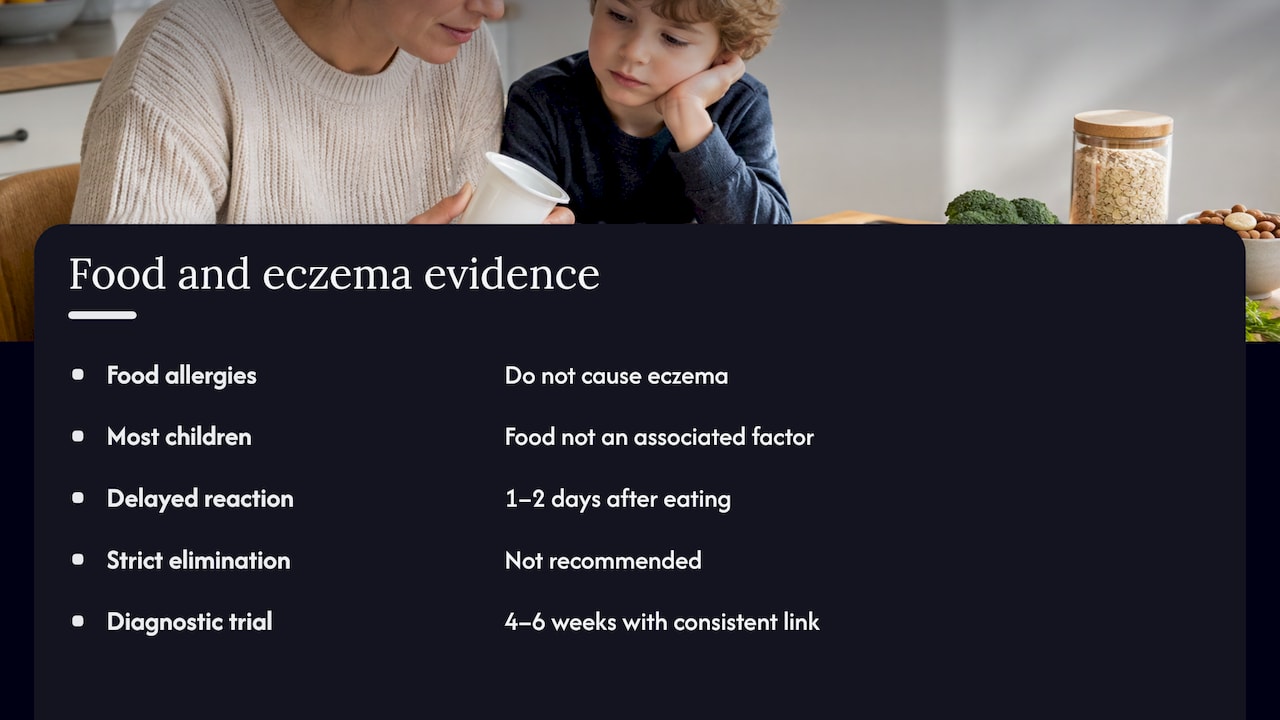
It helps to be realistic about what food can and cannot do for eczema. The British Association of Dermatologists (BAD) explains that research has shown eczema tends to come before food allergies, so food allergies do not cause the eczema, even though people with eczema can have them. Eczema UK’s childhood booklet adds that children with eczema have a slightly higher chance of a food allergy but, for the vast majority, food is not an associated factor.
That does not mean food never matters. A small number of people do find that certain foods make their eczema worse. Eczema Care Online notes that a delayed type of food allergy can cause reactions 1 to 2 days after eating, which is exactly why a flare is so hard to link to a meal by memory alone.
Allergy UK also points out that food can worsen eczema without an allergic origin. Some foods simply irritate skin or trigger itching, and the rubbing and scratching make eczema worse.
A review in the International Journal of Pediatric Dermatology concludes that strict dietary elimination is not recommended, but that a short diagnostic elimination of around 4 to 6 weeks may be tried when there is a consistent link between eating a food and symptoms getting worse. In other words: be specific, be short, and have a reason.
This is why a good elimination diet starts with a hypothesis, not a hunch about “everything”. The rest of this guide is about building that hypothesis well.
Foods most often linked to eczema flares
The foods below come up most often in UK guidance. Treat the list as a set of questions to ask about your own skin, not as a ban list.
| Food | What UK sources say | How it tends to show up |
|---|---|---|
| Cow’s milk | One of the most common delayed reactions, along with eggs and wheat, according to BAD | Flare starting a day or so after eating |
| Eggs | Common in both immediate and delayed reactions | Flare a day or so later, or an immediate reaction |
| Wheat and soya | Named by an NHS hospital patient leaflet among foods usually involved in delayed flare-ups | Flare starting the day or so after eating |
| Peanuts | Among the most common foods causing reactions, according to Eczema Care Online | Can be immediate, which needs medical assessment |
| Tomatoes, citrus, strawberries | Can worsen eczema without being an allergy, per Allergy UK | Itching, redness around the mouth |
The split between immediate and delayed reactions is important. An immediate reaction (hives, swelling, vomiting, breathing difficulty) is an allergy question for a doctor, not a diet experiment. BAD states that if a child has an immediate reaction to any food, they need to see an allergy specialist and have allergy tests to find out which foods to avoid and whether an adrenaline auto-injector may be needed.
Tomatoes, citrus and redness around the mouth
Searches such as “eczema after tomatoes” are common, and the answer is often reassuring. Many children develop redness around the mouth after acidic foods such as tomatoes, citrus fruits and berries. BAD says this is skin irritation rather than a true allergy and tends to improve as the eczema improves.
There is a practical side too. Eczema Care Online notes that tomatoes can cause a facial flare if they touch the skin or the saliva stays on it, and that moisturising the face and neck before and after eating these foods can help. Allergy UK adds that strawberries, tomatoes and citrus fruits do not need to be eliminated and can be included as tolerance allows, and are less likely to be a problem when eczema is well managed.
So if you are wondering about tomato intolerance symptoms, look at the pattern:
- Redness or soreness only where tomato touched the skin, fading within a short time: usually irritation. A barrier moisturiser before meals is the first thing to try.
- Itching or flares across the body a day or two later, repeating each time you eat the food: worth a structured trial, one food only.
- Swelling of lips or face, hives, vomiting or trouble breathing soon after eating: not an elimination diet question. Get medical help.
How to run an elimination diet, step by step
This is the careful version, based on how UK clinicians describe the process. If the person is a child, read the next section first.
- Pick one food. Choose the food you have most reason to suspect, based on a diary, a clear pattern or a professional’s advice. The JTF guideline notes that harms likely increase with the number of foods eliminated and the length of time, so the simplest plan that works is the best plan.
- Keep a two-week baseline diary first. Note what you eat, your itch level out of 10, sleep, and any new products on your skin. Without a baseline you cannot tell whether the elimination did anything.
- Remove the food completely. That means reading labels, including sauces, ready meals and baked goods. Our elimination diet checklist walks through label reading and swaps.
- Hold everything else steady. Do not change washing powder, moisturiser or other foods at the same time, or you will not know what made the difference.
- Run it for the agreed period. UK guidance gives 2 to 6 weeks depending on the source and the situation. Because delayed reactions take a day or two to appear, a few days is not enough.
- Reintroduce on purpose. Add the food back in a normal portion and keep logging for several days. A flare after reintroduction is a meaningful signal. No change means the food is probably not your trigger.
- Decide, then widen again. If the food is a trigger, discuss with your GP or dietitian how long to avoid it and when to retest. If it is not, bring it back permanently and move to the next suspect.
If the plan involves more than one food, or anything beyond a short trial, take it to a dietitian first. NICE says to seek dietitian advice on nutritional adequacy, timing and follow-up.
Babies and children: extra care before you remove anything
Parents are the biggest group searching for this, and the guidance is clearest here. Food allergy is more likely under the age of 2, but for most children food is not the driver of their eczema. The risks of getting it wrong are also higher for growing children.
Allergy UK warns that removing food groups from a child’s diet without the right substitutes can cause malnutrition and poor growth, and should only happen under a specialist such as an allergy doctor or dietitian. Eczema UK’s booklet says to never cut out food groups unless advised by an NHS dietitian, because children need nutrients such as calcium and phosphate for bones, teeth and growth.
There is a second risk that surprises many parents. A peer-reviewed review reports that tolerance seems to need continued exposure, and that avoidance may lead to loss of tolerance and a higher risk of an immediate reaction to the avoided food. A study on cow’s milk found that all 11 children with atopic dermatitis on a long milk-free diet developed immediate reactions on challenge, despite having tolerated milk before. That is why reintroduction is part of the plan, and why some reintroductions happen in hospital. A West Suffolk NHS leaflet says children with moderate to severe eczema need a supervised challenge in hospital before egg is reintroduced.
When is a trial appropriate? Eczema UK says a child should not go on a special diet unless their history strongly suggests a specific food allergy, or widespread eczema is not improving with emollients and topical steroids. In infants, a 4 to 6 week trial of egg and milk exclusion may be recommended by a dermatologist or GP, with NHS dietitian supervision. BSACI adds that where a baby is breastfed, the mother’s diet should be assessed and any changes carefully overseen.
For babies starting solids, the Eczema UK booklet advises introducing foods one at a time in small amounts so effects on the skin can be noted, with all high-risk foods introduced by 12 months. Our partner-free summary of the practical side is simple: one new food, a few days apart, written down. For a step-by-step approach, see this guide on introducing new foods and allergies safely.

For more family-focused help, our parental guide to food sensitivity covers how to talk to children about food changes and keep mealtimes calm.
When to speak to a professional
See your GP, and ask about a dietitian referral, if:
- eczema is moderate to severe and not improving with your current treatment;
- a baby or young child has eczema along with poor growth or digestive symptoms that do not settle. BSACI says a non-IgE-mediated allergy should be considered in this situation;
- you want to remove more than one food, or any whole food group;
- you suspect a reaction that happens quickly after eating.
Get urgent help if the skin suddenly becomes very red or darker than usual, itchy and swollen, especially with lip swelling or breathing changes. Eczema UK states that lips swelling with laboured breathing and a hoarse voice is angioedema and a medical emergency: call 999.
One more point on testing. NICE says that if IgE-mediated allergy is suspected, skin prick or specific IgE blood tests should be offered and carried out by suitably trained healthcare professionals. Clinical allergy tests are for allergy; they are a separate question from a food intolerance or sensitivity screen.
Where a home sensitivity report fits
The hardest part of an elimination diet is knowing where to start. Hundreds of foods could be involved, and you cannot remove them all. A diary helps, but it takes weeks to show a pattern.
This is the gap our home test is designed to fill. You collect a hair sample at home, our UK-based laboratory analyses it using bioresonance technology, and you receive a digital report within 48 to 72 hours. The report is designed to highlight foods and environmental items your body may be reacting to, so you can build a short, focused list for your diary instead of guessing. Our guide to eczema and food sensitivity explains what home testing can tell you, and our article on what your child’s sensitivity report means shows how to turn a report into next steps.
A sensitivity report is a screening tool for intolerance, not a diagnosis of allergy. Use it to choose which one or two foods to trial, keep your GP or dietitian in the loop, and treat any immediate or severe reaction as a medical matter.
Choosing a test
Our range is on the tests page, and our comparison of Core and Ultimate tests helps you pick the best fit. Our Ultimate Plus Intolerance Test is £140.99 one-off per person. Our reports cover over 1,450 items in total across the range, together with guidance for elimination diets.
Ready to start with a clear list?
If you would rather begin your elimination diet with a focused shortlist than a guess, our Ultimate Plus Intolerance Test gives you a detailed digital report in 48 to 72 hours, with support on how to use it in an elimination diet. You can order from the Ultimate Plus Intolerance Test page or browse the full test range.

It is simple, non-invasive and done from your own home. For families, our step-by-step guide to testing children at home shows how to prepare.
Our perspective
Most people who write to us about eczema have already tried the “cut everything out” route. They are tired, the skin is still unsettled, and mealtimes have become stressful. We understand why. Without a starting point, an elimination diet feels like searching a very large cupboard in the dark.
That is the reason we built our reports around clarity. A list of the foods and environmental items that may be affecting you lets you choose one or two to try first, rather than dozens. Short, targeted trials are kinder to your diet, easier on families, and fit what UK clinical guidance asks for: one food at a time, a defined period, a planned reintroduction.
We also believe in doing it safely. Our reports are designed to support an elimination diet and sit alongside your GP or dietitian’s advice, particularly for children. If your child has had a fast reaction to a food, please see your GP or an allergy specialist first.
Used that way, a sensitivity report gives you something practical to act on: a shortlist, a diary, and a clear route back to the widest diet your skin allows.
Rob
FAQ
How long should an eczema elimination diet last?
UK guidance gives a range rather than one number. NICE suggests normally 2 to 6 weeks for a suspected delayed food reaction, and Allergy UK usually describes 2 to 4 weeks, followed by reintroduction. Some infant plans run 4 to 6 weeks under dietitian supervision. Longer than agreed is not better, because risks rise with duration.
Can I do an elimination diet for my child’s eczema myself?
We would not recommend cutting out a food group without professional input. Eczema UK and Allergy UK both say children’s diets should only be changed with a dietitian or allergy specialist, because of nutrition and growth. Start by speaking to your GP, bring a food and skin diary, and ask about a referral.
Can tomatoes make eczema worse?
They can, but often through irritation rather than allergy. Redness around the mouth after tomatoes, citrus or berries is common in children and tends to improve as eczema improves. Moisturising the face before and after eating can help. If you see widespread flares a day or two later every time, test the food on its own.
Do food triggers cause eczema?
BAD says allergies do not cause eczema, and research suggests eczema usually comes first. Food can still make existing eczema worse for some people, which is why a careful, single-food trial can be worthwhile when there is a clear pattern.
Is a food intolerance test the same as an allergy test?
No. Allergy tests such as skin prick and blood tests check for IgE-mediated allergy and are arranged through healthcare professionals. Our home test screens for food and environmental sensitivities and is designed to help you plan an elimination diet. For any suspected allergy, speak to your GP.
Sources
- Food allergy and eczema in children and young people, British Association of Dermatologists
- Recommendations, Food allergy in under 19s, NICE CG116
- Eczema and Food Allergy, Allergy UK
- Diet and allergy, Eczema Care Online
- Diet and Eczema in Children, Royal United Hospital NHS
- Childhood atopic eczema booklet 2023, Eczema UK
- Management, BSACI
- Dietary elimination, JTF AD Guideline Supplement
- Role of Elimination Diet in Atopic Dermatitis, International Journal of Pediatric Dermatology
- Dietary exclusion for childhood atopic dermatitis, PMC
- Egg allergy, West Suffolk Hospitals NHS









Leave a Reply
Want to join the discussion?Feel free to contribute!