
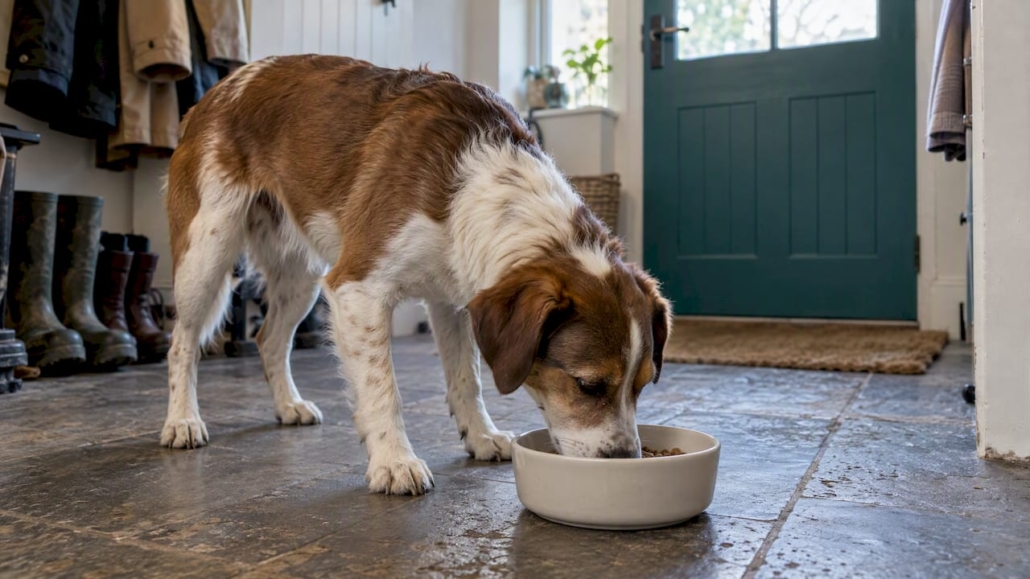
A dog elimination diet means feeding your dog one carefully chosen food, and nothing else, for several weeks. You then watch whether the itching, ear trouble or tummy upset settles. Done with your vet and done strictly, it is the standard way to find out whether food is behind your dog’s symptoms. Done loosely, it tells you very little. This guide walks you through choosing the food, the weeks themselves, the slip-ups that spoil results and what to do once you have an answer.
TL;DR
- An elimination diet (also called a food trial) feeds one vet-recommended diet and nothing else, to see whether symptoms such as itchy skin or diarrhoea are caused by food.
- Plan for 8 weeks, and up to 12 if your vet advises it. Shorter trials can miss slower responders.
- Treats, chews, dental sticks, flavoured medicines and shared bowls are the usual reasons trials fail.
- If your dog improves, a food challenge (reintroducing foods one at a time) confirms the trigger.
- A pet intolerance test can help you and your vet shortlist ingredients to be cautious about, but it does not replace the trial.
Table of Contents
- What a dog elimination diet actually is
- Who should consider one, and why your vet comes first
- Choosing what to feed during the trial
- How to run the trial, step by step
- How long should a dog be on an elimination diet?
- What spoils a trial
- Treats and rewards while you wait
- When your dog improves: the food challenge
- When your dog does not improve
- Where a pet intolerance test fits
- Ready to build a shortlist for your dog?
- Making the trial easier on you both
- FAQ
- Sources
What a dog elimination diet actually is
In plain terms, you feed a specially chosen food that your dog is unlikely to react to, and nothing else, for a set time. The PDSA explains that if symptoms improve or go away, your dog was probably reacting to something in its previous food. Vets use this approach to check whether signs such as itchy skin or diarrhoea are down to a food allergy.
You will see it called an elimination-challenge diet trial, a food trial or an exclusion diet. They all describe the same two-part idea:
- Elimination: remove everything your dog has been eating and feed a different, simple diet.
- Challenge: if things improve, put the old food or single ingredients back to see which one brings the symptoms back.
The challenge part matters. A review in a veterinary dermatology journal describes a limited-antigen diet trial followed by food provocation as the best way to confirm a food allergy diagnosis in dogs. Improvement alone is a strong hint. Seeing the symptoms return on rechallenge is the proof.
Who should consider one, and why your vet comes first
Food-related problems in dogs often look like other things. Persistent itching, paw licking, recurrent ear infections, loose stools and vomiting all have several possible causes, including fleas, environmental allergies and infections. Before you start a trial, ask your vet to examine your dog and rule out the quick-to-treat causes.
Your vet also matters for practical reasons:
- They can recommend a suitable diet. The referral team at Langford Vets says a clinician recommends a hydrolysed or novel diet based on your dog’s diet history and clinical findings.
- They can check any medicines your dog takes, because some are flavoured or coated.
- They help you read the result. If symptoms do not improve, the PDSA notes it is unlikely that food is the only cause, and your vet can look at what else is going on.
If your dog is very young, elderly, underweight or has a long-term condition, always agree the diet with your vet first, because a restricted diet must still be complete and balanced for them.
Choosing what to feed during the trial
There are two main types of trial diet, and your vet will pick between them.
| Diet type | How it works | Best suited to |
|---|---|---|
| Novel protein | Uses a protein (and often a carbohydrate) your dog has genuinely never eaten | Dogs with a clear, detailed diet history |
| Hydrolysed | Proteins are broken into pieces small enough that the immune system is less likely to recognise them | Dogs with a long or unclear diet history, or many past foods |
Why “never eaten” needs care
The whole method rests on the diet containing nothing your dog has met before. That is harder than it sounds. Veterinary writers stress that there is no test diet that works every time, which is why detailed diet histories matter so much. Think back over everything: previous complete foods, treats, chews, table scraps, flavoured toothpaste, supplements and the pill pockets used for tablets.
One common misunderstanding is worth clearing up. Many owners assume a dog cannot be allergic to a food it has eaten all its life. In fact, allergies can develop to any protein the dog has previously eaten. Long-term feeding does not make a food safe.
Home-cooked or commercial?
A commercial veterinary diet is usually the simplest to keep balanced. A home-cooked trial can work, but only with a recipe your vet or a veterinary nutritionist has approved, since cooking one meat with plain rice for many weeks will not meet all your dog’s nutritional needs. Whichever route you take, do not switch brands or flavours part-way through.
How to run the trial, step by step
Strictness is what makes a trial worth doing. Trials can be difficult because they depend on owner and dog compliance, the right diet and correct interpretation of the challenge. Here is a routine that makes it manageable.
- Book the vet check. Confirm that fleas, mites and infections are dealt with first.
- Write down the history. List every food, treat, chew and supplement your dog has had.
- Agree the diet and the length. Get the food, the feeding amounts and the end date in writing.
- Record a baseline. Score itching, skin redness, ear problems, stool quality and vomiting before day one.
- Switch over gradually unless your vet says otherwise, mixing the new food in over several days so the gut can adjust.
- Feed the trial diet only. The PDSA’s advice is to give nothing else, including human food, treats, dental sticks or milk. Water is fine.
- Keep a daily diary. Note symptoms, stools, itching and anything unusual. Record accidental exposures and tell your vet.
- Review with your vet at agreed points, not only at the end.
A simple diary layout
A notebook or phone note is enough. Each day, jot down:
- Itch level from 0 (none) to 10 (constant)
- Ears: clean, red or smelly
- Stool: firm, soft or loose, and how many times
- Any vomiting
- Anything eaten that was not on the plan, and how it happened
A pattern is far easier to spot on paper than from memory in week seven.
How long should a dog be on an elimination diet?
Plan for 8 weeks, and up to 12 if your vet suggests it. One veterinary education source says a trial should last 8 weeks and ideally up to 12, because the full improvement can take that long. The PDSA mentions a range of 6 to 12 weeks.
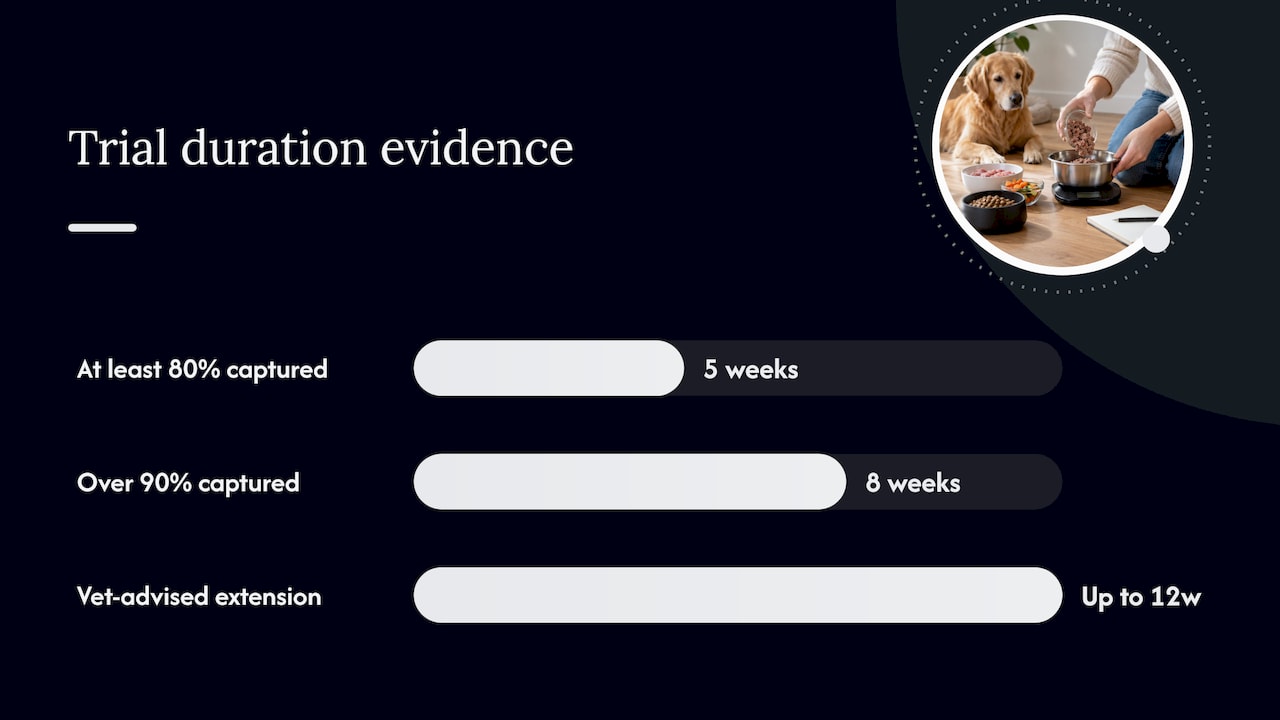
The numbers behind this are helpful. A 2015 critically appraised review found that a minimum of 5 weeks is enough to capture at least 80% of responding dogs, while extending to 8 weeks captures over 90%. If you stop at week three because it feels like nothing is happening, you may stop just before it works.
A rough guide to what you might notice:
| Period | What owners commonly see |
|---|---|
| Weeks 1 to 2 | Stools may settle first; skin often looks the same |
| Weeks 3 to 5 | Itching and redness start to ease in responding dogs |
| Weeks 6 to 8 | Clearer picture; your vet reviews the diary |
| Weeks 9 to 12 | Used where improvement is partial or slow |
This is a general pattern, not a promise. Your own dog may be quicker or slower, which is exactly why the diary matters.
What spoils a trial
Most failed trials are not caused by the wrong diet. They are caused by small, understandable leaks. Watch for these:
- Treats and chews. Dental sticks, rawhide, pig’s ears and “just a little bit” of cheese all count.
- Flavoured medicines. Any medication must be agreed with your vet, as flavoured versions or coatings can interfere with results.
- Flavoured preventives. Proteins in flavourings can make some dogs flare, so ask your vet about topical or non-flavoured options during the trial.
- Shared bowls and other pets. Where you can, keep all dogs in the house on the trial diet to avoid cross-contamination.
- Helpful visitors. Children, neighbours and grandparents need to know the rules. A printed note on the fridge works well.
- Pollen season. Starting during peak season for environmental allergies makes it harder to tell whether the trial is working, so timing matters.
- Giving up on a bad week. A single slip should be recorded and discussed with your vet, not hidden.
For busy households, support helps. Veterinary researchers suggest that regular phone contact from trained clinic staff can keep owners on track, so do ask your practice whether they offer a check-in.
Treats and rewards while you wait
Training does not have to stop. Ask your vet whether a small portion of the trial food itself can be used as rewards, set aside from the daily allowance. Many dogs happily work for their own kibble if it is kept back for training. If your dog has been cooped up on a limited diet, extra walks, sniffing games and toys also keep their spirits up without touching the food bowl.
When your dog improves: the food challenge
A clear improvement is encouraging. As a guide, a reduction of at least 50% in itching and skin lesions during an elimination diet generally raises suspicion of an adverse food reaction.
The next step is the challenge. A food challenge with the previous diet or single ingredients can confirm the reaction. Your vet will guide the order, but the principle is simple:
- Reintroduce one food or ingredient at a time.
- Give it for long enough to see a reaction, as agreed with your vet.
- If symptoms return, you have found a likely trigger. Return to the trial diet until your dog settles.
- If nothing happens, that food can usually go on the safe list.
This stage is where you build your dog’s long-term menu. Langford Vets recommends that after a successful trial the elimination diet is maintained for 3 to 6 months so that gut inflammation can resolve, so do not rush into rechallenge unless your vet advises it.
When your dog does not improve
A trial with no change still gives you information. It suggests food is unlikely to be the only cause, so your vet can look at other triggers such as environmental allergies or skin infections. Before you decide it failed, check the diary for leaks, confirm the diet was truly novel for your dog and make sure the full agreed time was completed.
Our perspective
We hear from many dog owners who feel stuck. The dog is itchy or unsettled, the vet visit has not given a clear answer, and the idea of weeks on a restricted diet feels daunting. Our view is that a good elimination diet starts with a good shortlist. The more you know about which ingredients your dog may be sensitive to, the easier it is to build a sensible plan with your vet and to avoid the foods most likely to cause trouble.
That is where we come in. Our pet tests use a simple, non-invasive hair sample, sent to a UK laboratory, and the report is designed to highlight foods and other items your dog may be sensitive to. We see it as a screening tool for intolerance, and we are open about that. It can give you and your vet a place to start, a list to check against your dog’s diet history and a way to feel less in the dark.
Used alongside your vet’s guidance, a report can make the trial feel more focused and less like guesswork. Your dog gets the plan, you get clarity, and the diary you keep tells you what really works.
Rob
Where a pet intolerance test fits
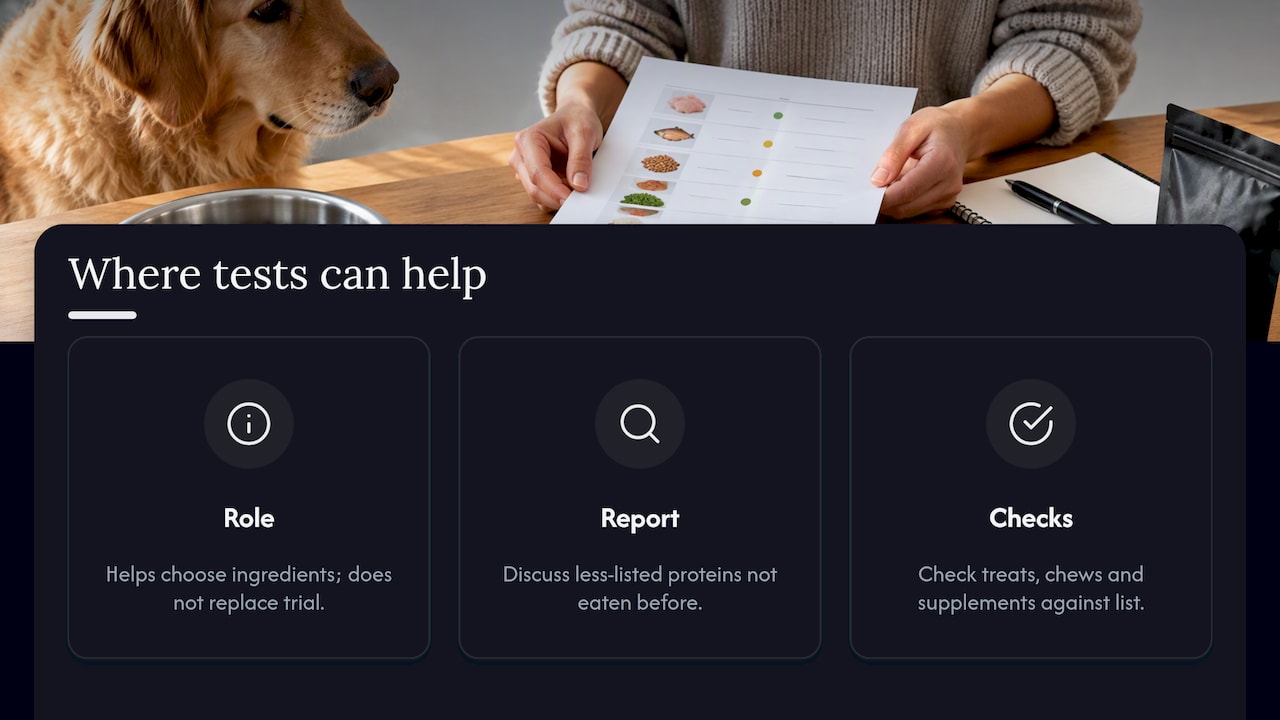
A test does not replace the trial. What it can do is help you think about ingredients before you pick a diet. If your dog’s report flags chicken and beef, for example, you can talk to your vet about proteins that appear less often in the results and that your dog has not eaten before. You can also check treats, chews and supplements against the list, which is where many trials leak.
If you want to read more first, our guides cover what pet hair intolerance testing can and cannot tell you, pet food intolerance tests for dogs and the story of a dog that was always sick. If you are comparing human and pet approaches, our elimination diet checklist shows the same strict, step-by-step thinking.
Ready to build a shortlist for your dog?
Our pet range includes the Intro 300, Essential 500 and Peak 700 panels, so you can choose how many items you would like checked. You collect a hair sample at home, send it to our UK laboratory and receive a digital report you can share with your vet. Prices and current panel details are on the pet testing page.

If you are also curious about how the technology works, our guide to bio-resonance testing explains the hair sample process in plain language.
Making the trial easier on you both
A few habits make the weeks pass more smoothly:
- Pick a calm start. Avoid holidays, house moves, kennel stays and, where you can, peak pollen weeks.
- Prepare the house. Move the old food and treats out of sight, or give them away.
- Brief everyone. One rule sheet, shared with the whole household and dog walkers.
- Weigh the food. Use scales so portions stay steady and your dog keeps a healthy weight.
- Take photos. A weekly photo of skin, paws and ears shows changes the diary can miss.
- Stay in touch with your vet. Ask for a mid-trial review rather than waiting until the end.
And be kind to yourself. It is a tough few weeks, but a clear answer at the end is worth it for a dog that has been uncomfortable for a long time.
FAQ
What should I feed a dog on an elimination diet?
Your vet will recommend either a hydrolysed diet or a novel-protein diet, chosen using your dog’s diet history and symptoms. Everything else is off the menu, including treats, chews and table food. Water is fine. Do not choose a food by yourself from the shelf, as many “limited ingredient” foods are not strict enough for a trial.
How long should my dog stay on the diet?
Plan for 8 weeks, and up to 12 if your vet advises it. Research suggests that 5 weeks captures most responding dogs, and 8 weeks captures over 90%. Keep your diary going throughout, and ask your vet before ending the trial early.
Can I use a home-cooked diet?
Only with a recipe your vet or a veterinary nutritionist has approved. A very simple home diet may not give your dog all the nutrients they need over many weeks. A complete commercial trial diet is usually easier to keep balanced and consistent.
What if my dog eats something they should not?
Note it in the diary, with the food and the amount, and tell your vet. A single small slip does not always ruin a trial, but your vet may want to extend or restart it depending on how your dog reacts.
Does a hair test replace an elimination diet?
No. A food trial followed by a challenge is how food allergy is confirmed in dogs. A pet intolerance report can help you shortlist ingredients to discuss with your vet and check your dog’s treats and chews, but the trial still does the proving.
Sources
- How to conduct a food trial: Dog (PDSA)
- Conducting a successful diet trial for the diagnosis of food allergy (Veterinary Dermatology, 2024)
- Food allergy in dogs and cats: current perspectives (JAVMA, 2023)
- Diet Trials (Langford Vets)
- Food hypersensitivities: performing an elimination diet trial (DVM360)
- Elimination diet trials for dogs and cats (Royal Canin Academy)
- Diagnostic options to identify adverse food reactions in dogs (Royal Canin Academy)
- Critically appraised topic on adverse food reactions of companion animals (PMC, 2015)
- Food trial instructions for dogs (Nextmune Laboratories, 2020)










Leave a Reply
Want to join the discussion?Feel free to contribute!