
Pet hair intolerance testing is a non-invasive screening tool. You send a small sample of your dog’s or cat’s fur, and the report lists foods and environmental items your pet may be sensitive to. It is not a diagnosis. Published veterinary research does not support hair tests as a way to diagnose allergies, so the sensible use of a result is to give you a short, focused list to work through with your vet in a structured diet trial.
We sell pet tests, and we would rather you know exactly what you are buying. Below you will find what these tests measure, what the evidence says, and how to turn a report into something useful for an itchy, gurgly or unsettled pet.
TL;DR
- A pet hair intolerance test is a screening tool that uses bioresonance. It produces a list of items to investigate, not a diagnosis.
- A published study of a hair and saliva test for dogs found it could not tell allergic, non-allergic and fake samples apart better than chance.
- The recognised way to confirm a food reaction in a dog is an elimination diet followed by reintroduction, ideally with your vet.
- If you use a test, treat the result as a starting hypothesis for a diet trial, and see a vet first for skin disease, vomiting, diarrhoea or weight loss.
- If you are the one sneezing around your pet, see your GP: human pet allergy is assessed with skin-prick or blood tests, not hair.
Table of Contents
- What a pet hair intolerance test actually measures
- What the evidence says about hair tests in dogs
- Pet allergy in people: a different question
- Where a hair test can still help your pet
- How to run a dog elimination diet plan
- Our perspective
- Choosing a non-invasive pet test: what to look for
- Our pet tests
- FAQ
- Sources
What a pet hair intolerance test actually measures
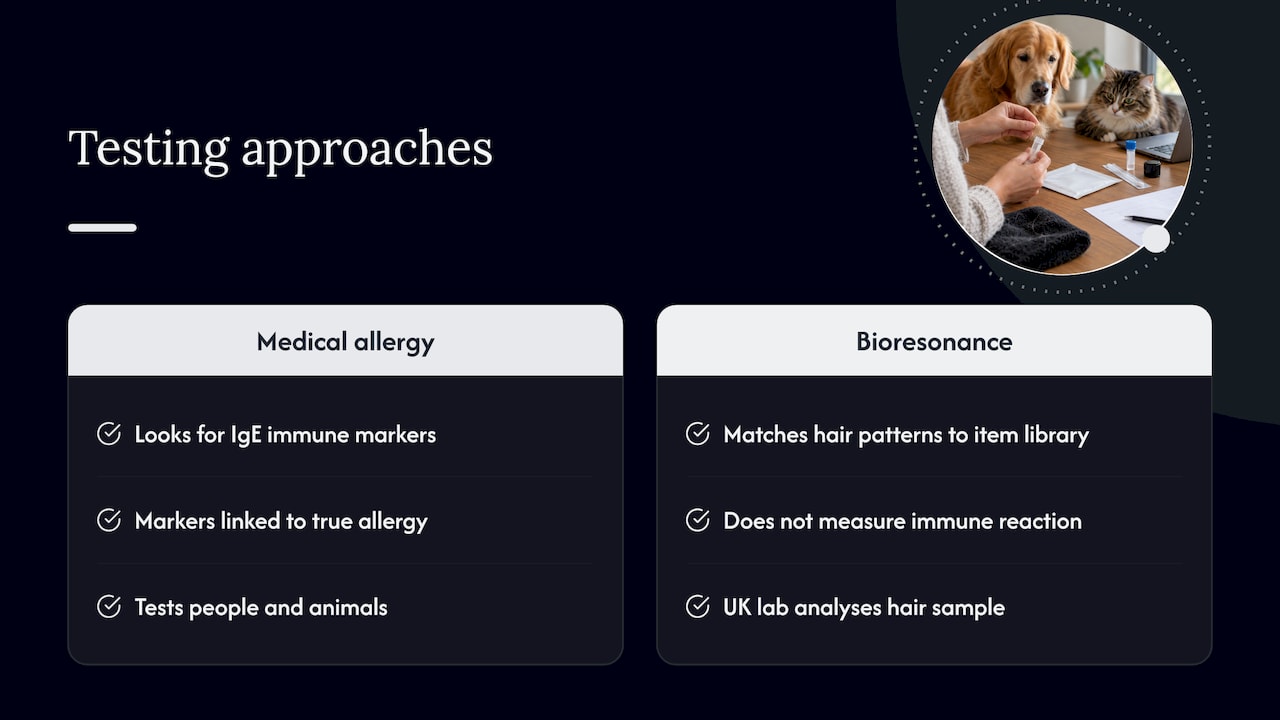
A hair intolerance test does not look for the same thing a medical allergy test looks for. Allergy tests in people and animals look for IgE antibodies, the immune markers linked to true allergy. Our tests use bioresonance: a hair sample is analysed in a UK laboratory for energetic patterns that are matched against a library of food and environmental items. If you want the detail of the method, our educational guide to bio-resonance technology explains the principles, and our research and methodology page sets out what we publish about it.
The practical appeal is clear. Collecting fur is painless, needs no vet visit, no needles and no restraint, and it suits pets that hate being handled. That is why people search for a non-invasive pet intolerance test in the first place. The report then ranks items, such as proteins, grains, dairy and common household or outdoor triggers, so you have somewhere to begin.
What the report is not is a measurement of an immune reaction. We say this plainly because the difference matters for how you use the result.
Intolerance, sensitivity and allergy are different things
In everyday talk, people mix these words up. In veterinary medicine, an adverse food reaction is the umbrella term, and food allergy is the immune-mediated part of it. Our reports use the language of sensitivity and intolerance, and we position them as a guide for an elimination diet. For a clear human-focused comparison of test types, see our guide to sensitivity versus allergy tests.
What the evidence says about hair tests in dogs
You deserve the unflattering evidence as well as the appealing sales pitch, so here it is.
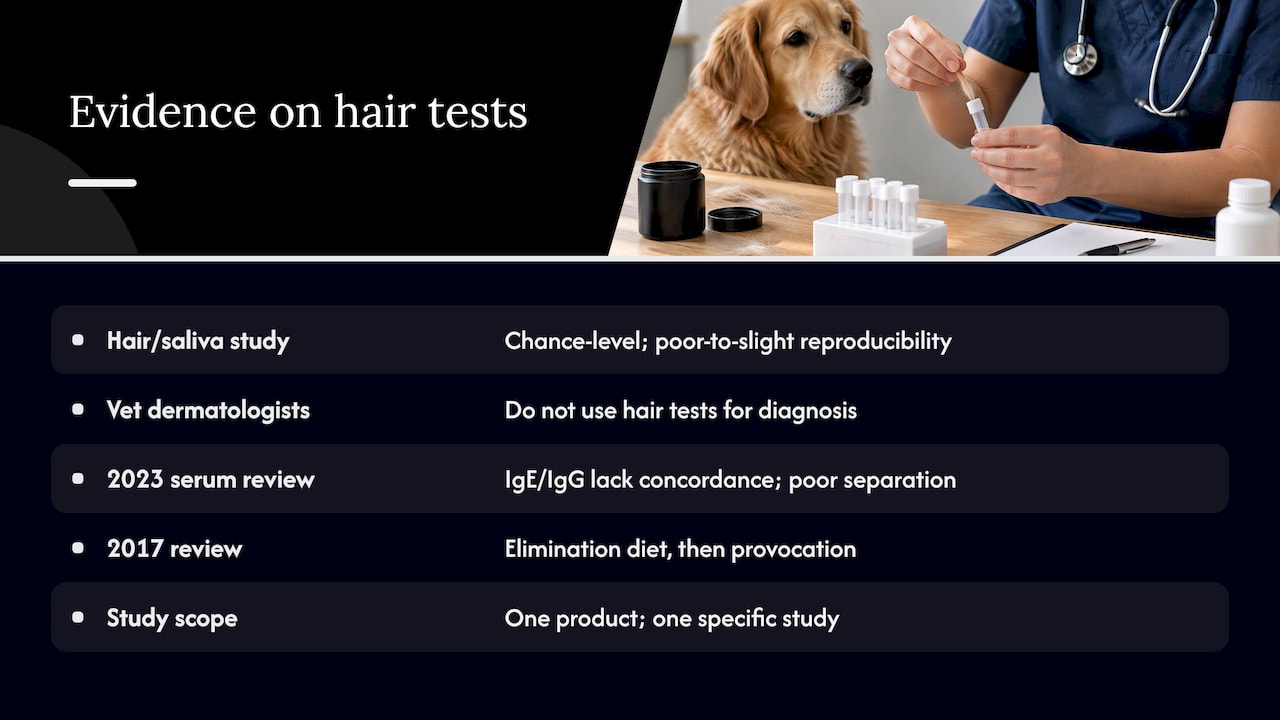
A study in the Journal of Small Animal Practice submitted samples from allergic dogs, non-allergic dogs and fake samples to a commercial hair and saliva test. The test did not separate them better than chance, and its test-retest reproducibility was poor to slight. That is a specific product and a specific study, and we are not claiming it describes every test on the market. But it is the best published evidence available, and it points the same way as the veterinary mainstream.
Veterinary dermatologists do not use hair tests for allergies or intolerances, and one explanation offered is that the antibodies measured in allergy testing are not present in hair. Even blood tests for food-specific antibodies have a poor record: a 2023 review in the Journal of the American Veterinary Medical Association says that serum tests for food-specific IgE and IgG lack concordance and fail to reliably separate allergic from healthy animals.
A 2017 critically appraised review reached a similar conclusion: the best diagnostic procedure is an elimination diet followed by provocation, and the other tests reviewed generally cannot be recommended for clinical diagnosis.
The real risk is a wrong turn
The harm the vets worry about is not the cost of a test. It is that misleading allergy tests can delay proper veterinary diagnosis and treatment, and can lead to dietary restrictions that do not address the underlying problem. If your dog has a sore, infected or constantly scratched skin, a hair report must never replace a vet appointment.
We agree with that caution, and it shapes how we describe our service. Our own view of the limits of hair testing for people is set out in our article on why hair tests cannot diagnose.
Pet allergy in people: a different question
Some readers searching this topic are not worried about their dog’s food at all. They sneeze, itch or wheeze around a pet and want to know if they are allergic.
Pet allergy is caused by proteins in saliva, urine or dander, and dog allergens are found mainly in hair, dander and saliva. Hair can also carry airborne allergens such as pollen, house dust mite and mould, according to Allergy UK. That is why a pet’s coat can seem to cause symptoms without the animal itself being the only source.
In the UK, you should raise suspected pet allergy with your GP or another health professional. Testing may involve a blood test for specific IgE or skin-prick testing, and you may be referred to an allergy specialist. A pet hair test cannot answer this question, and neither can ours.
Where a hair test can still help your pet
If the evidence is this cautious, why would anyone use a test? Because the gold-standard approach is hard to do. A 2017 review notes that elimination diets are work-intensive and time-consuming, which is why owners look for an easier route. Many people start a diet trial with no idea which ingredient to avoid, and the pet’s current food, treats, chews and table scraps can hide a dozen possible culprits.
A screening report can help in three practical ways:
- It narrows the starting list. Instead of guessing, you see which foods are flagged and which are not.
- It highlights hidden ingredients. Seeing a flagged item prompts you to read treat and chew labels you may have ignored.
- It gives you structure. A written list makes it easier to commit to a plan and to talk through it with your vet.
The key phrase is hypothesis, not answer. Your pet’s own response over several weeks is the evidence that counts. We cover the same logic for people in our guide to identifying allergens.
How to run a dog elimination diet plan
This is the part that actually gives you an answer, with or without a test. Talk to your vet before you begin, because the right diet depends on your dog’s age, health and symptoms, and because a vet can rule out other causes first. In practice, allergy testing for itchy skin conditions is typically reserved for after causes such as parasites have been ruled out.
Step 1: Rule out the other causes
Fleas, mites, ear infections, skin infections and general gut upsets can all look like a food problem. Your vet will check these first. If a dog is eating less, losing weight or seems unwell, work through the red flags before you assume it is a dietary sensitivity.
Step 2: Choose a novel or hydrolysed protein diet
A diet trial uses a novel or hydrolysed protein diet for several weeks. Novel means a protein your dog has not eaten before. Hydrolysed means the protein is broken into pieces small enough to avoid triggering a reaction. Your vet can recommend a suitable product. This is where a test report may help: a protein flagged in the report is one to avoid when choosing, and a protein your dog has never had is a natural candidate.
Step 3: Be strict for the full trial
Diet trials fail most often through accidental extras. Researchers who write on this point stress that success depends heavily on a precise dietary history and on preventing accidental intake of non-prescribed ingredients. In a household, that means:
- No flavoured medicines or supplements unless your vet approves them.
- No treats, dental chews, chew toys or table scraps.
- Everyone in the family, and neighbours who like to share, on the same rules.
- A simple diary of meals, stools, itching and energy.
Step 4: Give it long enough
A diet trial should last several weeks: 85% of dogs improve by five weeks, and eight weeks is adequate for over 95%. If you stop after ten days because nothing has changed, you have not learnt anything.
Step 5: Reintroduce and watch
If symptoms improve, the confirmation step is to return to the original diet and watch for a relapse. Then bring foods back one at a time, giving each a few days to a couple of weeks as your vet advises, and log the response. A relapse tells you the food matters. Without that step, you only know the new diet agrees with your dog.
The same patient approach works for people. Our elimination diet checklist sets out the logic in a human setting, and the principles of careful reintroduction are the same.
Our perspective
We built our service around a simple observation: most people who contact us are not after a lab certificate. They have a pet that is itchy, restless or has a sensitive stomach, and they want a place to start that does not involve a stressful day at the vet.
That is a reasonable wish, and our hair tests suit it, as long as everyone is honest about the job the report does. It is a screening tool. It gives you ideas to test, in the same way a food diary does, only with more items covered and a clear written output. It does not confirm an allergy, and we do not ask you to treat it that way.
Our advice, then, is this. If your pet has a skin problem, vomiting, diarrhoea or has lost weight, see your vet first. If your vet suggests a diet trial, or you are managing a long-running mild sensitivity, a report can help you plan. Pick one change at a time, keep a diary, and let your pet’s response overrule any list, including ours.
— Rob
Choosing a non-invasive pet test: what to look for
If you are comparing the best dog allergy test or the best pet allergy test, the label matters less than what the product claims. Use these criteria on any option, including ours:
- Does it say what it measures? An intolerance or sensitivity screen is not the same as an IgE allergy test. Be wary of any page that blurs the two.
- Does it admit its limits? A provider that states screening limits is more trustworthy than one promising to find the root cause of everything.
- Where is it analysed? A UK laboratory means no international postage for the sample and clear contact if something goes wrong.
- Does it tell you what to do next? A list of items with no plan is not much use. Look for guidance on running an elimination diet.
- Does it send you to your vet when needed? Good providers do.
For the veterinary route, the vets at one UK practice note that intradermal skin testing is generally preferred over blood testing by veterinary dermatologists when looking at environmental allergies. That is a referral conversation, not something you can order from home.
Our pet tests
We offer three pet panels, Intro 300, Essential 500 and Peak 700, with the number reflecting how many items are screened. You collect a small sample of fur at home, post it to our UK laboratory, and receive a digital report. It is a simple way to get a starting list for a diet trial, and you can take it to your vet.

See the panels and what each covers on our pet testing page. If you want to understand how the sample and process work before you order, our at-home testing workflow walks you through it, and our blog post on pet food intolerance tests for dogs gives more background.
FAQ
Can a hair test diagnose a food allergy in my dog?
No. Published veterinary research does not support hair testing as a diagnostic method, and a study of a commercial hair and saliva test found it performed no better than chance. The accepted way to confirm a food reaction is an elimination diet followed by reintroduction. A hair report can only suggest items to look at.
How long should a dog elimination diet last?
Several weeks. Research reviewed in a 2023 paper reports that 85% of dogs improve by five weeks and eight weeks is adequate for over 95%. Ask your vet to set the length and to approve the diet, because it depends on your dog’s health and age.
Is a non-invasive pet test safe to use for a dog with itchy skin?
Collecting fur is harmless, but the risk is in what you do with the result. Itchy skin can come from fleas, infection or environmental allergy, so see a vet first. Do not remove foods or start a restrictive diet on a report alone if your dog is unwell.
I think I am allergic to my pet. Should I use a pet hair test?
No. In the UK, suspected pet allergy in people should be discussed with a GP, who may arrange specific-IgE blood testing or skin-prick testing, or refer you to an allergy specialist. A hair intolerance test cannot diagnose an allergy in a person.
Sources
- Pet Allergy, Allergy UK
- Hair and saliva test fails to identify allergies in dogs, Journal of Small Animal Practice
- Which Allergy Tests for Pets are Worth It?
- Food allergy in dogs and cats: current perspectives, JAVMA
- Critically appraised topic on adverse food reactions of dogs and cats
- Conducting a successful diet trial, Veterinary Dermatology
- Is there a gold-standard test for adverse food reactions?, Veterinary Practice News
- Pet Allergy Testing, Animal Trust Vets










Leave a Reply
Want to join the discussion?Feel free to contribute!