

For most people with ADHD, food is not the cause and an elimination diet is not a cure. But a small group of children seem to behave differently after eating certain foods. If you have noticed a pattern, it is worth looking into carefully, with a clinician, a food and symptom diary and a clear plan.
This guide explains where the research stands, what UK guidance recommends, how to spot a real pattern, and where an at-home sensitivity test can and cannot help. We have tried to be straight with you, because you deserve clear information before you spend money or change what your family eats.
TL;DR
- NICE guidance does not support exclusion diets as a general treatment for ADHD. It does allow for exploring specific foods if a clear, consistent link to behaviour is reported.
- Research points to a small subgroup who may react to certain foods or additives, not the whole ADHD population.
- Any structured elimination should be planned with a dietitian and a paediatrician or mental health specialist, so nutrition stays protected.
- A food and symptom diary is the most useful first step, and it costs nothing.
- Our at-home hair tests are a screening tool for intolerance, not a diagnosis of ADHD or allergy. The NHS does not recommend home tests, so we cover how to use results sensibly.
Table of Contents
- What we mean by food sensitivity
- What the research says about ADHD and food
- What NICE and the NHS advise
- Signs that food may be playing a part
- Start with a diary: a simple four-week method
- Why elimination diets are hard with ADHD
- The risks of cutting out too much
- Our perspective on ADHD and food sensitivity
- Where an at-home test fits
- Our tests, if you decide to go ahead
- Eating well with ADHD, whatever your test shows
- FAQ
- Sources
What we mean by food sensitivity
The words get mixed up, so here is the short version.
- Food allergy: an immune reaction, sometimes fast and serious. It needs medical testing and advice.
- Food intolerance: difficulty digesting certain foods or ingredients. It is not usually serious, but eating the food can make you feel unwell.
- Food sensitivity: an everyday, non-medical term for feeling worse after certain foods. It covers intolerance and, in some people, reactions to additives.
ADHD is different again. It is a neurodevelopmental condition that affects the parts of the brain that help us plan, prioritise, focus and carry out tasks. Food can affect how anyone feels, including how settled, tired or irritable they are. That is not the same as food causing ADHD.
What the research says about ADHD and food
The idea that diet can change ADHD behaviour is decades old. The picture is mixed, and honesty about that helps you decide what to do next.
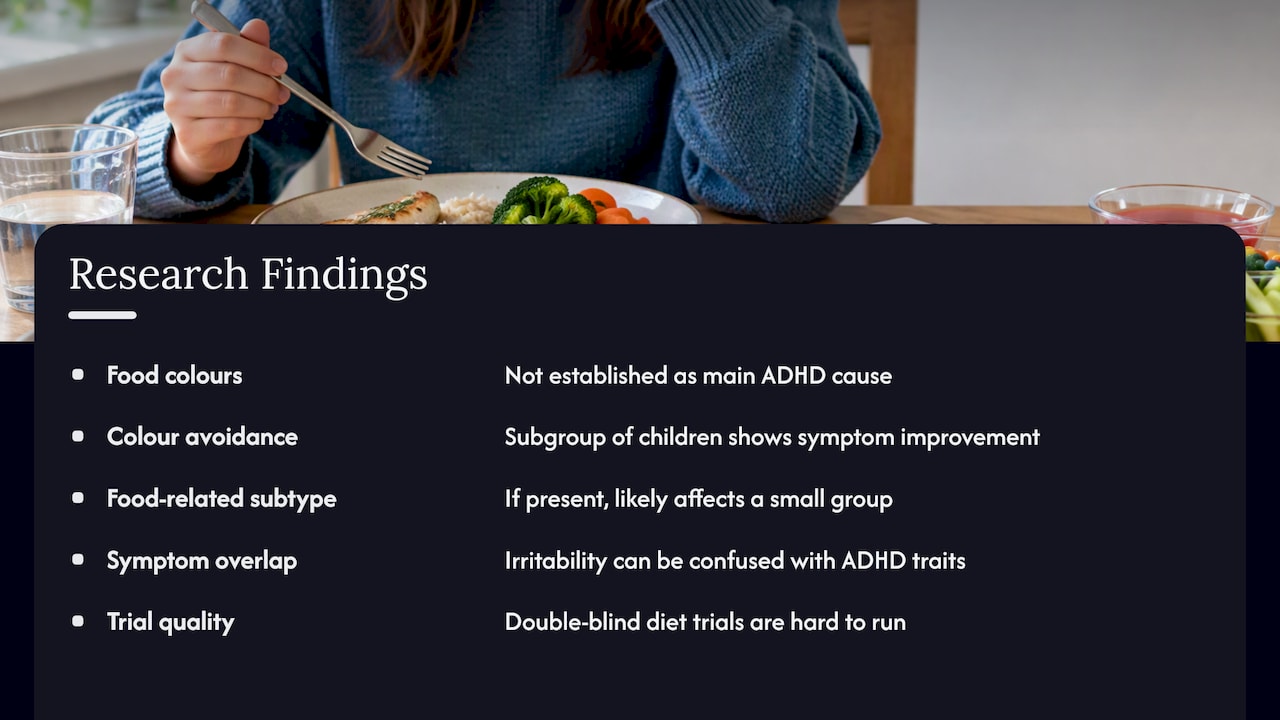
Additives and colourings. A thirty-five year review of dietary sensitivities and ADHD concluded that artificial food colours have not been established as the main cause of ADHD. It also found that a subgroup of children shows significant symptom improvement when they avoid them. That wording matters: a subgroup, not most children.
Elimination diets. A review of elimination diets in ADHD and autism describes how the approach began as a way to find foods behind physical reactions, then was applied to behaviour. It suggests that if a food-related subtype of ADHD exists, it probably involves a small group of children. It also warns that digestive or behavioural symptoms such as irritability can be confused with ADHD traits, which is why clinical oversight matters.
Trial quality. A systematic review of meta-analyses of double-blind trials looked at diet interventions and children’s ADHD behaviour, including few-foods diets and colour removal. It is a useful place to see how the evidence is built, and how hard these trials are to run.
What that adds up to: most people with ADHD will not find that a food is driving their symptoms. Some will find a clear link. The only way to know is to look carefully at the individual.
What NICE and the NHS advise
UK guidance is consistent, and we think you should hear it plainly.
NICE says healthcare professionals should stress the value of a balanced diet, good nutrition and regular exercise for children, young people and adults with ADHD. It advises against recommending the elimination of artificial colourings and additives as a generally applicable treatment. Its evidence addendum adds that clinicians should ask about foods or drinks that appear to influence behaviour.
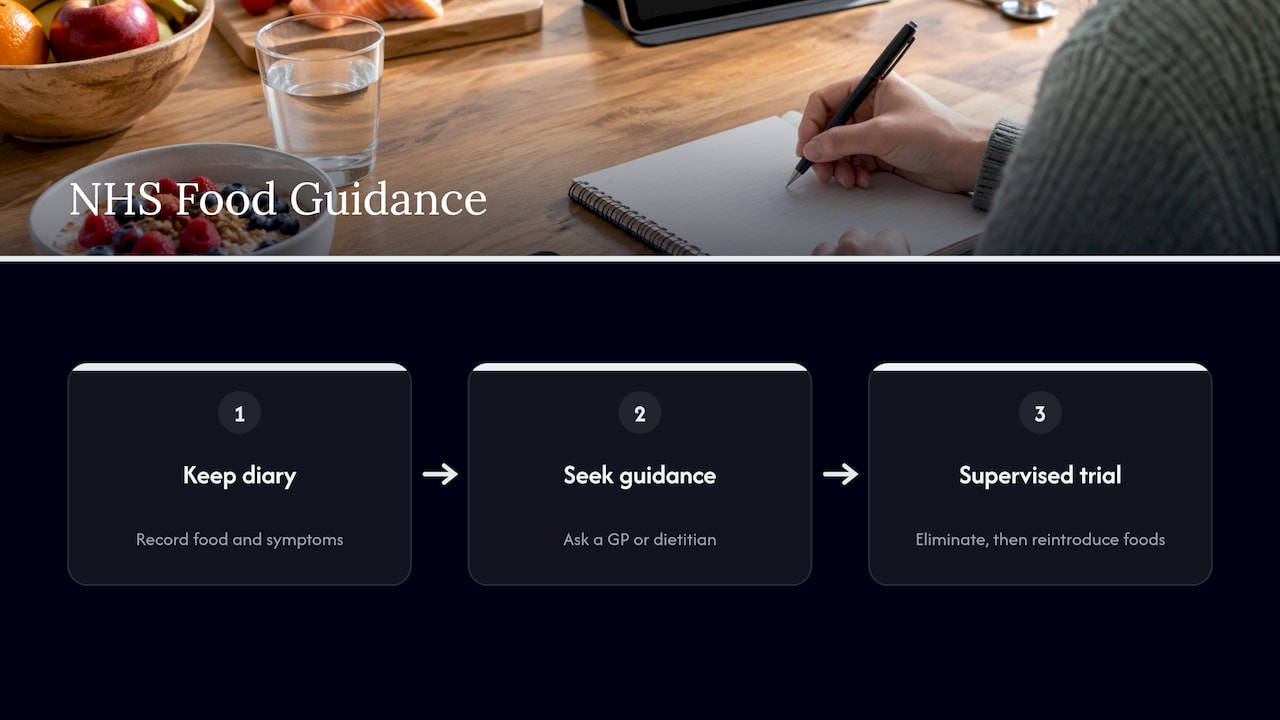
If a parent does report a clear link, a diary should confirm it first. Any dietary work should then be done jointly by a dietitian and a mental health specialist or paediatrician. An NHS leaflet for families says the same thing in plain language: a specific elimination should be jointly undertaken by a dietitian or paediatrician and the parent.
NHS-affiliated guidance for parents goes a step further on the positive side. It says nutrition is not a stand-alone treatment or cure for ADHD, but good habits can support brain function, behaviour, mood and overall health. It suggests protein at main meals, wholegrain carbohydrates, fewer highly processed foods and simple sugars, and regular mealtimes.
On home tests, the NHS food intolerance page is cautious. It advises that diagnosis usually involves a GP or dietitian, a food and symptom diary, and a supervised elimination and reintroduction. We think you should know that before you decide anything, including whether to buy from us.
Signs that food may be playing a part
A food link is more likely to be worth exploring when the pattern is specific. Think about:
- Timing. Does behaviour, mood or concentration change within hours of the same food or drink, again and again?
- Physical symptoms alongside. Bloating, stomach pain, loose stools, headaches, skin flare-ups or reflux often point to intolerance rather than behaviour alone.
- Consistency. One bad afternoon after a birthday party is not a pattern. Four weeks of notes might be.
- Other explanations ruled out. Hunger, poor sleep, medication wearing off and sensory overload can all look like a food reaction.
Sensory sensitivity is another trap. Many people with ADHD find certain textures, smells or tastes hard, which can look like food intolerance but is about how the food feels, not how it digests. That is a different problem with different solutions, and a dietitian can help you tell them apart.
Start with a diary: a simple four-week method
Before any test or diet, a diary gives you real information and gives a clinician something to work with.
- Write down everything eaten and drunk, with approximate times, for at least two to four weeks. Include sauces, sweets and drinks.
- Note symptoms and behaviour each day: mood, focus, energy, sleep, tummy trouble, skin.
- Record the context: medication times, school or work stress, illness, poor sleep.
- Look for repeats. Circle foods that show up before the same symptoms at least three or four times.
- Take it to your GP, or ask for a referral to an NHS dietitian. Bring the diary, not just your memory of it.
For tips on how to structure the later stages, our elimination diet checklist walks through it step by step.
Why elimination diets are hard with ADHD
This is the part many guides skip. ADHD can involve impulsivity, poor planning and executive dysfunction, and these make consistent meal preparation difficult. A complex elimination protocol that needs label-checking, batch cooking and a strict timetable is a lot to ask of anyone, and more so of a child or an adult with ADHD.
NHS-linked guidance suggests focusing on a supportive food environment: easy-to-grab snacks such as boiled eggs or fruit, rather than elaborate rules that are unlikely to last. It also stresses what the person can eat, not only what they cannot, to avoid stress and anxiety at mealtimes.
Practical ways to make a supervised trial more realistic:
- Remove one food group at a time, not ten.
- Keep a short, written list of safe meals on the fridge.
- Batch cook and freeze, so the safe option is also the easy one.
- Agree a fixed end date and a reintroduction plan before you start.
- Keep treats and social events in the plan, so the diet does not become a source of conflict.
The risks of cutting out too much
The biggest danger is not a food reaction. It is a restricted diet that is too narrow. NHS guidance says strict elimination diets should be overseen by a registered dietitian to avoid nutritional deficiencies. Dairy, for example, is an important source of calcium, so removing it without a replacement needs a plan.
And the NHS notes that a home test may falsely suggest avoiding many foods, which can mean unnecessary and harmful restriction, especially in children. We take that seriously. It is the reason our advice below is to use any result as a prompt for a careful, limited trial, not as a list of everything to ban.
See your GP or a dietitian before changing a child’s diet if your child is underweight, a very selective eater, taking medication that affects appetite, or has had any signs of an allergic reaction such as swelling, hives or breathing difficulty. Allergy symptoms need medical assessment, not a home test.
Our perspective on ADHD and food sensitivity
We make at-home sensitivity tests, so you might expect us to say a test is the answer. It is not, and we would rather say so.
What we see is that people come to us because something feels off and they want somewhere to begin. Parents of children with ADHD in particular are often worn out and looking for anything within their control. That is a reasonable thing to want. Our view is that food is one piece of a wider picture, and that your GP, a paediatrician or a dietitian should lead anything that touches on a diagnosis or a child’s nutrition.
Our tests use bio-resonance technology on a hair sample, analysed at a UK-based laboratory. We describe them as best suited to intolerance screening, and we are open about the limits of the method. They do not diagnose ADHD, allergy or coeliac disease. If you want to see how we describe the approach, our research and methodology page sets it out.
Where we think a report can help is in giving you a short list of foods to look at first, so a diary and a supervised elimination have a starting point. Used that way, alongside professional advice, it can make the process less overwhelming. Used as a reason to remove dozens of foods on your own, it can do harm. We would always choose the first.
— Rob
Where an at-home test fits
If you have kept a diary, spoken to a professional and still want extra information, here is how we would suggest using a test.
Treat it as a screening prompt. A report can flag items to look at first. It cannot prove that a food causes anything. Only a controlled removal and reintroduction can show that.
Pick the smallest change. If a report flags several foods, start with the one that also matches your diary. Change one thing at a time for a few weeks, then reintroduce it and watch.
Share it with your clinician. A dietitian can tell you which flagged items are worth acting on and which to ignore, and can make sure meals stay balanced.
Keep children’s diets broad. Do not remove several food groups from a child on the strength of a test alone.
Our process is simple. You collect a hair sample at home, following our step-by-step sample collection guide, and send it to our UK laboratory. You receive a digital report within 48 to 72 hours. Our guide to the elimination process then explains how to use it safely.
Our tests, if you decide to go ahead
If you want a broad screen, our Ultimate Plus Intolerance Test costs £140.99, one-off per person. Our range also includes Core, Essential, Premium, Ultimate, Gluten and Dairy & Lactose tests, so you can match the test to your question. You can compare the full range here. If your concern is a single food group, a narrower test may suit you better than a large panel.
We would ask one thing: if you are buying for a child, talk to your GP, health visitor or dietitian first, and treat the report as one input, not the verdict.
Eating well with ADHD, whatever your test shows
The best-supported advice is not exotic, and it works whether or not you ever find a trigger food.
- Protein at each main meal, such as eggs, beans, fish or poultry, to help keep energy steadier.
- Wholegrain carbohydrates, such as oats or brown rice, in place of refined ones where you can.
- Regular meals and snacks, which help with impulsive eating and with appetite swings. If medication dampens appetite, a snack at a time you know you will be hungry can help.
- Fewer highly processed foods and sugary snacks, which can make energy less stable.
- Easy defaults: fruit in a bowl, boiled eggs in the fridge, pre-chopped vegetables.
These habits are the foundation. Any elimination trial sits on top of them, not instead of them. If you want help turning a plan into weekly meals, our step-by-step diet optimisation guide is a practical next read.
FAQ
Can food intolerance cause ADHD?
No evidence shows that food intolerance causes ADHD. ADHD is a neurodevelopmental condition. Some children may show better behaviour when they avoid particular foods or additives, but research suggests this applies to a small subgroup, not most people with ADHD.
Should I try an elimination diet for ADHD?
NICE does not support elimination diets as a general ADHD treatment. If you notice a clear, consistent link between a food and behaviour, speak to your GP and ask about a referral to a dietitian. A trial should be planned and supervised, with a set end date and a reintroduction phase.
Can an at-home test diagnose ADHD or a food trigger?
No. Our tests screen for possible intolerances and do not diagnose ADHD, allergy or coeliac disease. The NHS does not recommend home food intolerance tests because of limited evidence on accuracy, so use a report only as a starting point for a supervised, limited trial.
Is it safe to test a child?
A hair sample is non-invasive, but the bigger question is what you do with the result. Do not remove several foods from a child’s diet on the strength of a report alone. Speak to your GP, health visitor or a dietitian first, particularly if your child is a selective eater or underweight.
What should I do first if I suspect a food link?
Start a food and symptom diary for two to four weeks, noting meals, mood, focus, sleep and tummy symptoms. Take it to your GP. It is the most useful evidence you can gather, and it costs nothing.
Sources
- NICE: ADHD diagnosis and management, recommendations (NG87)
- NICE: dietary interventions evidence addendum
- NHS: food intolerance
- NHS Dorset: understanding ADHD
- Nutrition and ADHD: a parent’s guide (NHS)
- Eating well with ADHD (NHS leaflet)
- Elimination diets in ADHD and autism spectrum disorder
- Dietary sensitivities and ADHD symptoms: thirty-five years of research
- Diet and ADHD, reviewing the evidence (PLOS ONE)










Leave a Reply
Want to join the discussion?Feel free to contribute!