

Yes, for many people, a meal triggers a measurable rise in inflammatory markers within hours, and repeated spikes can contribute to chronic low-grade inflammation over time. Triglyceride-rich meals and high-glycaemic foods are the most common culprits. If you suspect a meal has set off symptoms, your quickest move is simple: swap in a whole-food, lower-glycaemic option next time, or take a brisk 10 to 20 minute walk after eating to blunt the response.
TL;DR:
- Meals high in saturated fat, ultra-processed ingredients, and refined sugars trigger stronger postprandial inflammation compared to whole, minimally processed foods.
- The inflammatory response varies greatly between individuals due to factors like microbiome composition and metabolic health, affecting how each person reacts to the same meal.
- Repeated post-meal spikes over years can lead to chronic inflammation, increasing risks of heart disease, insulin resistance, and persistent health issues.
- Stress and poor sleep amplify inflammatory responses, making meal timing and overall mental health vital alongside diet for managing inflammation.
- Personalized testing and gradual dietary adjustments offer the most effective approach, especially for those with existing metabolic conditions or persistent symptoms.
Table of Contents
- What happens in the 0-6 hour postprandial window
- Which foods and meal patterns most commonly trigger inflammation
- Is it food, or something more persistent?
- Practical strategies to reduce after-meal inflammation
- Why personalised testing and elimination diets matter
- How diabetes and obesity change the picture
- The long-term cost of repeated post-meal spikes
- The stress and sleep connection
- Author perspective: balancing science and everyday diet
- At-home testing: how Ukfoodintolerance can help identify food triggers
- Sources
What happens in the 0-6 hour postprandial window
Your body doesn’t process a meal instantly. For roughly six hours after eating, blood fats and glucose rise, fall, and interact with your immune system in ways a fasting blood test never sees. Researchers call this postprandial inflammation, or “metaflammation” when it happens meal after meal and day after day.
The mechanics are worth understanding because they explain why some meals hit harder than others:
- Fat-heavy meals cause a temporary surge in blood triglycerides (hypertriglyceridaemia), and sugar-heavy meals spike blood glucose.
- Both processes generate reactive oxygen species that stress cells and provoke an immune response.
- Gut bacteria can leak bacterial fragments called lipopolysaccharides (LPS) into the bloodstream, activating inflammatory pathways such as NLRP3 and TLR4/NF-κB.
- These pathways affect the lining of your blood vessels, which is part of why repeated spikes matter for long-term heart health.
The scale of this response varies enormously between people. The PREDICT study, involving 1,002 participants, found that IL-6, a key inflammatory signalling molecule, rose in most participants after a standard meal, with a substantial average six-hour increase. GlycA, a biomarker that reflects broader inflammatory activity, increased in a significant portion of participants. Crucially, triglyceride peaks correlated strongly with GlycA increases, meaning your fat metabolism after a meal is a genuine window into your inflammatory load. A Frontiers review makes the point plainly: standard fasting bloodwork can miss all of this, because it only ever samples you in a resting state.
Which foods and meal patterns most commonly trigger inflammation
Not every meal provokes the same reaction. Certain patterns show up again and again in the research:
- Meals heavy in saturated fat, particularly from fried food and processed meat.
- Ultra-processed foods generally, regardless of their fat content.
- Refined carbohydrates and sugary drinks that spike blood glucose quickly.
- Trans fats, still present in some baked goods and margarines.
Processing matters as much as ingredients. A Cambridge review of food matrix effects found that whole, minimally processed foods blunt postprandial spikes compared with processed versions carrying identical macronutrients. A whole almond behaves differently in your gut than almond flour baked into a biscuit, even though the fat and calorie content look the same on paper.
The fix isn’t complicated. Build meals around fibre, protein, and unsaturated fat together, rather than eating any of them alone, and add polyphenol-rich foods such as berries, olive oil, and leafy greens where you can. Cooking method counts too: deep frying and heavily charring meat both generate compounds that add to the inflammatory burden, so grilling lightly or roasting tends to be the gentler option.
Pro Tip: If you’re choosing between two versions of the same dish, pick the one closer to its whole-food state; a jacket potato causes a gentler response than potato crisps, even though they start as the same vegetable.

Is it food, or something more persistent?
Bloating, mild fatigue, and a bit of gut discomfort an hour or two after eating are common and usually resolve on their own. Symptoms that persist for days, worsen over time, or come with unexplained weight change, joint pain, or skin issues deserve a closer look, ideally with a GP.
A simple tracking protocol helps separate the two:
- Log what you eat, roughly how much, and the time.
- Note any symptoms in the six hours that follow, since that’s the window where postprandial effects typically show up.
- Keep this log for one to two weeks, covering a mix of ordinary days and anything unusual.
- Look for patterns rather than one-off reactions; a single bad evening after a heavy meal tells you less than three occurrences after the same food.
If symptoms persist, a clinician may order dynamic tests rather than relying on fasting bloodwork alone, since a resting sample can miss the postprandial stress entirely.
Practical strategies to reduce after-meal inflammation
Small, repeatable changes at meal time do more than any single “superfood” ever will.
- Reduce the glycaemic load of your plate by choosing whole grains and legumes over refined starches.
- Pair carbohydrate with protein and fibre, which slows absorption and softens the glucose curve.
- Cook with olive oil and include oily fish a couple of times a week for their unsaturated fat content.
- Add polyphenol-rich extras: berries, herbs, dark leafy greens, green tea.
- Walk for 10 to 20 minutes after eating; this is one of the best-supported low-effort interventions for blunting both glucose and lipid peaks.
Beyond individual meals, a few habits shift your baseline:
- Portion control matters more than people expect; a smaller version of a “bad” meal produces a smaller spike.
- Grazing constantly keeps glucose and lipids elevated without giving your body a chance to reset, so spacing meals out helps more than snacking little and often.
- A modestly earlier eating window, finishing dinner a few hours before bed, tends to help.
- Weight management, moderate alcohol intake, and reasonable sleep all reduce your baseline inflammatory tone.
A simple sample day: porridge with berries and a spoon of nut butter for breakfast, a big salad with oily fish and olive oil dressing for lunch, and a stir-fry with vegetables, tofu or chicken, and brown rice for dinner, followed by a short walk. None of it is restrictive; it’s just built around the same rules repeated three times.
Why personalised testing and elimination diets matter
Two people can eat an identical meal and have very different inflammatory responses. Gut microbiome composition, visceral fat levels, and general metabolic flexibility all shape how your body handles the same plate of food, which is exactly what the PREDICT study demonstrated at scale, and it’s why generic advice only gets you so far.
Several routes exist for narrowing this down:
- Clinician-led testing and lab biomarkers for complex or persistent cases.
- Structured elimination diets, where suspect foods are removed and reintroduced one at a time.
- At-home sensitivity testing, useful as a starting point for prioritising which foods to test first.
Whichever route you take, reintroduction should be gradual and, for anything complicated, supervised by a GP. Ukfoodintolerance’s elimination-diet checklist walks through the safe order to remove and reintroduce foods without overstating what any single test can diagnose on its own.
How diabetes and obesity change the picture
If you’re managing diabetes or carrying excess visceral fat, the same meal produces a noticeably larger inflammatory response than it would in someone metabolically healthy. Insulin resistance blunts your body’s ability to clear glucose efficiently after eating, which extends the window your blood sugar stays elevated and, with it, the window for oxidative stress and immune activation.
Visceral fat, the fat stored around your abdominal organs rather than under the skin, behaves almost like an inflammatory organ in its own right. It releases signalling proteins that keep your baseline inflammation higher even before a meal arrives, so postprandial spikes stack on top of an already elevated starting point rather than rising from a clean baseline.
This creates something of a feedback loop. Chronic low-grade inflammation makes cells more resistant to insulin, and insulin resistance in turn makes postprandial glucose and lipid spikes larger and longer-lasting. Breaking that loop is one reason meal composition matters so much more for someone with type 2 diabetes or obesity than for someone without either condition; the same slice of cake carries a different physiological cost depending on your starting metabolic state.
None of this means the situation is fixed. Weight loss, even modest amounts, improves insulin sensitivity and tends to shrink the size of postprandial spikes over weeks rather than years. But it does mean that generic “eat less sugar” advice undersells how much metabolic context shapes your personal risk, and why tracking your own response matters more if you’re managing one of these conditions.
The long-term cost of repeated post-meal spikes
A single inflammatory spike after one indulgent meal isn’t the problem. The concern is what happens when that spike repeats three times a day, most days, for years.
Each postprandial episode is meant to resolve. Your body ramps inflammation up, deals with the metabolic load, and brings levels back down within hours. Trouble starts when meals arrive faster than your body can complete that resolution phase, a pattern the Frontiers review on postprandial cardiometabolic health describes as a shift from acute, useful inflammation into chronic low-grade inflammation that never fully switches off.
Left unaddressed, that chronic state is linked with a wider range of problems than most people expect: accelerated atherosclerosis, worsening insulin resistance, and greater long-term cardiovascular risk. The endothelial effects mentioned earlier, where inflammatory signalling irritates the lining of blood vessels, aren’t a one-off nuisance; repeated over years, they contribute to the plaque build-up behind heart disease.
There’s also a quieter cost. Chronic low-grade inflammation is increasingly associated with persistent fatigue, joint discomfort, and digestive symptoms that patients often describe as “just getting older” rather than recognising as diet-related. That’s part of why postprandial patterns deserve more attention than a single fasting blood test typically gives them; the damage accumulates in the hours you’re not being measured.
The stress and sleep connection
Food isn’t the only lever on your after-meal inflammatory response. Stress and sleep both shape how your body reacts to the exact same plate.
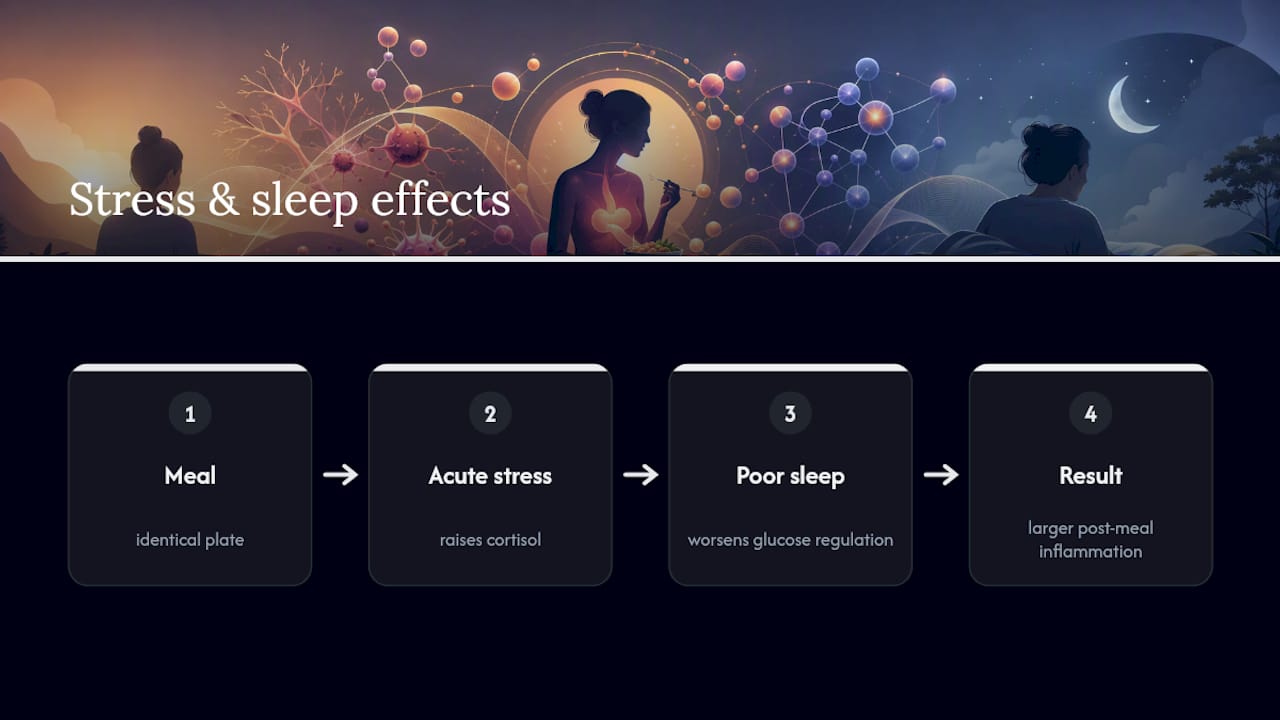
Acute stress raises cortisol, and cortisol interacts with the same inflammatory pathways activated by a heavy meal. Eat a fatty lunch during a stressful workday and you’re often stacking two inflammatory triggers on top of each other rather than dealing with either in isolation. Chronic stress does something similar over a longer timeline, keeping baseline inflammation elevated so that every subsequent meal starts from a higher point.
Sleep works the same way in reverse. Poor or shortened sleep disrupts glucose regulation the following day, which means a meal eaten after a bad night’s sleep tends to produce a larger glucose and inflammatory response than the identical meal eaten after good rest. This is one reason two people can log the same dinner and see different symptoms; the meal was never the only variable.
None of this means diet stops mattering when stress or sleep are poor. It means the three interact, and fixing food alone while ignoring a chronically short sleep pattern often leaves people frustrated that “clean eating” isn’t working as well as expected. If your symptom tracking shows inconsistent reactions to the same food, checking what your sleep and stress levels looked like on those particular days is often the missing piece.
Author perspective: balancing science and everyday diet
The temptation with postprandial inflammation is to treat it as a problem with a single villain, usually sugar or fat, and a single fix. The research doesn’t support that. Interindividual variability is the real headline of the PREDICT findings, not any one food group.
What I’d advocate for is gradual, data-informed change rather than a strict overhaul: track your symptoms for a couple of weeks, notice patterns, adjust meal composition before you adjust anything else, and treat testing as one input among several rather than a verdict. Where symptoms are persistent or confusing, get a GP involved rather than guessing indefinitely.
— Rob
At-home testing: how Ukfoodintolerance can help identify food triggers
If you’ve tracked your symptoms and spotted a pattern but can’t pin down which food is behind it, that’s exactly where Ukfoodintolerance fits in as a practical next step, without the wait times or cost of extensive clinical panels.

The process is straightforward: you collect a small hair sample at home, send it to a UK laboratory, and receive a detailed digital report within 48 to 72 hours. The Ultimate Single Intolerance Test screens over 1,100 items, while the Core test covers 500, giving you a data-backed shortlist to work from instead of eliminating foods at random. Results are designed to feed directly into a structured elimination diet, so you’re reintroducing foods one at a time with a clear starting hypothesis rather than guessing. If your tracking log points to several possible triggers, this is a sensible way to narrow the list before you start cutting foods out. Browse the full test range to find the option that matches your situation.
Sources
- Meal-induced inflammation: postprandial insights from the PREDICT study
- From meal to malfunction: exploring molecular pathways, biomarkers and interventions in postprandial cardiometabolic health
- Evaluating the roles of food matrix, lipid micronutrients and bioactives in controlling postprandial hypertriglyceridaemia and inflammation
This article is general information, not a substitute for advice from a qualified doctor. Consult a qualified healthcare professional about your own circumstances before acting on anything here.










Leave a Reply
Want to join the discussion?Feel free to contribute!