

TL;DR:
- A holistic intolerance assessment evaluates the entire body system, including gut health, immune function, and lifestyle, to identify food sensitivities. Unlike standard allergy tests, it detects delayed reactions and systemic imbalances, guiding personalized dietary and health improvements. The process combines multiple tools and emphasizes addressing root causes for lasting symptom relief.
A holistic intolerance assessment is a whole-person evaluation that identifies food sensitivities by examining your body’s reactions, gut health, lifestyle, and immune function together. Unlike a standard allergy test, this approach treats food reactions as signals of deeper systemic imbalance rather than isolated problems. It draws on tools like IgG antibody panels, bioresonance technology, symptom diaries, and patient history to build a complete picture. The goal is not a list of foods to avoid forever. It is to understand why your body is reacting and to guide you towards lasting dietary and health improvements.
What is a holistic intolerance assessment?
A holistic intolerance assessment is the recognised term for a comprehensive, multi-method evaluation of how foods and environmental factors affect your body as a whole system. Holistic health considers physical, mental, emotional, social, and environmental domains together. That framework directly shapes how practitioners approach intolerance testing.
Standard testing often stops at a single result. A holistic assessment goes further. It combines biomarker data with your symptom history, lifestyle habits, and gut health status to produce a picture that is genuinely useful for making changes. Practitioners using this method view assessments as system stress identification, not as permanent food removal lists.
This matters because food reactions are rarely simple. Your body may tolerate a food at low doses but react at higher ones. Stress, poor sleep, and gut barrier damage can all make sensitivities worse. A single test result, read without that context, can lead you to cut out foods unnecessarily.

How does it differ from standard allergy testing?
The distinction between allergies, intolerances, and sensitivities is the foundation of any good assessment. IgE allergies are immediate and life-threatening, involving the immune system’s rapid response. Intolerances are non-immune reactions, often caused by enzyme deficiencies such as the lack of lactase needed to digest dairy. Sensitivities involve delayed inflammatory responses, sometimes appearing 24–72 hours after eating a trigger food.
Standard allergy testing measures IgE antibodies. It is reliable for true allergies but misses the delayed, dose-dependent reactions that cause most everyday symptoms like bloating, fatigue, skin flare-ups, and brain fog. A holistic assessment is built specifically to catch those delayed reactions.
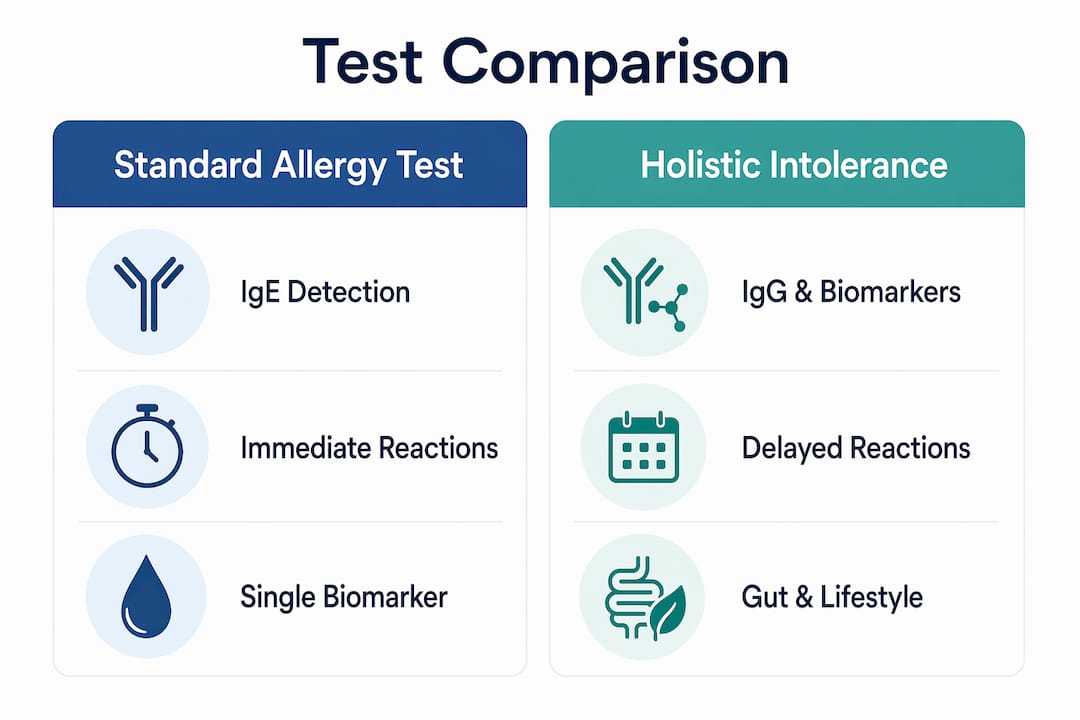
| Feature | Standard Allergy Test | Holistic Intolerance Assessment |
|---|---|---|
| Reaction type detected | Immediate IgE responses | Delayed IgG and non-immune reactions |
| Scope | Single biomarker | Multiple tools and lifestyle factors |
| Outcome | Allergy confirmed or ruled out | Personalised sensitivity and gut health picture |
| Follow-up guidance | Avoidance advice | Dietary plan, gut support, reintroduction protocol |
Pro Tip: If your symptoms appear hours or even a day after eating, a standard allergy test is unlikely to identify the cause. A holistic assessment is designed precisely for this pattern.
Holistic methods also consider gut integrity, immune balance, and inflammatory load. Food sensitivities often indicate underlying gut barrier dysfunction rather than a primary disease. That is why a holistic approach looks at the terrain, not just the trigger.
Which methods are used in a holistic assessment?
Several testing tools and evaluation techniques work together in a holistic intolerance assessment. No single test is definitive on its own. The strength of this approach lies in combining multiple data sources.
Common tools include:
- IgG food sensitivity panels: These measure antibody responses to specific foods. They identify delayed immune reactions that standard IgE tests miss. Results are interpreted alongside symptoms, not as standalone diagnoses.
- Bioresonance technology: This non-invasive method analyses the energetic frequencies of a hair sample to identify potential food and environmental stressors. Ukfoodintolerance uses bioresonance to test over 1,100 items from a simple home hair sample.
- Enzyme assessments: These evaluate whether your body produces sufficient digestive enzymes, such as lactase or diamine oxidase, to process specific foods.
- Muscle testing (applied kinesiology): Used by some naturopathic practitioners as a supplementary tool, though its evidence base is limited and it works best alongside other methods.
- Symptom diaries and patient history: These are non-negotiable components. Tracking what you eat, when symptoms appear, and how severe they are gives practitioners the context needed to interpret test results accurately.
Common tools include symptom review, IgG testing, and elimination diets integrated with lifestyle support. Each method adds a layer of information that the others cannot provide alone.
Pro Tip: Keep a detailed food and symptom diary for at least two weeks before your assessment. The patterns you notice will help you and your practitioner interpret results far more accurately.
Removing foods without addressing gut health or inflammation treats symptoms rather than causes. This is why practitioners combine lab results with lifestyle review. The data points only become meaningful when read together.
How do results guide your diet and lifestyle?
Test results from a holistic assessment are a starting point, not a final verdict. Results should start dietary exploration, not finalise the solution. This distinction is critical for avoiding unnecessary food restriction.
Here is how a well-structured post-assessment protocol typically works:
- Review results in context. Look at which food categories show reactions and consider whether gut health, stress, or recent illness may have amplified those responses. You can find clear guidance on interpreting your results at Ukfoodintolerance.
- Begin a structured elimination phase. Remove the highest-reactivity foods for a defined period, typically four to six weeks. This is temporary, not permanent.
- Support gut barrier health. Address intolerances and gut health together. This may involve dietary fibre, fermented foods, and reducing inflammatory triggers like alcohol and processed sugar.
- Manage stress and sleep. Both directly affect gut permeability and immune regulation. Poor sleep increases intestinal inflammation, which can worsen food reactions.
- Reintroduce foods systematically. After the elimination phase, reintroduce one food at a time and monitor your response. This experimental approach confirms which reactions are genuine and which were amplified by underlying dysfunction.
- Track symptoms throughout. A food and symptom tracking approach gives you real data to guide decisions rather than relying on memory.
The goal is restoring tolerance by changing the gut and immune system terrain to reduce sensitivity over time. Many people find they can reintroduce foods they once reacted to after addressing the underlying causes. That is the real promise of a holistic approach.
What are the benefits and challenges?
A holistic intolerance assessment offers genuine advantages over single-method testing, but it also requires realistic expectations.
Benefits:
- Personalised insight: Results are interpreted in the context of your specific health history, not applied as a generic template.
- Root cause focus: By examining gut health, immune function, and lifestyle alongside test data, you address why reactions occur, not just what triggers them.
- Symptom relief: Identifying and temporarily removing trigger foods gives your gut time to recover and reduces the inflammatory load driving symptoms like bloating, fatigue, and skin issues.
- Restored food variety over time: Elimination is a temporary tool; the goal is restoring tolerance through addressing underlying causes, including immune and digestive system balance.
- Empowerment: Understanding your body’s signals gives you confidence to make informed dietary choices rather than guessing.
Challenges to be aware of:
- Over-restriction risk: Without professional guidance, people sometimes eliminate too many foods based on test results alone. This can lead to nutritional gaps and increased anxiety around eating.
- Test misinterpretation: Tests alone can lead to false positives or unhelpful permanent restrictions without clinical context. Results need interpretation, not just reading.
- Lifestyle factors are non-negotiable: Holistic testing should be accompanied by education, gut health support, and stress management to improve outcomes. Testing without lifestyle change delivers limited results.
Working with a qualified practitioner or using a service that provides clear, detailed reports makes a significant difference. Ukfoodintolerance provides digital reports with guidance on dietary adjustments for food sensitivity to help you act on results confidently.
Key takeaways
A holistic intolerance assessment works because it combines biomarker testing, gut health evaluation, and lifestyle review to identify the root causes of food reactions, not just the triggers.
| Point | Details |
|---|---|
| Definition is specific | A holistic assessment evaluates the whole body system, not just one biomarker or food reaction. |
| Testing tools work together | IgG panels, bioresonance, enzyme assessments, and symptom diaries each add a layer of insight. |
| Results are a starting point | Use findings to begin dietary exploration and gut health support, not to create a permanent avoidance list. |
| Lifestyle factors are part of the process | Stress, sleep, and gut barrier health all influence food reactions and must be addressed alongside diet. |
| The goal is restored tolerance | Many people can reintroduce reactive foods after improving underlying gut and immune health. |
Why i think most people misunderstand this approach
People come to holistic intolerance assessments expecting a list. They want someone to tell them exactly what to cut out, and then they expect to feel better. That expectation is understandable, but it misses the point entirely.
What I have seen, time and again, is that the most valuable part of the process is not the test result itself. It is what happens after. The people who get the most from a holistic assessment are those who treat it as the beginning of a conversation with their own body, not the end of one. They use the results to ask better questions: Why is my gut reacting this way? What has changed in my life recently? Am I sleeping enough? Am I under chronic stress?
The uncomfortable truth is that food is often not the primary problem. It is the most visible symptom of a system under strain. Cutting out gluten or dairy without addressing the underlying gut dysfunction is like turning off a smoke alarm without finding the fire.
I also think there is a real risk in fear-based food avoidance. When people receive a long list of reactive foods and eliminate them all indefinitely, they often end up more anxious about eating, not less. The research is clear that combining biomarker data with lifestyle and symptom review produces far better outcomes than test results alone.
My honest view is that a holistic intolerance assessment is one of the most useful tools available for people with unexplained, persistent symptoms. But it requires patience, curiosity, and a willingness to look beyond the plate.
— Rob
Ready to start your assessment with Ukfoodintolerance?
If you have been experiencing unexplained symptoms like bloating, fatigue, skin reactions, or digestive discomfort, a structured intolerance assessment could give you the clarity you have been looking for.

Ukfoodintolerance offers non-invasive, at-home testing using bioresonance technology. The Ultimate Single Intolerance Test covers over 1,100 food and environmental items. The Core Single Intolerance Test covers 500 items at a more accessible price point. Both deliver detailed digital reports within 48–72 hours, with clear guidance to help you act on your results. You can browse the full range of intolerance test kits or explore all available tests to find the right option for you. Taking that first step is simple, and the results could change how you eat and feel for the better.
FAQ
What is a holistic intolerance assessment?
A holistic intolerance assessment is a whole-person evaluation that combines food sensitivity testing, gut health review, and lifestyle analysis to identify the root causes of food reactions. It uses tools such as IgG panels, bioresonance, and symptom diaries together rather than relying on a single test.
How is it different from a standard food allergy test?
Standard allergy tests measure immediate IgE immune responses, while a holistic assessment focuses on delayed, dose-dependent reactions caused by intolerances and sensitivities. It also considers gut barrier health, enzyme function, and lifestyle factors that a standard test does not capture.
Can i do a holistic intolerance assessment at home?
Yes. Services like Ukfoodintolerance offer at-home bioresonance testing using a hair sample, with results delivered digitally within 48–72 hours. The process is non-invasive and does not require a clinic visit.
Will i need to avoid foods permanently after an assessment?
No. The goal of a holistic assessment is to restore food tolerance over time, not to create a permanent avoidance list. Elimination is a temporary phase while you support gut health and address underlying causes.
How do i make the most of my test results?
Interpret results alongside your symptom history and lifestyle context rather than acting on them in isolation. Ukfoodintolerance provides detailed reports with guidance, and resources like reading intolerance test reports can help you translate findings into practical steps.










Leave a Reply
Want to join the discussion?Feel free to contribute!