

Struggling with ongoing symptoms like bloating or fatigue yet standard tests offer no answers? For many UK adults, the search for clarity leads to non-invasive options like hair sample testing. This approachable method promises quick, needle-free collection at home and aims to uncover hidden food sensitivities that might disrupt your daily wellbeing. Here, you’ll discover what sets hair testing apart and how it fits into your journey toward a diet that truly supports your health.
Table of Contents
- What Is Hair Sample Testing? Core Concepts
- Types Of Hair Test: Sensitivity Versus Allergy
- How Bio-Resonance Food Testing Works
- Benefits, Limitations And Common Myths
- Alternatives, Medical Advice, And UK Safety
Key Takeaways
| Point | Details |
|---|---|
| Non-Invasive Testing | Hair sample testing is a painless, at-home method that provides quick results without the need for needles. |
| Sensitivity vs. Allergy | The test identifies food sensitivities rather than true allergies, which require different medical approaches. |
| Exploratory Tool | Hair testing should be used as a preliminary screening tool, complemented by elimination diets and medical advice for reliable conclusions. |
| Medical Consultation Recommended | Consult a GP for any suspected allergies or underlying health conditions for proper diagnostics and guidance. |
What Is Hair Sample Testing? Core Concepts
Hair sample testing is a non-invasive method that analyses hair strands to identify potential food intolerances. Unlike blood tests that require needles, hair testing simply involves collecting a few strands from your scalp at home. This makes it accessible for people who dislike needles or prefer testing in their own comfort.
The core idea is straightforward: your hair may carry signals or markers related to food sensitivities you experience. These samples are then analysed using specialised technology to generate a detailed report of potential trigger foods.
Here’s what sets hair sample testing apart from other methods:
- No needles or blood draws needed
- Quick collection at home in minutes
- Fast results delivered within 48–72 hours
- Comprehensive reports testing hundreds of items
- Non-invasive process suitable for all ages
When you submit your hair sample, it travels to a UK-based laboratory where advanced analysis is performed. The laboratory then produces a detailed digital report identifying foods and items your body may be reacting to.
Hair sample analysis differs from traditional clinical blood tests, which measure specific immune responses. Hair testing approaches the question differently by examining signals present in your hair strands. This is why many people find it a helpful starting point for understanding their food reactions.
The beauty of this method is its simplicity. You collect the sample yourself using straightforward instructions, seal it in an envelope, and post it to the laboratory. No appointments, no waiting rooms, no clinic visits required.
Hair sample testing offers convenience and speed that traditional testing methods struggle to match, making it ideal for busy UK adults seeking clarity about food intolerances.
Once your results arrive, you’ll receive actionable information showing which foods and items may be triggering your symptoms. This data becomes the foundation for an elimination diet—where you remove suspected trigger foods and monitor how you feel.
The test works best when paired with practical next steps. Many people use their results to guide dietary changes, lifestyle adjustments, or conversations with healthcare professionals.
To help clarify the practical differences between hair sample testing and traditional allergy tests, see this comparison:
| Characteristic | Hair Sample Testing | Blood/Skin Allergy Tests |
|---|---|---|
| Sample Collection | At home, non-invasive | Requires clinic, invasive |
| Time to Results | 48–72 hours | Days to weeks |
| What Is Detected | Sensitivity markers in hair | IgE immune response |
| Clinical Validation | Not medically validated | Clinically approved in UK |
Pro tip: Collect your hair sample from multiple areas of your scalp to ensure accurate analysis, and store it in a cool, dry place until posting to avoid contamination.
Types Of Hair Test: Sensitivity Versus Allergy
Food sensitivity and food allergy are not the same thing, yet many people use these terms interchangeably. Understanding the difference is crucial when interpreting your hair test results.
A food allergy involves your immune system’s IgE antibodies reacting to specific proteins in food. This triggers immediate symptoms like swelling, itching, or difficulty breathing. Allergies can be life-threatening and require strict avoidance of trigger foods.
Food sensitivity, by contrast, relates to digestive enzyme deficiencies or food intolerances. These reactions are typically slower and less severe, causing bloating, fatigue, or skin issues hours or days after eating.
Here’s how they differ in practical terms:
- Allergies cause rapid, severe immune reactions
- Sensitivities produce delayed, milder digestive responses
- Allergies require lifelong avoidance
- Sensitivities may improve with elimination or digestive support
When you use a hair test for food intolerance, you’re typically looking for sensitivity markers rather than true allergies. The test analyses your hair to identify foods your body struggles to process efficiently. This is different from a clinical allergy test, which checks for specific IgE antibodies in blood.

Food sensitivity testing does not definitively measure immune responses the way traditional allergy tests do. Hair analysis examines different markers and signals, making it useful for identifying problem foods without measuring allergic reactions directly.
This distinction matters because it shapes how you use your results. If your hair test identifies wheat as a sensitivity trigger, you’re removing a food that causes digestive discomfort—not avoiding a life-threatening allergy.
Hair tests excel at identifying food sensitivities and intolerances, but they are not suitable for diagnosing true allergies requiring medical oversight and emergency preparedness.
Many UK adults benefit from understanding this difference. You might discover through hair testing that dairy causes bloating, yet you don’t have a milk allergy. This clarity helps you make informed dietary choices without unnecessary restriction.
If you suspect a true food allergy, consult your GP for proper allergy testing. Hair testing works best as a complementary tool for managing sensitivities and optimising your diet through elimination strategies.
Pro tip: If your results identify sensitivities, keep a food diary for two weeks before and after eliminating suspected triggers to track symptom improvements and confirm which foods genuinely affect you.
How Bio-Resonance Food Testing Works
Bio-resonance technology represents a distinct approach to identifying food intolerances. Rather than measuring specific immune markers in blood, it analyses subtle energy patterns present in your hair sample.
Here’s the basic process: you collect hair strands at home and post them to a UK laboratory. Sophisticated devices then measure electromagnetic frequencies thought to correspond with your body’s reactions to specific foods and environmental substances.
The technology operates on the principle that different foods and substances emit unique energy signatures. When your body struggles to process a particular food, these signatures create detectable patterns in your hair. The laboratory equipment identifies these patterns and generates a report of likely trigger foods.
The method works in these stages:
- Collect hair samples from your scalp
- Post samples to the UK laboratory
- Laboratory devices measure electromagnetic frequencies
- Software analyses the frequency data
- Results identify foods matching detected patterns
- You receive a comprehensive digital report within 48–72 hours
Detecting food intolerances through bio-resonance involves reading subtle signals your body produces in response to problem foods. This differs from traditional testing because it doesn’t require blood draws or measure specific antibodies. Instead, it captures energetic information encoded in your hair.
The appeal is straightforward. You get comprehensive results testing hundreds of items without needles, waiting rooms, or clinic appointments. Many UK adults find this approach accessible and practical for understanding their food reactions.
Bio-resonance technology categorised as complementary medicine, offers a non-invasive alternative for those seeking dietary clarity, though it operates differently from conventional clinical testing methods.
Once you receive your results, the data becomes actionable. You can begin an elimination diet, removing identified trigger foods and monitoring symptom changes. This practical approach helps confirm which foods genuinely affect your wellbeing.
The technology continues to gain popularity because results arrive quickly and the process feels manageable. No medical appointments needed, no waiting weeks for lab work, no anxiety about needles.
Understanding how bio-resonance works helps you interpret your results confidently. You’re not being tested for allergies the conventional way—you’re being screened for foods your body signals struggle with through energy pattern analysis.
Pro tip: Write down your current symptoms before submitting your hair sample, then review them alongside your results to identify clear connections between suspected trigger foods and your actual experiences.
Benefits, Limitations And Common Myths
Hair sample testing offers genuine convenience, but it comes with real limitations you should understand before interpreting your results.
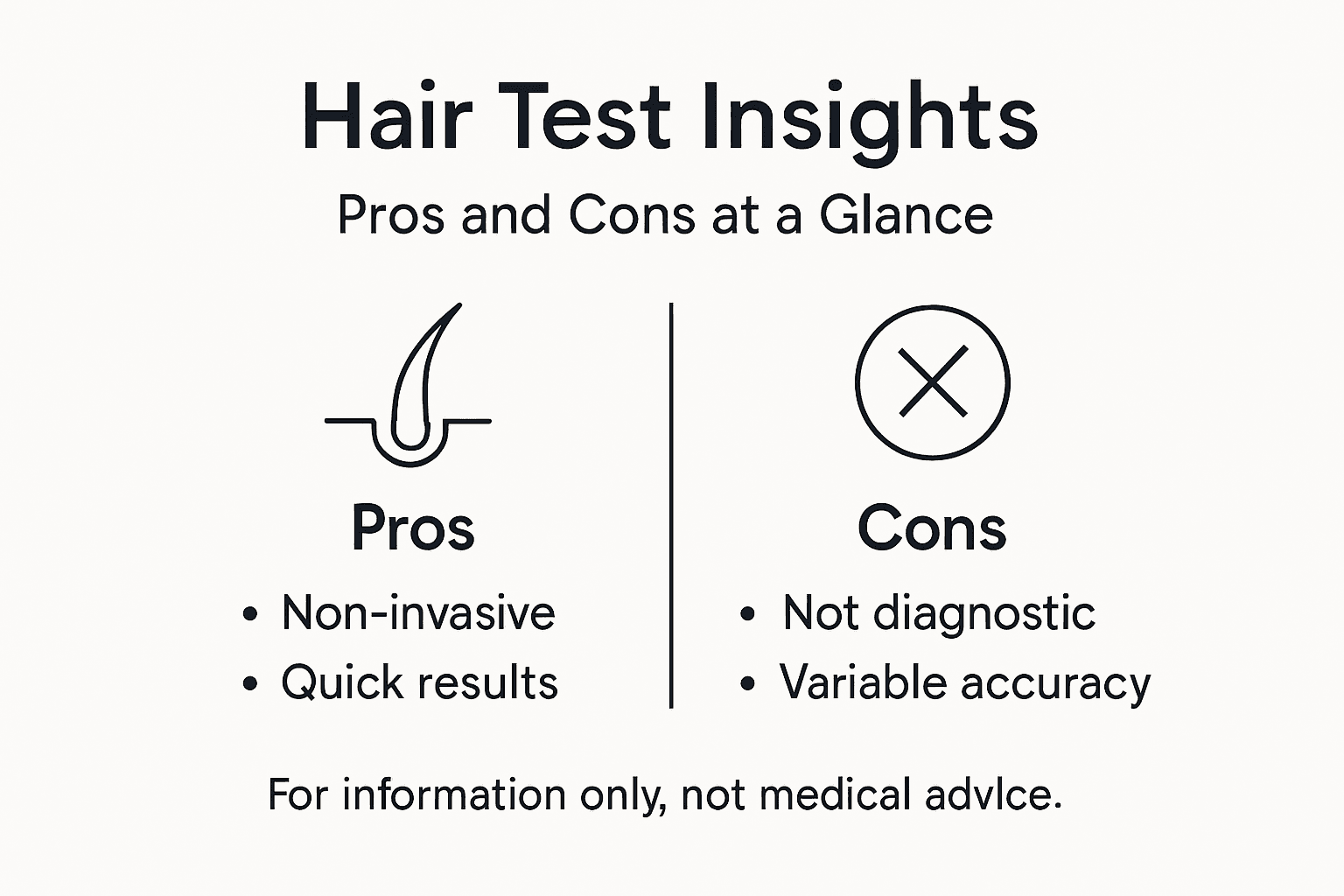
The actual benefits are straightforward. Testing is non-invasive, painless, and happens at home without needles or clinic appointments. Results arrive within 48–72 hours, giving you actionable information quickly. The cost is typically lower than multiple clinic visits.
Here’s what hair testing genuinely delivers:
- Fast, convenient sample collection
- Comprehensive reports covering hundreds of items
- Quick turnaround on digital results
- No needles, blood draws, or waiting rooms
- Affordable starting point for dietary exploration
But the limitations are significant. Hair testing does not measure actual immune responses or allergic reactions the way blood tests do. Hair testing lacks credible biological mechanisms for identifying true food allergies or medically-confirmed intolerances.
Reproducibility is another concern. Different laboratories might produce different results from the same hair sample. This inconsistency raises questions about reliability compared to standardised clinical testing.
Common myths distort expectations. Many people believe hair tests can diagnose true allergies—they cannot. Others think results are definitive medical diagnoses—they are not. Some assume hair analysis measures the same immune markers as blood tests—it does not.
Another myth: results apply universally across all people. Food sensitivities vary based on individual digestive health, enzyme deficiencies, and lifestyle factors. What triggers one person may not affect another.
Hair testing works best as an exploratory tool paired with elimination diets and symptom tracking, not as a replacement for clinical allergy diagnosis or medical testing.
Using results uncritically risks unnecessary dietary restrictions. You might eliminate foods your body actually tolerates well, creating nutritional gaps. This is why pairing results with practical testing—elimination diets and food diaries—matters so much.
The most realistic view: hair testing provides useful screening data for identifying potential sensitivities. It’s a starting point for exploring your food reactions, not a final medical diagnosis.
Many UK adults benefit from this approach when they understand its scope. You’re gathering information to guide dietary experiments, not receiving clinical proof of allergies.
Here is a summary of common misconceptions versus facts about hair sample testing:
| Myth | Actual Fact |
|---|---|
| Diagnoses allergies | Screens for sensitivities only |
| Results are medical proof | Results are exploratory, not diagnostic |
| Works for everyone | Individual variability is significant |
| Measures immune responses | Measures signals, not antibodies |
Pro tip: Don’t eliminate foods based solely on hair test results; instead, use results as hypotheses to test through elimination diets and symptom tracking over 2–4 weeks.
Alternatives, Medical Advice, And UK Safety
If you’re unsure whether hair testing is right for you, understanding alternatives and medical guidance helps you make informed decisions about your health.
The UK medical system recognises specific testing methods as reliable. Blood tests measuring IgE antibodies detect true allergies through clinical laboratory analysis. Skin prick tests provide immediate allergy confirmation by introducing small amounts of allergens to your skin.
These alternatives offer what hair testing cannot: medically-validated results backed by clinical evidence and regulatory oversight.
The most practical medical-supported approach combines two strategies:
- Start with an elimination diet under professional guidance
- Carefully reintroduce foods one at a time over weeks
- Track symptoms systematically in a food diary
- Observe which foods trigger genuine reactions
- Confirm patterns through repeated testing
Medically-recognised methods for diagnosing food intolerance include elimination diets and clinical blood or skin testing, with careful food reintroduction confirming actual intolerances. This approach takes longer but produces reliable, personalised results.
UK regulatory bodies like the MHRA do not approve hair testing for diagnosing intolerances. This distinction matters: approval means clinical validation and safety oversight. Hair testing sits outside this framework.
When consulting your GP about food reactions, mention any testing you’ve considered or completed. Your doctor can help interpret results within your broader health context and rule out underlying conditions mimicking intolerance symptoms.
Over-relying on unvalidated tests risks unnecessary dietary restriction, potential malnutrition, and missing serious underlying health conditions that need medical attention.
Many UK adults use hair testing as a starting point, then confirm findings through elimination diets and professional consultation. This pragmatic approach balances convenience with medical safety.
Safety concerns emerge when people eliminate foods based solely on hair results without medical oversight. Removing entire food groups without nutritional replacement can create deficiencies. Masking symptoms through unnecessary restriction might hide conditions requiring actual treatment.
Your GP remains your best resource. They understand your medical history, can recommend appropriate testing, and help interpret results sensibly.
Pro tip: If you’ve received hair test results, bring them to your GP appointment so they can contextualise findings within your full health picture and recommend next steps.
Discover Your Food Sensitivities with Simple At-Home Hair Testing
If you have been struggling with unexplained digestive discomfort, fatigue, or other symptoms possibly linked to food sensitivities, hair sample testing offers a non-invasive and quick way to gain valuable insights. As highlighted in the article, this method helps identify potential trigger foods without needles or clinic visits, making it ideal for anyone seeking clarity about their wellbeing. At UK Food Intolerance, we provide trusted bio-resonance testing services analysed in UK laboratories to deliver clear, comprehensive reports that guide your next dietary steps.
Take control of your health with our Ultimate Single Intolerance Test or Core Single Intolerance Test. Both options are designed to fit your needs and budget while providing detailed results within 48-72 hours. Begin your journey with a straightforward hair sample collection at home, and receive expert support to interpret your report and confidently implement an elimination diet. Explore more about how our non-invasive testing can help you identify hidden food sensitivities and improve your quality of life today.
Frequently Asked Questions
What is hair sample testing for food intolerances?
Hair sample testing is a non-invasive method that analyses hair strands to identify potential food intolerances by detecting sensitivity markers related to foods you consume.
How is a hair sample for testing collected?
You can collect a hair sample from your scalp at home, following simple instructions. After gathering a few strands, you seal them in an envelope and post them to the laboratory for analysis.
How quickly can I expect results from hair sample testing?
Results typically arrive within 48–72 hours of the laboratory receiving your hair sample, providing you with actionable insights into potential food triggers.
What is the difference between food sensitivity and food allergy?
Food sensitivity involves digestive reactions that are typically milder and delayed, while food allergies involve the immune system’s immediate and potentially severe reactions to specific proteins in foods.










Leave a Reply
Want to join the discussion?Feel free to contribute!